

You applied for a business loan, your credit score looked solid, your business has been running for years, and you still got denied. It happens more than most people realize, and the reason is almost never what you expect. Understanding why business loans get denied goes well beyond your personal credit number. Lenders evaluate a layered picture of your financial life, your business performance, and sometimes even behavioral signals you did not know were being tracked. This guide breaks down the real reasons loans get turned down and what you can do about each one.
Table of Contents
- Key takeaways
- Why business loans get denied: the financial basics
- How lenders evaluate your business credit profile
- Hidden risk signals that trip up strong applicants
- Practical steps to improve your approval odds
- Denial reasons vary by loan type
- My take on what actually gets business owners denied
- How Emorylending can help you secure funding
- FAQ
Key takeaways
| Point | Details |
|---|---|
| Credit score is not the whole story | Lenders weigh income stability, debt load, and credit behavior alongside your score. |
| DTI thresholds can kill your application | A debt-to-income ratio above 50% triggers sharp denial rate increases regardless of other strengths. |
| Business credit profiles matter more now | SBA lenders must now manually review three commercial credit bureaus, raising the bar for approval. |
| Behavioral signals can trigger AI flags | Unusual deposits, application timing, and data mismatches can trigger automatic denials. |
| You have legal rights after a denial | Lenders must provide written denial reasons within 60 days, including credit score details. |
Why business loans get denied: the financial basics
The most common reasons for loan denial are rooted in financial fundamentals, and knowing them in advance gives you a real advantage.
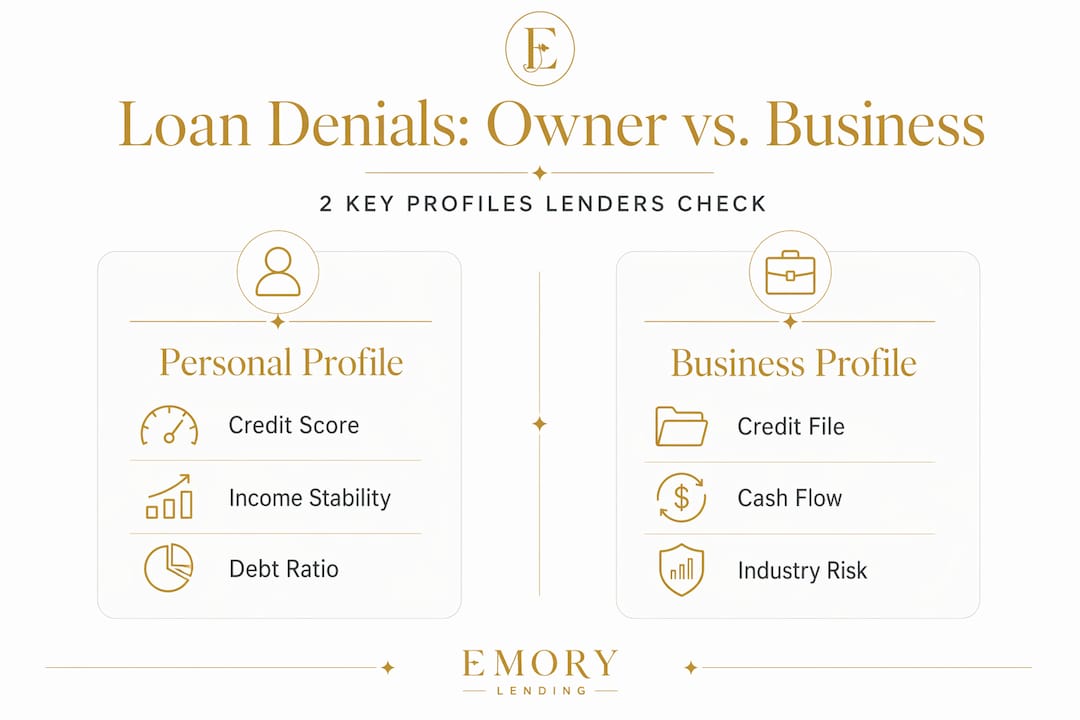
Credit score thresholds. Most traditional lenders set a minimum floor for personal credit scores, typically 650 for bank loans and 680 or higher for SBA products. But it is not just your score that matters. Recent hard inquiries on your credit report signal to lenders that you may be in financial trouble. Multiple applications in a short window can make a lender nervous even if your score sits comfortably above the minimum.
Debt-to-income ratio. This is one of the most underestimated denial triggers. Denial rates jump sharply at a 50% debt-to-income ratio, with rejection rates rising 15 to 17 percentage points at that threshold. If your monthly debt payments consume more than half your income, most lenders will walk away regardless of how strong other factors look.
Cash flow and revenue instability. Lenders want to see consistent monthly deposits, not revenue that spikes one quarter and disappears the next. If your bank statements show irregular income or frequent overdrafts, that pattern raises red flags about your ability to make scheduled payments.
Additional triggers that often catch business owners off guard include:
- Insufficient collateral for secured loan products
- Short time in business (most banks want at least two years of operating history)
- Errors in credit reports such as duplicate accounts or outdated negative items that create a false impression of your financial picture
- Missing or inconsistent documentation, including tax returns, profit and loss statements, and bank statements that do not match reported income
Pro Tip: Pull your personal and business credit reports at least 60 days before applying. Dispute any errors before they reach a lender’s desk, not after the denial lands in your inbox.
How lenders evaluate your business credit profile
Understanding how your business credit is evaluated is one of the most overlooked parts of preparing a strong application.
Many small business owners focus exclusively on their personal FICO score and assume that is what lenders check. That is only part of the picture. Your business has its own credit file, maintained separately by Dun & Bradstreet, Equifax Business, and Experian Business. Each bureau uses different data and scoring models. A lender reviewing all three can get a very different picture than what your personal score suggests.

This became even more significant in 2026. The SBA eliminated automated credit scoring for small business loans, requiring lenders to now manually verify commercial credit profiles across all three major bureaus. The SBA also set a minimum debt service coverage ratio of at least 1.1, meaning your business cash flow must demonstrably exceed your debt obligations by at least 10%. Businesses that were borderline approvals under the old automated system now face much more scrutiny.
Here is how to get ahead of this process:
- Claim and review your Dun & Bradstreet profile. If your business does not have a DUNS number, get one before you apply anywhere. An empty or sparse profile is treated almost the same as a negative one.
- Check your Equifax Business and Experian Business files. Look for outdated trade lines, incorrect payment history, or accounts that do not belong to your business.
- Build trade credit relationships. Vendors and suppliers who report payment history to commercial bureaus are one of the fastest ways to build a real business credit profile.
- Monitor your Paydex score. Dun & Bradstreet uses this scoring model, and a score of 80 or above indicates you consistently pay on time. Most lenders use this as a baseline signal. You can find deeper guidance on this process in the Emorylending guide on improving business credit.
Pro Tip: Many business owners discover their commercial credit files are thin or inaccurate only after a denial. Check them annually, the same way you check your personal credit.
Hidden risk signals that trip up strong applicants
This is where things get interesting, and where a lot of otherwise qualified business owners lose their applications.
Modern lenders, including many SBA-approved banks, use AI-driven underwriting tools that go beyond traditional credit metrics. These systems are designed to detect patterns that suggest financial instability or application fraud, and they can flag your application for manual review or outright denial without your credit score being the issue at all.
Lenders scan for behavioral red flags like late-night application submissions, sudden large deposits inconsistent with your stated revenue, and heavy crypto-based transaction activity. None of these things appear on a credit report. But they can trigger an automatic hold or a denial before a human underwriter ever looks at your file.
Here are the patterns most likely to cause problems:
- Multiple hard inquiries in a short period. Clustered hard pulls signal to lenders that you may be desperately seeking credit, which reads as financial instability regardless of your actual score.
- Mismatches between your application and your bank statements. Inconsistent financial data across documents is one of the most common automatic denial triggers. If your application says you earn $20,000 per month but your deposits average $12,000, that gap will stop the process.
- Pre-approval confusion. Many business owners apply after receiving a pre-approval offer and feel blindsided when the final decision is different. That is because pre-approval uses a soft credit pull and broad eligibility filters. The actual underwriting process uses hard pulls, verified income, and full risk analysis. Getting pre-approved means you passed an initial screen, not that you are guaranteed funding.
“After addressing specific issues identified during a denial, re-application success rates approach 70 to 90% within 30 to 60 days.” — maintainmarket.com
That number should tell you something important: denials are not permanent verdicts. They are feedback.
Practical steps to improve your approval odds
If you want to know how to avoid loan denial, the answer is preparation before the application, not corrections after the fact.
- Pull and clean your credit reports first. Both personal and business reports. Give yourself 60 days minimum to dispute errors and let corrections process before your application creates a hard inquiry.
- Get your debt-to-income ratio below 40%. Pay down revolving balances, avoid taking on new debt in the months before applying, and consider whether any existing obligations can be consolidated. Lenders weight DTI heavily, and high DTI combined with credit utilization spikes accounts for nearly half of all personal loan rejections.
- Prepare documentation in advance and make sure it is consistent. Your tax returns, profit and loss statements, and bank statements must all tell the same story. Any gap between what you report and what appears in your bank account will be noticed.
- Limit applications to lenders you have genuinely researched. Each application creates a hard inquiry. Applying to five lenders in two weeks to see who bites is one of the fastest ways to tank your chances with all of them. Understand each lender’s business loan eligibility criteria before submitting.
- Use pre-qualification tools that rely on soft pulls. Many lenders offer pre-qualification checks that do not affect your credit. Use these first to narrow your list before committing to formal applications.
- Know your denial rights. If you are denied, you have 60 days to request a written explanation and a free copy of the credit report used in the decision. That document is your roadmap for the next application.
Pro Tip: Treat a denial as a diagnostic tool, not a final answer. The adverse action notice tells you exactly what the lender found problematic. Fix those specific items, then reapply.
Denial reasons vary by loan type
Not every loan denial happens for the same reason. The type of loan you apply for shapes the specific criteria you need to meet.
| Loan type | Common denial triggers | Key thresholds |
|---|---|---|
| SBA loans | Thin commercial credit profile, low DSCR, incomplete documentation | DSCR of at least 1.1, manual review of all three commercial bureaus |
| Traditional bank loans | Low personal credit score, insufficient collateral, short business history | Minimum 650 to 680 personal credit, 2+ years in business |
| Online and alternative lenders | Revenue inconsistency, high credit utilization, behavioral risk flags | Minimum monthly revenue often $10,000+, softer credit floors but strong cash flow required |
| Equipment financing | Insufficient down payment, collateral mismatch, weak business credit | Equipment value must support the loan amount; business credit matters more than personal |
SBA loans carry the strictest underwriting because they are partially backed by the federal government, which means lenders face regulatory scrutiny on every file they approve. Traditional bank loans rely heavily on collateral and personal credit history. Alternative lenders, the kind Emorylending works with, tend to focus more on actual business performance and cash flow, which opens the door for businesses that do not fit the rigid bank mold.
My take on what actually gets business owners denied
I have seen hundreds of small business owners go through the loan process, and the pattern I keep seeing is not bad credit. It is unpreparedness and misaligned expectations. Most people assume that running a profitable business means they will qualify. Profitability matters, but lenders are evaluating risk across multiple dimensions at once.
What surprises people most is how much their business credit profile can undermine them. I have worked with owners who had 720 personal credit scores and still got denied because their commercial credit files were essentially blank. The SBA’s 2026 shift to manual bureau review made this problem much more visible, and it is going to catch more business owners off guard going forward.
The other thing I keep coming back to is the documentation gap. Owners who manage their finances informally, maybe using a mix of personal and business accounts, or who have not filed clean tax returns for two consecutive years, are starting the application process at a significant disadvantage. Lenders are not just evaluating your creditworthiness. They are evaluating whether your business operates like one.
The owners I have seen succeed after an initial denial are the ones who treat the denial letter seriously. They read it carefully, address each specific issue, and come back prepared. That 70 to 90% re-application success rate is real, but it requires actual changes, not just waiting a few months and trying again.
— Jason
How Emorylending can help you secure funding
If you have been denied or are worried about qualifying, you do not have to figure this out alone.
Emorylending works differently than traditional banks. Instead of making a decision based almost entirely on personal credit, Emorylending evaluates your actual business performance and cash flow. That means more small businesses get funded, even those that would not qualify through a conventional lender. Whether you need working capital to cover operations, equipment financing for growth, or a plan to get business funding the right way, Emorylending has options from $5,000 to over $5,000,000. Start by reviewing the business funding checklist to see exactly what you need to prepare before your next application.
FAQ
What is the most common reason business loans get denied?
The most common reasons for loan denial include a high debt-to-income ratio, insufficient cash flow, and a thin or inaccurate business credit profile. Lenders weigh multiple factors simultaneously, so weakness in two or three areas often results in denial even when credit scores look acceptable.
How does a debt-to-income ratio affect loan approval?
Denial rates rise sharply once your debt-to-income ratio crosses 50%, with rejection rates increasing by 15 to 17 percentage points at that threshold. Keeping your DTI below 40% before applying gives you a meaningful edge.
Can you get denied for a business loan despite good personal credit?
Yes. Good personal credit is one factor, but lenders also evaluate your business credit profile, cash flow stability, documentation accuracy, and debt load. Many applicants with strong personal scores still get denied because of thin commercial credit files or revenue inconsistencies.
What should you do immediately after a business loan denial?
Request the adverse action notice from the lender, which they are required to provide within 60 days. This document explains the specific reasons for the denial and includes the credit score used. Use it to target the exact issues before reapplying.
Do multiple loan applications hurt your chances of approval?
Yes. Each formal application triggers a hard credit inquiry, and clustered hard pulls signal financial desperation to lenders, which can lead to rejection even when your underlying credit profile is strong. Use soft-pull pre-qualification tools to narrow your options before submitting formal applications.


