

An unsecured line of credit is defined as a revolving credit facility that gives businesses access to funds without pledging any collateral. Lenders approve these lines based on your creditworthiness, business cash flow, and often a personal guarantee. For small business owners, this means you can draw funds for payroll, inventory, or unexpected expenses without risking a specific asset like equipment or real estate. Emorylending works with businesses at exactly this stage, evaluating cash flow and performance rather than just personal credit scores. Understanding how unsecured lines work puts you in a stronger position to use them well.
What is an unsecured line of credit and how does it work?
An unsecured business line of credit operates as a revolving facility, meaning you borrow, repay, and borrow again within your approved limit. Draw periods typically last 12–24 months, during which you make interest-only payments on the outstanding balance. That structure keeps your monthly costs low while the line remains open. After the draw period ends, you either repay the remaining balance in full or move into a fixed repayment schedule, depending on your agreement.

The cost structure is straightforward. Interest accrues only on the amount drawn, not on your full credit limit. If your limit is $100,000 and you draw $20,000, you pay interest on $20,000. That distinction matters because it makes an unsecured line far cheaper than a term loan when you only need short-term access to capital.

Unsecured lines differ from business credit cards in one key way: the interest rates are typically lower and the credit limits are higher. They also differ from secured lines because no appraisal or asset lien is required. That absence of collateral speeds up the process considerably. Funding can happen in as little as 1 to 7 business days, compared to weeks for secured credit. Lenders review your creditworthiness annually, so maintaining strong financials keeps the line available at renewal.
Pro Tip: Track your draw and repayment dates carefully. Letting a balance sit past the draw period without a repayment plan can trigger penalty rates or early closure of the line.
What are the typical limits and qualification requirements?
Unsecured business lines of credit typically range from $10,000 to $500,000, with larger facilities exceeding $5 million for businesses with strong revenue and credit profiles. That range is wide because lenders calibrate limits to your specific business performance, not a fixed formula. A newer business with $300,000 in annual revenue will qualify for a very different limit than an established firm generating $3 million.
Qualification criteria center on three factors:
- Credit score. Most lenders require a personal credit score of at least 600, with better terms available above 700. Lenders focus on the owner’s personal credit history alongside business cash flow, treating both as equally important signals.
- Cash flow consistency. Lenders want to see steady monthly revenue, not just a strong annual total. Irregular cash flow raises the risk profile and can reduce your approved limit.
- Time in business. Most lenders require at least 6 months of operating history, with 2 years preferred for larger limits.
The trade-off for skipping collateral is cost. Unsecured loans carry higher interest rates and stricter credit requirements than secured facilities. That premium reflects the lender’s increased risk. A secured line backed by real estate might carry a rate of 7–9%, while an unsecured line for the same borrower might run 10–25% depending on the lender and business profile.
| Qualification Factor | What Lenders Look For |
|---|---|
| Personal credit score | Minimum 600; 700+ for best rates |
| Business cash flow | Consistent monthly revenue over 6+ months |
| Time in business | At least 6 months; 2 years preferred |
| Annual revenue | Varies by lender; higher revenue unlocks larger limits |
| Personal guarantee | Required by nearly all unsecured lenders |
Pro Tip: Pull your business bank statements for the last 6 months before applying. Lenders will request them, and reviewing them yourself first lets you spot and explain any irregular months.
What are the benefits and risks of unsecured credit?
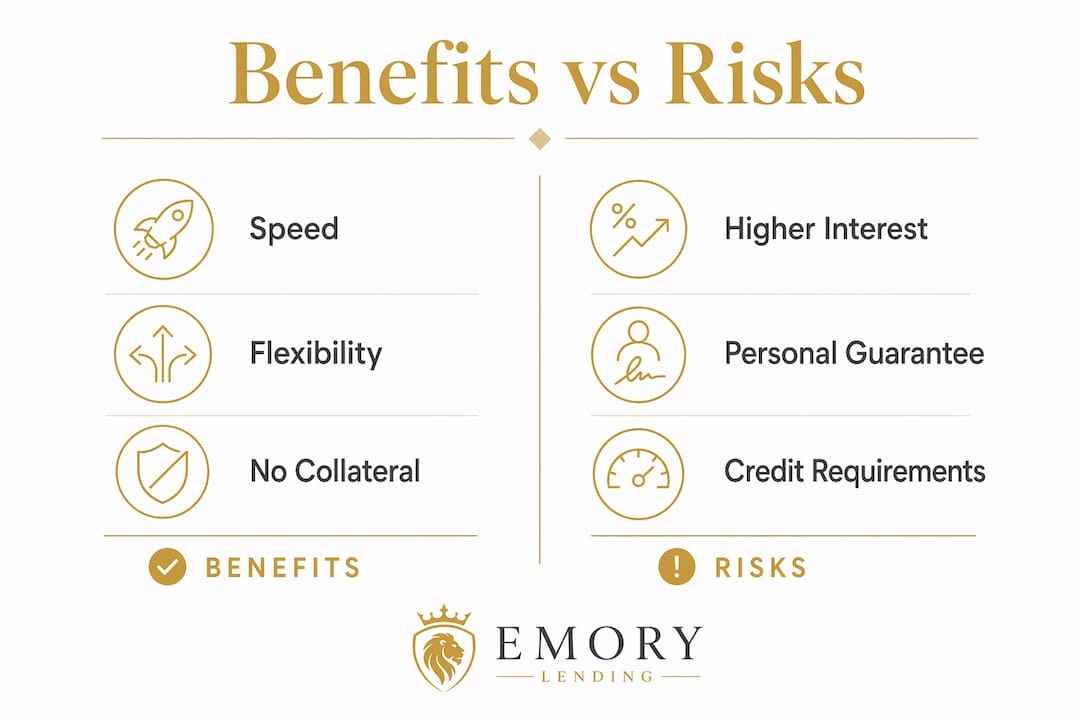
The primary benefit of an unsecured line of credit is speed and flexibility. No collateral means no appraisal, no lien filing, and no waiting for a property valuation. Unsecured lines fund faster than secured ones because lenders skip the lengthy asset review process entirely. For a business owner facing a time-sensitive opportunity or a cash gap, that speed is the deciding factor.
The flexibility is equally valuable. You draw only what you need, when you need it. A seasonal retailer can pull $30,000 in october to stock inventory, repay it by december, and start the new year with a clean balance. A service business can use the line to cover payroll while waiting on a large receivable, then repay as soon as the client pays. That kind of on-demand access is difficult to replicate with a term loan.
The risks, though, deserve equal attention. The most misunderstood risk is the personal guarantee.
Though an unsecured line requires no specific collateral, the personal guarantee gives lenders full legal rights to pursue your personal assets, including savings, income, and property, if the business defaults. The absence of a collateral lien does not mean the absence of personal liability.
Personal guarantees are required by nearly all unsecured business lenders, and many business owners sign them without fully understanding the exposure. Defaulting on an unsecured line can trigger legal action against your personal bank accounts and assets. The line is unsecured for the lender in the sense that no specific asset is pre-pledged, but it is not risk-free for the owner. You can read more about common financing misconceptions that trip up small business owners at every stage.
The higher interest rate is the second risk. Borrowing $50,000 at 18% costs significantly more than borrowing the same amount at 8% against secured collateral. If you carry a balance for an extended period, that cost compounds quickly.
How can small business owners use unsecured lines effectively?
Using an unsecured line well requires treating it as a cash flow tool, not a long-term funding source. Here are five practical ways to deploy it without creating financial strain:
-
Bridge receivables gaps. If a client owes you $40,000 but payment is 45 days out, draw from the line to cover operating costs now. Repay immediately when the receivable clears. This keeps operations running without taking on permanent debt.
-
Cover seasonal payroll. Retail, hospitality, and construction businesses often need extra staff during peak periods. Drawing on the line for payroll during a busy season, then repaying from the resulting revenue, is a textbook use case.
-
Handle unexpected expenses. Equipment repairs, emergency supply orders, or a sudden vendor price increase can strain cash reserves. A credit line absorbs the shock without disrupting your operating budget.
-
Fund inventory purchases. Buying inventory in bulk often means a lower unit cost. If you have a confirmed order or a predictable sell-through rate, drawing on the line to purchase inventory at a discount can generate a net positive return even after interest costs.
-
Maintain creditworthiness for renewal. Responsible use and timely payments directly affect your renewal terms. Lenders review your credit health annually. Keeping your utilization below 50% of the limit and making every payment on time signals reliability and often leads to limit increases at renewal.
The businesses that get the most value from unsecured lines are those that plan their draw and repayment cycles in advance. Treat the line like a tool with a specific job, not a backup account to tap whenever cash feels tight. Understanding how working capital fuels growth gives you a clearer framework for deciding when to draw and when to hold.
Key Takeaways
An unsecured line of credit gives small businesses fast, flexible access to capital without collateral, but the personal guarantee means owner liability is real and must be managed carefully.
| Point | Details |
|---|---|
| No collateral required | Approval relies on credit score, cash flow, and a personal guarantee instead. |
| Credit limits vary widely | Business lines typically range from $10,000 to $500,000, with larger limits available. |
| Interest on drawn amounts only | You pay interest only on what you borrow, not on the full credit limit. |
| Fast funding timeline | Unsecured lines can fund in 1 to 7 business days, faster than secured credit. |
| Personal guarantee is real risk | Defaulting exposes your personal assets to legal claims despite no pledged collateral. |
What I’ve learned about unsecured lines after years in small business financing
Most small business owners come to unsecured credit with one of two misconceptions. The first is that “no collateral” means “no risk.” It does not. The personal guarantee is a legally binding commitment, and I have seen owners genuinely surprised when a lender pursues personal assets after a default. Read every guarantee clause before you sign.
The second misconception is that unsecured lines are only for businesses that cannot qualify for secured credit. That is backwards. Many strong businesses choose unsecured lines precisely because they do not want to tie up assets or wait weeks for an appraisal. Speed and flexibility have real value, especially when a growth opportunity has a short window.
My practical advice: get your financials in order before you apply. Three to six months of clean bank statements, a clear picture of your monthly revenue, and a personal credit score above 700 will open more doors and better rates than almost any other preparation. If your score is below 680, spend 90 days paying down revolving balances before applying. The rate difference between a 670 and a 720 score can save you thousands over the life of the line.
Use the line for short-cycle needs. Draw, deploy, repay. The owners who get into trouble are the ones who use a 12-month draw period to fund something that takes 36 months to generate a return. Match the financing to the timeline of the expense it covers.
— Jason
Emorylending’s unsecured credit options for small businesses
Emorylending evaluates your business performance and cash flow, not just your personal credit score, which means more small business owners qualify for the capital they need.
Whether you need working capital to bridge a receivables gap, funds to cover seasonal payroll, or credit to handle unexpected expenses, Emorylending offers flexible financing options built for how small businesses actually operate. The application process is straightforward, approval timelines are fast, and funding ranges from $5,000 to $5,000,000+. If you want to understand all your business financing options before deciding, Emorylending’s team can walk you through what fits your stage and goals.
FAQ
What is an unsecured line of credit in simple terms?
An unsecured line of credit is a revolving credit facility that lets you borrow funds up to a set limit without pledging any asset as collateral. Approval is based on your credit score, business cash flow, and a personal guarantee.
What are typical limits on unsecured lines for businesses?
Business unsecured lines typically range from $10,000 to $500,000, with some lenders extending limits above $5 million for businesses with strong revenue and credit profiles.
Is unsecured credit safe for small business owners?
Unsecured credit is a legitimate and widely used financing tool, but it carries real risk through the personal guarantee requirement. Defaulting can expose your personal assets to legal claims, so responsible use and a clear repayment plan are critical.
How fast can I get an unsecured line of credit?
Unsecured lines fund faster than secured credit because no asset appraisal is required. Many lenders complete funding within 1 to 7 business days of approval.
What credit score do I need to qualify for an unsecured line?
Most lenders require a personal credit score of at least 600, though scores above 700 unlock better rates and higher limits. Consistent business cash flow is equally important in the approval decision.


