

Running a small business in the Southeast means you often need equipment fast, whether that’s a commercial refrigerator for your restaurant in Atlanta, a dump truck for your landscaping company in Charlotte, or new CNC machinery for your manufacturing shop in Birmingham. The challenge? That equipment costs serious money. Buying outright can drain your cash reserves overnight, but doing nothing means falling behind. Equipment financing gives you a third path: get what you need now, pay over time, and keep your business moving forward without emptying your bank account.
Table of Contents
- What is equipment financing?
- Types of equipment financing options
- The equipment financing process: Step by step
- How to qualify and get the best deal
- What most guides miss about equipment financing
- Next steps: Secure the right financing for your business
- Frequently asked questions
Key Takeaways
| Point | Details |
|---|---|
| Financing preserves cash | Equipment financing lets you grow your business without draining funds. |
| Multiple financing options | You can choose between loans, leases, and SBA-backed options based on your needs. |
| Approval factors matter | Business age, credit score, and cash flow all affect your approval chances and rates. |
| Know the trade-offs | Leasing is often more expensive long-term; loans build equity but require higher upfront payments. |
What is equipment financing?
Equipment financing is a funding arrangement where a lender helps you acquire the tools, vehicles, machinery, or technology your business needs, and you repay that amount over a set period with interest. You don’t have to hand over a lump sum on day one. Instead, you spread the cost into manageable monthly payments that fit your cash flow.
Here’s the core idea: the lender either purchases the equipment directly or provides funds for you to buy it. You use the equipment while making payments. Depending on the structure you choose, you may own the equipment at the end, or you may have the option to upgrade to newer models.
There are two primary forms of equipment financing every small business owner should understand:
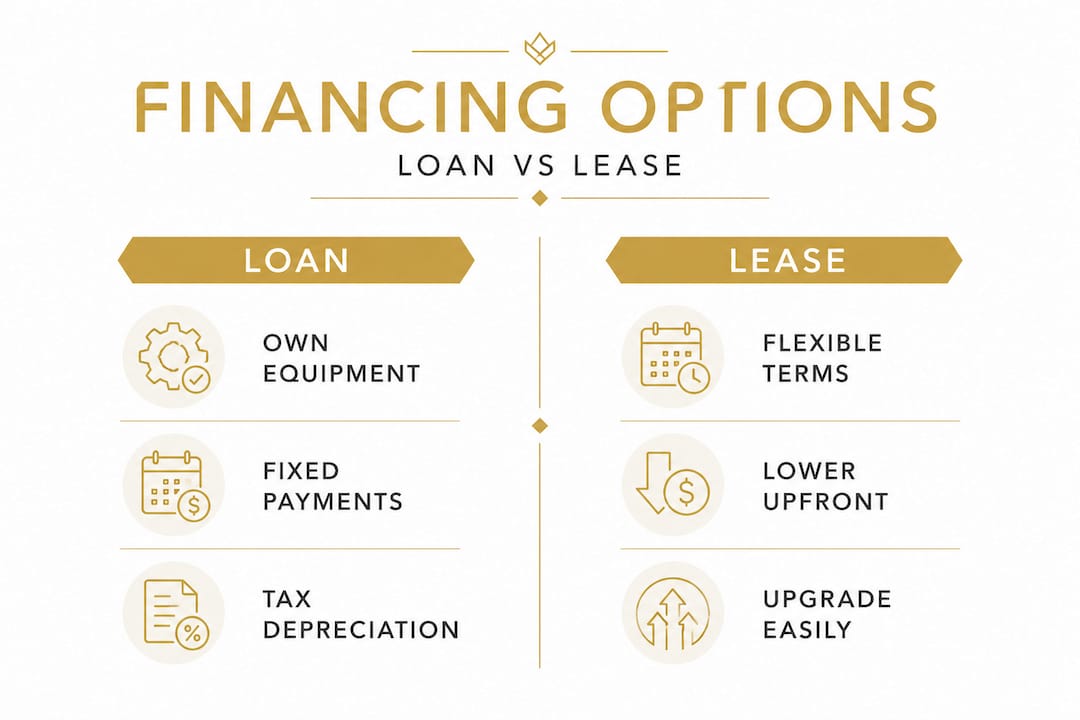
- Equipment loans: You borrow money to purchase the equipment outright. Once you finish repaying the loan, you own the asset free and clear. These typically come with fixed monthly payments and may offer tax advantages through depreciation deductions.
- Equipment leases: You essentially rent the equipment for a set term. Monthly payments are usually lower than a loan, and at the end of the lease, you can often buy the equipment at a reduced price, return it, or upgrade to something newer.
“Leasing preserves cash in the short term but tends to cost more over time and builds no equity. Loans come with higher payments but give you ownership and potential tax advantages. SBA loans offer lower rates but involve a longer approval process.” Owning vs. leasing equipment is a real trade-off that depends heavily on your business stage and goals.
Understanding these basics helps you make smarter decisions. If you want a deeper look at how the structure works, the equipment financing basics page at Emory Lending walks through the key details in plain language.
Why does this matter for your business? Equipment financing preserves your working capital. Instead of spending $80,000 on a piece of machinery, you might pay $1,500 a month and keep the rest of your cash available for payroll, inventory, or unexpected expenses. That flexibility is often the difference between a business that grows steadily and one that stalls.
Types of equipment financing options
With a basic understanding in place, let’s compare your main equipment financing choices. Each option has a different structure, cost profile, and best-use scenario. Picking the wrong one can cost you thousands over the life of the agreement.
Direct equipment loans work like most business loans. You receive a lump sum, purchase the equipment, and repay the lender in fixed installments over a term that typically ranges from two to seven years. The equipment itself usually serves as collateral, which keeps rates reasonable. You own the asset from day one, and you can claim depreciation on your taxes. The trade-off is that monthly payments are higher than leases.
Equipment leases come in two main flavors: operating leases and finance leases (sometimes called capital leases). An operating lease is closer to a rental. You use the equipment, make lower monthly payments, and return it at the end. A finance lease is structured so you’ll likely own the equipment at the end, often for a nominal buyout price like $1. Leases work well for technology or equipment that becomes outdated quickly, like computers, medical devices, or point-of-sale systems.
SBA equipment loans are backed by the U.S. Small Business Administration and offer some of the lowest interest rates available. The SBA and term loan comparison shows why these are appealing for larger purchases. The downside is the approval process can take several weeks and requires more documentation than a standard loan or lease.
Here’s a side-by-side comparison to help you decide:
| Feature | Equipment loan | Equipment lease | SBA loan |
|---|---|---|---|
| Ownership | Yes, immediately | Optional at end | Yes, immediately |
| Monthly payment | Higher | Lower | Moderate to lower |
| Approval speed | Days to 1 week | 24 to 48 hours | Several weeks |
| Total cost | Moderate | Higher long-term | Lowest overall |
| Flexibility | Moderate | High | Low |
| Best for | Long-term assets | Tech or short-life gear | Large purchases |
If you’re weighing whether a lease or a business line of credit insight might serve your short-term needs better, it’s worth running the numbers on both before committing.
Pro Tip: Don’t just compare monthly payments. A lease might save you $300 a month but cost you $10,000 more over five years with no asset to show for it. Always calculate the total cost of the financing, not just what hits your account each month.
The equipment financing process: Step by step
After comparing your options, here’s what the financing process typically looks like. Knowing these steps in advance helps you move faster and avoid delays that could hold up your operations.
- Identify your equipment needs. Be specific. Know the make, model, and estimated cost of what you need. Vague requests slow down the process.
- Research lenders. Compare banks, credit unions, online lenders, and specialized equipment finance companies. Look at rates, terms, and how they evaluate applications.
- Gather your financial documents. This typically includes recent business bank statements, profit and loss statements, tax returns from the last one to two years, and a copy of your business license.
- Get a quote from the equipment vendor. A formal quote or invoice from the manufacturer or dealer is often required and can speed up approval significantly.
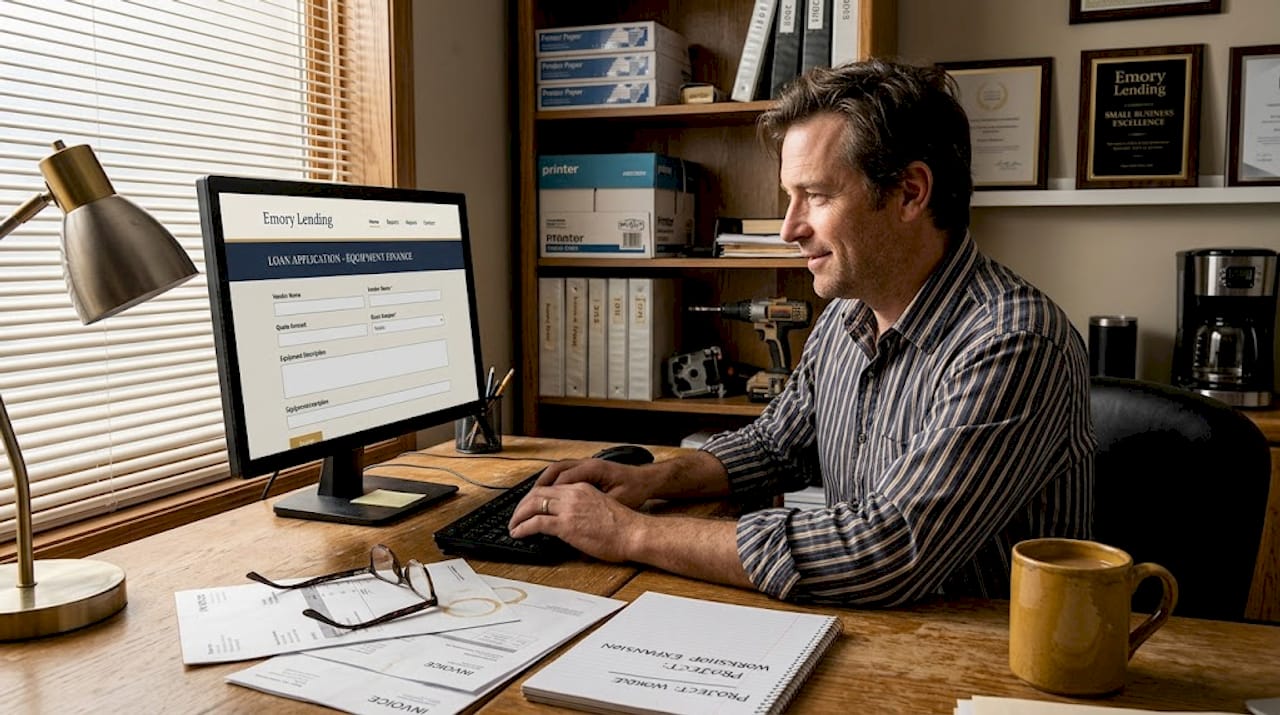
- Submit your application. Fill out the lender’s application completely and accurately. Missing information is one of the most common causes of delays.
- Lender review. The lender evaluates your credit, cash flow, business history, and the equipment’s value. This is where approval factors get weighed.
- Receive approval and funding. Once approved, funds are either sent directly to the vendor or deposited in your account. Equipment delivery can often begin immediately.
Common factors lenders look at during review include your personal and business credit scores, how long your business has been operating, your annual revenue, and the type and condition of the equipment. Qualifying for equipment financing is more accessible than many owners think, especially when your cash flow is strong.
The timeline varies widely. A simple equipment lease from an online lender can be approved within 24 hours. An SBA loan might take three to six weeks. Traditional bank loans typically fall somewhere in between. If you’re ready to move, you can apply for equipment financing and get a clear picture of where you stand.
Pro Tip: Have your equipment vendor’s quote ready before you apply. Lenders want to see exactly what they’re financing. A formal quote with the equipment’s serial number, price, and vendor details can cut your approval time in half.
How to qualify and get the best deal
Now that you understand the steps, here’s how to maximize your chances for approval and secure favorable terms. Qualification isn’t just about having a good credit score. Lenders look at the full picture of your business.
Here’s what most lenders evaluate:
- Credit score: Personal scores above 650 and business scores above 75 (on the Paydex scale) put you in a strong position. Some lenders work with scores as low as 600.
- Time in business: Most lenders prefer at least one to two years of operating history. Startups face more scrutiny.
- Annual revenue: Lenders want to see that your business generates enough cash to cover payments comfortably. Many require at least $100,000 in annual revenue.
- Equipment value: The equipment itself acts as collateral. Newer, widely used equipment is easier to finance than highly specialized or older gear.
- Cash flow stability: Consistent monthly revenue is often more persuasive than a single strong quarter.
Here’s a quick reference for typical lender requirements and rates:
| Financing type | Min. credit score | Min. time in business | Typical APR range |
|---|---|---|---|
| Equipment loan | 620 to 650 | 1 to 2 years | 6% to 24% |
| Equipment lease | 600 | 6 months to 1 year | 8% to 20% |
| SBA loan | 650 to 680 | 2+ years | 5.5% to 11% |
The financing approval factors that matter most vary by lender, but cash flow consistency is almost universally near the top of the list.
Ways to save money and improve your deal:
- Make a down payment. Even 10% to 20% down reduces your loan amount, lowers monthly payments, and signals financial stability to the lender.
- Consider used or refurbished equipment. Quality used equipment can cost 30% to 50% less than new, and many lenders finance it without issue.
- Choose a shorter term when possible. Shorter repayment terms mean less total interest paid, even if monthly payments are slightly higher.
- Shop multiple lenders. Rates and terms vary significantly. Getting three to four quotes is standard practice and costs you nothing.
- Improve your cash flow documentation. Lenders love seeing consistent deposits. If your business working capital position is strong, make sure your bank statements reflect it clearly.
Negotiating is also fair game. Ask lenders about prepayment penalties, flexible payment schedules during slow seasons, and whether they offer deferred first payments. Many lenders will work with you, especially if your business profile is solid.
What most guides miss about equipment financing
Most articles on equipment financing stop at explaining the options and walk away. But after working with small businesses across the Southeast, we’ve seen the same costly mistakes happen over and over. Here’s what actually matters in practice.
The biggest trap is focusing only on the monthly payment. A business owner sees a lease at $900 a month versus a loan at $1,400 a month and immediately picks the lease. But over five years, that lease might cost $15,000 more in total, and at the end, you own nothing. That $500 monthly difference is real, but so is the long-term math. Always look at total cost of ownership alongside monthly cash flow impact.
Leasing makes genuine sense in specific situations. If you’re financing technology that will be obsolete in three years, a lease lets you upgrade without being stuck with outdated gear. Medical equipment, computers, and point-of-sale systems often fall into this category. But for a refrigerated delivery truck, a commercial oven, or a piece of heavy machinery you plan to run for a decade, a loan almost always wins financially. The equipment financing strategies that work best are the ones matched to the actual lifespan of the asset.
Another thing most guides skip: local and regional lenders often have more flexibility than national banks. A big bank in New York doesn’t understand that your HVAC business in Knoxville has seasonal cash flow patterns that look irregular on paper but are completely normal for your market. Regional lenders and specialized small business lenders can look at your full story rather than running your numbers through a rigid algorithm.
Finally, leasing vs. loans has real tax implications that most business owners don’t think about until tax season. Loan payments include interest that’s deductible, and you can depreciate the equipment. With a lease, you typically deduct the full lease payment as a business expense. Depending on your tax situation, one approach can be meaningfully better than the other. Talk to your accountant before you sign anything.
Next steps: Secure the right financing for your business
You’ve got the knowledge. Now it’s time to put it to work. Choosing the right equipment financing isn’t just about finding the lowest rate. It’s about matching the structure to your business goals, cash flow, and the type of equipment you’re acquiring.
At Emory Lending, we specialize in helping small businesses across the Southeast get the equipment financing they need without the runaround. We evaluate your business performance and cash flow, not just your personal credit score. Whether you’re looking to explore equipment financing options, want to compare term and SBA loans side by side, or are ready to apply for equipment financing today, we’re here to make the process simple and fast. Funding ranges from $5,000 to $5,000,000 and beyond, with terms built around your business.
Frequently asked questions
What credit score is needed for equipment financing?
Most lenders require at least a 600 credit score to qualify, but SBA loans and some programs may consider lower scores if your revenue and cash flow are strong enough to offset the risk.
How fast can I get approved for equipment financing?
Simple equipment leases can be approved within 24 hours, while SBA loans typically take several weeks due to the additional documentation and government review process involved.
Can I finance used equipment?
Yes, many lenders will finance used or refurbished equipment, though they may require an appraisal or limit the loan-to-value ratio depending on the equipment’s age and condition.
Do I need collateral to get equipment financing?
In most cases, the equipment itself serves as the collateral, which means you don’t need to pledge other business or personal assets to secure the financing.


