

Many small business owners in the Southeast assume a business term loan is simply a large sum of money handed over with a handshake. The reality is sharper: lenders evaluate specific financial benchmarks, documentation, and ratios before approving a single dollar. Miss one benchmark and your application stalls. Understand them all and you move from confusion to funded. This guide gives you the exact definitions, qualification requirements, and step-by-step strategies you need to approach a term loan with confidence and get the capital your business deserves.
Table of Contents
- What is a business term loan?
- Key requirements for term loan approval
- Term loans vs other business financing options
- How to apply for a business term loan
- A smarter approach to term loans: What most business owners miss
- Find the right term loan for your business growth
- Frequently asked questions
Key Takeaways
| Point | Details |
|---|---|
| Clear loan definition | A business term loan gives you a fixed amount of money to repay over a set period with interest. |
| Approval benchmarks | You need strong credit, solid financials, and a DSCR over 1.25 to qualify for most term loans. |
| Comparison matters | Review APR—including fees—before choosing between term loans, SBA loans, or lines of credit. |
| Speed varies | Online lenders can process term loan applications much faster than traditional banks and SBA options. |
| Application prep | Gather financial documents early to streamline your term loan application and boost approval odds. |
What is a business term loan?
A business term loan is a fixed amount of capital borrowed from a lender and repaid over a set period through regular scheduled payments. Think of it like a mortgage for your business: you receive the full amount upfront, and you make predictable payments (monthly or weekly) over a defined term, whether that is one year or ten. The interest rate can be fixed or variable, but most small business term loans carry fixed rates to make budgeting easier.
What makes a term loan different from other financing products is the structure. A business line of credit works more like a credit card: you draw funds as needed, repay, and draw again. A bridge loan is a short-term solution designed to cover a gap between two financing events, such as purchasing new property before your existing one sells. A term loan, by contrast, is a one-time lump sum designed for a specific, planned purpose.
Here’s how common business financing products compare at a glance:
| Feature | Term Loan | Line of Credit | Bridge Loan |
|---|---|---|---|
| Funding structure | Lump sum | Revolving | Short-term lump sum |
| Repayment | Fixed schedule | Flexible | Balloon or short-term |
| Best for | Growth, equipment | Cash flow gaps | Transitional needs |
| Typical term | 1 to 10 years | Ongoing | 3 to 24 months |
| Rate type | Fixed or variable | Variable | Often higher, fixed |
Small business owners typically use term loans for four core purposes:
- Business expansion, such as opening a second location or entering a new market
- Equipment purchases, including machinery, vehicles, or technology upgrades
- Cash flow stabilization, covering payroll or operating expenses during slow seasons
- Working capital, funding the day-to-day operations that keep the doors open
To qualify for a term loan, lenders look for specific benchmarks: a personal credit score of 680 or higher, strong business credit, one to two or more years in operation, at least $100,000 in annual revenue, and a Debt Service Coverage Ratio (DSCR) above 1.25. You will also need to provide tax returns, financial statements, and bank statements. Understanding these requirements upfront saves you from surprises at the application stage. Explore Emory Lending’s term loans overview to see how we structure these products for Southeastern businesses.
Key requirements for term loan approval
Now that we know what a term loan is, let’s look at exactly what you need to qualify and what lenders will scrutinize closely. Each benchmark exists for a reason, and knowing the “why” helps you strengthen your position before you apply.

1. Personal credit score: 680 or higher
Most lenders treat your personal credit score as a proxy for financial responsibility. A score below 680 signals risk. Above 680, lenders feel more confident. If you’re not there yet, spend 60 to 90 days paying down revolving balances and disputing any errors on your report before applying.
2. Business credit score: Strong standing
Business credit is separate from personal credit. It’s tracked by bureaus like Dun & Bradstreet, Experian Business, and Equifax Business. Review your business credit score before applying so you’re not caught off guard. A strong business profile tells lenders your company honors its obligations.
3. Time in business: 1 to 2+ years
Startups face a real challenge here. Most traditional lenders want to see at least one to two years of operating history. Some online lenders accept six months, but rates may be higher. The longer your history, the better your odds and terms.
4. Annual revenue: $100,000 or more
Revenue requirements vary by lender, but $100,000 annually is a common baseline. This isn’t about profit; it’s about demonstrating that money flows through your business consistently.
5. DSCR above 1.25
DSCR stands for Debt Service Coverage Ratio. It measures your ability to cover loan payments from your operating income. A DSCR of 1.25 means you earn $1.25 for every $1.00 of debt obligation. Anything below 1.0 means you can’t cover the payments with current income. Lenders want at least DSCR above 1.25 to feel confident in repayment. You calculate it by dividing your net operating income by your total annual debt service.
Here’s a quick benchmark reference:
| Requirement | Minimum Threshold | What It Signals |
|---|---|---|
| Personal credit score | 680+ | Personal financial reliability |
| Business credit | Strong | Business payment history |
| Time in business | 1 to 2 years | Operational stability |
| Annual revenue | $100,000+ | Cash flow consistency |
| DSCR | Above 1.25 | Repayment capacity |
Documents you’ll need to gather (in order of typical importance):
- Two to three years of business tax returns
- Year-to-date profit and loss statement
- Balance sheet (current)
- Three to six months of business bank statements
- Business license and formation documents
- Accounts receivable and payable aging reports
If you’re financing equipment specifically, our equipment financing criteria page walks through any additional documentation that may apply.
“Lenders evaluate DSCR, credit history, and revenue benchmarks together, not in isolation. A strong score in one area rarely compensates for a significant weakness in another.”
Pro Tip: When comparing loan offers, don’t just look at the interest rate. Always compare the Annual Percentage Rate (APR), which includes fees like origination costs, closing costs, and prepayment penalties. A loan with a lower stated rate but high fees can cost more than one with a slightly higher rate and no extras. Also consider working capital solutions if your cash flow numbers are borderline.
Term loans vs other business financing options
Understanding requirements is only part of the puzzle. Now let’s see how term loans stack up against other popular business financing choices, because sometimes a different product fits better.
| Financing Type | Approval Speed | Best For | Downside |
|---|---|---|---|
| Business term loan | Days to weeks | Planned, large purchases | Rigid repayment schedule |
| SBA loan | Weeks to months | Lower rates, long terms | Slow and documentation-heavy |
| Line of credit | Days to weeks | Ongoing cash needs | Variable rates, can be pulled |
| Invoice factoring | 24 to 48 hours | Receivables-heavy businesses | Fees reduce invoice value |
SBA loans offer lower interest rates and longer repayment terms, which makes them attractive. But the tradeoff is time. SBA programs can take weeks to process, and the documentation requirements are extensive. For a business that needs funding fast, that timeline is a real obstacle.
Lines of credit work well for businesses with unpredictable cash flow needs. You draw only what you need and pay interest only on what you use. However, lenders can reduce or close your line if your financials weaken, which makes it less reliable for large, planned investments.
Invoice factoring is not a loan at all. Instead, you sell your outstanding invoices to a factoring company at a discount in exchange for immediate cash. Explore our invoice factoring page to see how it compares to term lending. It’s fast but expensive over time, especially for businesses with thin margins.
When a term loan is the right choice:
- You need a specific, fixed amount for a defined purpose
- You want predictable monthly payments for budgeting
- You have strong financials and can qualify at good rates
- Your growth plan has a clear return on investment
When a term loan might not be right:
- You need ongoing, flexible access to cash
- Your business is under two years old with thin revenue
- You’re looking for the absolute lowest rate and can afford to wait (SBA may suit better)
Lenders, especially online lenders, prioritize DSCR above most other metrics because it directly predicts whether you can repay. Online lenders often approve in days while traditional banks and SBA programs take weeks. Speed matters when opportunity doesn’t wait. See the full picture on our SBA loans guide.
Pro Tip: If you run a business in a seasonal industry (like landscaping, hospitality, or construction in the Southeast), ask lenders whether they offer flexible repayment structures that align with your revenue cycles. Some term loan products allow for lower payments during slow months.
How to apply for a business term loan
Ready to pursue a term loan? Here’s how you can prepare, apply, and maximize your chances of getting approved.
Step 1: Know your numbers before you apply
Pull your business credit report, calculate your DSCR, and review your last two years of revenue. You want zero surprises in the lender’s office or on an online portal.
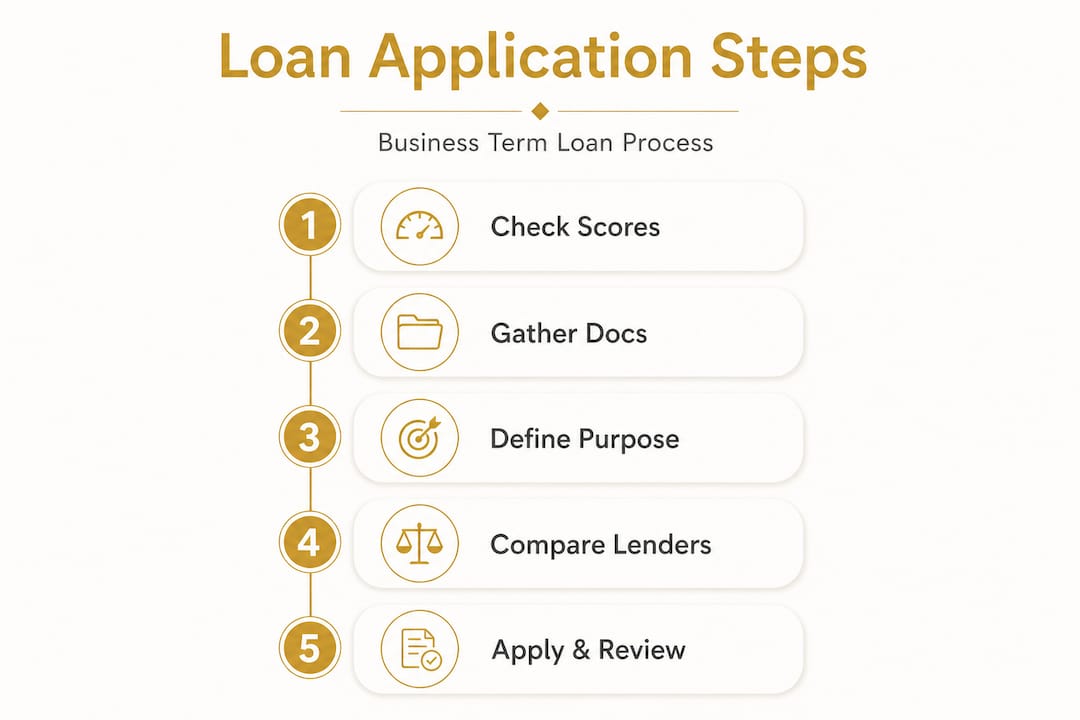
Step 2: Gather your documentation
Based on standard documentation requirements, collect your tax returns (two to three years), current financial statements, and recent bank statements. Organize these into a clean folder, digital or physical. Disorganized applications send a subtle negative signal.
Step 3: Define your loan purpose clearly
Lenders want to know exactly how you’ll use the funds. “Business growth” is too vague. “Purchasing two commercial refrigeration units at $45,000 each for our second location opening in March” is compelling and specific. Clear purpose reduces perceived risk.
Step 4: Compare multiple lenders
Don’t accept the first offer. Use APR as your comparison tool, not just the stated interest rate. Review the full loan terms including prepayment penalties, origination fees, and repayment flexibility.
Step 5: Submit a complete application
Missing documents slow everything down. Submit everything requested upfront. Follow up within 24 hours if the lender needs clarification. Responsive borrowers signal reliability.
Step 6: Review the offer carefully
Before signing, verify the loan amount, APR, total repayment amount, payment frequency, and any covenants (conditions you must maintain). If you don’t understand a term, ask.
Pro Tip: If you are financing equipment, lenders may want an invoice or quote from the vendor before approving. Check our equipment loan documents section so you show up prepared. Having vendor quotes ready can shave days off the approval timeline.
When you’re ready to move forward, you can apply for funds directly through Emory Lending’s simple online application.
A smarter approach to term loans: What most business owners miss
Most guides tell you to get your credit score up and gather your documents. That’s table stakes. What they rarely tell you is where businesses actually lose their shot at a term loan, and it usually comes down to three blind spots.
First, owners obsess over interest rates while ignoring DSCR. We’ve seen businesses with excellent credit get declined because their debt load was too heavy relative to income. A lender looking at your DSCR above 1.25 requirement doesn’t care that your credit score is 750 if your ratio is 0.95. Cash flow is the real conversation. Fix your DSCR before you fixate on rate shopping.
Second, the timing of your application matters more than people realize. Applying right after a slow quarter, a major equipment failure, or a large one-time expense can make your financials look worse than they are. If possible, apply when your trailing three to six months reflect your strongest performance. Lenders look backward to predict forward. Give them a picture worth lending against.
Third, communication gaps kill deals. A lender asks for a missing document and the business owner takes four days to respond. That delay signals disorganization and makes underwriters nervous. Treat your lender like a partner, not a gatekeeper. Respond fast, provide more than what’s asked, and explain any anomalies in your financials proactively. If revenue dipped in Q3 because of a hurricane (a reality in the Southeast), write a one-paragraph explanation. Silence creates assumption, and assumption rarely favors the borrower.
Finally, consider working capital insights to understand whether you actually need a term loan or if a revolving solution fits better. The right product for the wrong use case is still the wrong decision.
Find the right term loan for your business growth
Choosing the right financing is one of the most consequential decisions a growing business can make. At Emory Lending, we built our process specifically for small businesses in the Southeastern United States who are tired of being evaluated by credit scores alone.
We look at your business performance and cash flow, not just your personal financial history. Whether you need working capital to cover payroll, funds to purchase new equipment, or capital to open your next location, we can help you find the right structure. Businesses can secure funding from $5,000 to over $5,000,000 through our platform. Explore your options on our about Emory Lending page or go straight to our apply for funds page to get started today.
Frequently asked questions
What does DSCR mean and why is it important for term loans?
DSCR, or Debt Service Coverage Ratio, measures your ability to repay debt from operating income. Lenders require a DSCR above 1.25 to confirm your business generates enough cash to cover loan payments comfortably.
How fast can I get a business term loan approved?
Online lenders approve term loans in as little as a few days, while traditional banks and SBA programs typically take several weeks due to more intensive review processes.
What documents are required to apply for a business term loan?
You will typically need to provide tax returns, financial statements, and recent bank statements, along with business formation documents and a clear description of how you’ll use the funds.
Can I use a term loan for equipment purchases or working capital?
Yes. Term loans cover equipment purchases, working capital needs, business expansion, and other planned growth investments, making them one of the most versatile financing products available.
Is my credit score important for business term loan approval?
Lenders expect a personal credit score of 680+ and strong business credit history when reviewing term loan applications, though cash flow and DSCR often carry equal or greater weight in the final decision.


