

You’re pulling in steady revenue, your books show a profit, and yet somehow you’re scrambling to make payroll on Friday. Sound familiar? This frustrating gap between profit and cash on hand is one of the most common and most misunderstood problems small business owners face. Working capital is the concept that explains exactly why this happens. Get a clear grip on it and you gain a real tool for managing cash flow, surviving slow seasons, and funding growth without constantly feeling like you’re one bad month away from a crisis.
Table of Contents
- What is working capital? Breaking down the basics
- How to interpret working capital: Positive, negative, and everything in between
- Trade working capital and the operating cycle: The details that matter most
- Using liquidity ratios to assess your financial health
- Managing cash flow gaps: How working capital financing fits in
- A smarter take on working capital: Why context is everything
- Grow your business with the right working capital solution
- Frequently asked questions
Key Takeaways
| Point | Details |
|---|---|
| Definition matters | Working capital is current assets minus current liabilities, revealing your true short-term financial health. |
| Context is critical | What’s ‘healthy’ for working capital depends on your business’s model, cycles, and industry standards. |
| Manage the drivers | Monitor receivables, payables, and inventory to directly influence your working capital. |
| Financing is a tool | Short-term loans can help bridge cash flow gaps but match funding to your operating cycle. |
What is working capital? Breaking down the basics
Working capital tells you whether your business has enough short-term resources to cover its short-term obligations. The formula is simple: Current assets minus current liabilities equals working capital. As Investopedia explains, working capital measures short-term liquidity and indicates how well a business can meet its near-term financial commitments.
The word “current” is key here. It means anything expected to be converted into cash or paid out within one year or within your normal business cycle, whichever is longer.
Current assets are the resources you expect to turn into cash soon:
- Cash and cash equivalents: Money in your checking account or short-term savings
- Accounts receivable (AR): Invoices your customers owe you but haven’t paid yet
- Inventory: Products you’ve purchased or produced and plan to sell
- Prepaid expenses: Things like insurance premiums paid in advance
Current liabilities are the obligations you owe in the near term:
- Accounts payable (AP): Bills you owe your suppliers
- Short-term debt: Loan payments due within the year
- Accrued expenses: Wages owed, taxes due, and similar pending costs
According to Investopedia, current assets and liabilities are the building blocks of the working capital calculation, and getting them right is the first step to understanding your financial position.
Here’s a simple example. Say your bakery has $40,000 in current assets (cash, ingredients, outstanding invoices) and $25,000 in current liabilities (supplier bills, a short-term loan payment). Your working capital is $15,000. That positive number means you have a buffer. If the numbers flip and you owe more than you have coming in, that’s where trouble starts.

| Component | Example Amount |
|---|---|
| Cash on hand | $10,000 |
| Accounts receivable | $18,000 |
| Inventory | $12,000 |
| Total current assets | $40,000 |
| Accounts payable | $15,000 |
| Short-term loan payment | $10,000 |
| Total current liabilities | $25,000 |
| Working capital | $15,000 |
For a deeper look at how this concept applies to your business, the working capital overview at Emory Lending is a strong starting point.
“Working capital is one of the first numbers lenders and financial advisors look at when evaluating the financial health of a small business.”
How to interpret working capital: Positive, negative, and everything in between
Now that we know how to calculate working capital, let’s talk about what those numbers actually reveal about your business finances.
Positive working capital generally means your business can pay its near-term bills without borrowing. Most of the time, that’s a good sign. But a number that’s extremely high could actually signal problems too. If you’re sitting on a mountain of inventory that isn’t moving, or you have a huge pile of receivables that customers are slow to pay, that “positive” number can mask real operational inefficiencies. Cash locked up in slow-moving assets isn’t doing you any favors.
Negative working capital means your short-term liabilities outpace your assets. Working capital can be positive or negative depending on whether assets exceed liabilities or vice versa. For most small businesses, negative working capital is a red flag that can lead to missed payments, strained supplier relationships, and serious cash crunches. However, some large retailers operate with intentionally negative working capital because customers pay upfront while suppliers grant extended payment terms, which actually funds operations. For a small business in Georgia or the Carolinas without that scale and leverage, that model rarely works safely.
The nuance piece most guides skip: What counts as “healthy” working capital depends heavily on your business model and industry context. A construction contractor in Alabama with long project cycles needs far more working capital cushion than a food truck with daily cash sales. Comparing yourself to the wrong benchmark can lead you to make poor decisions.
| Working capital status | What it often means | Watch out for |
|---|---|---|
| Strongly positive | Good short-term buffer | Idle cash, slow inventory, poor collections |
| Slightly positive | Lean but manageable | Any disruption can tip you negative |
| Near zero | High risk zone | Missed payments, vendor friction |
| Negative | Potential liquidity crisis | Unless your model supports it |
Pro Tip: Always compare your working capital to industry peers and your own historical numbers rather than relying on generic benchmarks. A ratio that alarms one industry is completely normal in another. Reviewing your own trends over six to twelve months shows whether things are improving or quietly deteriorating before they become emergencies.
For practical guidance on structuring financing around these realities, the small business loan strategies blog at Emory Lending covers real-world scenarios in detail.
Trade working capital and the operating cycle: The details that matter most
Interpreting your working capital number is useful, but breaking it down into its moving parts gives you true control over your cash flow.
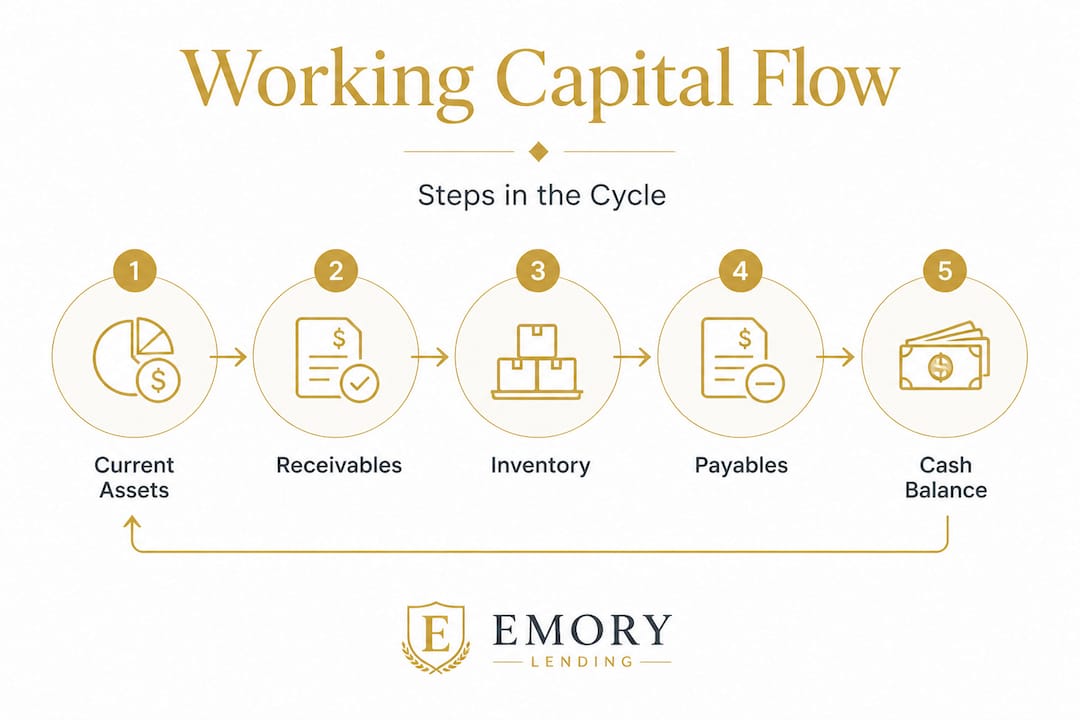
This is where trade working capital comes in. While standard working capital includes everything in the current category, trade working capital focuses specifically on the cash tied up in your day-to-day operations: inventory, accounts receivable, and accounts payable. It strips out things like short-term investments or prepaid expenses to give you a tighter view of operational cash needs.
Understanding your operating cycle is equally important. The operating cycle is the time it takes to buy inventory, sell it, and collect the cash. The shorter your cycle, the less working capital you need to tie up at any given time.
Here are the three key drivers and how to manage them:
-
Accounts receivable days. This is the average number of days it takes your customers to pay you. Invoice quickly and consistently. Offer small early-payment discounts if cash flow is tight. Follow up on overdue invoices within 48 hours of the due date. Consider requiring deposits on large orders.
-
Inventory days. This tracks how long products sit before they’re sold. Identify your slowest-moving items and either discount them to move them faster or stop ordering them. Use historical sales data to tighten your ordering patterns, especially heading into slower seasons.
-
Accounts payable days. This is how long you take to pay your own suppliers. Negotiate for longer payment terms wherever possible without damaging the relationship. If a supplier offers net-30 terms and you’re paying on net-15 out of habit, you’re giving up 15 free days of cash in hand.
“The businesses that manage cash flow most effectively don’t just track their totals. They obsess over the timing of when money moves in and out.”
Pro Tip: Set specific key performance indicators (KPIs) for each of these drivers. For example, target a receivables collection window of 25 days or fewer, aim to keep inventory days under 30, and negotiate payables to net-45 wherever the supplier relationship allows. Review these monthly, not quarterly.
Understanding how financing can support these gaps is important too. The business loan benefits page explains how accessing capital at the right moment can keep operations moving without interrupting growth.
Using liquidity ratios to assess your financial health
While tracking operating details helps, sometimes you need a big-picture check on your liquidity. That’s where financial ratios come in.
The most widely used is the current ratio. As Investopedia confirms, lenders and owners commonly use the current ratio (current assets divided by current liabilities) as a quick check on whether a business has enough cushion to handle its obligations. A ratio above 1.0 means you have more assets than liabilities in the short term. Most financial advisors consider a range of 1.2 to 2.0 to be solid for most small businesses.
But the current ratio doesn’t tell the whole story. Two other ratios fill in important gaps:
- Quick ratio (also called the acid-test ratio): This removes inventory from the current assets calculation because inventory isn’t always immediately convertible to cash. Formula: (Cash plus receivables) divided by current liabilities. This gives a more conservative picture of your liquidity.
- Cash ratio: The strictest measure. Only counts actual cash and cash equivalents against current liabilities. Useful in a worst-case-scenario analysis.
| Ratio | Formula | Best used when |
|---|---|---|
| Current ratio | Current assets ÷ current liabilities | General health check |
| Quick ratio | (Cash + receivables) ÷ current liabilities | When inventory is slow or hard to sell |
| Cash ratio | Cash ÷ current liabilities | Stress-testing your ability to survive |
Use the current ratio for routine monthly monitoring. Switch to the quick ratio when you’re carrying more inventory than usual or entering a slow season. Pull out the cash ratio before a major financial decision like signing a lease or taking on a large contract.
If you’re thinking about using a revolving credit facility to support liquidity, understanding business line of credit options can help you see how borrowing can serve as a managed buffer rather than a last resort.
Managing cash flow gaps: How working capital financing fits in
With foundational knowledge established, let’s look at the tools available when cash flow gets tight, especially financing options tailored for working capital needs.
Working capital financing is designed specifically for short-term operational needs, not long-term investments like equipment or real estate. Financing products help cover expense gaps between paying your vendors and getting paid by your customers. That timing gap is often the core problem for profitable but cash-strapped businesses.
Common situations where working capital financing makes sense:
- Payroll timing gaps. You have invoices outstanding but payroll is due this Friday. A short-term loan or line of credit bridges the gap without disrupting your team.
- Seasonal inventory builds. A landscaping company in Tennessee needs to stock up on materials in March for a peak season that won’t fully pay out until June.
- Covering rent during slow months. Retail businesses across the Southeast see major drops in foot traffic certain times of year. Financing smooths those dips without depleting reserves.
- Waiting on large receivables. A staffing agency submits weekly invoices but waits 45 to 60 days for client payments. That float creates a real operational strain.
- Unexpected expense spikes. Equipment breaks, insurance premiums jump, or a supplier raises prices with little notice.
The key principle is matching the loan term to your cash flow cycle. Borrowing short-term money for a long-term asset is a mismatch that creates long-term stress. Borrowing short-term money to cover a short-term gap, and then paying it off as cash comes in, keeps your financial structure healthy. You can explore how business loans work to better understand which structures fit which situations. For businesses exploring multiple options, short-term financing solutions can also provide a useful framework for comparison.
A smarter take on working capital: Why context is everything
Here’s something most working capital guides won’t tell you directly: following the textbook formula without understanding your specific business context can actually lead you into worse decisions.
We’ve worked with business owners in the Southeast who were told they had “great” working capital numbers on paper, yet were constantly stressed about cash. Why? Because their assets were mostly sitting in slow-moving inventory or in receivables from clients who paid on 60-day terms. Their balance sheet looked fine. Their bank account told a very different story.
The uncomfortable truth is that the balance sheet gives you a snapshot, not a movie. A snapshot taken on December 31st might show strong working capital for a retailer who just had a huge holiday season. That same business on March 15th could be in a completely different position.
Southeastern businesses also face specific regional dynamics that national formulas don’t account for. Payment culture in some industries, particularly construction, agriculture, and hospitality across states like Mississippi, Alabama, and Georgia, tends to run slower than national averages. Net-45 is often net-70 in practice. Seasonal rhythms tied to agriculture, tourism, and weather can swing working capital wildly within a single quarter.
The businesses we’ve seen thrive are the ones that stopped fixating on hitting a target ratio and started building real-time cash flow visibility. They track operating cycle metrics weekly. They know exactly how many days their biggest customers typically take to pay. They manage inventory like a working capital asset, not just a cost of doing business.
The right number is the one that keeps your business healthy, given your cycle, your customers, and your market. That’s the insight most articles leave out. For more grounded examples, the real-world financing lessons from Emory Lending’s blog offer perspectives from businesses that navigated exactly these challenges.
Grow your business with the right working capital solution
Understanding your working capital is the foundation. Acting on it is where growth happens.

At Emory Lending, we specialize in helping small businesses across the Southeast access financing that actually fits how their business operates. We look at your business performance and cash flow, not just your personal credit score, so more owners get approved and get funded fast. Whether you need to cover a payroll gap, build seasonal inventory, or smooth out a receivables lag, we have options designed for exactly that. Explore working capital options built for businesses like yours, or check out our invoice financing guide if receivables are your biggest challenge. When you’re ready to move forward, you can apply for working capital funds directly and get a decision without the runaround.
Frequently asked questions
What is the main purpose of working capital in business?
Working capital funds everyday operations, covers timing gaps between paying expenses and collecting revenue, and keeps your business running without interruption. As Stripe explains, it bridges the gap between when you pay vendors and when customers pay you.
How often should working capital be reviewed?
Monthly reviews are the standard best practice so you can catch shifts in your cash position before they turn into crises, especially heading into slower seasons.
Can a business have too much working capital?
Yes. Excess working capital can indicate that cash is sitting idle, inventory is stagnant, or receivables are taking too long to collect, all signs of operational inefficiency.
How does working capital differ from cash flow?
Working capital measures your financial position at a specific point in time, while cash flow tracks the actual movement of money into and out of your business over a period.
What happens if my working capital stays negative?
Consistently negative working capital creates real pressure on your ability to pay bills on time and can damage supplier relationships, your credit standing, and your ability to operate, unless your specific business model is designed to function that way.


