

Growth capital is one of the most misunderstood tools in small business finance. Most owners assume it belongs to venture-backed startups or Fortune 500 companies planning massive acquisitions. The truth is that stable, revenue-generating small businesses across the Southeast use growth capital every day to hire staff, buy equipment, open new locations, and scale operations in a controlled, strategic way. If you’ve been running your business for a few years and you’re ready to grow but unsure how to fund that next step, this guide breaks down exactly what growth capital is, who it’s for, and how to access it.
Table of Contents
- What is business growth capital?
- How business growth capital supports small business expansion
- Underwriting and approval: What lenders look for
- Key growth capital options for Southeastern small businesses
- The growth capital reality: What most business owners miss
- How Emory Lending supports your growth capital journey
- Frequently asked questions
Key Takeaways
| Point | Details |
|---|---|
| Growth capital focus | Growth capital funds expansion for established businesses, based on proven performance. |
| Diverse funding options | Southeastern small businesses can choose from loans, lines of credit, and community lenders. |
| Lender priorities | Lenders value revenue history and cash flow more than projections or business plans. |
| Best practices | Smart capital use drives sustainable business growth instead of temporary fixes. |
What is business growth capital?
Business growth capital is funding specifically designed to help an established company scale up. It is not a rescue loan. It is not startup funding. It is money deployed to accelerate a business that already has real revenue, a proven model, and a clear path to expansion.
Here is the key distinction most people miss: growth capital targets businesses with proven scalability and real revenue, not companies pitching ideas on a slide deck. Lenders and investors in this space focus on relatively mature, profitable companies that need capital to move faster than their current cash flow allows.
Growth capital comes in two broad forms:
- Debt-based growth capital: Term loans, lines of credit, SBA loans, and equipment financing. You borrow money and repay it with interest. You keep full ownership of your business.
- Equity-based growth capital: An investor provides funds in exchange for a minority ownership stake. Less common for small businesses, but it exists.
For most small business owners in Georgia, Tennessee, Florida, the Carolinas, and across the Southeast, debt-based options are the most practical and accessible route.
| Feature | Growth capital | Startup funding |
|---|---|---|
| Target business stage | Established, revenue-generating | Early-stage, pre-revenue |
| Underwriting basis | Cash flow and track record | Business plan and projections |
| Typical use | Scaling, expansion, equipment | Building the initial product |
| Ownership impact | Usually none (debt) | Often diluted (equity) |
One thing that separates growth capital from a standard small business loan is the underwriting philosophy. Lenders evaluate your current performance, not your future hopes. The loan benefits for small business growth become most powerful when you already have cash flow to demonstrate repayment capacity.
“Growth capital is not for unproven models. It rewards businesses that have already figured out how to make money and simply need more fuel to go faster.”
That distinction matters enormously. If your business has been operating for two or more years, generates consistent monthly revenue, and has a specific expansion goal in mind, you are likely a strong candidate for growth capital.
How business growth capital supports small business expansion
With a clear definition in mind, let’s look at how growth capital tangibly fuels business expansion for small companies.
The most common uses are more practical than most people expect. Many small businesses take on debt to meet payroll and inventory needs, and the trajectory of a business often depends directly on how well it manages that capital. A landscaping company in Charlotte might use growth capital to purchase three additional trucks and hire seasonal crews before a busy spring season. A restaurant group in Atlanta might use it to fund a second location buildout while keeping the first location’s cash flow intact.

Here is a quick look at the most common practical applications:
Short-term growth needs:
- Covering payroll during a slow season
- Buying inventory ahead of a high-demand period
- Bridging gaps while waiting on receivables
Long-term expansion applications:
- Purchasing major equipment to increase production capacity
- Funding a new location lease and buildout
- Hiring and training a management team to support scale
The difference between these two categories is important. Short-term needs call for flexible products like lines of credit. Long-term expansion efforts are better matched with term loans or equipment financing, where repayment schedules align with the revenue the investment generates.
A useful framework for aligning capital with your goals:
- Identify the specific growth goal. Be precise. “I want to grow” is not a plan. “I need to add a second service van and hire one technician to handle 40% more service calls” is a plan.
- Estimate the capital required. Get real quotes. Know your numbers before you apply.
- Match the need to the right product. Explore how working capital works for short-term needs and equipment financing insights for asset purchases.
- Project the revenue impact. Lenders want to see that the capital will generate returns. You should want to see that too.
- Apply with a clear narrative. Know your numbers and be ready to explain how the funding accelerates your business.
Pro Tip: Thriving microbusinesses can graduate to larger loan products like SBA 7(a) loans as they stabilize and grow. If you started with a small line of credit or microloan, that track record of repayment is a genuine asset when you apply for larger growth capital. Document it carefully.
The businesses that use growth capital most effectively treat it as a planned investment, not a reaction to a problem. They time their applications strategically, often before the growth push begins rather than during it. Explore small business loan strategies to see how other owners have structured their capital approach.
Underwriting and approval: What lenders look for
Once you understand where growth capital fits, it’s important to know what lenders will scrutinize when you apply.
The core principle is straightforward: lenders underwrite based on established business performance, meaning your actual revenue and cash flow history, not your projected ideas or optimistic forecasts. This is actually good news for businesses that have been operating successfully for a few years. Your track record is your strongest asset.
Here is what most lenders want to see:
- Consistent monthly revenue: Most growth capital lenders want to see at least six to twelve months of steady revenue. Some require two years of business history.
- Positive cash flow: Lenders need to see that your business generates enough cash to service new debt without straining operations.
- Business bank statements: Typically three to six months of statements showing real transaction activity.
- Financial statements: Profit and loss statements, balance sheets, and sometimes tax returns.
- Payment history: A record of meeting existing obligations, whether that’s rent, supplier payments, or existing loans.
Debt vs. equity underwriting differences:
For debt-based growth capital, lenders focus almost entirely on your ability to repay. For equity-based options, investors look more at your growth potential and market size. Most Southeast small businesses will deal almost exclusively with debt-based underwriting, so cash flow is king.
Pro Tip: Before you apply, pull your last six months of bank statements and calculate your average monthly deposits. That number is often the first thing a lender uses to estimate how much you can borrow and what repayment terms make sense. Knowing your number before the conversation puts you in control.
Understanding how business loans work before you apply helps you present your financials in the most favorable and accurate way. It also helps you ask the right questions about rates, terms, and repayment structures.
Quick ways to improve your approval odds:
- Separate personal and business finances completely if you haven’t already
- Keep business bank accounts active and consistent
- Reduce outstanding short-term debt before applying for larger capital
- Build a clear one-page summary of what the capital will fund and why
Lenders who specialize in growth capital, including those offering term loans and SBA options, are generally more focused on your business performance than your personal credit score. That is a significant advantage for many small business owners who have strong operations but imperfect personal credit histories. You can also review equipment financing criteria if your primary need is asset-based.
Key growth capital options for Southeastern small businesses
Now, let’s break down the prime types of growth capital Southeastern business owners should consider next.
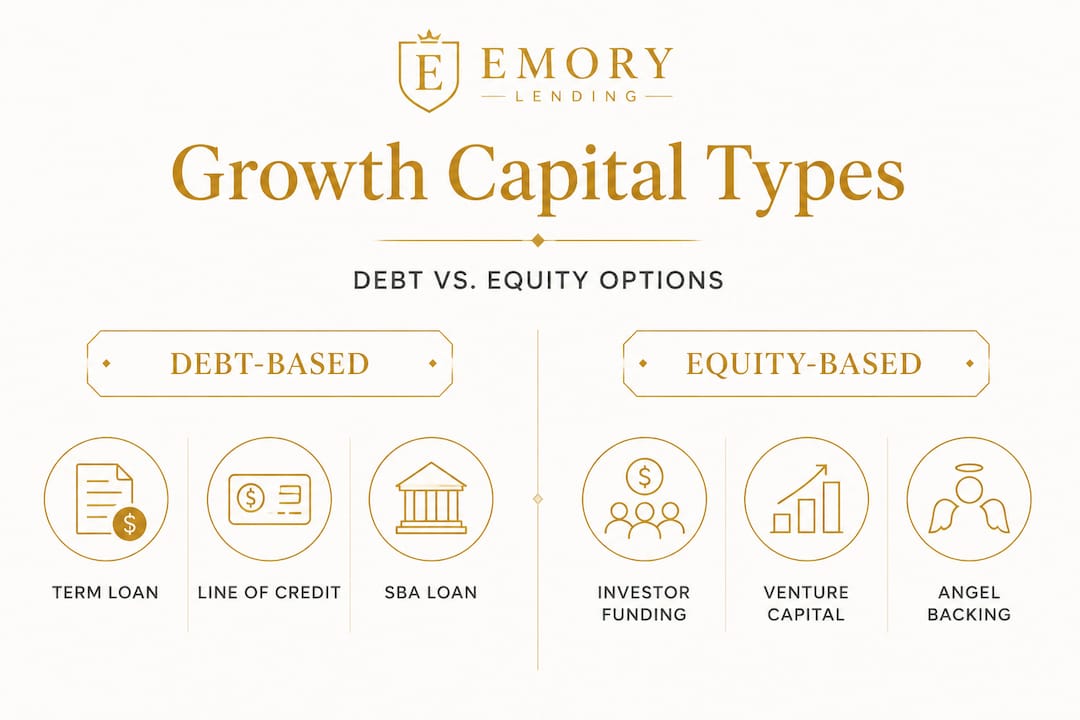
The Southeast has a strong network of lenders, community development financial institutions (CDFIs), and specialty financing companies that serve small businesses. Community lenders can support growth through technical assistance and larger loans as businesses stabilize, which makes regional relationships especially valuable.
Top growth capital options to consider:
- Term loans: A lump sum repaid over a fixed period, ideal for large one-time investments like equipment or a location buildout. Predictable payments make budgeting straightforward.
- SBA loans: Government-backed loans with competitive rates and longer repayment terms. The SBA 7(a) is the most common for growth purposes. Approval takes longer but the terms are often the best available.
- Equipment financing: Funding specifically tied to a piece of equipment, which serves as collateral. Easier to qualify for and often faster to close. Check out business loan insights for real examples.
- Business line of credit: A revolving credit facility you draw from as needed. Best for managing cash flow gaps and short-term operational needs. Learn more about business line of credit options available to you.
| Capital type | Best use case | Typical speed | Key requirement |
|---|---|---|---|
| Term loan | Expansion, buildout, large purchase | 1 to 4 weeks | 2 years in business, strong revenue |
| SBA 7(a) loan | Long-term growth, real estate | 30 to 90 days | Good credit, detailed documentation |
| Equipment financing | Machinery, vehicles, technology | 24 to 72 hours | Equipment quote, business revenue |
| Line of credit | Working capital, cash flow gaps | 1 to 2 weeks | Consistent monthly revenue |
Choosing the right product matters as much as getting approved. A business that uses a short-term line of credit to fund a two-year expansion project will strain its cash flow unnecessarily. A business that takes a five-year term loan to cover a one-time payroll gap will pay far more in interest than needed. Match the product to the purpose.
Regional factors also matter. Southeastern markets often have seasonal revenue patterns, particularly in agriculture, tourism, construction, and hospitality. Lenders familiar with your region understand those patterns and can structure repayment accordingly.
The growth capital reality: What most business owners miss
Here is the perspective that most articles won’t give you, drawn from working directly with small business owners across the Southeast.
The biggest mistake we see is treating growth capital like emergency funding. Owners wait until they are stretched thin, cash flow is tight, and they need money yesterday. At that point, they are applying from a position of weakness, and lenders can see it in the numbers. The businesses that get the best terms and the most capital apply when things are going well, not when things are falling apart.
Growth capital is a planning tool, not a rescue tool. The businesses that use it most effectively plan their capital needs six to twelve months in advance. They know what growth milestone they are funding, they have the documentation ready, and they apply before the need becomes urgent.
The second thing most owners miss is how much small steps compound. You don’t need a million-dollar loan to change your trajectory. A $75,000 equipment purchase that doubles your production capacity, funded through equipment financing lessons from businesses like yours, can generate returns that justify the next, larger round of capital. Growth capital works best when it is layered strategically over time.
There is also a common misconception that lenders only care about credit scores. In reality, the lenders who specialize in small business growth capital care far more about your revenue consistency, your cash flow patterns, and your ability to articulate a clear plan. A business owner who walks in with three years of steady monthly deposits and a specific expansion plan will often outperform a business owner with a perfect credit score and no clear strategy.
Finally, do not underestimate the value of a lender who understands your industry and your region. A lender who has worked with dozens of Southeast contractors, restaurant owners, or healthcare practices understands your seasonality, your margins, and your growth patterns. That context leads to better terms and a more productive relationship.
How Emory Lending supports your growth capital journey
With fresh perspective in mind, here’s how you can put funding insights to work for your business with Emory Lending’s support.
At Emory Lending, we built our approach around one simple idea: your business performance should determine your access to capital, not just your personal credit score. We work with small businesses across the Southeast that are ready to grow and need a lender who evaluates what actually matters.
Whether you need working capital solutions to bridge a cash flow gap, an equipment financing guide to fund your next major asset purchase, or a full growth capital strategy to support a location expansion, we have the products and the expertise to match you with the right funding. We help businesses secure capital from $5,000 to $5,000,000 and beyond. The application process is straightforward, the decisions are fast, and we focus on your business story, not just your credit report. Ready to take the next step? Apply for growth capital today and get a decision based on what your business has actually built.
Frequently asked questions
Is growth capital different from a regular business loan?
Yes, growth capital targets expansion for established businesses and often uses proven revenue as a key qualification rather than just a business plan or personal credit history.
What are the main uses for growth capital?
Most businesses use growth capital for hiring, inventory, new equipment, or opening additional locations, since different trajectories exist depending on how that capital is deployed and managed.
Who provides growth capital to small businesses?
Lenders, specialty financing companies, and community lenders supporting growth through technical assistance and larger loans all offer growth capital, typically to businesses with established, consistent revenue.
What documents are needed to apply for growth capital?
Lenders usually ask for business financials, cash flow statements, and evidence of consistent revenue, since underwriting is based on established performance rather than projected ideas or future estimates.


