

A business grant is defined as non-dilutive, debt-free financing awarded to businesses by government agencies, corporations, or foundations without any repayment obligation or equity loss. Unlike a loan, a grant does not add debt to your balance sheet. Unlike equity financing, it does not cost you ownership. For entrepreneurs and small business owners exploring what is a business grant and whether one fits their funding plan, the short answer is this: grants are free money with strings attached, and understanding those strings is everything.
What is a business grant, exactly?
A business grant is a one-off financial award restricted to specific, approved uses rather than general operating expenses. The grantor, whether a federal agency, state program, private foundation, or corporation, sets the rules for how funds must be spent. You apply, you compete, and if selected, you receive funding you never pay back.
Grants differ from loans in one fundamental way: there is no repayment schedule. They also differ from equity deals because no investor takes a stake in your company. That combination makes grants the most capital-efficient form of funding available. The catch is that grants are highly competitive and typically awarded for a defined project, not as ongoing operational support.

The standard industry term for this category is “non-dilutive funding.” You will hear that phrase often in startup and small business finance circles. It simply means the funding does not reduce your ownership percentage. Business grants sit at the top of that category alongside revenue-based financing and certain government programs.
What types of business grants are available?
Grant sources fall into four main categories, each with different funding levels, competition intensity, and eligibility requirements.
Federal government grants
The U.S. federal government does not offer grants specifically for starting a business. Federal programs focus on R&D, innovation, and community impact. The Small Business Innovation Research (SBIR) and Small Business Technology Transfer (STTR) programs are the most prominent examples. SBIR and STTR awards range from $275,000 to $1.8 million, but the application process is rigorous and the competition is national.
State and local grants
State and local grants target regional economic development. A state may fund a manufacturing business to create local jobs, or a city may grant money to a minority-owned restaurant in an underserved neighborhood. These programs tend to have less competition and higher success rates for small businesses than federal programs. Your state’s economic development office is the best starting point.
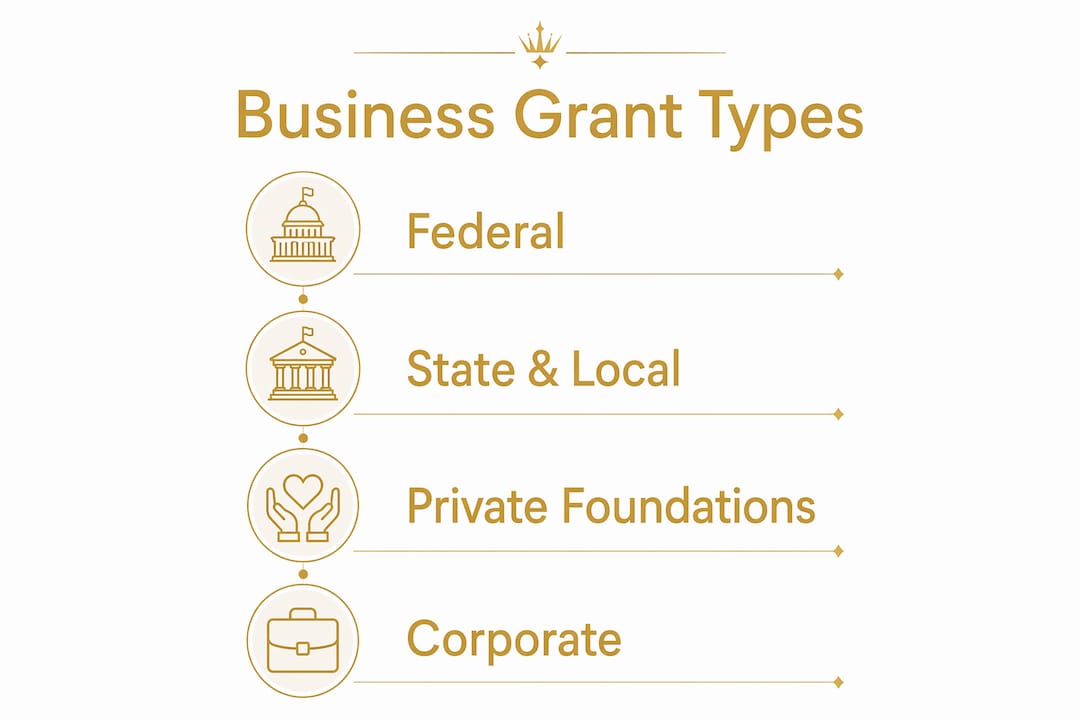
Private foundation grants
Private foundations award grants aligned with their specific mission. A foundation focused on environmental sustainability may fund green technology businesses. One focused on workforce development may fund job training programs. Funding amounts vary widely, and the application process is often less bureaucratic than federal grants.
Corporate grants
Corporations run grant programs to support social impact, industry development, or communities where they operate. These programs are often tied to a company’s corporate social responsibility goals. Award amounts are typically smaller than federal grants, but the application requirements are more accessible for early-stage businesses.
| Grant source | Typical focus | Competition level | Funding range |
|---|---|---|---|
| Federal (SBIR/STTR) | R&D, innovation | Very high | $275,000–$1,800,000 |
| State and local | Economic development | Moderate | Varies by state |
| Private foundation | Mission-driven projects | Moderate to high | Varies widely |
| Corporate | Social impact, industry | Lower to moderate | Typically smaller |
What are the eligibility requirements for business grants?
Grant eligibility typically involves a combination of business size, industry, location, ownership demographics, and project alignment with the funder’s mission. No two grant programs use identical criteria. A grant for women-owned businesses in rural areas will screen applicants very differently than a federal R&D grant for tech startups.
The most common eligibility factors include:
- Business size: Many grants target small businesses as defined by the SBA, using employee count or annual revenue thresholds.
- Industry: Some grants are sector-specific, covering agriculture, technology, healthcare, or manufacturing.
- Location: State and local grants often require your business to operate within a specific county, city, or economic zone.
- Ownership demographics: Grants exist specifically for minority-owned, women-owned, veteran-owned, and disabled-owned businesses.
- Project alignment: Your proposed use of funds must match the grantor’s stated goals.
A common misconception is that any small business can apply for any grant. That is not how it works. Each program has a defined target, and applying outside that target wastes your time. Read the eligibility criteria before you invest hours in an application.
For federal grants, administrative setup adds another layer. Registering with SAM.gov and obtaining a Unique Entity ID can take several weeks. Start that process before you find a grant you want to apply for, not after.
Pro Tip: Search Grants.gov using your NAICS industry code to filter federal opportunities by your specific sector. This cuts research time significantly and surfaces programs you would otherwise miss.
How do you apply for a business grant?
The business grant application process has four distinct phases, and most applicants underestimate the time each one requires.
Phase 1: Research and targeting. Identify grants that match your business profile, industry, location, and project goals. Use Grants.gov for federal programs, your state’s economic development website for local options, and foundation directories for private grants. The small business funding workflow at Emorylending covers how to map your funding needs before you start searching.
Phase 2: Administrative preparation. Gather your business documents before you apply. You will typically need:
- Business registration and EIN
- Financial statements (profit and loss, balance sheet)
- Tax returns for the past one to two years
- A business plan or project narrative
- Unique Entity ID from SAM.gov (for federal grants)
Phase 3: Writing the proposal. Grant proposals require you to explain what you will do, why it matters to the funder, how you will measure success, and how you will spend the money. Follow the application guidelines exactly. Reviewers disqualify applications that miss required sections or exceed word limits.
Phase 4: Post-award compliance. Winning a grant is not the end of the work. Most grantors require progress reports, financial documentation, and proof that funds were spent as proposed. Treat this as a contractual obligation.
One practical reality that surprises many first-time grant recipients: many grants are reimbursable. You spend the money first, then submit receipts for reimbursement. That means you need working capital on hand before the grant funds arrive. Plan your cash flow accordingly.
Pro Tip: Never pay to apply for a grant. Legitimate grant programs never charge application or processing fees. Any request for payment before you receive funding is a scam.
How do business grants fit into your overall funding strategy?
Grants are supplemental funding, not a business model. Treating them as reliable, recurring revenue is one of the most common mistakes small business owners make. A grant funds a specific project once. When that project ends, the funding ends.
The most effective approach is to treat grants as one layer in a diversified funding stack. Here is how the main options compare:
| Funding type | Repayment required | Equity cost | Best use |
|---|---|---|---|
| Business grant | No | No | Specific projects, R&D, community impact |
| Business loan | Yes | No | Working capital, equipment, expansion |
| Equity financing | No | Yes | High-growth scaling, large capital needs |
| Revenue-based financing | Yes (from revenue) | No | Growth with flexible repayment |
Grants reduce your need for debt and protect your ownership. That is genuinely valuable. But the application process takes weeks or months, and approval is never guaranteed. Relying on a grant to cover payroll or rent puts your business at serious risk.
Smaller, niche grants often offer better odds than large federal programs. A local economic development grant or an industry association award may have fewer applicants and a more accessible application. These are worth prioritizing alongside larger federal opportunities, not instead of them.
The practical funding mix for most small businesses looks like this: grants cover project-specific costs and reduce capital needs, while loans or lines of credit cover operations and growth. Emorylending evaluates businesses based on cash flow and performance rather than personal credit, which makes financing accessible even when grant funding is pending or uncertain. You can learn more about funding options for startups to see how grants and lending work together.
Key Takeaways
Business grants are non-repayable, project-specific awards that work best as one layer in a broader funding strategy, not as a standalone capital source.
| Point | Details |
|---|---|
| Grants are debt-free and non-dilutive | You repay nothing and give up no ownership, making them the most capital-efficient funding type. |
| Federal grants are competitive and narrow | SBIR/STTR awards reach $1.8 million but require rigorous applications focused on R&D and innovation. |
| Eligibility varies by program | Business size, industry, location, and ownership demographics all affect which grants you qualify for. |
| Many grants reimburse after spending | You need working capital on hand before grant funds arrive, so plan your cash flow carefully. |
| Grants supplement, not replace, other funding | Treat grants as one layer in a diversified stack alongside loans, lines of credit, or revenue-based financing. |
The grant reality most guides won’t tell you
I have watched entrepreneurs spend six months chasing a federal grant, win nothing, and then scramble for capital they needed in month two. The grant process rewards patience and preparation, but it punishes anyone who treats it as a primary funding plan.
The most overlooked opportunity in the grant world is local and niche programs. A regional economic development grant or an industry association award rarely makes headlines, but the applicant pool is a fraction of what you face with federal programs. I have seen businesses win $25,000 local grants with a two-page application while their federal SBIR proposal sat in a review queue for eight months.
Administrative readiness separates winners from repeat losers. Get your SAM.gov registration done now, before you need it. Keep your financials current and organized. Write a one-page project summary you can adapt quickly when a new opportunity appears. The businesses that win grants consistently are not the ones with the best ideas. They are the ones who are ready to apply on short notice.
One warning I repeat to every business owner I work with: if anyone asks you to pay money to apply for or receive a grant, walk away immediately. That is a scam, every time, without exception.
— Jason
Emorylending’s financing options for small businesses
Grants are worth pursuing, but they cannot carry your business alone. Emorylending helps small businesses access capital based on actual business performance and cash flow, not just personal credit scores.

Whether you need working capital while waiting on a grant decision, equipment financing to fulfill a new contract, or funds to expand a location, Emorylending offers flexible financing options from $5,000 to $5,000,000+. The application process is fast, and approvals are based on how your business performs, not just your credit history. Pairing grant funding with the right lending product gives you the capital coverage to grow without waiting on a single funding source.
FAQ
What is the business grant definition in simple terms?
A business grant is free money awarded by a government agency, corporation, or foundation for a specific business purpose, with no repayment required and no equity given up.
Do business grants have to be paid back?
No. Grants are non-repayable by definition. However, if you misuse the funds or fail to meet reporting requirements, a grantor can demand repayment.
What are the most common types of business grants?
The main types are federal government grants (such as SBIR and STTR), state and local economic development grants, private foundation grants, and corporate grants tied to social impact goals.
How long does the business grant application process take?
Federal grant applications can take several months from submission to decision. State and local programs vary, but most require at least four to eight weeks for review.
Are there business grants for startups?
Yes, but options are limited. Most federal programs require a track record of research or operations. State programs and corporate grants are more accessible for early-stage businesses.


