

A business capital management workflow is the structured sequence of processes that governs how capital requests are created, reviewed, approved, and allocated within an organization to ensure optimal use of financial resources. In practice, this means every dollar request moves through defined stages: submission, review, approval, and deployment. Without that structure, businesses lose money to redundant approvals, missed budget cycles, and poor visibility into where funds actually go. The formal discipline behind this process is called capital expenditure management, or CapEx governance, and it applies equally to working capital decisions. Businesses that treat capital allocation as a repeatable process, rather than a series of one-off decisions, consistently outperform those that do not.
What are the essential components of a capital management workflow?
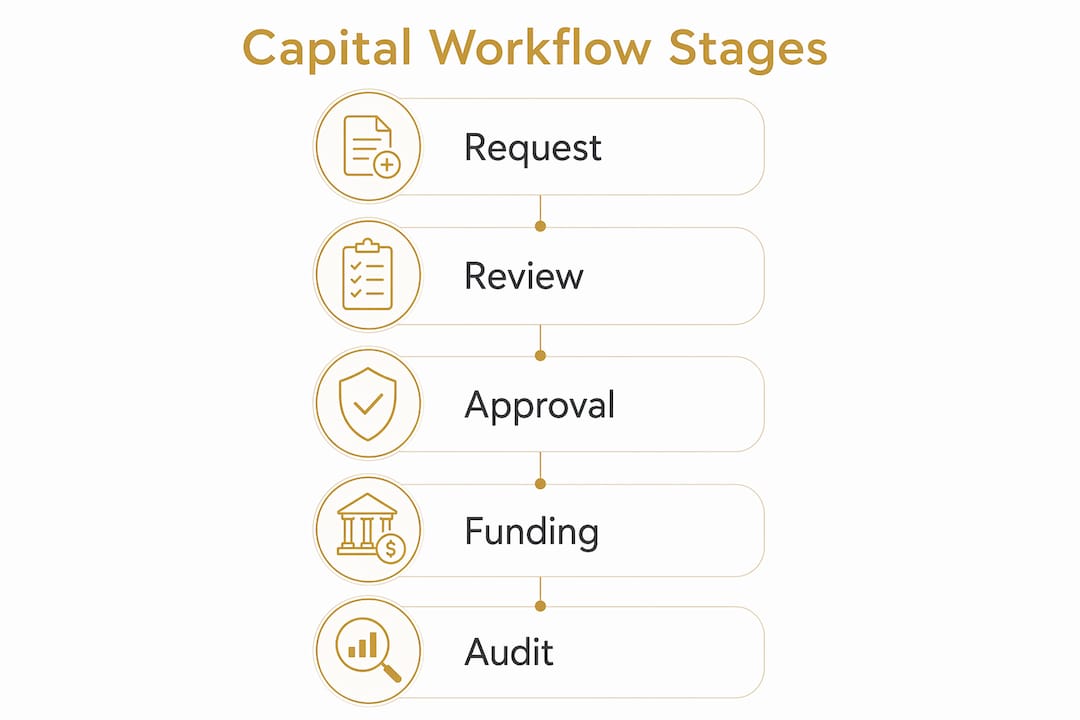
A well-built capital management workflow has five core stages, each with a defined owner and output.
-
Capital request submission. The requestor submits a standardized form that includes the business case, cost estimate, expected return, and budget line reference. Incomplete submissions must be rejected at intake. A hard stop on incomplete requests prevents bottlenecks and audit failures downstream.
-
Department review. The requestor’s manager or department head validates the business case and confirms budget availability. This stage filters out requests that do not align with operational priorities before they consume finance team time.
-
Finance review. The finance team checks the request against the current budget, cash flow position, and financial modeling outputs. Integration with tools like Oracle EPM or Anaplan at this stage improves governance and CFO decision quality.
-
Threshold-based approval escalation. Requests below a set dollar threshold are approved at the department level. Requests above that threshold escalate to the CFO or executive committee. Role-based, tiered approval matrices ensure senior leaders see only high-stakes decisions.
-
Procurement and asset registration. Once approved, the request moves to procurement for vendor selection and purchase. The acquired asset is registered in the fixed asset ledger or working capital tracker, closing the audit trail.
The table below maps each stage to its owner and primary output.
| Stage | Owner | Output |
|---|---|---|
| Request submission | Department requestor | Completed intake form with business case |
| Department review | Line manager | Validated and prioritized request |
| Finance review | Finance team | Budget-confirmed, modeled request |
| Approval escalation | CFO or exec committee | Signed approval with conditions |
| Procurement and registration | Procurement and accounting | Purchase order and asset record |
Role clarity is what separates a functional workflow from a chaotic email chain. When every participant knows their stage, their decision authority, and their deadline, capital moves faster and with fewer errors.
How can businesses redesign their capital management workflow for efficiency?
Redesigning a capital workflow starts with mapping what actually happens, not what the process diagram says should happen. Most businesses discover a gap between the two within the first hour of honest mapping.
- Map the current state first. Walk every request through the actual process and record each handoff, wait time, and decision point. This surfaces bottlenecks that policy documents never mention.
- Identify and rank bottlenecks. Use an Impact vs. Effort matrix to prioritize which problems to fix. Mid-market businesses operate with roughly 20 broken processes but can realistically fix only two per quarter. Prioritization is not optional.
- Eliminate redundant steps. Dual approvals at the same dollar threshold, repeated data entry across systems, and manual status updates are the most common waste points. Remove any step that does not add a decision or a control.
- Pilot before full rollout. Test the redesigned workflow on one department or one request category for 60 days. Measure cycle time, error rate, and requestor satisfaction before scaling.
- Build in continuous monitoring. Assign a process owner who reviews workflow performance monthly. Structured workflow optimization can reduce end-to-end process time by 30–50% when discovery, analysis, implementation, and monitoring all happen in sequence.
Pro Tip: Before your next redesign session, pull the last 20 capital requests and time each stage manually. The data will tell you exactly where the process breaks, and you will not need to guess.
Aligning the redesigned workflow with your budget cycle is the step most businesses skip. Capital approvals that happen outside the annual or quarterly budget review create off-cycle spending that erodes financial discipline. Build approval windows into the workflow calendar, not just the process map.
What role does automation play in capital management workflows?
Automation accelerates a well-designed workflow. It destroys a broken one. Automating before redesign scales inefficiencies rather than eliminating them. The sequence matters: map, redesign, measure, then automate.

Once the workflow is clean, automation delivers real gains in three areas.
| Automation area | Manual state | Automated state |
|---|---|---|
| Request routing | Email to manager, often lost | Auto-routed by amount and department rule |
| Approval reminders | Requestor follows up manually | System sends timed escalation alerts |
| Budget visibility | Finance updates spreadsheet weekly | Live dashboard pulls from ERP in real time |
Setting a performance baseline before deploying any automation tool is non-negotiable. Organizations that skip baseline measurement struggle to prove ROI from AI or automation initiatives. Record your current average cycle time, approval error rate, and budget variance before you change anything.
ERP integration is the highest-value automation investment for most businesses. Connecting your capital request workflow to your general ledger means approvals automatically update budget balances, eliminating the manual reconciliation step that typically takes finance teams hours each week.
Pro Tip: Start automation with the routing and reminder functions. These deliver fast, visible results and build organizational confidence in the new system before you tackle more complex integrations.
By the end of 2026, 40% of enterprise applications will include task-specific AI agents, up from 4% in 2024. That shift means AI-assisted capital request scoring and risk flagging will become standard features in financial management platforms. Businesses that have already redesigned their workflows will absorb these tools quickly. Those still running manual processes will find the technology impossible to use effectively.
What are best practices and common pitfalls in capital workflow management?
The most effective capital management programs share a short list of non-negotiable practices.
- Enforce submission completeness. Every capital request must include a business case, cost estimate, and budget reference before it enters the workflow. Incomplete submissions create delays and audit gaps.
- Define approval thresholds in writing. Ambiguous thresholds are the single most common cause of workflow failure. Publish a clear matrix: who approves what, at what dollar amount, and under what conditions.
- Align approvals with budget cycles. Capital decisions made outside the budget review window create unplanned spending. Build hard deadlines into the workflow that match your quarterly or annual planning calendar.
- Assign process ownership. Every workflow stage needs a named owner who is accountable for cycle time and quality. Shared ownership is no ownership.
- Audit the process quarterly. Pull metrics on cycle time, rejection rates, and escalation frequency every quarter. Use the data to identify drift before it becomes a structural problem.
Successful capital allocation requires deciding what not to fund. Prioritizing requests according to strategy rather than isolated project metrics produces stronger returns and clearer organizational focus. The discipline of saying no is as important as the speed of saying yes.
Manual, email-based approvals are the most common pitfall. They create no audit trail, no visibility into pending decisions, and no mechanism for escalation. A cash flow management process built on email threads will always underperform one built on defined stages and documented decisions.
Businesses with short cash conversion cycles and proactive risk tools consistently show better long-term financial outcomes and market share. That correlation is not accidental. It reflects the compounding effect of making faster, better-informed capital decisions over time.
Capital allocation also requires portfolio thinking. Separating funding into categories, such as core operations, growth investments, and strategic options, increases investment precision and builds resilience against market shifts. A business that funds everything from a single undifferentiated pool will always struggle to protect its core while betting on growth.
Key Takeaways
An effective business capital management workflow combines clear submission standards, tiered approvals, workflow redesign before automation, and continuous performance monitoring to produce faster decisions and better financial control.
| Point | Details |
|---|---|
| Define every stage clearly | Assign a named owner and required output to each workflow stage before anything else. |
| Redesign before automating | Fix broken processes first; automation applied to a flawed workflow scales the problem. |
| Enforce submission completeness | Reject incomplete capital requests at intake to prevent downstream delays and audit risk. |
| Align with budget cycles | Build approval windows into the workflow calendar to prevent off-cycle, unplanned spending. |
| Measure before and after | Set a performance baseline so you can prove the impact of every process change you make. |
What I’ve learned from watching capital workflows fail
Most capital workflow failures I have seen share one trait: the business automated before it understood its own process. A finance team installs a new platform, migrates the old email-based approval chain into it, and calls it a transformation. Six months later, cycle times are the same and the team is frustrated with the software instead of the process.
The uncomfortable truth is that technology does not fix a workflow. It reveals whether the workflow was worth fixing. The businesses that get real results from working capital improvements are the ones that spent two weeks mapping their actual process before they touched a single tool.
The second failure pattern is treating capital allocation as a finance department problem rather than an organizational discipline. When department heads do not understand approval thresholds, when requestors submit incomplete forms because no one enforces the standard, and when budget owners are not in the room during approval reviews, the workflow breaks at every handoff. Finance cannot fix that alone.
The practice that consistently separates high-performing businesses is the monthly process review. Not a quarterly audit, not an annual retrospective. A monthly 30-minute review of cycle time, rejection rates, and escalation patterns. That cadence catches drift early and keeps the workflow honest. Improving cash flow is not a one-time project. It is a habit built into the operating rhythm of the business.
— Jason
How Emorylending supports your capital management goals
A well-designed capital workflow tells you exactly when and how much funding you need. Getting that funding quickly is where Emorylending comes in.

Emorylending evaluates your business performance and cash flow, not just your personal credit score. That means more small businesses qualify for the capital they need to execute on their plans. Whether you need working capital to cover a gap in receivables, equipment financing to support a new service line, or growth capital to open a second location, Emorylending offers flexible financing options from $5,000 to $5,000,000+. The application process is fast, and decisions are based on how your business actually performs. When your workflow identifies the need, Emorylending helps you move on it.
FAQ
What is a business capital management workflow?
A business capital management workflow is the defined sequence of steps that governs how capital requests are submitted, reviewed, approved, and allocated within an organization. It replaces ad hoc decisions with a repeatable, auditable process.
Why should workflow redesign come before automation?
Automating a broken process scales its inefficiencies rather than eliminating them. Redesigning the workflow first ensures that automation accelerates a process that already works correctly.
What is a tiered approval matrix in capital management?
A tiered approval matrix defines who approves capital requests at each dollar threshold. Requests below a set amount are approved at the department level, while larger requests escalate to the CFO or executive committee.
How does capital workflow optimization improve cash flow?
Faster, more accurate capital approvals reduce the time between identifying a need and deploying funds. Businesses with short cash conversion cycles and structured approval processes consistently show stronger financial outcomes.
How often should a capital management workflow be audited?
A monthly review of cycle time, rejection rates, and escalation frequency is the most effective cadence. Quarterly audits catch structural problems, but monthly reviews prevent drift before it compounds.


