

Lending criteria are the specific financial and qualitative factors lenders analyze to decide whether to approve your loan and on what terms. Small business owners who grasp these factors gain a real advantage. The framework most lenders use traces back to the 5 Cs of credit, and in 2026, updated SBA 7(a) and 504 eligibility rules add new layers every applicant must know. Understanding lending criteria is not just about checking boxes. It is about building a complete picture that gives a lender confidence you will repay.
What are the primary quantitative lending criteria lenders evaluate?
Numbers come first in any loan review. Commercial lenders analyze financial statements, tax returns, and bank statements to calculate ratios that measure your ability to repay. These ratios guide both approval decisions and the interest rate you receive.
Debt service coverage ratio (DSCR)
The DSCR is the single most watched metric in commercial lending. It measures your net operating income against your total debt payments. Lenders prefer a DSCR of at least 1.25x, meaning your business generates $1.25 in income for every $1.00 owed. A ratio below 1.0 signals the business cannot cover its own debt, which is a near-automatic denial.

Credit scores and credit history
Your personal and business credit scores tell lenders how reliably you have managed debt in the past. Most conventional lenders set minimum personal credit score thresholds, often in the 650–700 range for standard products, though SBA lenders may apply their own internal floors. A thin or damaged credit history forces lenders to rely more heavily on cash flow data and collateral.
Key financial ratios lenders check
| Ratio | What it measures | Typical benchmark |
|---|---|---|
| DSCR | Income vs. debt payments | 1.25x minimum |
| Debt-to-equity | Leverage level | Varies by industry |
| Current ratio | Short-term liquidity | Greater than 1.0 |
| Debt-to-income | Owner’s personal repayment load | Below 43% for most programs |
The debt-to-income ratio, loan purpose, and employment stability all factor into how lenders score your repayment capacity. Secured loans generally receive better rates than unsecured ones because collateral reduces lender risk.
Pro Tip: Pull your last three years of business tax returns and calculate your own DSCR before applying. If it falls below 1.25x, address the gap before you submit.
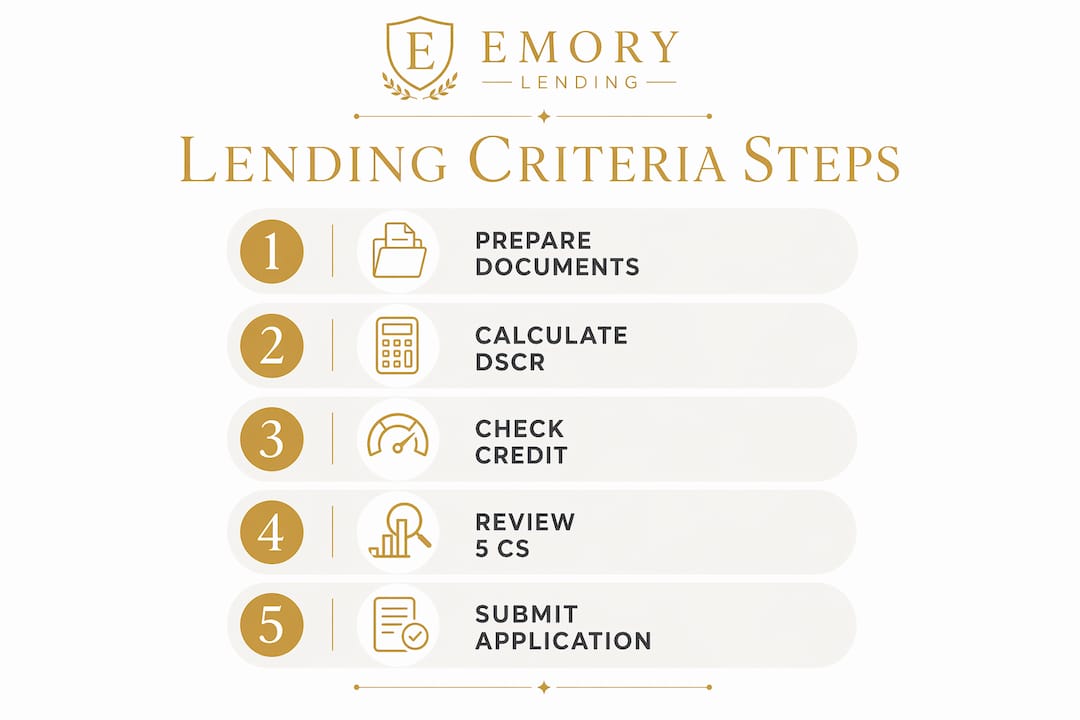
Equity injection matters too. For certain SBA loans, owners must contribute at least 10% of the loan amount from their own funds. This requirement shows the lender you have real skin in the game. Lenders also review bank statements for average daily balances and cash flow consistency, not just the bottom line on a tax return.
How do the 5 Cs of credit influence lending decisions?
The 5 Cs of credit are character, capacity, capital, collateral, and conditions. Together they give lenders a structured way to evaluate risk beyond raw numbers. Each C addresses a different dimension of your creditworthiness.
- Character covers your credit history, business reputation, and management track record. Lenders look for consistency, honesty in the application, and a demonstrated history of honoring obligations.
- Capacity measures your ability to generate enough cash flow to service the debt. This is where DSCR and income verification live.
- Capital reflects how much of your own money you have invested in the business. Higher owner equity signals commitment and reduces lender exposure.
- Collateral is the asset a lender can claim if you default. Real estate, equipment, and receivables are common examples for small businesses.
- Conditions include the purpose of the loan, current economic conditions, and industry trends that affect your business’s outlook.
“Quantitative analysis answers whether a borrower can repay. Qualitative factors tell lenders whether they believe the borrower will sustain repayment.”
— Commercial credit analysis principle
Management quality carries more weight than most owners expect. A lender reviewing a restaurant loan will look at the owner’s industry experience, not just the profit and loss statement. A diversified customer base, long-term contracts, and low staff turnover all strengthen the qualitative case. Credit analysts value business longevity and diversified revenue alongside key financial ratios.
Lenders apply knockout rules that trigger immediate denial before full underwriting even begins. Active bankruptcy, illegal use of funds, or evidence of fraud are automatic disqualifiers. Bank statements receive forensic scrutiny. Frequent overdrafts or high gambling-related transactions raise red flags regardless of your credit score. These patterns signal financial instability that no ratio can offset.
Pro Tip: Review six months of your business bank statements before applying. Flag any irregular patterns and be prepared to explain them proactively.
What are the SBA loan requirements and eligibility updates for 2026?
SBA loan programs carry specific eligibility rules that go beyond what conventional lenders require. As of March 1, 2026, SBA 7(a) and 504 loans require owners to be U.S. citizens or nationals with a principal U.S. residence. This residency and citizenship requirement is new and affects any business with foreign-born ownership structures.
SBA loan eligibility also depends on industry restrictions, the credit elsewhere test, business size standards, and personal guarantees. The credit elsewhere test means the SBA will not back a loan if you can obtain financing on reasonable terms without the guarantee. Industries like gambling, lending, and certain nonprofits are ineligible.
| SBA criteria | Requirement |
|---|---|
| Citizenship | U.S. citizen or national (effective March 1, 2026) |
| Equity injection | At least 10% of loan amount for some programs |
| Personal guarantee | Required for most SBA loans |
| Collateral | Required when available; not always mandatory |
| Industry eligibility | Restricted industries are excluded |
Personal guarantees are required for most SBA loans, meaning you are personally liable if the business defaults. For standard 7(a) loans, available personal real estate equity may be considered as collateral. Lenders are not required to decline a loan solely for lack of collateral, but they must document what is available.
SBA-backed loans are underwritten by private lenders whose internal policies often add tighter criteria on top of SBA program rules. A startup may meet SBA eligibility on paper but still face denial from a specific lender that requires two years of operating history. Checking the 2026 eligibility requirements before choosing a lender saves significant time.
Documentation you should prepare includes three years of personal and business tax returns, year-to-date profit and loss statements, a current balance sheet, six months of business bank statements, and a signed personal financial statement.
How can small business owners improve their loan approval chances?
Improving your loan profile is a process, not a last-minute fix. Proactive communication with lenders and a clear understanding of criteria help align your application strength with what the underwriter actually needs. The owners who get approved fastest are the ones who walk in prepared.
- Calculate your DSCR now. If it falls below 1.25x, reduce discretionary expenses or pay down existing debt before applying.
- Pull all three credit reports. Dispute any errors on your personal and business credit files at least 90 days before applying.
- Organize your financial documents. Lenders expect clean, consistent records. Gaps or inconsistencies slow approvals and raise questions.
- Increase your equity contribution. A larger down payment or capital injection lowers the lender’s risk and can improve your rate.
- Clean up your bank statements. Avoid overdrafts, reduce cash-heavy transactions, and keep average daily balances stable for at least six months before applying.
- Document your management experience. A one-page biography covering your industry background strengthens the character component of the 5 Cs.
- Work with a lender who evaluates cash flow, not just credit. Traditional lenders often weight personal credit scores heavily. Lenders like Emorylending evaluate business performance and cash flow directly, which opens doors for owners with strong revenue but imperfect personal credit.
Pro Tip: Use the loan application checklist to verify your documents before submission. Missing a single item can delay approval by weeks.
Reviewing your financing options before committing to a single product also matters. Working capital loans, equipment financing, and SBA programs each carry different criteria. Matching your business profile to the right product type increases approval odds significantly.
Key Takeaways
Meeting lending criteria requires both strong financial ratios and a credible qualitative case, and small business owners who prepare both sides of that equation consistently outperform those who focus on numbers alone.
| Point | Details |
|---|---|
| DSCR is the top metric | Lenders require a minimum 1.25x ratio; calculate yours before applying. |
| 5 Cs shape every decision | Character, capacity, capital, collateral, and conditions together determine lender confidence. |
| 2026 SBA rules changed | Owners must be U.S. citizens or nationals with principal U.S. residence as of March 1, 2026. |
| Bank statements are scrutinized | Overdrafts and irregular spending patterns can override a strong credit score. |
| Cash flow beats credit alone | Lenders who evaluate business performance directly give more owners a fair shot at approval. |
What I’ve learned about lending criteria that most guides won’t tell you
After working with small business owners across dozens of financing situations, the pattern I see most often is this: owners focus almost entirely on their credit score and ignore everything else. They clean up their personal credit, then walk into a lender meeting with three years of messy financials and no clear explanation of what the loan is for. That combination fails more applications than bad credit ever does.
The qualitative side of a loan review is where deals actually get made or lost. A lender who trusts your judgment, believes in your industry experience, and sees a realistic plan will find ways to work with imperfect numbers. A lender who does not trust the story will find reasons to decline even a strong application. That is not a cynical observation. It reflects how commercial credit analysis actually works.
The 2026 SBA citizenship and residency changes caught many business owners off guard. If your ownership structure includes non-citizen partners, you need to review your eligibility before applying for any SBA-backed product. This is not a technicality. It is a hard eligibility gate.
My strongest advice: treat your loan application like a business presentation, not a form. Know your numbers cold, tell a clear story about why you need the capital and how it generates returns, and pick a lender whose underwriting model fits your business profile. The owners who do that consistently get funded.
— Jason
Emorylending’s approach to small business financing
Small business owners who understand their lending profile are ready to find the right financing match.

Emorylending evaluates your business performance and cash flow directly, not just your personal credit score. That means more small businesses qualify for the capital they need to grow, hire, and expand. Whether you need working capital to cover operations, equipment financing for new assets, or funds to open a second location, Emorylending offers flexible financing options from $5,000 to $5,000,000+. The application process is built for speed and clarity, so you spend less time on paperwork and more time running your business.
FAQ
What is the minimum DSCR lenders require for small business loans?
Most commercial lenders require a DSCR of at least 1.25x, meaning your business generates $1.25 in net operating income for every $1.00 in debt payments. Falling below 1.0 signals the business cannot cover its own debt obligations.
What are the 5 Cs of credit in small business lending?
The 5 Cs are character, capacity, capital, collateral, and conditions. Lenders use this framework to evaluate both your financial strength and your reliability as a borrower beyond raw numbers.
Did SBA loan requirements change in 2026?
Yes. As of March 1, 2026, SBA 7(a) and 504 loans require all owners to be U.S. citizens or nationals with a principal U.S. residence. Some programs also require an equity injection of at least 10% of the loan amount.
Can a strong credit score guarantee loan approval?
No. Lenders also review bank statements for red flags like frequent overdrafts or irregular spending patterns, which can override a strong credit score during underwriting.
How does loan purpose affect lending criteria?
Loan purpose directly affects the risk profile lenders assign to your application. A clearly defined purpose tied to revenue growth or asset acquisition generally receives more favorable terms than vague or high-risk uses of funds.


