

The interest rate for business loans is the annual percentage a lender charges on the principal amount you borrow. This figure, formally called the annual percentage rate or APR when fees are included, determines how much your financing actually costs. As of June 2026, bank term loan rates range from 6.8% to 17.25%, SBA 7(a) loans from 9.75% to 14.75%, and online lenders from 14% to 99% APR. Understanding what is interest rate for business loans, and how it differs by lender and loan type, is the single most important step before you sign any financing agreement.
What are current average business loan interest rates?
Business loan interest rates vary sharply depending on where you borrow and what product you choose. The spread between the cheapest and most expensive options is not marginal. It can be the difference between a loan that helps your business grow and one that drains your cash flow for years.
| Loan Type | Typical Rate Range | Lender Type |
|---|---|---|
| Bank term loan | 6.8%–17.25% | Traditional bank |
| SBA 7(a) loan | 9.75%–14.75% | SBA-approved lender |
| Online term loan | 14%–99% APR | Online lender |
| Business line of credit | 8%–60% APR | Bank or online lender |

Average bank loan rates fall between 6.8% and 11%, making traditional banks the most affordable option for qualified borrowers. The tradeoff is strict underwriting. Banks want strong credit scores, years in business, and solid revenue documentation.
SBA 7(a) loans sit in the middle of the market. The U.S. Small Business Administration caps maximum rates by loan size: loans of $50,000 or less are capped at the base rate plus 6.5%, loans between $250,001 and $350,000 at base plus 4.5%, and loans over $350,000 at base plus 3.0%. These caps protect small business borrowers from predatory pricing on large loans. If you qualify for an SBA loan, those caps are a meaningful protection worth understanding before you shop.
Online lenders charge APRs as high as 99%. That number is not a typo. Online lenders approve borrowers faster and with fewer requirements, but they price that risk into the rate. A $100,000 loan at 99% APR costs dramatically more than the same loan at 10% from a bank. Speed and accessibility come at a real price.
Fixed vs. variable rates: which one costs you more?
The structure of your interest rate matters as much as the number itself. Business loans come in two rate types, and choosing the wrong one can hurt your budget at the worst possible time.
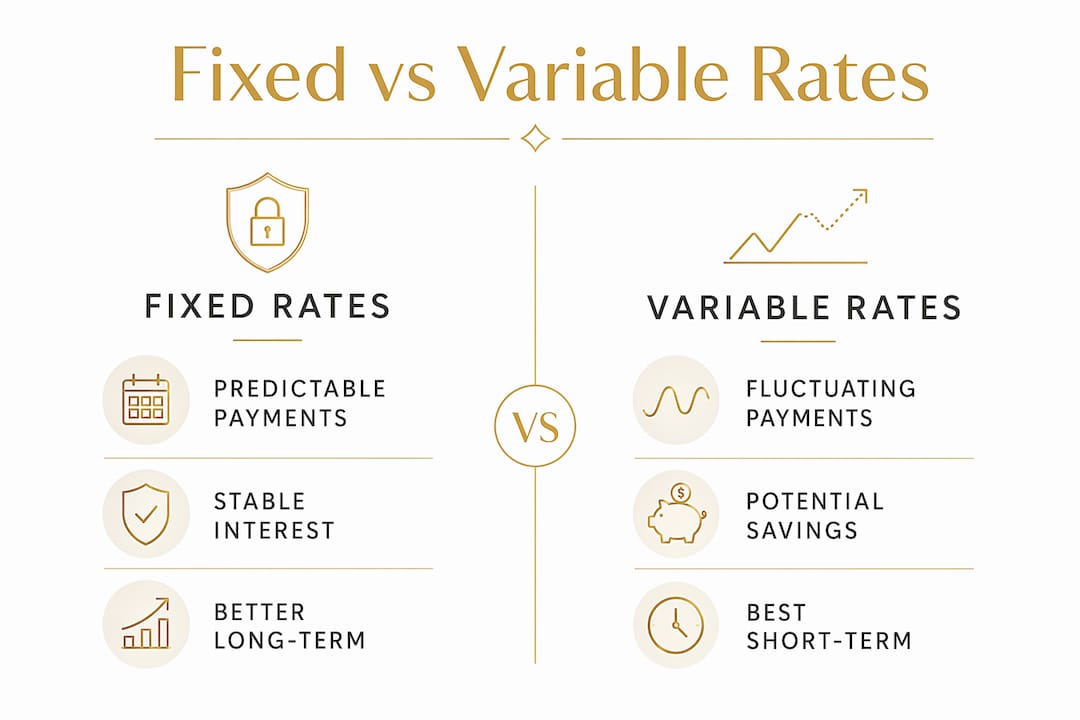
Fixed rates stay constant for the entire loan term. Your monthly payment is predictable from day one. Fixed rates work well when you need stable cash flow planning, such as when covering payroll or funding a long-term expansion.
Variable rates are tied to a market index, most commonly the prime rate. When the prime rate rises, your rate and payment rise with it. Variable rates shift interest rate risk directly onto the borrower, making long-term budgeting harder. A rate that looks attractive in month one can become a burden by month eighteen if the Federal Reserve raises rates.
Here is a quick breakdown of the tradeoffs:
- Fixed rate pros: Predictable payments, easier budgeting, no exposure to rate hikes
- Fixed rate cons: Often starts higher than variable rates, less flexibility
- Variable rate pros: Lower initial rate, can decrease if market rates fall
- Variable rate cons: Payments can increase unexpectedly, harder to plan around
Pro Tip: If your loan term is longer than three years, prioritize a fixed rate. The short-term savings from a variable rate rarely outweigh the risk of a rate spike mid-term when your business may be least prepared to absorb it.
Most small businesses benefit from the certainty of a fixed rate. Variable rates make more sense for short-term borrowing where the window for rate movement is narrow.
What factors affect your business loan interest rate?
Lenders do not assign rates randomly. Every rate offer reflects a calculated assessment of how likely you are to repay. Business loan rates depend on creditworthiness, loan size, loan term, national interest rates, and lender policies. Knowing which factors you can control gives you real leverage when negotiating.
Here are the key factors lenders evaluate:
-
Personal and business credit scores. A FICO score above 700 signals low risk and unlocks better rates. Scores below 600 push you toward online lenders with higher APRs. Check both your personal and business credit reports before applying.
-
Time in business. Lenders favor businesses with at least two years of operating history. Startups are seen as higher risk, which translates directly into higher rates or outright denials.
-
Annual revenue and cash flow. Lenders want to see that your business generates enough revenue to cover loan payments comfortably. Strong cash flow documentation can offset a weaker credit score in some cases.
-
Loan amount and term length. Larger loans often carry lower rates because the lender earns more total interest. Longer terms can mean higher rates because the lender’s risk exposure extends further into the future.
-
Collateral. Secured loans backed by equipment, real estate, or receivables typically carry lower rates than unsecured loans. Collateral reduces the lender’s downside if you default.
-
Economic conditions. When the Federal Reserve raises the federal funds rate, business loan rates follow. This is outside your control, but timing your application during a stable rate environment can help.
Pro Tip: Pull your business credit report from Dun and Bradstreet or Experian Business at least 90 days before applying. Dispute any errors and pay down outstanding balances. A 20-point improvement in your score can shift your rate offer by a full percentage point or more.
Understanding why loan applications get denied often comes down to these same factors. Addressing them before you apply puts you in a stronger position from the start.
How to calculate business loan interest and compare true costs
The stated interest rate is not the full story. Fees can add thousands of dollars to your total borrowing cost, and two loans with identical rates can have very different actual costs once fees are included.
Interest rate vs. APR. The interest rate reflects only the annual cost of the principal. APR includes the interest rate plus fees such as origination, underwriting, and closing costs. APR is the number you should compare across lenders because it captures the true cost of borrowing.
Simple interest calculation example. If you borrow $50,000 at a 10% annual interest rate for two years, your interest cost is $50,000 x 0.10 x 2 = $10,000. That is the baseline. Add a 3% origination fee ($1,500) and your actual cost rises to $11,500 before you make a single payment.
| Loan Amount | Rate | Term | Interest Cost | Origination Fee (3%) | Total Cost |
|---|---|---|---|---|---|
| $50,000 | 10% | 2 years | $10,000 | $1,500 | $11,500 |
| $50,000 | 15% | 2 years | $15,000 | $1,500 | $16,500 |
| $100,000 | 8% | 3 years | $24,000 | $3,000 | $27,000 |
Factor rates. Some online lenders and merchant cash advance providers use factor rates instead of APRs. A factor rate of 1.3 on a $50,000 advance means you repay $65,000 total. Factor rates look small but translate to very high effective APRs, often above 50%. Always convert a factor rate to an APR before comparing it to a traditional loan.
Key questions to ask before signing any loan agreement:
- What is the APR, including all fees?
- Is there a prepayment penalty if I pay off early?
- Are there monthly maintenance or draw fees on a line of credit?
- What happens to my rate if I miss a payment?
Understanding how business loans work at the structural level helps you read loan agreements with confidence and avoid surprises after funding.
Key Takeaways
Business loan interest rates range from under 7% at traditional banks to nearly 100% APR at online lenders, and the rate you receive depends on your credit, cash flow, loan type, and the broader economic environment.
| Point | Details |
|---|---|
| Rates vary widely by lender | Bank loans start at 6.8%; online lenders can charge up to 99% APR. |
| SBA loans have legal rate caps | The SBA caps rates by loan size, protecting borrowers on larger loans. |
| Fixed rates offer budget stability | Fixed rates eliminate payment surprises, especially on loans longer than three years. |
| APR beats interest rate for comparison | APR includes fees and gives a true picture of total borrowing cost. |
| Credit and cash flow drive your rate | Improving your credit score and revenue documentation before applying lowers your rate offer. |
What I’ve learned about picking the right rate structure
I have worked with hundreds of small business owners on financing decisions, and the most common mistake I see is fixating on the interest rate number while ignoring the full cost picture. A 9% loan with a 4% origination fee and a prepayment penalty can cost more than a 12% loan with no fees and flexible terms.
The second mistake is choosing a variable rate because it looks cheaper today. Variable rates make sense in very specific situations, mainly short-term loans in a stable or declining rate environment. For most small businesses funding equipment, expansion, or working capital over a multi-year term, the risk is not worth the initial savings. The U.S. Chamber of Commerce notes that variable rates shift risk to the borrower, and most small businesses are not positioned to absorb a sudden payment increase.
My honest advice: get at least three rate quotes before committing. Use APR as your comparison metric, not the stated rate. And if a lender is reluctant to give you a clear APR figure upfront, that tells you something important about how they operate. The right lender makes the numbers easy to understand, not harder.
— Jason
How Emorylending helps you find competitive rates
Emorylending evaluates your business performance and cash flow rather than focusing solely on personal credit scores. That approach opens doors for small business owners who have strong revenue but imperfect credit histories.
Whether you need working capital, equipment financing, or funds to cover payroll and expansion, Emorylending works with businesses seeking $5,000 to $5,000,000 and above. Transparent terms and a straightforward process mean you spend less time decoding loan documents and more time running your business. Explore the full business financing options available through Emorylending and find the loan structure that fits your goals and budget.
FAQ
What is the average interest rate for a business loan in 2026?
Average business loan rates range from 6.8% to 17.25% at traditional banks, 9.75% to 14.75% for SBA 7(a) loans, and 14% to 99% APR at online lenders. The rate you receive depends on your credit profile, loan type, and lender.
What is the difference between interest rate and APR on a business loan?
The interest rate reflects only the annual cost of the principal. APR adds fees such as origination and underwriting costs, making it the more accurate number for comparing loan offers.
How do SBA loan interest rate caps work?
The SBA sets legal maximum rates by loan size. Loans of $50,000 or less are capped at the base rate plus 6.5%, while loans over $350,000 are capped at base plus 3.0%. These caps prevent lenders from overcharging on larger SBA loans.
What credit score do I need to get a low business loan rate?
A personal FICO score above 700 typically qualifies you for bank and SBA loan rates. Scores below 600 generally push borrowers toward online lenders, where rates can reach 99% APR.
Should I choose a fixed or variable rate for my business loan?
Fixed rates are the better choice for most small businesses because they provide predictable payments. Variable rates shift market risk to the borrower and can increase your payment unexpectedly if the prime rate rises.


