

If your loan application has ever been declined, poor business credit is likely part of the reason. Poor credit history is one of the main reasons small-business loan applications get denied, and for business owners across Georgia, Tennessee, the Carolinas, and Florida, that rejection can mean missing out on a new piece of equipment, a second location, or the working capital to get through a slow season. Knowing how to improve business credit is not just a financial exercise. It is the difference between being fundable and being stuck.
Table of Contents
- Understanding business credit and why it matters
- Preparing your business credit profile: a checklist for legitimacy
- Step-by-step actions to improve your business credit
- Monitoring and correcting errors on your business credit reports
- What to expect as your business credit improves
- Why consistency and accuracy trump shortcuts in business credit improvement
- Financing solutions that leverage your improved business credit
- Frequently asked questions
Key Takeaways
| Point | Details |
|---|---|
| Business and personal credit matter | Both your personal and business credit histories affect your chances of securing favorable financing. |
| Build legitimacy first | Establishing your business’s legal identity and registration is critical before building credit. |
| Pay bills early or on time | Consistent prompt payments to vendors and lenders are the most effective way to improve your credit score. |
| Regularly monitor and correct errors | Disputing inaccuracies with credit bureaus and furnishers ensures your credit report reflects true payment behavior. |
| Consistency beats shortcuts | Steady credit-building habits combined with accuracy lead to sustainable credit improvement and financing access. |
Understanding business credit and why it matters
Business credit is a score assigned to your company, separate from your personal credit score, based on how reliably your business pays its obligations. Agencies like Dun & Bradstreet, Experian Business, and Equifax Business track this data and generate reports that lenders, suppliers, and even insurance companies use to evaluate risk.
Here is what your business credit score actually affects:
- Loan approvals and interest rates. A low score often means denial or high-cost financing. A strong score opens access to better terms on business loans and credit.
- Vendor relationships. Suppliers set net payment terms based on your credit. Poor credit means paying upfront for inventory.
- Insurance premiums. Business insurers in many states factor your credit into commercial policy pricing.
- Partnerships and contracts. Larger companies often run credit checks before entering supplier or contractor agreements.
For new businesses, personal credit tends to carry more weight because there is limited business history to evaluate. Establishing good credit for both personal and business lines is what ultimately helps you secure financing with better terms. The sooner you treat your business credit as a separate, managed asset, the faster you build the profile that gets you funded.
Preparing your business credit profile: a checklist for legitimacy
Before you can improve your score, your business needs to appear credible to credit bureaus and lenders. Many small business owners skip this foundation and wonder why their credit-building efforts go nowhere. Your business entity must look independent, legitimate, and financially active.
Here is what you need in place:
- Legal structure. Form an LLC or corporation to legally separate your business from your personal identity.
- EIN (Employer Identification Number). Apply through the IRS at no cost. This is your business’s tax ID and replaces your Social Security number on business applications.
- Dedicated business bank account. All business income and expenses should run through one account. Mixing personal and business transactions is a red flag to lenders.
- Business phone line. List a dedicated number in 411 directories. Bureaus verify business existence this way.
- D-U-N-S Number. Register with Dun & Bradstreet for a free D-U-N-S number. This is how D&B tracks your payment history and assigns your PAYDEX score.
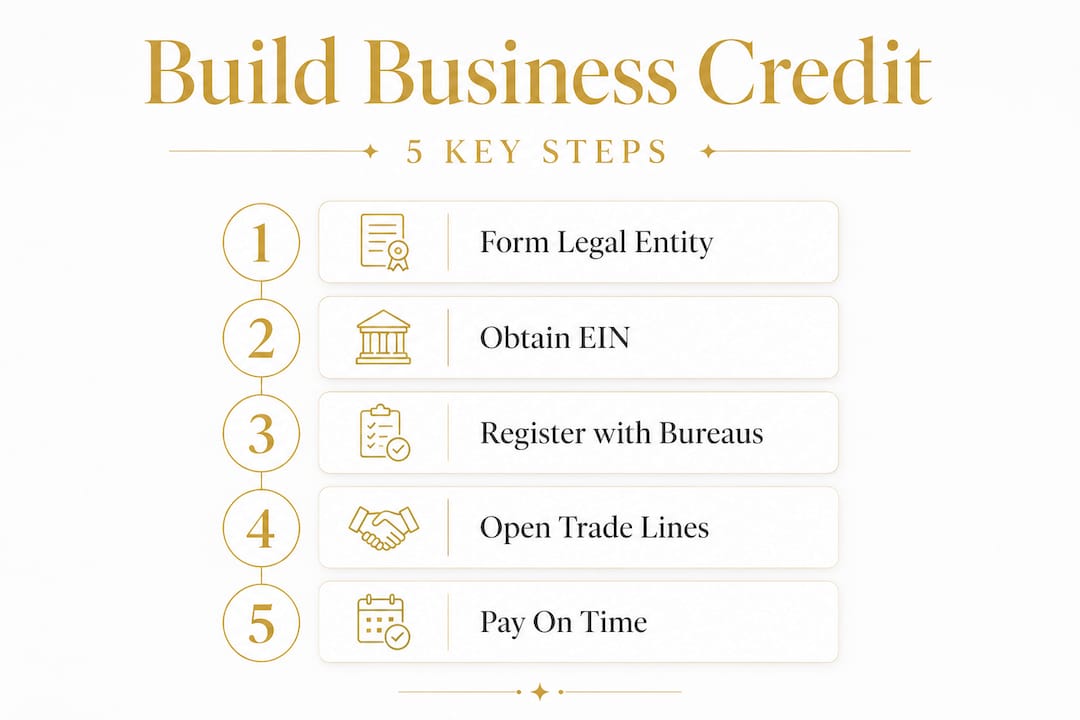
Forming an LLC, obtaining an EIN, and registering with bureaus are the foundational steps that make your business appear legitimate to creditors. Without them, your credit-building activity may never get recorded. You can explore more business credit basics to get familiar with how lenders evaluate your profile before you apply.
| Step | Why it matters |
|---|---|
| Form LLC or corporation | Legally separates personal and business liability |
| Get an EIN | Required for business banking and credit applications |
| Open a business checking account | Establishes financial history separate from personal funds |
| Register for a D-U-N-S number | Enables D&B to begin tracking your payment history |
| List a business phone number | Confirms business legitimacy with credit bureaus |

Step-by-step actions to improve your business credit
Once your profile is established, the actual work of improving your credit begins. This is where most business owners have the most direct control over their outcomes.
- Open vendor trade accounts. Start with suppliers that report to business credit bureaus, like Uline, Quill, or Grainger. These are often referred to as “net 30 accounts.” Buy something, pay within 30 days, and the payment gets reported.
- Pay on time, or better yet, early. Your PAYDEX score, which is Dun & Bradstreet’s primary business credit metric, is built almost entirely on payment timing. Maintaining three or more trade lines and paying on time or early is the most direct way to achieve a strong PAYDEX score.
- Keep credit utilization below 30%. If you have a business credit card with a $10,000 limit, keep the balance under $3,000. Credit utilization below 30% keeps your credit profile healthy across Experian and Equifax business reports.
- Apply for a business credit card. Even a secured card that reports to business bureaus helps diversify your credit mix and builds history fast.
- Add a business line of credit. Revolving credit that you manage responsibly shows bureaus you can handle flexible borrowing, which is more complex than just paying invoices.
- Avoid excessive credit inquiries. Multiple hard pulls in a short window signal financial stress to lenders.
Pro Tip: Not every vendor or supplier automatically reports to business credit bureaus. Before you open a trade account to build credit, ask the company directly whether they report to D&B, Experian Business, or Equifax Business. If they do not report, those on-time payments will not help your score.
Payment timing and PAYDEX score impact
| Payment timing | PAYDEX score range | Lender perception |
|---|---|---|
| 30+ days late | 1 to 49 | High risk |
| On time (net 30) | 70 to 79 | Acceptable |
| Early payment | 80 to 100 | Low risk, preferred |
Visit the credit building tips section to understand how these scores play into real financing decisions.
Monitoring and correcting errors on your business credit reports
Here is something that catches many business owners off guard: your business credit report can contain errors that you never caused and may not know about. Unlike personal credit, there is no federal law requiring businesses to receive free annual credit reports, so you have to be proactive about checking them.
- Pull reports from all three major bureaus. Get your business credit reports from Dun & Bradstreet, Experian Business, and Equifax Business. Errors on one bureau do not automatically appear on the others.
- Review every tradeline. Look for accounts that are not yours, payments marked late that you paid on time, incorrect balances, and outdated delinquencies that should have aged off.
- Gather your documentation. Bank statements, canceled checks, wire confirmations, and invoices are all evidence you can use when disputing errors.
- Contact the bureau and the furnisher. You must dispute errors by reaching out to both the credit bureau and the business or lender that supplied the incorrect information. Both parties are legally required to investigate and correct inaccurate data free of charge.
- Follow up in writing. Send dispute letters via certified mail and keep copies. If corrections are made, request an updated report to confirm the change.
Pro Tip: Set a calendar reminder to pull your business credit reports every 90 days. Errors tend to surface after a new credit relationship is opened or when a previously resolved delinquency reappears. Catching them early costs you nothing. Letting them sit can cost you a loan approval.
Common items to look for when disputing credit errors include:
- Payments reported late despite proof of on-time payment
- Duplicate accounts inflating your total debt
- Incorrect legal business name or address (this can merge your file with another business)
- Derogatory marks older than the reporting window
What to expect as your business credit improves
The results of building strong business credit are not just about getting approved for loans. The downstream benefits touch nearly every part of running and growing a business.
Here is what changes when your credit profile strengthens:
- Larger loan amounts become available. Lenders are more willing to extend bigger credit lines when they see a track record of responsible borrowing. A PAYDEX score of 80 enables better credit limits, competitive insurance rates, and favorable loan terms.
- Interest rates come down. The difference between a 12% and 7% rate on a $200,000 equipment loan can add up to tens of thousands of dollars over the life of the loan.
- Supplier terms improve. With a strong credit profile, vendors may extend net 60 or net 90 terms, giving you more cash flow flexibility.
- You reduce personal liability. As your business credit profile grows, lenders become less reliant on your personal credit score and personal guarantees.
- Financing decisions become faster. When your business credit benefits are clear on your file, less back-and-forth documentation is needed.
The timeline varies, but most businesses that follow a consistent credit-building process see meaningful score improvements within three to six months. Sustainability matters more than speed.
Why consistency and accuracy trump shortcuts in business credit improvement
Here is an uncomfortable truth that most business credit guides avoid: the “quick hacks” that promise to boost your score in days are mostly noise. Not because they are all fraudulent, but because they address only one piece of a system that rewards consistency and penalizes disorder.
We see this pattern repeatedly. A business owner opens five vendor accounts in one month, pays every invoice early, and then discovers that two of those vendors do not actually report to bureaus. Another opens a secured business card and checks off that task, but three unresolved errors on their D&B file are dragging the score down regardless of new positive activity. Paying on time is necessary but not sufficient.
SBA guidance consistently points to sustained, legitimate creditworthiness as the fastest path to better loan approvals, not credit hacks that game the system temporarily. A lender reviewing your file looks at patterns, not individual data points.
The piece most people skip is disputing errors with both bureaus and furnishers. That step is not optional. A single stale derogatory mark can cancel out six months of positive payment history. Accuracy in your credit file is not just cleanup. It is infrastructure.
Our advice is to build internal payment workflows before worrying about score tactics. Set up automatic payments, assign someone to manage vendor accounts, and create a 90-day audit cycle for all three bureau reports. When those systems are running, your credit improves almost automatically. The score follows the behavior.
Financing solutions that leverage your improved business credit
You have done the work to build a credible business credit profile. Now it is time to put that credit to use. At Emory Lending, we specialize in small business financing across the Southeast, and we evaluate your business performance and cash flow alongside your credit history, so even businesses still building their profile have a real shot at funding.
Whether you are ready to finance a new equipment purchase, cover working capital gaps, or fund an expansion, we make the process straightforward. Explore our equipment financing options and working capital solutions to see what fits your business right now. And if you want to understand exactly how lenders evaluate your application, our business loans guide walks you through the full picture. We fund from $5,000 to $5,000,000+, and we are built to say yes more often than the traditional banks you have already tried.
Frequently asked questions
How long does it take to improve business credit?
You can see early score improvements in 30 to 60 days by opening trade lines and paying on time, but building a credit profile that lenders trust consistently takes several months of sustained activity.
Can I improve business credit if I have poor personal credit?
Yes, but it will take more time. For newer businesses, loan eligibility is often tied to the owner’s personal credit score, so working on both your personal and business credit simultaneously gives you the best chance at favorable financing terms.
What if I find errors on my business credit report?
Dispute errors by contacting both the credit bureau and the business that supplied the incorrect information. Both are required to investigate and correct inaccurate data at no cost to you.
How does paying early impact my PAYDEX score?
Paying before the due date can push your PAYDEX score above 80, which signals early payment behavior to lenders and suppliers and positions your business as a low-risk borrower.


