

Over half of small business owners cite uneven cash flows as their primary financial challenge, and if you run a business in the Southeast, you know exactly what that pressure feels like. Understanding how working capital fuels growth is the difference between watching opportunities pass and actually capturing them. Whether you are buying equipment, hiring ahead of demand, opening a second location, or simply making sure payroll clears on Friday, working capital is the engine behind every move you make. This guide breaks down what it is, how it works, and what you can do to manage it smarter.
Table of Contents
- Understanding working capital and its impact on business growth
- How working capital consumption can both enable and challenge growth
- Strategies to optimize working capital and shorten the cash conversion cycle
- Leveraging working capital solutions to finance growth initiatives
- Why managing working capital is a leadership responsibility for sustainable growth
- Supporting your growth with tailored working capital solutions
- Frequently asked questions
Understanding working capital and its impact on business growth
Working capital is simple in concept: it is your current assets minus your current liabilities. What makes it powerful is what those numbers actually represent in practice.
Current assets include everything that can be converted to cash within a year: accounts receivable, inventory on hand, and cash in the bank. Current liabilities are the obligations due within that same window: supplier invoices, short-term loan payments, and payroll. The gap between them tells you how much financial cushion you have to operate and grow.
The three components you need to watch most closely are:
- Accounts receivable: Money customers owe you. Until collected, it exists only on paper.
- Inventory: Product sitting in a warehouse or on a shelf is cash frozen in physical form.
- Accounts payable: What you owe suppliers. Managing timing here is one of the fastest ways to free up cash.
These three connect through the cash conversion cycle (CCC), which measures how long it takes from the moment you spend money on inventory or production to the moment you collect payment from a customer. The longer that cycle, the more cash you need on hand to stay operational. Smaller businesses in the Southeast, especially those in manufacturing, construction, and food distribution, often face longer CCCs than large companies because they lack the negotiating power to demand fast payment from customers or slow payment to vendors.
As working capital explained in detail, every dollar sitting idle in your cycle is a dollar you cannot reinvest. The principle holds: “every dollar trapped in your working capital” is a dollar that cannot fund growth. That is not an abstraction. It is the equipment you did not buy, the employee you did not hire, the location you did not open.
How working capital consumption can both enable and challenge growth
Here is the part most business finance articles skip: growth actually makes your cash flow situation harder before it makes it better.

When revenue rises, your cash demands rise faster. Revenue expansion requires upfront investment in inventory, staffing, and extended customer credit before payment is ever collected. In other words, you spend now and get paid later. If your working capital cannot absorb that gap, a booming sales period can actually push you toward insolvency. This is what finance professionals call the growth trap, and it catches otherwise healthy businesses off guard every year.
Here is the typical sequence of cash demands when a small business starts to scale:
- Inventory buildup: Before you can fulfill larger orders, you need more product. That costs cash upfront, sometimes weeks before revenue arrives.
- Staffing: New employees, training, and payroll begin immediately. Their productivity contribution lags by weeks or months.
- Extended receivables: Larger clients often expect 30, 60, or even 90-day payment terms. The bigger your customer, the slower they tend to pay.
- Infrastructure and equipment: Expansion usually requires physical upgrades before the revenue from those upgrades materializes.
- Carrying costs: Rent, utilities, insurance, and loan payments do not pause while you wait on receivables to clear.
The financial risks cut both ways. Over-investing in working capital, for example by holding too much inventory, ties up cash unnecessarily and hurts profitability. Under-investing means you cannot meet demand, miss payroll, or default on obligations. Striking the right balance is what separates businesses that scale cleanly from those that stumble at the moment of opportunity.
Understanding working capital as a leadership strategy means treating your CCC not as an accounting artifact, but as a real-time indicator of business health.
Pro Tip: Build a rolling 13-week cash flow forecast before you pursue growth. Map out the working capital basics you will need at each stage and align your financing to those specific milestones, not a round number someone guessed in a boardroom.
Strategies to optimize working capital and shorten the cash conversion cycle
Shortening your CCC is one of the highest-leverage moves available to a small business owner. To do it, you need to understand its three measurable components:
- Days Sales Outstanding (DSO): How long it takes to collect payment after a sale. Lower is better.
- Days Inventory Outstanding (DIO): How long inventory sits before it is sold. Lower is better.
- Days Payable Outstanding (DPO): How long you take to pay suppliers. Higher is better, within reason.
The math is simple: CCC = DSO + DIO minus DPO. Every day you shave off that number frees up real cash. Each single-day improvement in CCC frees approximately $1 million in cash for a $365 million revenue business. Scale that ratio to your own revenue and the opportunity becomes clear.
Here is how to act on each component:
- Speed up collections (DSO): Send invoices immediately upon delivery, not at month-end. Offer a small early-payment discount, even 1 or 2 percent, to motivate faster payment. Set up automated reminders at 7, 14, and 30 days past due.
- Reduce inventory lag (DIO): Adopt a just-in-time ordering approach where possible. Review slow-moving SKUs quarterly and clear them before they lock up cash. For businesses in distribution or manufacturing, even a 10 percent inventory reduction can release significant cash.
- Extend payables strategically (DPO): Negotiate longer payment terms with suppliers, particularly for larger or repeat orders. Thirty-day terms are not automatic; you often have to ask.
| Strategy | CCC component affected | Typical impact timeline |
|---|---|---|
| Early payment incentives | DSO | 2 to 4 weeks |
| Automated invoicing | DSO | Immediate |
| Just-in-time inventory | DIO | 30 to 90 days |
| Supplier term negotiation | DPO | 1 to 3 months |
| Inventory SKU rationalization | DIO | 60 to 90 days |
For working capital improvement strategies to stick, you need visibility into these metrics on at least a monthly basis. Most accounting platforms can generate CCC-adjacent reports, but you may need to configure them intentionally.
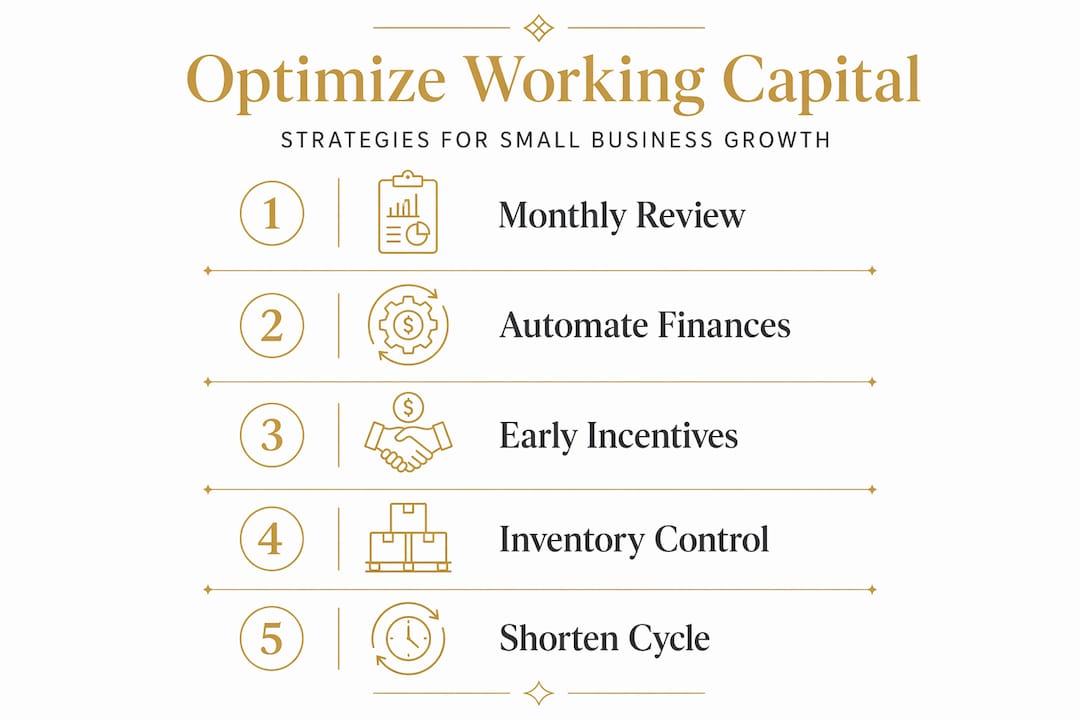
Pro Tip: Automate your accounts receivable and accounts payable processes before you scale. Manual follow-up on invoices is one of the biggest silent killers of small business cash flow, and software eliminates the delay without requiring extra headcount.
Leveraging working capital solutions to finance growth initiatives
Even with an optimized CCC, many growth initiatives require more capital than your operations can self-fund. That is where financing products built for small businesses come in.
The main options worth knowing:
- SBA working capital loans: The SBA’s Working Capital Pilot Program offers loans up to $5 million with flexible repayment structures. These are well-suited for businesses with strong operating history that need a larger capital base to fund expansion.
- Asset-based lines of credit: These tie your credit availability to the value of receivables or inventory. As those assets grow, your available credit grows with them, making this a natural fit for businesses with seasonal demand or rapid sales cycles.
- Transaction-based lines of credit: Approval and limits are tied to your business’s actual revenue, not just credit score or collateral. This model works well for newer businesses or those with limited hard assets.
| Product | Best use case | Typical approval timeline | Key consideration |
|---|---|---|---|
| SBA working capital loan | Expansion, equipment, staffing | 2 to 8 weeks | Strong documentation required |
| Asset-based line of credit | Receivables, inventory cycles | 1 to 3 weeks | Tied to asset value |
| Transaction-based line | Revenue-driven short-term needs | 24 to 72 hours | Higher rates possible |
| Equipment financing | Specific asset acquisition | 1 to 2 weeks | Asset serves as collateral |
One of the most costly mistakes small business owners make is waiting until they are in a cash crisis to apply for financing. At that point, options narrow and rates worsen. Establishing a working capital financing facility during a strong revenue period gives you access when you need it, on terms you can actually live with.
Lenders evaluating your application will typically look at monthly revenue, time in business, accounts receivable aging, and overall cash flow consistency. They are less interested in your personal credit score than you might expect, particularly with lenders who evaluate business performance directly. Familiarize yourself with your business financials before you apply, and understand what a line of credit actually costs across different product types.
Why managing working capital is a leadership responsibility for sustainable growth
Most business owners treat working capital as a finance department problem. That framing is part of why so many businesses hit liquidity walls at exactly the worst moment.
Working capital is a strategic leadership issue, not just a back-office finance task. When the owner of a regional HVAC company in Georgia treats cash flow forecasting as something the bookkeeper handles, he finds out about a $200,000 shortfall two weeks before it arrives. When he treats it as a leadership responsibility, he sees it coming three months out and has time to act. The difference is not accounting software. It is who owns the conversation.
Cash pressure is a signal, not a nuisance. Tight working capital usually means one of a few things: your receivables are too slow, your inventory is too fat, your payables terms are too aggressive, or your growth is outpacing your financing. Each of those has a specific fix. The problem only feels overwhelming when it is treated as a single amorphous crisis rather than a set of solvable operational problems.
The businesses we see navigate growth most cleanly are the ones that have built cash flow visibility into their weekly rhythm, not their annual review. They look at DSO, DIO, and available credit the same way they look at sales numbers. They model out what a 20 percent revenue increase actually does to their cash position before they commit to the contracts that would create it.
Pro Tip: If you have more than three people involved in financial decisions, establish a monthly working capital review that brings together your operations lead, your bookkeeper, and yourself. Siloed information is where cash surprises are born.
For deeper reading on working capital leadership insights and how to apply them at the ownership level, the framework translates directly to better financing decisions, faster.
Supporting your growth with tailored working capital solutions
If you are running a small business in the Southeast and you are serious about growth, the right financing partner matters as much as the right financing product.
At Emory Lending, we evaluate your business performance and cash flow, not just your personal credit score. That means more business owners qualify, and the ones who do get terms that actually work for their situation. Whether you need working capital financing to cover payroll and inventory during a growth phase, equipment financing to add capacity without draining your cash reserves, or you simply want to understand your options before a crunch arrives, we are set up to help. We fund from $5,000 to $5,000,000 and above, and our process is built for small business owners, not large corporate borrowers. Read through our funding business growth strategies to see how other businesses like yours have used capital to scale with confidence.
Pro Tip: Start the conversation with a lender before you need the money. Businesses that apply during strong periods almost always secure better terms than those applying under pressure.
Frequently asked questions
What is working capital and why is it important for my small business?
Working capital is the difference between your current assets and current liabilities, and it funds your daily operations, payroll, and expansion. When it runs low, even a profitable business can stall because every dollar trapped in working capital is a dollar you cannot put back into growth.
How does the cash conversion cycle affect my business growth?
The cash conversion cycle measures how long cash is tied up between spending on operations and collecting from customers. Each single-day improvement in the CCC frees meaningful cash that you can redirect toward hiring, inventory, or expansion.
When should I consider applying for a working capital loan?
Apply when your business is performing well, not when you are already in a bind. Seeking credit urgently is the worst position to be in because options shrink and costs rise fast.
What are common strategies to improve working capital efficiency?
The most effective moves are speeding up how quickly you collect from customers, negotiating longer payment windows with suppliers, and trimming inventory to only what you need. Working capital optimization is the active management of receivables, payables, and inventory working in coordination, not isolation.


