

The cash flow management process is the systematic tracking, forecasting, and controlling of cash inflows and outflows to maintain your business’s liquidity and support informed financial decisions. Most small business owners confuse profitability with financial health. A business can show strong revenue on paper and still miss payroll because the timing of cash in and cash out is misaligned. Tools like QuickBooks, rolling forecasts, and cash flow statements exist precisely to close that gap. Forecasting cash flow is the mechanism to plan, not guess, and it separates businesses that survive slow seasons from those that don’t.
What are the essential components of an effective cash flow management process?
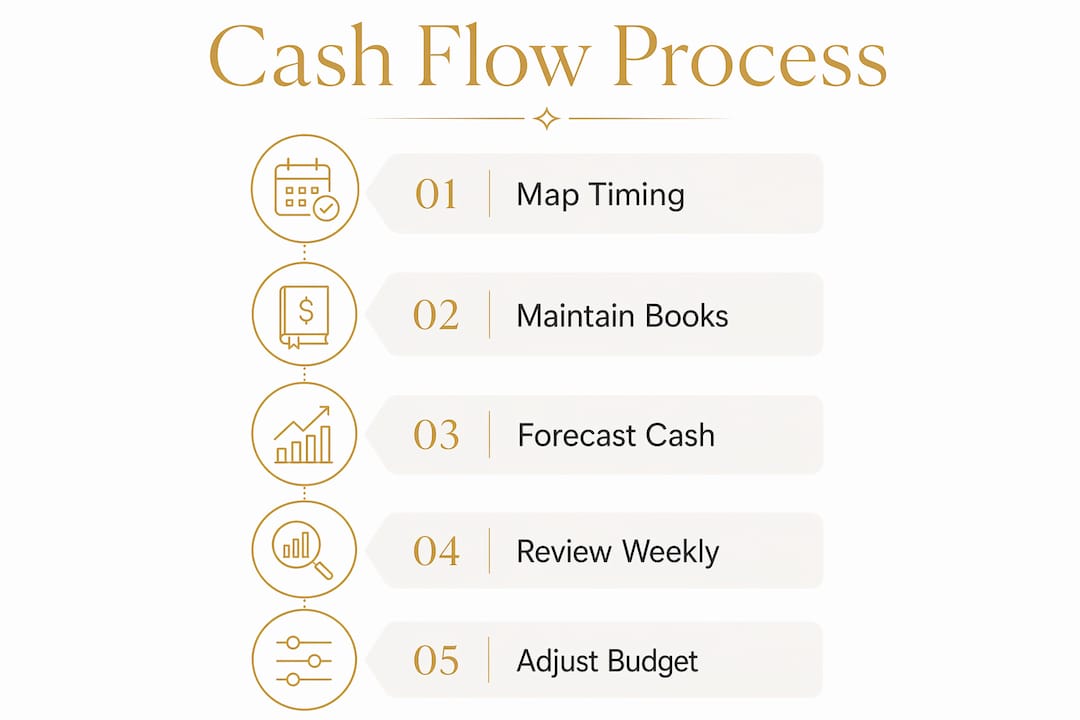
The cash flow management process rests on four building blocks: mapping your cash rhythm, maintaining accurate financial records, using cash flow statements for visibility, and building a realistic budget. Skip any one of these and the whole system loses integrity.
Mapping your cash rhythm means identifying when money actually enters and leaves your bank account, not when invoices are issued or bills are received. A landscaping company, for example, might invoice clients on the 1st but collect on the 30th, while supplier payments are due on the 15th. That 15-day gap is where cash shortfalls happen.

Accurate, up-to-date books are non-negotiable. Real-time bookkeeping is the foundation for dynamic cash flow forecasting rather than guesswork. If your books are two weeks behind, your forecast is two weeks blind.
Cash flow statements give you a structured view of operating, investing, and financing activities. Unlike a profit and loss statement, the cash flow statement shows you what actually moved through your accounts in a given period. Review it weekly, not monthly.
Budgeting ties the whole process together. A budget without cash timing is just a wish list. Build your budget around when cash arrives and when obligations come due, and treat fixed costs and variable costs as separate line items since they behave differently under pressure.
Pro Tip: Set a recurring 30-minute weekly calendar block to review your cash position. Businesses that review cash flow weekly catch timing problems before they become emergencies.
How do you build a 13-week rolling cash flow forecast?
The 13-week rolling cash flow forecast is the gold standard for SMB cash planning. It covers one full quarter, which is long enough to spot problems early and short enough to stay accurate. Here is how to build and maintain one.
-
Anchor week 1 on your reconciled bank balance. Never start with an accounting balance. The opening cash balance must come from your actual bank statement, reconciled to the day. Accounting accrual dates often misrepresent when cash moves, which corrupts the entire model from the start.
-
List every expected receipt by week. Pull your accounts receivable aging report and assign each open invoice a collection probability and an expected payment week. A 30-day invoice from a reliable client gets 95% probability in week 2. A 90-day overdue invoice gets 40% in week 4.
-
List every disbursement by week. Use your accounts payable schedule to map out rent, payroll, loan payments, vendor invoices, and tax obligations. Assign each to the week the cash actually leaves your account.
-
Calculate the weekly net cash position. Subtract disbursements from receipts each week and carry the running balance forward. This running balance is your early warning system.
-
Update weekly by dropping the completed week and adding a new week 13. Record actuals for the week just closed, compare them to your projection, and note any variance. Near-term forecast accuracy for weeks 1 through 4 can exceed 90% when you track invoice due dates and payment commitments consistently.
-
Run at least two scenarios. Build a base case, a downside case (what if your top client pays 30 days late?), and an upside case (what if you close that pending deal this week?). Scenario modeling turns a forecast from a report into a decision tool.
| Forecast element | What to use | Why it matters |
|---|---|---|
| Opening balance | Reconciled bank balance | Eliminates accrual timing errors |
| Receipts | AR aging with collection probability | Reflects realistic cash timing |
| Disbursements | AP schedule by due date | Prevents surprise outflows |
| Update cadence | Weekly, rolling forward | Maintains accuracy over 13 weeks |
| Scenario cases | Base, downside, upside | Supports proactive decision-making |
Pro Tip: After 4 to 6 weekly update cycles, repeated weekly updating reduces near-term forecast variance significantly. The model gets smarter the longer you run it.
What operational practices support ongoing cash flow control?
Building a forecast is step one. Keeping it connected to live data is what makes cash flow optimization a daily discipline rather than a monthly fire drill.
- Audit your cash data sources daily. Know your bank balance every morning. This takes two minutes with online banking and eliminates the most common SMB mistake: assuming cash is available because the books say so.
- Integrate your AR and AP systems with your forecast. Connecting cash forecasts directly to live AR and AP data reduces lag and increases confidence in liquidity decisions. Tools like QuickBooks Online, Xero, and Datarails can feed updated invoice and payment data directly into your forecast model.
- Track Days Sales Outstanding (DSO) and Days Payable Outstanding (DPO). DSO measures how long it takes customers to pay you. DPO measures how long you take to pay suppliers. Monitoring DSO and DPO tells you whether your cash cycle is tightening or loosening over time.
- Use dashboards for continuous visibility. Automated dashboards let leadership see real-time cash, forecasts, and variances without generating manual reports. This shifts cash management from reactive to continuous.
- Review expenses quarterly. Fixed costs creep up. A quarterly expense audit identifies subscriptions, vendor contracts, and overhead items that no longer deliver value.
“Cash flow management is not a finance department task. It is a leadership discipline. The businesses that treat daily cash visibility as a non-negotiable habit are the ones that scale without crisis.”
How do you respond to cash flow gaps and improve your cash management strategies?
Gaps in cash flow are not failures. They are predictable events that a well-run forecast reveals weeks in advance. The question is what you do when you see one coming.
-
Identify the gap early. Your 13-week forecast will show a negative running balance in a future week. That is your window to act. A gap spotted four weeks out gives you options. A gap spotted on Friday afternoon gives you none.
-
Build a cash cushion covering 60 to 90 days of operating expenses. Maintaining a cash cushion of 60 to 90 days is the standard recommendation for SMBs. This buffer absorbs slow payment months, unexpected repairs, and seasonal dips without requiring emergency financing. For guidance on building that reserve, the framework used for personal emergency funds applies directly to business cash reserves.
-
Negotiate payment terms proactively. Ask key suppliers for net-60 terms instead of net-30. Offer customers a 1% to 2% early payment discount to accelerate receivables. These two moves alone can shift your cash cycle by 20 to 30 days without any financing.
-
Use financing as a timing tool, not a lifeline. A working capital line of credit or invoice financing covers the gap between when you deliver and when you get paid. That is a legitimate, strategic use of debt. Borrowing to cover operating losses is a different problem entirely. Explore your financing options for small businesses before a gap becomes a crisis.
-
Cut non-essential costs before the gap arrives. Identify discretionary expenses that can be paused or reduced without affecting operations or customer delivery. Doing this proactively preserves your cash cushion for genuine emergencies.
| Strategy | Best used when | Expected impact |
|---|---|---|
| Early payment discounts | Receivables are slow | Accelerates cash by 15 to 30 days |
| Supplier term negotiation | Payables are tight | Extends cash runway by 30 days |
| Working capital financing | Gap is timing-based | Bridges specific shortfall windows |
| Expense reduction | Costs have crept up | Improves baseline cash position |
Pro Tip: Review your cash flow strategies quarterly alongside your forecast. What worked in Q1 may need adjustment by Q3 as your revenue mix and cost structure shift.
Key takeaways
A structured cash flow management process built on weekly forecasting, live AR/AP integration, and proactive gap response is the single most effective way for small businesses to maintain financial stability.
| Point | Details |
|---|---|
| Map cash timing first | Identify when cash actually moves, not when invoices are issued or bills are received. |
| Use the 13-week rolling forecast | Anchor on reconciled bank balances and update weekly to maintain accuracy above 90% for near-term weeks. |
| Track DSO and DPO | These two metrics reveal whether your cash cycle is improving or deteriorating over time. |
| Build a 60 to 90 day cushion | A cash reserve of this size absorbs seasonal dips and slow payment months without emergency borrowing. |
| Use financing strategically | Working capital financing covers timing gaps. It is not a substitute for a healthy cash position. |
What I’ve learned from watching SMBs get cash flow wrong
Most small business owners I work with understand cash flow in theory. Where they consistently fall short is treating the forecast as a one-time document rather than a living management tool. They build a projection in January, file it away, and then react with surprise when March looks nothing like the plan.
The single most underused practice is variance-to-forecast analysis. Every week, when you record actuals, you should be asking: why did this week differ from the projection? Was it a timing shift, a volume change, or a magnitude error? Each answer sharpens your next 13 weeks. Without that discipline, you are just updating numbers without learning anything.
The other mistake I see constantly is using accounting dates instead of cash dates. A sale recorded on March 31 does not mean cash arrived on March 31. Using bank transaction timing rather than accrual dates is the difference between a forecast that reflects reality and one that flatters your books. This single correction has changed the financial picture for businesses I have worked with more than any other adjustment.
Cash flow discipline also changes how you make decisions. When you know your 13-week position with confidence, you stop making gut-feel calls about hiring, purchasing, or taking on new contracts. The data tells you what you can afford and when. That shift from reactive to data-driven decision-making is what separates businesses that scale from those that stall.
— Jason
How Emorylending supports your cash flow management

When your forecast reveals a timing gap, having the right financing partner makes the difference between a manageable problem and a crisis. Emorylending evaluates your business performance and cash flow directly, not just your personal credit score. That means more small businesses qualify for the capital they need to cover payroll, bridge receivables, or fund growth without disrupting operations.
Whether you need working capital to cover a 45-day receivables gap or a larger facility to fund expansion, Emorylending structures financing around your actual cash cycle. Funding ranges from $5,000 to $5,000,000 and up, with decisions based on how your business actually performs. Use financing as the timing tool it is designed to be, and keep your cash cushion intact for the unexpected.
FAQ
What is the cash flow management process?
The cash flow management process is the systematic tracking, forecasting, and controlling of cash inflows and outflows to maintain business liquidity. It includes mapping cash timing, maintaining accurate books, building rolling forecasts, and responding proactively to gaps.
How often should I update my cash flow forecast?
Update your forecast weekly by recording actuals for the completed week and rolling the model forward by one week. Near-term forecast accuracy for weeks 1 through 4 can exceed 90% with consistent weekly updates.
What is the 13-week rolling cash flow forecast?
The 13-week rolling forecast is a quarter-horizon cash planning model that starts with a reconciled bank balance, maps all expected receipts and disbursements by week, and updates weekly. It is the standard tool for SMB cash flow planning because it balances accuracy with enough forward visibility to act.
What metrics should I track for cash flow health?
Track Days Sales Outstanding (DSO) to measure how quickly customers pay, and Days Payable Outstanding (DPO) to measure how long you take to pay suppliers. Together, these two metrics define your cash conversion cycle and reveal whether your cash position is improving over time.
When should a small business use financing for cash flow?
Use financing when your forecast identifies a timing gap between when you deliver and when you collect. Working capital lines of credit and invoice financing are designed for this purpose. Financing should cover predictable timing shortfalls, not ongoing operating losses.


