

A business line of credit works best for short-term timing gaps: payroll during a slow month, inventory before a busy season, a repair you can’t put off, or a customer order too good to pass up. It’s a revolving pool of working capital, and you pay interest only on the amount you actually draw, not the full limit sitting there. The SBA frames it well: it’s cash on demand up to a set ceiling, and paying down principal restores what you can borrow again.
The highest-value uses share one trait: they’re self-liquidating. You draw, the money does its job, and revenue that follows pays it back.
- Payroll gaps when receivables lag behind payday
- Inventory buildups ahead of a predictable sales spike
- Bridging the wait between invoicing a customer and getting paid
Pro Tip: Before you draw, ask one question: will this expense generate cash back within a single operating cycle? If the answer is no, a line of credit is the wrong tool.
Key Takeaways
A business line of credit works best when it funds short-term, self-liquidating needs and gets repaid within one operating cycle, not treated as permanent capital.
| Point | Details |
|---|---|
| Match borrowing to your cycle | Only draw for expenses that will convert back into cash within roughly one operating cycle. |
| Pay down principal, not just minimums | Minimum payments mostly cover interest, so extra principal payments shrink your real cost faster. |
| Keep more than one credit source | Diversifying lenders protects you if one tightens terms or pulls back access. |
| Match the tool to the need | Use a line for short-term gaps and a term loan or equipment financing for long-lived assets. |
| Emorylending evaluates cash flow first | Emorylending connects businesses with funding amounts varying widely based on business performance, not personal credit alone. |
Table of Contents
- How a Business Line of Credit Actually Works
- Real Situations Where a Credit Line Solves the Problem
- What a Line of Credit Actually Costs
- Pros, Cons, and the Mistakes That Get Businesses Into Trouble
- Do You Qualify? Eligibility and Documents to Gather
- Line of Credit vs. Term Loan vs. Other Options
- Rules That Keep a Credit Line Working for You, Not Against You
- Applying and Getting Funded: What to Expect
- Ready to Explore Your Financing Options?
- Sources
How a Business Line of Credit Actually Works
Draw what you need, pay interest only on that portion, repay it, and the credit becomes available again. That’s the entire mechanic, and it’s what separates a line of credit from a term loan that hands you a lump sum on day one. Most lenders calculate interest daily on the outstanding balance, and many set a minimum monthly payment that covers accrued interest plus a small slice of principal. Some agreements offer interest-only periods for a stretch before principal payments kick in.
Getting the money out is usually simple. Depending on the lender, you might transfer funds through an online portal, tap a linked business card, or write a check against the account. Most lines have a draw period, when you can pull funds as needed, followed by or overlapping with a repayment phase where the focus shifts to paying down balances.
A line of credit is a revolving facility, not a one-time loan. You draw, repay, and reuse the same available balance, over and over, as long as the account stays in good standing.
Structure comes down to collateral. Secured lines are backed by business assets, often equipment, receivables, or inventory, and lenders frequently file a UCC-1 lien against those assets to protect their position. Unsecured lines don’t require pledged collateral but usually come with tighter underwriting and lower limits for newer businesses. Fees vary by lender and can include:
- Interest charges on the drawn balance (the main cost)
- Draw fees charged each time you access funds
- Commitment or maintenance fees for keeping the line open
- Renewal fees when the line comes up for its annual review
If you want a deeper look at how these facilities are built, Emorylending’s guide to flexible financing breaks down the structure in plain terms. The key contrast worth remembering: a term loan gives you a fixed amount with a fixed schedule, while a line of credit stays open and reusable for as long as the account is active.
Real Situations Where a Credit Line Solves the Problem
Textbook definitions don’t tell you much until you see the scenario play out. Here’s where a line of credit earns its keep for a small business.
- Seasonal inventory. A retailer draws funds to stock up before the holiday rush, sells through it by January, and repays the balance from that revenue.
- Payroll during a slow month. A landscaping company draws to cover payroll in a rainy stretch, then repays once billing catches up the following month.
- Bridging receivables. A B2B supplier with 60-day payment terms draws against the line to cover operating costs while waiting on a large invoice, then repays the moment the customer pays.
- Vendor deposits. A contractor draws to put down a deposit on materials for a signed job, repaying from the client’s progress payment.
- Emergency repairs. A restaurant draws to fix a broken walk-in cooler overnight instead of losing a week of inventory and revenue.
- A one-off large order. A manufacturer draws to buy raw materials for an unusually large order, repaying once the customer’s invoice clears.
These line up with what most small businesses actually run into: seasonal stock, payroll timing, deposits, and unplanned expenses are the recurring themes, not exotic financing needs.
Pro Tip: Don’t use a line of credit to buy a delivery van, renovate your storefront, or fund a multi-year expansion. Those are long-lived investments, and a line priced for short-term borrowing is a poor match for them. That’s what term loans and equipment financing exist for.
What a Line of Credit Actually Costs
Interest accrues only on what you draw, calculated daily in most cases, and stops accumulating the moment you repay. That single fact is why a line of credit often beats a term loan for short-term needs: you’re not paying interest on money sitting unused in your bank account.
Beyond interest, expect a mix of these charges, though not every lender applies all of them:
- Interest rate on the outstanding balance, often tied to a variable benchmark
- Draw fees, a flat charge or percentage each time you pull funds
- Commitment or maintenance fees for keeping the line open, drawn or not
- Renewal fees when the line comes up for its annual reassessment
- Early repayment penalties, less common but worth checking before you sign
Daily interest works out to roughly $10,000 x (0.12 / 365), or about $3.29 per day. Carry that balance for 30 days and you’re looking at roughly $98.60 in interest, separate from any draw or maintenance fees. Pay it off in 10 days instead, and you owe closer to $33.
That’s the formula in plain terms: daily interest = balance owed x (annual rate ÷ 365). Multiply by the number of days you carry the balance to estimate your cost.
One more thing to watch: many lines carry a variable rate tied to a benchmark like prime or SOFR. When the benchmark moves up, your cost of carrying a balance moves up with it, even if you haven’t drawn a dollar more.
Pros, Cons, and the Mistakes That Get Businesses Into Trouble
A line of credit is flexible by design, and that flexibility cuts both ways. Used well, it’s one of the cheapest ways to cover a short-term gap. Used carelessly, it can quietly become a drag on your margins.
| Advantages | Disadvantages |
|---|---|
| Interest applies only to what you draw | Variable rates can raise your cost without warning |
| Available credit refills as you repay | Easy to lean on it as permanent capital instead of a bridge |
| Faster access to funds than most term loans | Fees (draw, maintenance, renewal) add up if underused or overused |
| Builds a track record that can support larger limits later | Overreliance on one lender limits leverage and backup options |
Watch for these red flags in your own habits, not just your lender’s fine print:
- Making only minimum payments month after month, which mostly covers interest and barely touches principal
- Treating the line as a permanent source of working capital instead of a short-term bridge
- Drawing repeatedly without a clear repayment plan tied to specific incoming revenue
- Relying on a single lender for all your credit access, with no backup if that relationship changes
The single most common mistake is the first one. A line of credit that’s never paid down stops being a tool and starts being a fixed cost you never planned for.
Do You Qualify? Eligibility and Documents to Gather
Lenders generally want to see time in business, consistent revenue, and a reasonable credit profile before extending a line. Most want at least six months to two years in operation, though requirements vary widely by lender and by whether the line is secured or unsecured.
Before you apply, pull together:
- Two to three months of recent business bank statements
- Profit-and-loss statement and balance sheet
- Business tax returns from the last one to two years
- Outstanding customer invoices (if you’re pledging receivables as collateral)
- Business formation documents (articles of incorporation, EIN confirmation)
If you’re going the secured route, common collateral includes equipment, inventory, or accounts receivable, and the lender will typically file a lien against those assets. That’s a normal part of secured lending, but you should understand what it means before you sign: the lender has a legal claim on that collateral until the balance is repaid.
Personal credit still matters for newer businesses, even when the lender emphasizes business performance. Many lenders require a personal guarantee, especially for companies without a long credit history of their own. Establishing a distinct business credit profile over time, separate from your personal score, tends to open better terms down the road. Emorylending’s guide to business credit evaluation walks through the specific steps for building that profile.
Pro Tip: Lenders who evaluate business performance and cash flow, not just personal credit scores, tend to approve more small businesses that would otherwise get passed over by traditional banks.
Line of Credit vs. Term Loan vs. Other Options
Match the financing to the shape of the need, not the other way around. If the expense is short-term and revolving, a line fits. If it’s a long-lived asset or a project with a defined payoff timeline, a term loan or equipment financing usually costs less and fits the repayment schedule better.
Ask yourself three questions before choosing:
- How long will it take before this expense turns back into cash?
- Is this a one-time need or a recurring, unpredictable one?
- How sensitive is my business to a variable interest rate?
| Financing type | Best for | Typical term | Cost shape | Example use |
|---|---|---|---|---|
| Term loan | Large one-time purchases | Fixed, 1 to 10 years | Fixed or variable rate on full amount | Buying a building, major expansion |
| Invoice financing | Waiting on unpaid invoices | Per invoice, short-term | Fee per invoice advanced | Bridging a single large receivable |
| Business credit card | Small, frequent purchases | Revolving, ongoing | Higher APR, sometimes rewards offset cost | Office supplies, travel, small vendor payments |
SBA-backed loan programs are worth a look too, particularly when the need is long-term and you want the lowest possible rate; they come with different eligibility rules and a longer approval process than most lines of credit. Emorylending’s financing options overview breaks down how these products stack up against each other in more detail.
Rules That Keep a Credit Line Working for You, Not Against You
The businesses that get the most out of a line of credit treat it like a tool with rules attached, not a blank check. A few habits separate the owners who use credit lines well from the ones who end up trapped by them.
- Match your borrowing to your operating cycle: if inventory takes 60 days to sell, don’t plan a 12-month repayment.
- Pay down principal whenever cash flow allows, instead of settling for the minimum payment every month.
- Keep more than one source of credit available so you’re not fully dependent on a single lender’s terms or availability.
- Track your actual cost per dollar borrowed, including fees, not just the headline interest rate.
A simple internal policy helps enforce this discipline. Consider setting:
- A cap on how much of the line you’ll draw at once (say, no more than 50% of the limit without a specific repayment plan)
- An approval threshold for who signs off on draws above a certain amount
- A target repayment window for each draw, tied to the revenue event that will repay it
Pro Tip: Relying on minimum payments alone often means you’re covering interest plus a sliver of principal, month after month, while the balance barely moves. Pay extra toward principal whenever a strong revenue month gives you the room.
Lenders underwrite based on how consistently you manage cash flow, not just your credit score, and diversifying where you access credit gives you leverage if one lender tightens terms or pulls back. It’s also worth keeping an eye on benchmark rates like prime or SOFR if your line carries a variable rate, since those movements affect your cost even when your borrowing habits haven’t changed.
Three Worked Examples: What the Numbers Actually Look Like
Numbers make this concrete faster than any explanation. Here are three quick scenarios, each with simple, illustrative math (actual rates and terms depend entirely on your lender and credit profile).
Example 1: The $10,000 draw. A bakery draws funds to cover a payroll gap while waiting on a catering contract payment. At an illustrative annual rate, daily interest runs on the drawn amount. They repay the full balance once the contract payment clears, for interest proportional to the days outstanding.
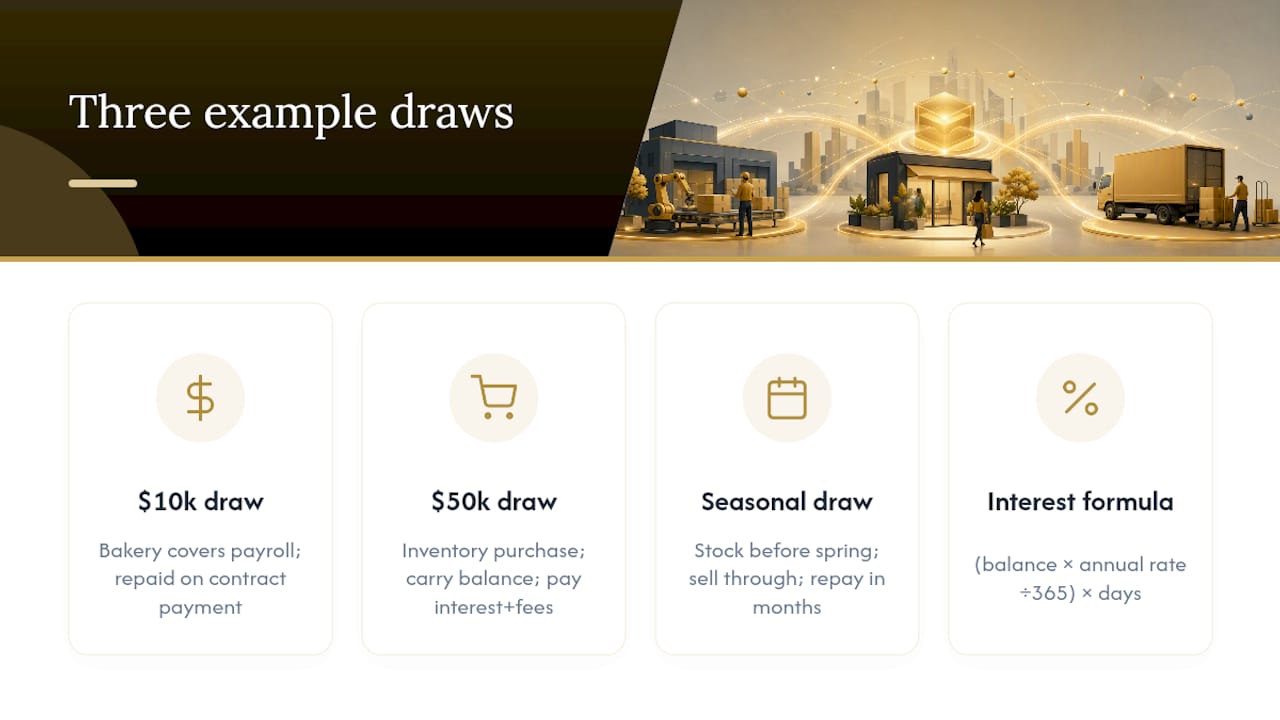
Example 2: The $50,000 draw. A wholesale distributor draws funds to buy inventory ahead of a big seasonal order. At an illustrative annual rate, daily interest accrues on the drawn amount. They carry the balance for a period before the inventory sells through, paying interest plus any applicable draw fees.
Example 3: Seasonal inventory timeline. A garden supply store draws funds early in the year to stock up before spring. They sell through the inventory within a few months and generate enough revenue to repay the full draw plus interest within the operating cycle.
The formula behind all three: daily interest = balance x (annual rate ÷ 365), multiplied by the number of days the balance is outstanding. These figures are illustrative estimates only. Your actual rate, fees, and payment structure depend on your lender and your business’s credit profile.
Applying and Getting Funded: What to Expect
Gather your documents first, choose the type of lender that fits your timeline, submit the application, respond quickly to any follow-up requests, and draw funds once approved. That’s the process in five steps, though the timeline varies a lot depending on who you’re borrowing from.
- Gather documentation: bank statements, tax returns, profit-and-loss statement, and business formation papers
- Choose your lender type: online lenders move faster; banks and SBA lenders take longer but sometimes offer lower rates
- Submit the application with accurate, complete financial information
- Respond to underwriting requests promptly, whether that’s clarifying a bank statement or providing additional invoices
- Get approved and draw funds, often within a day or two of final approval for online lenders
Realistic timelines differ sharply by lender type:
- Online and alternative lenders: often 1 to 5 business days from application to funding
- Traditional banks: typically 2 to 4 weeks, sometimes longer for larger lines
- SBA-backed lines: often 30 to 60 days given the additional documentation and review involved
Speed up your approval by having recent bank statements ready (most lenders want the last three to six months), keeping your financial documents current, and stating a clear, specific purpose for the line when you apply. Vague applications tend to slow underwriting down.
A Lender’s View on Using Credit Lines Well
Emorylending evaluates business performance and cash flow first, rather than leaning primarily on personal credit scores the way many traditional banks do. That approach tends to open doors for small businesses with strong revenue but a less-than-perfect personal credit history.

Emorylending helps connect business owners across North Carolina, South Carolina, Florida, and Virginia with funding ranging from $5,000 to $5,000,000 or more, covering everything from working capital and equipment purchases to lines of credit and SBA lending. One caution worth repeating: don’t lean on a single credit source for every need your business has. Spreading your access across a line of credit, a term loan, and maybe an SBA product gives you more room to maneuver when one option tightens up.
Ready to Explore Your Financing Options?
If you’ve made it this far, you already understand the mechanics better than most owners applying for a line of credit for the first time. The next step is matching that knowledge to the right product, and that’s exactly where Emorylending comes in: an underwriting approach built around what your business actually earns, not just a personal credit score.

Emorylending works with small businesses across North Carolina, South Carolina, Florida, and Virginia to connect them with funding partners suited to their specific situation, whether that’s a revolving line for payroll and inventory or a term product for a bigger investment.
- Funding amounts from $5,000 to $5,000,000+
- Lines of credit, working capital, term loans, equipment financing, SBA lending, and invoice factoring
- Applications evaluated on business performance and cash flow, not personal credit alone
- Common uses supported: payroll gaps, inventory buildups, equipment purchases, expansion, and bridging receivables
Take a look at the full range of financing options Emorylending offers and start an application to see what your business qualifies for.
Sources
- Business Line of Credit: Complete 2026 Guide | Drip Capital
- How to Use a Business Line of Credit the Right Way – LegalClarity


