

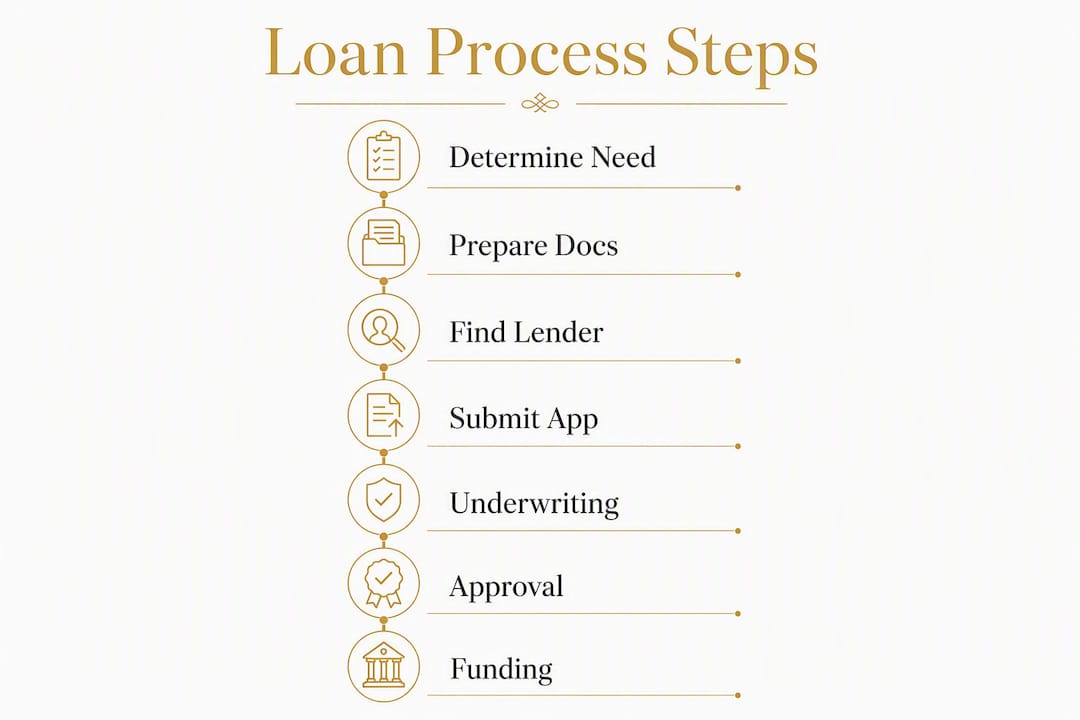
Getting a business loan comes down to seven clear steps: define your need, check your eligibility, choose the right loan type, find lenders, gather documents, apply, then review and close. Start right now by calculating the monthly payment your cash flow can realistically support and pulling together your last two years of tax returns.
Here is the full sequence at a glance:
- Step 1: Define your need (how much, for how long, and why)
- Step 2: Check eligibility using the Five C’s of credit
- Step 3: Choose the loan type that fits your situation
- Step 4: Find lenders and compare offers
- Step 5: Gather your documents
- Step 6: Apply and navigate underwriting
- Step 7: Review the offer and close
Each step below unpacks exactly what to do, what lenders look for, and where most owners trip up.
Table of Contents
- Step 1: How much do you need, and for how long?
- Step 2: What do lenders actually look for?
- Step 3: Which loan type actually fits your situation?
- Step 4: Where should you look for a lender?
- Step 5: What documents will lenders ask for?
- Step 6: What happens during underwriting, and how do you speed it up?
- Step 7: How do you evaluate an offer and close without surprises?
- What kills a loan application, and how do you fix it?
- What do the numbers say about timelines and lender expectations?
- Key Takeaways
- Why cash flow matters more than most owners realize
- Emorylending helps you move from preparation to funded
- Useful sources and further reading
Step 1: How much do you need, and for how long?
Before you talk to a single lender, you need a number. Not a rough estimate. An actual dollar figure tied to a specific business purpose.
Start with the use of funds. Are you buying $80,000 worth of commercial kitchen equipment? Covering three months of payroll at $25,000 per month? Stocking inventory ahead of a seasonal rush? Each scenario points to a different loan size, term, and repayment structure. Lenders want to see that you have thought this through, and a vague answer like “working capital” without supporting detail is one of the fastest ways to slow down an underwriter.
Once you have a project cost, convert it into a monthly payment. A $100,000 loan at 8% over five years runs roughly $2,000 per month. Shorter terms increase monthly payments but reduce total interest. The shorter the term, the lower the total interest paid, but the higher the monthly burden. Run those numbers against your average monthly net cash flow before you commit to a term. A working capital loan used for short-term needs generally fits a shorter term; equipment or expansion financing often warrants a longer one.
Pro Tip: Build a 15–20% cushion into your repayment estimate. Seasonal revenue dips, a slow-paying client, or an unexpected expense can all compress your cash flow in the same month your loan payment is due. Borrow for what you need, not for what feels comfortable in your best month.
Before you shop lenders, have these four things locked down:
- The specific purpose of the funds
- The exact dollar amount requested
- Your preferred repayment term (and the maximum monthly payment you can absorb)
- A backup plan if the primary loan type is unavailable
Small Business Development Centers (SBDCs) offer free pre-application reviews that can help you pressure-test your numbers before you submit anything.
Step 2: What do lenders actually look for?

Lenders evaluate every application through five dimensions, commonly called the Five C’s of credit. Understanding them lets you predict which products you qualify for and where your application might be weak.
Character is your credit history and reputation as a borrower. Lenders check your personal credit score, any prior defaults or bankruptcies, and sometimes your business credit profile. Banks often prefer moderate personal credit scores and require some time in business and annual revenue as benchmarks for bank-quality terms.
Capacity is your ability to repay. This is where cash flow dominates. Underwriters look at your debt service coverage ratio (DSCR), which compares your net operating income to your total debt obligations. A healthy debt service coverage ratio (DSCR) indicates an ability to comfortably cover debt obligations. The Federal Reserve’s 2025 report on employer firms confirms that lenders prioritize demonstrated repayment ability, and that clean, current financial statements accelerate the underwriting process significantly.
Capital refers to the money you have already invested in the business. A lender who sees an owner with skin in the game takes on less risk. This shows up as equity in your balance sheet or a down payment on a larger purchase.
Conditions cover the loan’s purpose, the current economic environment, and your industry. A restaurant applying during a regional economic downturn faces different scrutiny than a healthcare services firm in a growth market.
Collateral is the asset a lender can claim if you default. Equipment, real estate, inventory, and receivables all qualify. Many online lenders skip hard collateral requirements but substitute a personal guarantee or a UCC-1 blanket lien on business assets.
Use this quick self-assessment before you apply:
- Time in business: under 1 year, 1–2 years, or 2+ years?
- Monthly average bank deposits over the last 3 months?
- Personal credit score (pull it free at AnnualCreditReport.com)?
- Any open tax liens, judgments, or recent delinquencies?
- Do you have collateral to offer, and what is its approximate value?
If your answers reveal gaps, the fastest fixes are correcting bookkeeping errors, disputing inaccurate items on your credit report, and cleaning up 90 days of bank statements before applying. For a deeper look at what affects business loan approval, the five factors break down further than the Five C’s alone.
Step 3: Which loan type actually fits your situation?
The loan market is not one-size-fits-all. Picking the wrong product costs you time, money, or both. Here is how the major categories stack up:
| Loan Type | Best For | Typical Amount & Term | Typical Qualification | Speed to Fund | Collateral / Fees |
|---|---|---|---|---|---|
| SBA 7(a) loans serve large fixed investments with relatively long terms and require strong credit and business history. Processing takes multiple weeks. | |||||
| Bank term loans suit established businesses with major needs and require years in business, average credit, and revenue. Decision timelines span a few weeks. | |||||
| Business lines of credit provide revolving funds for working capital and require reasonable business tenure and credit. Funding speed is moderate. | |||||
| Equipment financing | Purchasing specific equipment or vehicles | Up to 100% of asset value, 2–7 years | 1+ year, good credit | 1–2 weeks | Equipment serves as collateral |
| Online term loans offer quick funding for short-term needs, with lighter qualifications but typically higher costs. | |||||
| Merchant cash advances serve businesses with significant card sales, fund rapidly, and are costly over the long term. |
The trade-off is straightforward: cheaper financing takes longer and requires stronger credentials. SBA loans carry the lowest rates and longest terms, but the approval process can stretch two to three months. Online lenders fund in days, but you pay for that speed in higher APRs and shorter repayment windows.
Pro Tip: Use an SBA 7(a) for large fixed investments when you can afford to wait. Use an online term loan or line of credit when you need capital within the week and your margins can absorb a higher rate. Never use a merchant cash advance for anything other than a short-term, high-confidence revenue gap.
For equipment purchases specifically, equipment financing keeps the asset itself as collateral, which often means lower rates and less documentation than a general term loan. If you are still deciding between products, a business financing options overview can help you narrow the field.
Step 4: Where should you look for a lender?

The lender you choose shapes the entire experience: the rate you get, the speed of funding, and how much paperwork stands between you and the money. Each lender category has a distinct profile.
Community banks and credit unions offer competitive rates and relationship-based underwriting. They are slower than online lenders but often more flexible on collateral and more willing to work with an owner they know. If you have a business checking account at a local bank, start there.
SBA-preferred lenders are banks and credit unions authorized to approve SBA loans in-house, which cuts weeks off the standard SBA timeline. The SBA’s lender match tool at sba.gov connects you with preferred lenders in your area.
Online lenders prioritize speed and accessibility. Many accept applicants with less than two years in business and credit scores below what banks require, per industry lending research. The trade-off is cost: annual percentage rates from online lenders often run significantly higher than bank products.
Microlenders serve startups and underserved businesses with loan amounts typically under $50,000. The SBA’s Microloan Program and CDFI-certified lenders are the most common sources. Approval criteria are more flexible, and many programs include technical assistance.
Non-bank alternatives include invoice factoring companies, revenue-based lenders, and equipment finance companies. These are not traditional loans, but they solve specific cash flow problems faster than any bank product.
When comparing offers, check every one of these before you sign:
- APR (not just the stated interest rate): APR includes fees and gives you a true cost comparison
- Origination and underwriting fees: sometimes 1–5% of the loan amount, deducted at funding
- Prepayment penalties: some lenders charge you for paying off early
- Personal guarantee: most lenders require one; know what you are personally liable for
- Covenants: restrictions on taking on additional debt, maintaining certain financial ratios, or requiring lender approval for major business decisions
- Customer service and responsiveness: a lender who takes five days to return a call will take longer to process your file
Get at least two to three quotes before committing. Broker channels and lending marketplaces can surface multiple offers from a single application, which saves time without multiplying hard credit inquiries.
Step 5: What documents will lenders ask for?
A complete, well-organized document package is one of the fastest ways to accelerate underwriting. Missing or poorly formatted files are the single most common cause of processing delays. The SBA’s loan documentation guidance and SBDC pre-application reviews both emphasize this point.
| Document | Typical Lender Ask | Why It Matters |
|---|---|---|
| Personal tax returns | 2–3 years | Verifies personal income and confirms no major undisclosed liabilities |
| Business tax returns | 2–3 years | Shows revenue trends, profitability, and tax compliance |
| Business bank statements | 3–6 months | Demonstrates actual cash flow and average daily balance |
| Profit & loss statement | Year-to-date, current year | Shows operating performance and margin |
| Balance sheet | Most recent | Reveals assets, liabilities, and owner equity |
| Cash flow statement | Year-to-date or trailing 12 months | Confirms ability to service debt |
| Business licenses & registrations | Current | Confirms legal standing to operate |
| Ownership documents | Articles of incorporation, operating agreement | Verifies ownership structure and signing authority |
| Government-issued ID | Owner(s) with 20%+ ownership | Identity verification |
| Business debt schedule | All current loans and leases | Helps lender calculate true DSCR |
SBA loans require the full list above plus additional forms (SBA Form 1919, Form 912, and sometimes a business plan). Online lenders often accept three months of bank statements and a one-page application, skipping tax returns entirely for smaller loan amounts.
For formatting: submit everything as clearly labeled PDFs. Name files logically (“2024_Business_Tax_Return.pdf,” not “Scan001.pdf”). Make sure bank statements cover consecutive months with no gaps. Inconsistent date ranges are a common reason underwriters send files back for re-submission.
Prepare these additional documents in advance, because lenders frequently request them mid-process:
- Accounts receivable aging report
- Key customer contracts or purchase orders
- Equipment invoices or quotes (for equipment financing)
- Lease agreements for business premises
For a complete formatted checklist, the business loan requirements guide walks through every document category with formatting notes.
Step 6: What happens during underwriting, and how do you speed it up?
Once you submit your application, the file moves through a predictable sequence. Knowing what happens at each stage lets you stay ahead of delays instead of reacting to them.
Application intake is the first review: does the file contain everything required to open underwriting? Missing documents at this stage send the file back immediately, sometimes adding a week or more to the timeline.
Documentation review is where an analyst verifies that your financials are consistent, your bank statements match your tax returns, and your stated revenue is supported by actual deposits. Discrepancies here trigger follow-up questions. The cleaner your books, the faster this step moves.
Credit checks come next. Lenders typically pull a soft inquiry on business credit (Dun & Bradstreet, Experian Business, or Equifax Business) early in the process and a hard inquiry on personal credit before issuing a final decision. Multiple hard inquiries within a short window (typically 14–45 days) are usually treated as a single inquiry for scoring purposes, so shopping multiple lenders simultaneously does not hurt your credit the way it might seem.
Cash flow analysis is where underwriters calculate your DSCR and stress-test your repayment ability. This is the step where having accurate, up-to-date financial statements makes the biggest difference. According to the Federal Reserve’s employer firm research, lenders who can verify repayment ability quickly move files from weeks to days.
Decision follows cash flow analysis. Traditional banks may take two to eight weeks to reach a decision. SBA loans can take four to twelve weeks depending on the lender and loan complexity. Online lenders often decide within 24–72 hours.
Closing is the final step: signing documents, confirming wire instructions, and receiving funds.
The single most important thing you can do during underwriting is respond to every lender request within 24 hours. A file that sits waiting for a missing document is a file that can be deprioritized or, in some cases, declined for non-response. Keep your phone and email accessible during the review period and have your document folder ready to send additional items on short notice.
Step 7: How do you evaluate an offer and close without surprises?
Getting an offer is not the finish line. The terms in the loan agreement determine whether this financing actually works for your business over the full repayment period.
Check every one of these before you sign:
- APR vs. stated interest rate: the interest rate alone does not capture origination fees, closing costs, or other charges. APR does. Always compare offers on APR, not rate. The FTC’s guidance on business loans recommends this specifically.
- Origination and underwriting fees: confirm whether these are deducted from the funded amount or added to the loan balance.
- Prepayment penalties: some lenders charge a percentage of the remaining balance if you pay off early. If you expect to refinance or pay down the loan ahead of schedule, this clause matters.
- Balloon payments: a loan with a balloon payment requires a large lump sum at the end of the term. Make sure you have a plan for it.
- Covenants: restrictions that require you to maintain certain financial ratios, get lender approval before taking on new debt, or notify the lender of major ownership changes. Violating a covenant can trigger a default even if you are current on payments.
- Collateral and personal guarantee provisions: know exactly what assets are pledged and what your personal liability looks like if the business cannot repay.
- Payment schedule: confirm whether payments are daily, weekly, or monthly, and whether the first payment is due immediately or after a grace period.
For the closing itself:
- Confirm the exact disbursement amount (after fees) and the funding timeline
- Verify wire instructions directly with your lender by phone before sending any information
- Set up automatic payments from the correct account before the first due date
- Store a signed copy of the full loan agreement somewhere accessible
If any clause is unclear, the FTC recommends getting a lawyer or financial advisor to review the agreement before signing. This is especially worth doing for loans above $250,000, SBA loans with complex covenant structures, or any agreement where the lender has added non-standard terms.
What kills a loan application, and how do you fix it?
Most denials trace back to a short list of problems. The good news is that most of them are fixable.
Insufficient cash flow is the most common deal-killer. If your DSCR falls below 1.0, the lender cannot justify the loan regardless of your credit score. The remediation path: prepare a 6–12 month cash flow forecast showing a realistic improvement trajectory, reduce existing debt obligations before applying, or request a smaller loan amount that fits within your current cash flow.
Missing or poorly formatted documents delay files and sometimes trigger outright denials. Fix: assemble a complete package before you apply, have an SBDC advisor review it, and submit everything in clearly labeled PDFs.
Short time in business disqualifies applicants from most bank and SBA products. If you have been operating under two years, focus on online lenders, microlenders, or CDFI programs that accept six to twelve months of operating history. Use the time to build your business credit profile and clean up your financials.
Low personal credit narrows your options but does not eliminate them. Dispute inaccurate items on your credit report, pay down revolving balances to below 30% utilization, and avoid opening new credit accounts in the 90 days before applying. Some lenders, including cash-flow-focused alternatives, weight business performance more heavily than personal credit.
Undisclosed liens or judgments are a fast path to denial. Pull a UCC lien search on your business before applying and address any open items. A lender who discovers an undisclosed lien mid-underwriting will almost always decline the file.
Unclear use of funds signals risk. “General business purposes” is not an answer. State the specific use, the expected return or operational benefit, and how the loan fits into your broader business plan.
Pro Tip: If you receive a denial, request the specific reason in writing. Lenders are required to provide an adverse action notice under the Equal Credit Opportunity Act. Use that notice to identify the exact issue, fix it, and reapply with documented evidence of the correction. Reapplying without addressing the root cause produces the same result.
For a deeper look at denial patterns and recovery steps, the guide to why business loans get denied covers the most common scenarios with specific remediation paths.
What do the numbers say about timelines and lender expectations?
Setting realistic expectations before you apply prevents the frustration that comes from expecting a two-week turnaround on an SBA loan.
Funding timelines vary sharply by lender type. Traditional banks typically take several weeks for decisions and funding. SBA loans take multiple weeks to months. Online lenders often fund within a few business days.
| Loan Type | Typical Decision Time | Typical Funding After Approval |
|---|---|---|
| Online lender (term loan or line of credit) | 24–72 hours | Same day to 3 business days |
| Community bank or credit union | 2–4 weeks | 1–2 weeks after approval |
| SBA 7(a) — preferred lender | 2–4 weeks | 1–2 weeks after approval |
| SBA 7(a) — standard processing | 4–8 weeks | 2–4 weeks after approval |
| Equipment financing | 1–2 weeks | 3–5 business days after approval |
| Microloan | 2–6 weeks | 1–2 weeks after approval |
Time-in-business thresholds follow a similar pattern by lender type. Some online lenders accept applicants with as little as six months of operating history, while traditional banks and most SBA programs prefer two or more years, per industry lending data.
The most commonly required documents across all lender types are personal and business tax returns (two to three years), three to six months of business bank statements, and current financial statements (P&L, balance sheet, and cash flow statement), as outlined in SBA loan documentation guidance. Having these ready before you apply is the single most reliable way to keep your timeline on track.
Key Takeaways
A complete, well-organized application built around strong cash flow evidence is the most reliable path to a funded business loan in the United States.
| Point | Details |
|---|---|
| Start with a specific number | Define the exact loan amount, purpose, and repayment term before approaching any lender. |
| Cash flow outweighs credit | Lenders prioritize debt service coverage and bank statement cash flow; clean financials accelerate underwriting from weeks to days. |
| Match loan type to timeline | SBA loans offer the lowest rates but take 4–12 weeks; online lenders fund in days at a higher cost. |
| Assemble documents before applying | Tax returns (2–3 years), bank statements (3–6 months), and current financial statements are universally required. |
| Emorylending evaluates performance | Emorylending reviews business cash flow and performance, not just personal credit, for funding across North Carolina, South Carolina, Florida, and Virginia. |
Why cash flow matters more than most owners realize
The conventional wisdom about business loans goes something like this: fix your credit score, and the money follows. That framing is not wrong, but it is incomplete in a way that costs owners real opportunities.
Credit score is a proxy for repayment behavior. What underwriters actually want to see is whether your business generates enough cash, consistently enough, to cover a new debt payment without straining operations. A business with a 720 personal credit score and erratic monthly deposits is a harder approval than one with a 640 score and steady, growing bank balances. The score gets you in the door; the cash flow closes the deal.
This matters practically because it changes where you focus your preparation time. Spending three months trying to move a credit score from 640 to 660 is less valuable than spending those same three months cleaning up your bookkeeping, reconciling your accounts, and building a 12-month cash flow projection that tells a clear story. Lenders read bank statements the way a doctor reads a chart: they are looking for patterns, not just a single number.
There is also a common mistake in how owners frame the loan request. Vague purposes (“working capital,” “growth”) invite scrutiny. Specific ones (“purchasing a $45,000 walk-in cooler to support a new wholesale contract starting in September”) give the underwriter something to evaluate and approve. The more clearly you can connect the loan to a measurable business outcome, the easier you make the underwriter’s job, and the faster your file moves.
The step-by-step business loan process is not complicated. It rewards preparation, specificity, and responsiveness. Owners who treat the application like a business presentation, not a form to fill out, consistently get better results.
Emorylending helps you move from preparation to funded
Most small business owners spend weeks preparing an application, only to discover they approached the wrong lender or missed a document that stalls the process. Emorylending takes a different approach: the focus is on your business performance and cash flow, not just your personal credit score, which means more businesses qualify than traditional lenders would suggest.
Emorylending connects business owners in North Carolina, South Carolina, Florida, and Virginia with funding from $5,000 to $5,000,000+ across working capital, equipment financing, term loans, SBA lending, lines of credit, and invoice factoring. The application considers how your business actually performs, so a strong revenue track record carries real weight even when your credit history is not perfect.
If you are ready to move forward, start with the business funding checklist to confirm your documents are in order, then submit your application through Emorylending’s flexible financing page to get matched with the right lender for your situation.
This article provides general information about the business loan process and is not a substitute for professional financial or legal advice. Confirm current program requirements and loan terms directly with your lender or a qualified advisor before applying.
Useful sources and further reading
- SBA Loans — The SBA’s primary loan resource, covering program types, eligibility, and required documentation for SBA-backed financing.
- SBA Local Assistance (SBDC) — Find a Small Business Development Center near you for free pre-application reviews and loan preparation support.
- FTC Business Loans Guidance — The Federal Trade Commission’s plain-language guide to reviewing loan agreements, spotting costly clauses, and protecting your rights as a borrower.
- Federal Reserve 2025 Report on Employer Firms — Annual data on small business credit conditions, lender priorities, and approval trends across the United States.
- SCORE — Free mentoring and workshops from experienced business advisors, including guidance on loan preparation and financial planning.
- Emorylending: Business Financing Options — Overview of loan products available through Emorylending for businesses in the Southeast.
- Emorylending: Business Loan Application Process Guide — Step-by-step walkthrough of the application process as Emorylending structures it, with preparation tips for each stage.


