

If you need capital for your South Carolina business right now, start here: open South Carolina Business One Stop (SCBOS), call your nearest SBDC office, and contact the SBA South Carolina District Office. Those three moves cover the majority of funding routes available to SC entrepreneurs. Emorylending is a practical next step for working capital, equipment financing, or invoice factoring once you know your numbers.
The fastest two routes for most SC small businesses:
- SBA-backed bank loan (7(a) or 504): best for longer-term needs like equipment, real estate, or expansion capital. Expect 30–90 days from application to funding.
- Working capital or invoice financing: best for immediate cash-flow gaps, payroll, or receivables. Emorylending can connect you to lenders evaluating your business performance, not just your personal credit score.
Do these in the next 72 hours:
- Pull together 3 months of bank statements, your most recent tax returns, and a basic profit and loss statement.
- Book a free SBDC counseling session at scbos.sc.gov or through your local SBDC office.
- Run a pre-qualification with Emorylending to see which lender programs match your profile.
One thing worth knowing upfront: there is no free money waiting for most SC startups. Most business funding comes through loans, bank financing, venture capital, or personal savings. The sooner you accept that, the faster you can pursue the routes that actually work.
Table of Contents
- Where do you start with South Carolina business funding?
- What grants and state programs are available in South Carolina?
- Which federal programs serve South Carolina businesses?
- Community lenders and CDFIs worth knowing in South Carolina
- Which type of funding fits your South Carolina business need?
- How do you prepare to apply for business funding in SC?
- What certifications improve your funding access in South Carolina?
- How do you match your business profile to the right funding path?
- How Emorylending supports South Carolina businesses
- Key Takeaways
- What most SC business owners get wrong about funding
- Getting started with Emorylending is straightforward
- Useful sources and official links
Where do you start with South Carolina business funding?
South Carolina has a well-organized set of official entry points. The challenge is knowing which one to use first.
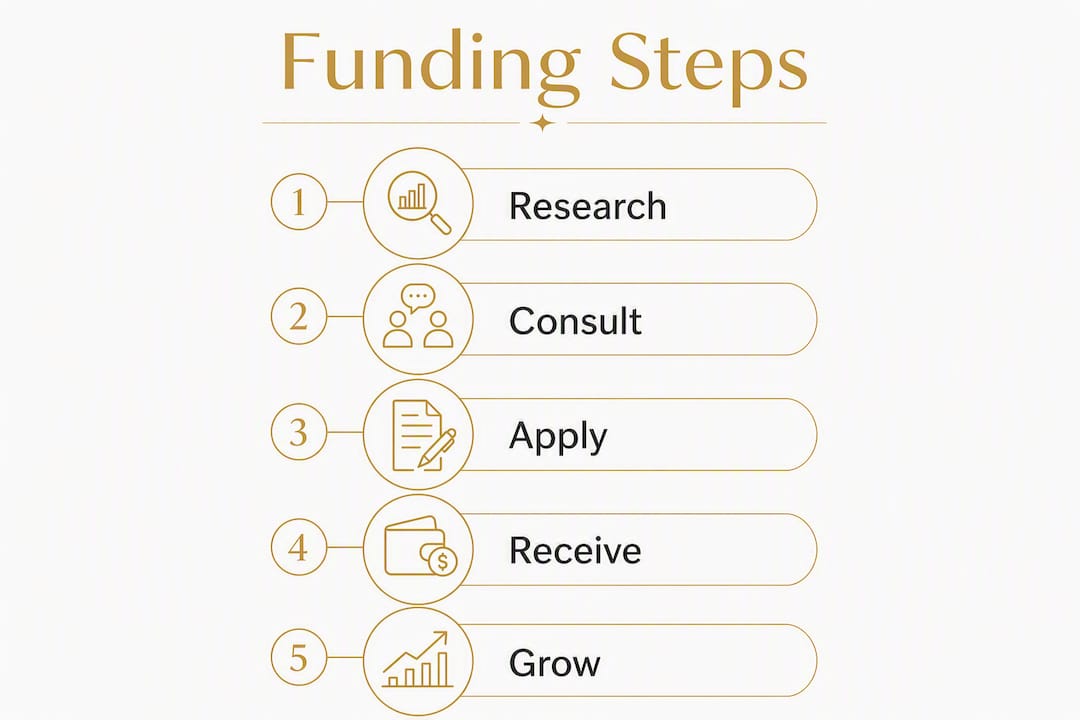
South Carolina Business One Stop (SCBOS)
SCBOS is the state’s centralized funding directory. You can search for grant programs, find SBDC office contacts, and review lender resources all in one place. Think of it as the index before you start reading the chapters. If you are not sure which program applies to your business, SCBOS is where you figure that out before making calls.

South Carolina Department of Commerce
The SC Department of Commerce is the right contact when your project involves job creation, capital investment, or site selection. Commerce administers discretionary incentive programs and can connect you with economic development staff who know which county-level programs apply to your location. Their guidance is clear: develop a written business plan, determine your exact funding need, and prepare cash-flow projections before you approach any lender or incentive program.
SBDC network
The South Carolina Small Business Development Center network offers free one-on-one counseling and can introduce you to lenders directly. SBDC advisors know which local banks are actively lending, which CDFIs have open intake, and which grant windows are coming up. To book an appointment, search for your nearest office through SCBOS or the SBDC state website. Wait times for an initial session are typically a few business days.
| Resource | Best used for | How to reach |
|---|---|---|
| SCBOS portal | Research, program search, SBDC contacts | scbos.sc.gov |
| SC Department of Commerce | Incentives, job-creation projects, site selection | scbizdev.sccommerce.com |
| SBDC network | Free counseling, lender introductions, grant guidance | Via SCBOS or local SBDC office |
| SBA SC District Office | SBA loan programs, lender match, disaster loans | sba.gov/district/south-carolina |
What grants and state programs are available in South Carolina?
South Carolina does offer grant and incentive programs, but most of them are not designed for seed-stage startups. Understanding that distinction saves you weeks of chasing the wrong applications.
State discretionary incentives
The SC Department of Commerce administers three main discretionary programs through the Coordinating Council for Economic Development:
- Closing Fund: flexible grants for companies making significant capital investments and creating jobs, evaluated case by case.
- Enterprise Program: tax credits tied to job creation, primarily for manufacturers and distribution operations.
- Rural Infrastructure Fund (RIF): infrastructure grants for rural counties to support business expansion projects.
These programs are not open applications you submit online. They are negotiated incentives, typically for companies committing to create a defined number of jobs and invest a specified amount of capital. A small retail shop or solo service business will not qualify. A manufacturer planning to hire a significant number of people and invest a substantial amount in equipment might.
SCRA programs for tech startups
The South Carolina Research Authority (SCRA) runs programs specifically for technology-based companies, including the SC Launch program, which provides funding and support for early-stage tech ventures. If your business involves software, life sciences, or advanced manufacturing, SCRA is worth a direct inquiry.
Regional and local grants
Several cities and counties in South Carolina maintain small business grant programs, often funded through federal Community Development Block Grants (CDBG). Charleston, Columbia, and Greenville each have economic development offices that periodically open grant windows for local businesses. These tend to be modest and competitive amounts.
Pro Tip: Pursue a state grant when you can credibly commit to job creation and capital investment thresholds. Pursue a loan when you need operating capital or equipment. Mixing up those two paths wastes application time and delays the funding you actually need.
Which federal programs serve South Carolina businesses?
Federal programs, especially SBA loans, are the most accessible capital source for the majority of SC small businesses. They are not fast, but they are reliable and well-structured.
SBA loan programs
- SBA 7(a) — the most flexible SBA loan, covering working capital, equipment, real estate, and business acquisition. Amounts up to $5 million, terms up to 25 years for real estate. Best for established businesses with 2+ years of tax returns.
Finding SBA lenders in South Carolina
The SBA South Carolina District Office maintains a list of preferred lenders and can direct you to SBA Lender Match, an online tool that connects you with SBA-approved lenders based on your business profile. Using a preferred lender shortens the approval timeline considerably.
Federal programs work best when you have time (30–90 days minimum), documented financials, and a clear use of funds. For faster capital needs, community lenders and alternative financing fill the gap.
Community lenders and CDFIs worth knowing in South Carolina
Community Development Financial Institutions (CDFIs) and nonprofit lenders serve borrowers that traditional banks often overlook: newer businesses, credit-challenged owners, and community-development projects. They are not a consolation prize. For the right borrower, they are the right lender.
Key community lenders active in South Carolina:
- Microloan intermediaries — SBA-approved microloan intermediaries operate throughout SC and can fund amounts from $500 to $50,000 with more flexible underwriting than a commercial bank.
CDFIs typically evaluate cash flow and community impact alongside credit history. If your personal credit score is below what a bank requires, a CDFI intake conversation is worth having before you assume you cannot qualify for anything. Deal sizes commonly range from $5,000 to $250,000, and the application process is usually more hands-on than a bank’s.
Which type of funding fits your South Carolina business need?
Matching your immediate need to the right funding type is the step most business owners skip. They apply for whatever they heard about first, then wonder why they got declined.

Working capital covers operational gaps: payroll, inventory, short-term cash shortfalls. Equipment financing funds asset purchases, with the equipment itself serving as collateral, which typically means lower rates and longer terms than unsecured working capital loans.
| Business need | Best funding type | Typical source |
|---|---|---|
| Payroll gap or cash-flow shortfall | Working capital loan or line of credit | Alternative lender, CDFI, bank line |
| New machinery or vehicles | Equipment financing | Bank, equipment lender, Emorylending |
| Commercial real estate or major expansion | SBA 504 or term loan | SBA-approved bank, CDC |
| Startup with no revenue history | SBA Microloan or CDFI loan | SBA intermediary, CommunityWorks Carolina |
| Waiting on invoices | Invoice factoring | Alternative lender, Emorylending |
| R&D or tech development | SCRA programs, SBIR/STTR grants | SCRA, federal agencies |
Equipment financing in South Carolina
South Carolina’s manufacturing base and port activity make equipment financing particularly active here. One detail that changes the math: South Carolina caps the sales tax on qualifying manufacturing equipment at $300, which meaningfully reduces the total acquisition cost on large purchases. Combined with Section 179 federal tax deductions, financing equipment in SC often delivers better after-tax economics than paying cash. If you are buying manufacturing equipment, run the numbers on financing before writing a check.
FILOT (Fee in Lieu of Taxes) agreements are another SC-specific tool for larger capital investments, reducing property tax obligations on new equipment for qualifying manufacturers.
How do you prepare to apply for business funding in SC?
Preparation is where most applications succeed or fail before they are ever submitted. Local lenders in South Carolina consistently report that realistic cash-flow projections matter as much as credit scores for smaller loan requests.
Document checklist:
- Business plan executive summary (1–2 pages minimum)
- Profit and loss statement (last 2–3 years, or YTD if newer)
- Balance sheet (current)
- Cash-flow projection (12 months forward)
- Business and personal tax returns (last 2–3 years)
- Business bank statements (last 3–6 months)
- Ownership and formation documents (articles of incorporation, operating agreement)
- Equipment quotes (if applying for equipment financing)
- Accounts receivable aging report (if applying for invoice factoring)
Timeline expectations by funding type
| Funding type | Typical timeline (application to funds) |
|---|---|
| SBA 7(a) loan | 30–90 days |
| SBA 504 loan | 30–90 days |
| CDFI microloan | 2–6 weeks |
| Equipment financing | 1–5 business days |
| Invoice factoring | 24–72 hours |
| Working capital loan (alternative lender) | 1–5 business days |
Common fees to budget for: SBA guarantee fees (varies by loan size), appraisal costs for real estate-backed loans, legal fees for complex transactions, and application fees for some CDFI programs. While waiting for SBA approval, invoice factoring or a short-term working capital advance can bridge the gap without disrupting operations. Review the business funding checklist to make sure nothing is missing before you submit.
What certifications improve your funding access in South Carolina?
Certain certifications unlock set-asides, grant priority, and specialized lender programs. They take time to obtain, but the access they provide is real.
- Minority Business Enterprise (MBE): apply through the South Carolina Office of Small and Minority Business Contracting and Certification (SMBCC) at smbcc.sc.gov. Required documentation includes proof of ownership, personal financial statements, and business formation documents.
- HUBZone certification: for businesses located in Historically Underutilized Business Zones, certified through the SBA. HUBZone status provides a competitive advantage in federal contracting and can improve access to SBA loan programs.
Certification does not guarantee funding, but it changes the competitive landscape. A certified MBE or WBE competing for a state contract or grant has access to a smaller applicant pool. For procurement-driven revenue, that matters more than most business owners realize.
How do you match your business profile to the right funding path?
The right funding route depends on where your business is right now, not where you plan to be. Three common profiles cover most SC entrepreneurs.
Micro startup (under 2 years, limited revenue)
Your best path is an SBA Microloan through a local intermediary or a CDFI loan from CommunityWorks Carolina. Banks will want 2 years of tax returns you do not have yet. CDFIs and microloan programs are built for exactly this stage. Bring a business plan, a 12-month cash-flow projection, and any revenue documentation you have. Contact your SBDC office first; they can introduce you to the right intermediary.
Established small business with recurring revenue
You have options. An SBA 7(a) loan through a preferred lender gives you the best rates for amounts above $150,000. For faster capital, a working capital loan or line of credit through Emorylending can fund in days rather than weeks. If you are buying equipment, equipment financing structured around the asset’s value often beats a general-purpose loan on rate and term.
Capital-intensive growth (manufacturing, construction, multi-location)
SBA 504 is the right tool for commercial real estate and large equipment. Pair it with a FILOT agreement if your county offers one. For the gap between your equity contribution and the SBA portion, ask your lender whether they participate in SSBCI programs, which reduce lender risk and can open approval pathways that are not publicly advertised. SSBCI participation is worth asking about directly; many lenders do not volunteer it.
Pro Tip: Always ask any lender whether they participate in SSBCI or state risk-share programs. These programs reduce the lender’s exposure on marginal applications and can turn a decline into an approval without changing your underlying financials.
How Emorylending supports South Carolina businesses
Emorylending works with South Carolina businesses across the full range of financing needs, from a $5,000 working capital advance to $5,000,000+ in growth capital. The key difference from a traditional bank: Emorylending evaluates your business performance and cash flow rather than leading with personal credit scores. That matters for business owners who have strong revenue but imperfect credit histories.
What Emorylending offers SC businesses:
- Equipment financing — for machinery, vehicles, and technology purchases, with the asset as collateral.
- Term loans and SBA lending — for longer-term growth and expansion needs.
To speed up your application, have 3–6 months of bank statements, your most recent tax returns, and a basic profit and loss statement ready before you start. The pre-qualification process is fast; most applicants get an initial response within one business day. For a clear picture of what lenders look for, review business loan eligibility requirements for Southeastern small businesses before submitting.
Key Takeaways
South Carolina small businesses have the best funding outcomes when they pair official state resources with a lender that evaluates cash flow, not just credit scores.
| Point | Details |
|---|---|
| Start with SCBOS and SBDC | Use SCBOS to research programs and book a free SBDC counseling session before applying anywhere. |
| Grants are limited in scope | State discretionary grants target job creation and capital investment; most small firms should prioritize SBA and CDFI loans. |
| Prepare documents first | Bank statements, tax returns, P&L, and a cash-flow projection are required for nearly every funding route. |
| Match funding type to need | Equipment financing for asset purchases; working capital for cash-flow gaps; SBA 504 for real estate and major expansion. |
| Emorylending for SC businesses | Emorylending connects SC businesses to lenders evaluating cash flow, with funding from $5,000 to $5,000,000. |
What most SC business owners get wrong about funding
The conventional wisdom says “apply for everything and see what sticks.” In practice, that approach costs you time, generates hard credit inquiries, and signals desperation to lenders who talk to each other more than you might expect.
The smarter move is to sequence your applications. Start with the resource that costs you nothing: an SBDC counseling session. A good SBDC advisor will tell you honestly whether your financials are lender-ready, which programs you actually qualify for, and which ones are a waste of your time. That conversation takes an hour and can save you months of misdirected effort.
The other thing most owners underestimate is how much the framing of the funding request matters. Lenders do not just want to know how much you need. They want to know how the capital will change your cash flow and create sustainable operations. A business owner who walks in asking for $150,000 to “grow the business” gets a different response than one who says “we need $150,000 to purchase a CNC machine that will reduce our per-unit production cost by 30% and support three new hires within 12 months.” Same amount, completely different conversation.
South Carolina’s funding ecosystem is genuinely good compared to many states. The SCBOS portal, the SBDC network, the SBA district office, and programs like SSBCI give you real tools. The gap is almost never the availability of capital. It is preparation and presentation.
Getting started with Emorylending is straightforward
South Carolina entrepreneurs have more funding options than ever, but navigating SBA timelines, CDFI intake processes, and state incentive applications takes time you may not have. Emorylending offers a faster path: one application connects you to multiple lenders who evaluate your business performance and cash flow, not just your credit file. Whether you need flexible financing for your small business or a specific product like equipment financing or invoice factoring, Emorylending works across the full range of needs from $5,000 to $5,000,000+.
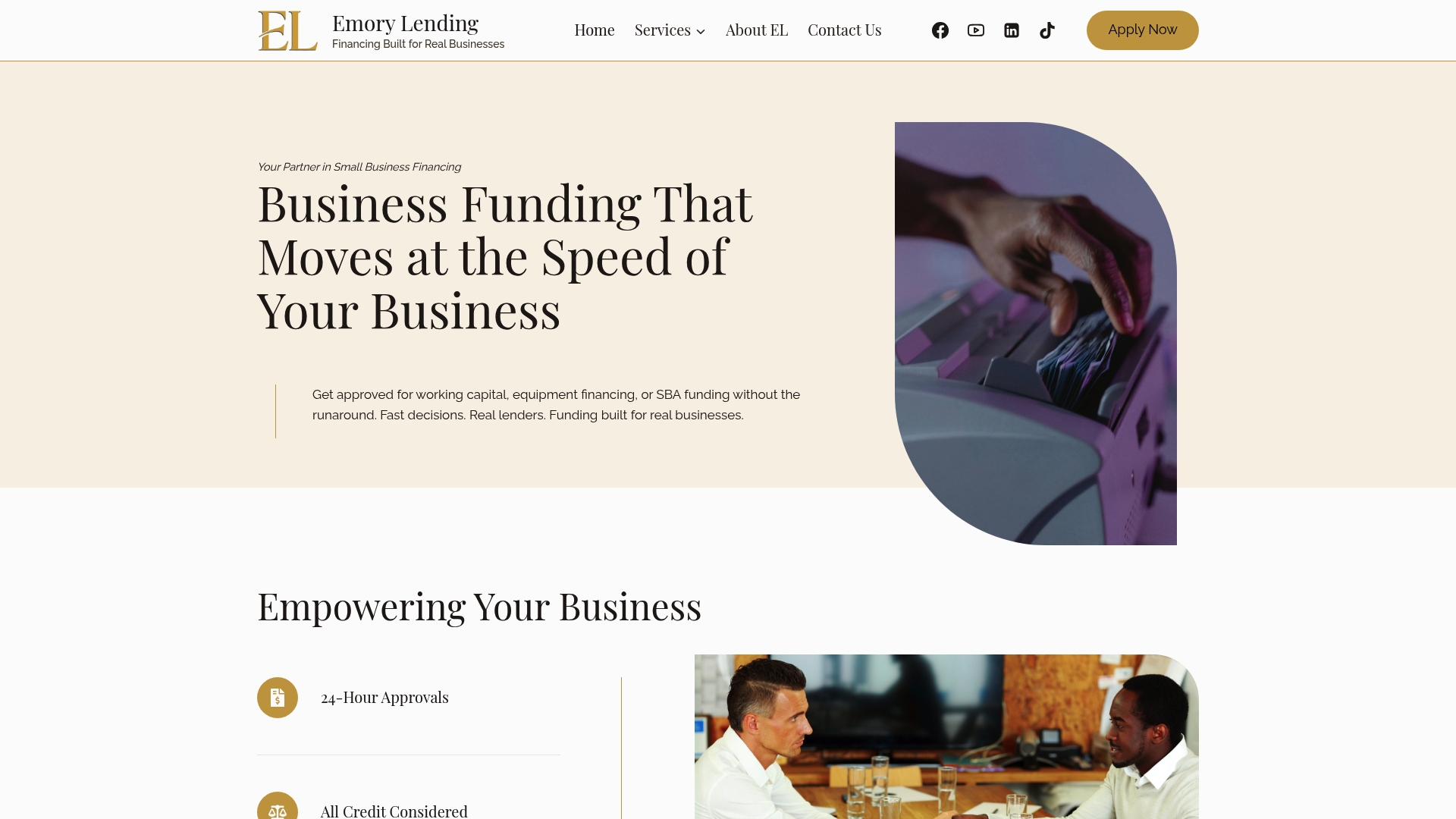
Three steps to get started:
- Upload your documents: 3–6 months of bank statements, most recent tax returns, and a basic P&L. The more complete your file, the faster the match.
- Receive your options: Emorylending presents lender matches based on your actual business profile, typically within one business day.
- Choose and close: select the offer that fits your timeline and terms, and funds can arrive in as little as 24–72 hours for working capital products.
Ready to find out what your business qualifies for? Start your pre-qualification at emorylending.com.
Useful sources and official links
These are the primary portals and contact points referenced throughout this guide.
- South Carolina Business One Stop (SCBOS): the state’s centralized funding directory; start here to research programs and find SBDC contacts
- SBA South Carolina District Office: SBA loan programs, preferred lender lists, and Lender Match for SC businesses
- SC Office of Small and Minority Business Contracting and Certification (SMBCC): MBE and WBE certification applications for South Carolina.
- Emorylending: pre-qualification and financing options for SC businesses from $5,000 to $5,000,000+.
This guide provides general information about business funding options in South Carolina and does not constitute financial, legal, or professional advice. Program terms, eligibility requirements, and availability change. Confirm current details directly with the relevant agency or a qualified financial advisor before applying.


