

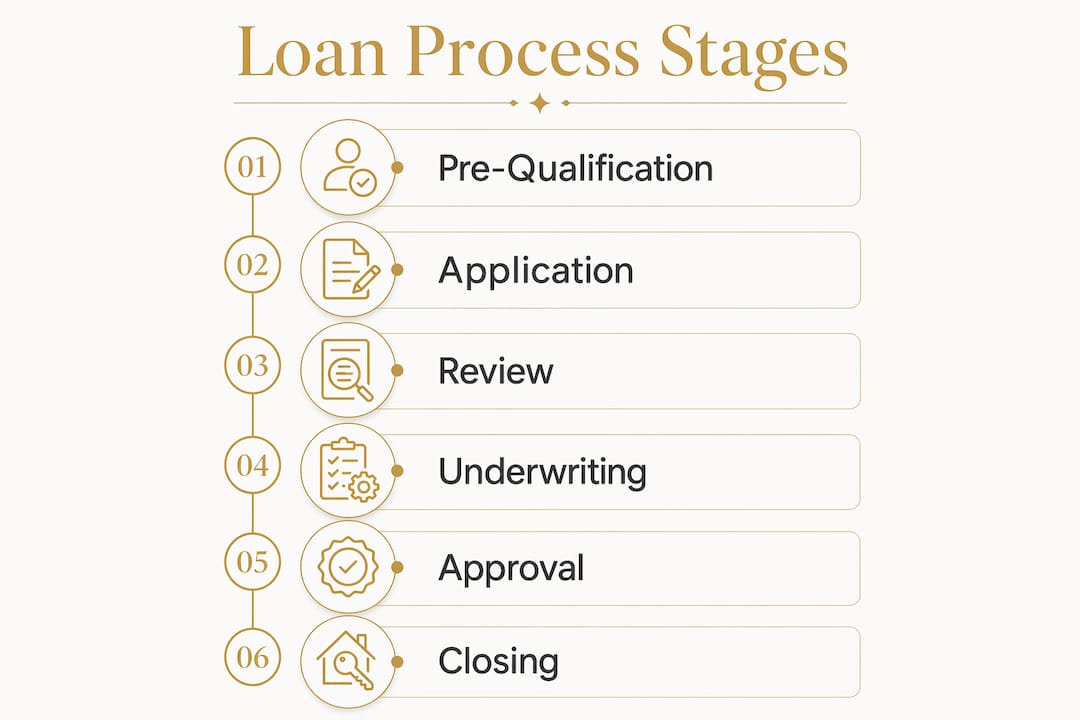
The business loan application process is a structured sequence of six stages that takes a small business owner from initial eligibility check to funded account. Those six stages are pre-qualification, application submission, initial review, underwriting, approval, and closing. Each stage has its own timeline and document requirements. Understanding what lenders look for at every step gives you a real advantage over applicants who show up unprepared.
What are the key stages in the business loan application process?
The six stages of a loan follow a predictable sequence, though timelines vary sharply by loan type. Pre-qualification takes as little as 5–15 minutes with an online lender. Submission typically runs 1–3 hours. Initial review takes 1–3 days, underwriting takes 3–14 days, approval takes 1–3 days, and closing takes 1–7 days. SBA loans sit at the longer end of every range.
Knowing these windows helps you plan. If you need capital in two weeks, an SBA 7(a) loan is not the right fit. An online lender or a working capital advance will move faster. Matching your timeline to the right loan type is the first real decision in the process.

| Stage | Typical Timeline | Notes |
|---|---|---|
| Pre-qualification | 5–15 minutes | Basic eligibility check, soft credit pull |
| Application submission | 1–3 hours | Forms, documents, loan purpose statement |
| Initial review | 1–3 days | Lender confirms completeness |
| Underwriting | 3–14 days | Deep financial and risk analysis |
| Approval and terms | 1–3 days | Conditional or final offer issued |
| Closing and funding | 1–7 days | Agreements signed, funds disbursed |
Pro Tip: Start gathering your financial documents before you even pick a lender. Delays almost always come from the borrower’s side, not the lender’s.
What business loan requirements must you meet?
Lenders evaluate four core factors: revenue, credit, time in business, and documentation. Traditional lenders require minimum annual revenue of $100,000 to $250,000, while online lenders may accept businesses earning as little as $96,000 to $120,000 annually. Revenue strength can offset a weaker credit score. Businesses earning less than $500,000 annually still account for a meaningful share of approved loans.
Credit scores matter, but they are not the whole picture. Lenders also look at cash flow consistency, debt service coverage, and how long the business has been operating. A business with two years of steady revenue and a 640 credit score can outperform a newer business with a 720 score.
Documentation is where most applicants slow down. SBA 7(a) loans require the most thorough packages, including personal financial statements and a formal business plan. Traditional and online lenders typically ask for a shorter list.
Documents you will need for most loan types:
- 3–6 months of business bank statements
- Current profit and loss statement (year to date)
- Balance sheet
- Two years of business tax returns
- Two years of personal tax returns
- Government-issued ID and business licenses
- Business plan (required for SBA loans)
- Personal guarantee for any owner holding 20% or more equity
Organize these documents before you apply. Lenders will not wait while you track down a missing tax return.
How to prepare and submit a successful loan application
Preparation is the single biggest factor in approval speed. Borrowers who delay the application stage almost always do so because they cannot quickly pull together updated financial data. The fix is simple: maintain a lending folder year-round with your balance sheet, year-to-date profit and loss statement, and the most recent two years of tax returns. Update it quarterly.
Choosing the right loan type before you apply matters just as much as your documents. Short-term, high-cost loans suit immediate operational needs like covering payroll or bridging a cash gap. Long-term loans and SBA products align with growth projects like opening a second location or buying equipment. Mismatching loan type to business need is one of the most common reasons applications stall or get denied. For a clear breakdown of how to match funding to purpose, the smart ways to use loans guide at Emorylending is worth reading before you apply.
Step-by-step application checklist:
- Build your lending folder with all required financial documents
- Check your personal and business credit reports for errors
- Identify the loan type that matches your funding purpose and timeline
- Research lenders that serve businesses at your revenue and credit level
- Complete the application form accurately: business name, EIN, loan amount, stated purpose
- Attach all required documents in the formats the lender specifies
- Have an accountant or SBDC advisor review your package before submission
- Submit and confirm receipt with the lender
Pro Tip: Never round up your loan request to a “comfortable” number. Request exactly what your business plan justifies. Lenders notice inflated requests and it raises red flags during underwriting.
The SBA’s Lender Match tool connects you to participating lenders, but the SBA does not issue loans directly. You work with the matched lender throughout the entire process. Knowing this saves confusion when you get your first response.
What happens during loan underwriting and approval?
Underwriting is the lender’s full risk assessment. It goes far deeper than the initial review. The underwriter examines your financial statements, tax returns, cash flow patterns, existing debt obligations, and the collateral you are offering. This stage takes the most time because it is the most consequential for the lender.
Pre-approval offers are not final. Terms get refined during underwriting. The lender may reduce the approved amount, require additional collateral, or add covenants to the loan agreement. This is normal and does not mean the deal is falling apart.
Common underwriting criteria lenders evaluate:
- Debt service coverage ratio (net operating income divided by total debt payments)
- Business and personal credit scores
- Collateral value relative to loan amount
- Time in business and industry risk profile
- Owner’s personal guarantee and equity stake
- Consistency of revenue over the past 12–24 months
You can negotiate after underwriting. If the terms are less favorable than expected, bring competing offers or point to specific financial strengths in your records. Borrowers with strong documentation and competing lender offers consistently negotiate better rates and terms. Do not accept the first offer as fixed.
Once underwriting is complete and you accept the terms, closing moves quickly. You sign the loan agreement, any collateral documents, and the personal guarantee. Funds typically arrive within 1–7 days of signing.
Key takeaways
The business loan application process requires six distinct stages, and preparation before pre-qualification determines how fast and successfully you move through all of them.
| Point | Details |
|---|---|
| Six-stage structure | Every loan follows pre-qualification through closing; timelines range from minutes to weeks. |
| Revenue and credit thresholds | Traditional lenders require $100,000–$250,000 in annual revenue; strong cash flow can offset lower credit scores. |
| Document readiness | Maintain a year-round lending folder with bank statements, tax returns, and financials to avoid delays. |
| Loan type alignment | Match the loan product to your specific need; short-term loans cover operations, long-term loans fund growth. |
| Underwriting is negotiable | Pre-approval terms are not final; competing offers and strong records give you real negotiating power. |
What I’ve learned from watching small businesses navigate loan applications
Most small business owners treat the loan application as a one-time scramble. They need money, they start gathering documents, and they discover three weeks in that their tax returns are outdated or their bank statements are missing a month. The process grinds to a halt. The lender moves on.
The owners who get funded fast do one thing differently: they treat their financial documents like a living file, not a once-a-year tax obligation. I have seen businesses with average credit scores and modest revenue get approved ahead of stronger applicants simply because their package was complete, clean, and submitted without a single follow-up request from the lender.
Transparency also matters more than most people realize. If your revenue dipped last year, explain it in writing before the underwriter asks. A brief, honest explanation of a one-time event reads very differently than a gap the lender has to discover on their own. Lenders are not looking for perfection. They are looking for predictability.
My honest advice: get an SBDC advisor or accountant to review your package before you hit submit. It costs little or nothing, and it catches the errors that kill otherwise solid applications. The funding checklist at Emorylending is also a practical starting point if you want a structured way to confirm you have everything in order.
— Jason
How Emorylending simplifies your path to business funding
Emorylending evaluates your business performance and cash flow, not just your personal credit score. That means more small businesses qualify for the capital they actually need. Whether you need working capital to cover payroll, equipment financing for a new purchase, or growth capital to open a second location, Emorylending funds businesses from $5,000 to $5,000,000+.
Explore the full range of small business financing options at Emorylending to find the product that fits your business stage and funding goal. The application is straightforward, and the team evaluates your real business performance from day one.
FAQ
What are the six stages of a business loan application?
The six stages are pre-qualification, application submission, initial review, underwriting, approval, and closing. Timelines range from minutes for pre-qualification to up to 14 days for underwriting, depending on the lender and loan type.
What credit score do you need to qualify for a business loan?
Credit score requirements vary by lender and loan type. Traditional lenders and SBA programs generally prefer scores above 660, but strong annual revenue and consistent cash flow can offset a lower score with many lenders.
How long does the business loan approval timeline take?
The full process typically takes 1–3 weeks with online lenders and 30–90 days with SBA lenders. The biggest variable is how quickly the borrower provides complete, accurate documentation.
What documents do you need to apply for a small business loan?
Most lenders require 3–6 months of bank statements, two years of business and personal tax returns, a current profit and loss statement, a balance sheet, and a personal guarantee from owners with 20% or more equity.
Can you negotiate business loan terms after approval?
Yes. Pre-approval terms are not final. Borrowers with competing lender offers or strong financial records regularly negotiate lower rates, longer repayment terms, or reduced collateral requirements during the underwriting stage.


