

Peer-to-peer (P2P) lending connects borrowers directly with individual investors through an online platform, cutting out the bank as the middleman. For small business owners, it can be a real option when traditional lenders say no — but it comes with variable costs, a funding process that depends on investor demand, and credit-reporting consequences worth understanding before you apply. Experian, the SBA, and lenders like Emorylending all approach small-business financing differently; knowing where P2P fits helps you pick the right tool.
TL;DR
- Best for: Owners with decent personal credit who need fast, unsecured capital and lack collateral
- Funding speed: As quickly as the next business day, though investor subscription can add days
- Cost range: Origination fees of 1%–9.99% plus interest that varies by credit profile
- Risk signal: Missed payments may be reported to credit bureaus faster than with traditional banks
Table of Contents
- How does peer to peer lending work, step by step?
- What do P2P loans actually cost?
- Which small businesses are a good fit for P2P lending?
- Key risks every small-business borrower should know
- How to evaluate a P2P platform before you apply
- What documents should you prepare before applying?
- What are the real alternatives to P2P lending?
- How Emorylending evaluates your business differently
- Key Takeaways
- Why cash-flow lending changes the outcome for real businesses
- Emorylending: small business financing built around your cash flow
- Useful sources and further reading
How does peer to peer lending work, step by step?
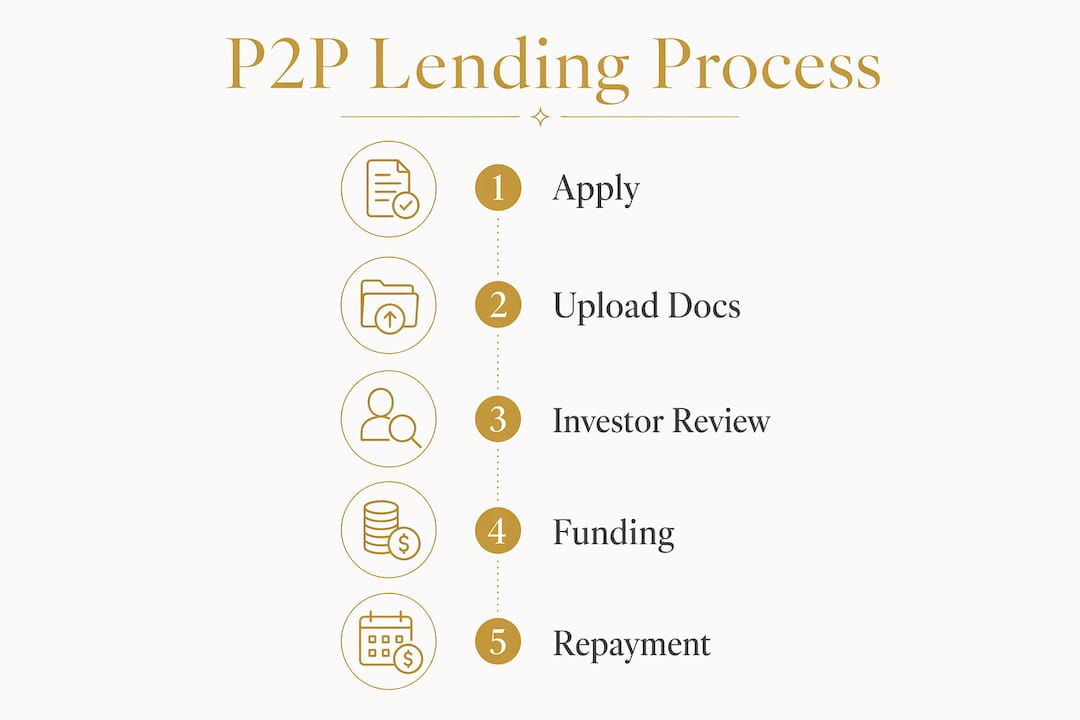
P2P lending follows four stages: pre-qualification, formal application, investor funding period, and electronic disbursement. Understanding each stage prevents surprises, especially around credit inquiries and timing.
- Pre-qualification (soft pull). You submit basic business and personal financial details. The platform runs a soft credit inquiry that does not affect your score and returns a preview APR and estimated terms.
- Formal application (hard pull). Once you decide to proceed, the platform triggers a hard inquiry. This can lower your score by a few points and stays on your credit report.
- Investor review and funding period. Your approved loan listing goes live for investors to fund. Platforms handle credit modeling, verification, and payment servicing, but individual investors still choose which loans to back. If investor demand is low, your loan can sit unfunded even after approval.
- Disbursement. Once fully subscribed, funds transfer electronically. Funding can happen as quickly as the next business day but often takes longer depending on how fast investors commit.
The investor funding period is the step most owners overlook. Unlike a direct lender who approves and funds from its own balance sheet, a P2P platform depends on investor demand to close your loan. A slow week for investors means a slower week for you. For a deeper look at how funding phases affect your cash flow planning, see Emorylending’s guide to funding timelines.
Pro Tip: Apply early in the week and have all documents uploaded before submitting. Loans with complete files tend to attract investors faster because the platform can verify and list them immediately.
What do P2P loans actually cost?
P2P loans are typically unsecured, which makes them accessible if you lack collateral, but that accessibility comes at a price. Fee structures vary widely across platforms, so knowing what to look for protects you.
| Fee Type | Typical Range | Notes |
|---|---|---|
| Origination fee | 1%–9.99% | Deducted from disbursement, not paid upfront |
| Servicing fee | Varies by platform | Charged annually or as a % of outstanding balance |
| Late payment fee | Varies | Can trigger faster collections than traditional banks |
| Prepayment penalty | Often none | Confirm in the loan agreement |
Interest rates depend heavily on your credit profile. Borrowers with scores under 600 often face higher rates because unsecured loans carry more default risk for investors. Strong credit can get you competitive rates; weaker credit can make P2P more expensive than an SBA loan.
Before you sign, ask the platform to disclose in writing:
- The exact origination fee percentage and when it is deducted
- Any annual or monthly servicing fee
- The late-payment fee and the grace period
- Whether the platform reports to business or personal credit bureaus
Which small businesses are a good fit for P2P lending?
P2P lending works best for established businesses with steady revenue, decent personal credit, and a specific short-term capital need. It is not the right tool for every situation.
Strong candidates:
- Businesses with at least one year of operating history and consistent monthly revenue
- Owners with personal credit scores in the mid-600s or higher
- Needs that fit unsecured loan sizes (typically under $50,000, though some platforms go higher)
- Use cases: working capital gaps, short-term equipment purchases, or consolidating higher-rate debt
When another option likely fits better:
- SBA loan: You can wait 30–90 days and want the lowest possible rate with government backing
- Bank term loan: You have strong financials, collateral, and a two-plus-year track record
- Invoice factoring: Your cash-flow problem is tied to slow-paying clients, not a capital shortage
- Performance-based lender (Emorylending): Your personal credit is limited but your business revenue and cash flow are strong — a lender that evaluates business performance rather than just your FICO score will likely get you better terms
Key risks every small-business borrower should know
P2P lending carries real downsides: higher rates for riskier profiles, no federal insurance on investor funds, and collection timelines that can move faster than you expect.
- Default rates on P2P platforms can run higher than at conventional banks, and investors bear that risk without FDIC-style protection.
- Missed payments may be reported to credit bureaus and sent to collections more quickly than a traditional bank would act, compressing your response window.
- Interest paid on a business loan is generally deductible as a business expense, but origination fees and how they are amortized can get complicated. Talk to your accountant before closing.
- Platforms generate revenue from origination and servicing fees, which means their incentive is volume. Read the fine print rather than relying on the platform’s own rate comparisons.
Pro Tip: Set up automatic payments the day you receive funds. P2P platforms often move to collections faster than banks, and a single missed payment can damage both your personal and business credit before you realize there was a problem.
How to evaluate a P2P platform before you apply
The right framework: assess transparency, underwriting method, investor base size, fee structure, funding speed, and customer service responsiveness. A platform that scores well on all six is worth your application; one that hedges on fees or won’t show you a sample contract is not.
Checklist before applying:
- Request the full fee schedule in writing, including origination, servicing, and late fees.
- Ask for a sample loan contract before submitting a formal application.
- Confirm the platform is licensed to operate in your state.
- Verify how the platform underwrites: credit score only, or does it consider revenue and cash flow?
- Check the investor base size — a larger, more active investor pool means faster funding.
- Ask how quickly the platform initiates collections after a missed payment.
- Confirm whether delinquencies are reported to personal credit bureaus, business credit bureaus, or both.
- Look for borrower protections: hardship programs, payment deferrals, or restructuring options.
For a broader look at what lenders weigh during underwriting, Emorylending’s breakdown of loan approval factors covers the five variables that most often determine outcomes.

What documents should you prepare before applying?
Gathering these items before you submit reduces delays and avoids unnecessary hard credit pulls from multiple applications.
- Three to six months of business bank statements
- Two years of business tax returns (or personal returns if the business is newer)
- Current profit and loss statement
- Articles of organization or incorporation
- Government-issued owner ID
- Accounts receivable aging report (if applicable)
- Voided business check for disbursement
Some platforms accept alternative data — utility payments, POS deposit history, or rent payment records — as supplemental evidence of cash-flow stability. If your tax returns understate actual revenue, ask the platform explicitly whether bank statement deposits carry weight in their model.
| Document Status | Typical Outcome |
|---|---|
| All documents uploaded at submission | Faster investor listing; funding possible within 1–3 business days |
| Missing tax returns or bank statements | Application paused; delays of 3–7 days or more |
The business loan application guide at Emorylending walks through each document in detail if you want a step-by-step reference.
What are the real alternatives to P2P lending?
P2P is one option among several. The right choice depends on your timeline, credit profile, and how much the rate matters.
- SBA loans: Lowest rates and longest terms, but approval takes weeks to months and requires strong documentation. Best when cost matters more than speed. Compare the tradeoffs at this commercial vs. SBA loan guide.
- Bank term loans: Competitive rates for well-qualified borrowers with collateral and two-plus years in business. Slower than P2P, stricter on credit.
- Business line of credit: Flexible draw-and-repay structure for recurring working capital needs. Better than a term loan if your cash-flow gaps are cyclical.
- Invoice factoring: Converts outstanding receivables to immediate cash. No credit-based approval; the factor cares about your clients’ creditworthiness, not yours.
- Equipment financing: Asset-backed, so rates are often lower than unsecured P2P loans for the same purchase. The equipment itself serves as collateral.
- Performance-based financing (Emorylending): If your personal credit is limited but your business generates consistent revenue, a lender that evaluates cash flow and business performance can approve deals that P2P platforms and banks decline.
Decision rule: Need speed and have decent credit? P2P is worth checking. Need the lowest rate and can wait? SBA or bank term loans win. Strong cash flow but limited personal credit? Consider cash-flow-based financing through a performance-based lender.
How Emorylending evaluates your business differently
Emorylending looks at business performance and cash flow first, not just your personal credit score. That single difference opens the door for businesses that generate real revenue but haven’t built a long personal credit history or don’t have hard assets to pledge.
What Emorylending supports:
- Working capital for day-to-day operations
- Equipment financing for growth or replacement
- Payroll coverage during revenue gaps
- Receivables bridge while waiting on client payments
- Funding from $5,000 to $5,000,000+ through a network of partner lenders
For businesses in North Carolina, South Carolina, Florida, and Virginia, Emorylending connects you with multiple lenders through a single application, which means more options and less paperwork. The evaluation focuses on what your business actually does, not just what a credit bureau says about you.
Key Takeaways
P2P lending is a legitimate small-business financing option, but the investor funding period, variable fees, and fast collections timeline make it essential to compare total cost and platform terms before committing.
| Point | Details |
|---|---|
| Origination fees vary widely and are deducted from your disbursement. | |
| Funding speed depends on investors. Approval can be fast, but the investor subscription period can delay disbursement by days. | |
| Missed payments move fast | P2P platforms may report delinquencies and initiate collections faster than traditional banks. |
| Gather documents first | Complete applications fund faster; missing bank statements or tax returns cause multi-day delays. |
| Emorylending as an alternative | If personal credit limits your P2P options, Emorylending evaluates cash flow and business performance for $5,000–$5,000,000+ in funding. |
Why cash-flow lending changes the outcome for real businesses
The conventional wisdom says “fix your credit score, then apply for a loan.” That advice works fine for borrowers who have the time and the runway to wait. Most small-business owners don’t. A restaurant covering payroll, a contractor buying equipment before a job starts, a retailer stocking inventory ahead of a busy season — none of them can wait six months to rebuild a FICO score.
P2P lending was supposed to solve this by democratizing access to capital. And it does, partially. But it still leans heavily on personal credit, and the investor funding period introduces uncertainty that a direct lender simply doesn’t have. The businesses I see turned away most often aren’t failing businesses. They’re growing ones with real revenue, real customers, and a cash-flow timing problem. Evaluating a business on what it actually earns, not just on a three-digit score, is the more honest way to underwrite a loan.
Emorylending: small business financing built around your cash flow
Most P2P platforms still run your personal credit as the primary filter. Emorylending takes a different approach: your business revenue, cash flow, and performance are the story, and that story gets matched to the right lender from a network built for small businesses.
Whether you need working capital, equipment financing, or a bridge while waiting on receivables, Emorylending works with businesses from $5,000 to $5,000,000+ across North Carolina, South Carolina, Florida, and Virginia. The application is straightforward, the evaluation is fast, and you get access to flexible financing options without the uncertainty of an investor funding period. See which financing options fit your business and start your application today.
Useful sources and further reading
- Experian: What Is Peer-to-Peer Lending? — Covers the P2P process, origination fees, and funding timelines.
- Investopedia: Peer-to-Peer Lending Explained — Detailed breakdown of platform mechanics, default risk, and investor protections.
- NerdWallet: Peer-to-Peer Loans — Explains soft vs. hard credit pulls and how to compare offers.
- SoFi: Understanding P2P Lending — Good on investor demand dynamics and funding-period variability.
- MarketWatch: Peer-to-Peer Lending Guide — Positions P2P vs. bank and SBA options for borrowers with varying credit profiles.
- Equifax: Peer-to-Peer Lending — Explains the funding period and what happens when investor subscription is slow.
- Chime: Understanding Peer-to-Peer Lending — Covers unsecured loan risks and how platform fee incentives affect underwriting.
This article is general information, not financial or legal advice. Confirm current rates, platform terms, and tax treatment with a qualified financial professional or accountant for your specific situation.


