

Online lenders are technology-driven financing platforms that replace branch visits and paper applications with automated underwriting, giving small business owners faster access to capital than traditional banks can deliver. The role of online lenders has grown sharply as the global digital lending market surpassed $500 billion, with fintech platforms approving thin-credit applicants at rates up to 30% higher than conventional banks. For small business owners who need working capital, equipment financing, or payroll coverage, understanding how these platforms work is no longer optional. It is the difference between funding a growth opportunity and watching it pass.
What defines the role of online lenders vs. traditional banks?
Online lenders operate without physical branches, which fundamentally changes how they serve small businesses. Every step, from application to funding, runs through a digital interface backed by automated systems. That structure cuts overhead and speeds up decisions in ways a branch-based bank simply cannot match.
The most significant structural difference is underwriting. Traditional banks rely on loan officers who review documents manually, a process that can take days or weeks. Fintech platforms replace human officers with algorithmic real-time data analysis, which reduces certain human biases and compresses decision timelines to hours. The tradeoff is that the algorithm depends entirely on data quality, and any gap in that data creates friction.

Online lenders also fund loans differently. They do not hold customer deposits. Instead, they draw on warehouse lines, institutional investors, or retail capital markets. That capital structure keeps operating costs lower, which can translate into reduced origination fees for borrowers.
Key structural differences between online lenders and traditional banks:
- No physical branches: Applications, approvals, and funding happen entirely online.
- Algorithmic underwriting: AI and alternative data replace manual document review.
- Faster decisions: Most online lenders issue decisions within hours, not days.
- Alternative credit signals: Cash flow, transaction history, and digital footprints supplement or replace FICO scores.
- Lower overhead: No branch network means reduced operating costs passed on as savings.
Pro Tip: Before applying, confirm whether a lender uses direct underwriting or routes your application through a marketplace. Marketplace platforms share your data with multiple lenders, which affects both your privacy and the number of credit inquiries on your file.
How do online lenders benefit small businesses?
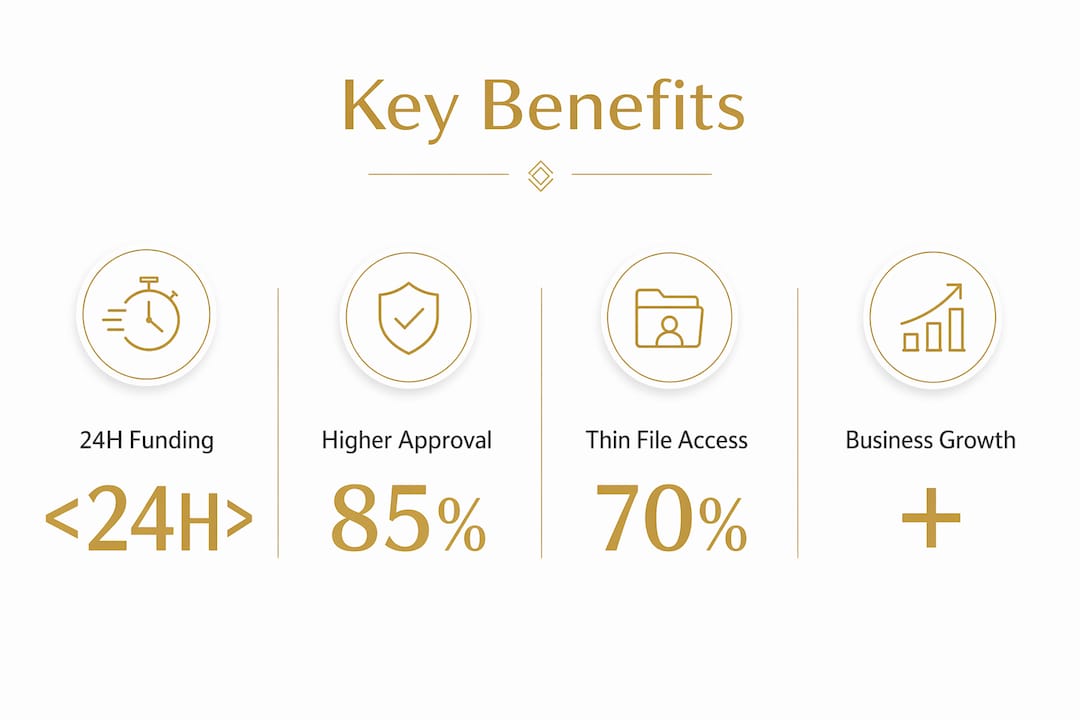
Speed is the most immediate benefit. Most online lenders fund within 24 hours, saving borrowers an estimated $150–$400 in origination costs per loan compared to traditional bank processes. For a business owner covering payroll or seizing a bulk inventory deal, that timeline is the deciding factor.

Accessibility is the second major advantage. Small businesses with thin credit files, meaning limited credit history rather than bad credit, face consistent rejection from traditional lenders. Fintech platforms use alternative data such as bank transaction patterns, revenue trends, and even accounts receivable cycles to build a fuller picture of creditworthiness. This is why approval rates for thin-file applicants run significantly higher on digital platforms.
The long-term benefit is often overlooked. Getting an initial loan from a fintech platform increases the chance of accessing formal financial services later by 13.7 percentage points. Researchers call this the “fintech ladder effect.” A first digital loan builds a repayment record that unlocks better terms on future financing, including traditional bank loans at lower interest rates.
Here is how the benefits stack up in practice:
- Same-day or next-day funding for urgent capital needs like payroll or emergency repairs.
- Higher approval rates for businesses with limited credit history but strong cash flow.
- Fully digital process that requires no branch visits or in-person document submissions.
- Transparent pricing with prequalification tools that show rates before a hard credit pull.
- Credit building through on-time repayment that strengthens your business credit profile over time.
The business loan benefits that come from digital lending extend well beyond the immediate cash injection. Each successful loan cycle positions your business for larger, cheaper capital in the future.
What risks should small business owners understand about online lending?
Online lending carries real risks that deserve honest attention. Default rates for first-time fintech borrowers run 5–7 percentage points higher than for traditional credit borrowers. That gap reflects the reality that faster access to capital does not automatically mean better financial outcomes. Borrowers who do not fully understand repayment schedules, factor rates, or daily debit structures can find themselves in a cash flow squeeze within weeks of funding.
The “fintech paradox” captures this tension well. Algorithmic lending improves repayment performance on average, but it can simultaneously increase financial stress for borrowers who lack digital financial literacy. A business owner who does not understand the difference between an APR and a factor rate may accept terms that cost far more than expected.
Data privacy is another genuine concern. When you apply through a marketplace platform rather than a direct lender, your financial data moves to multiple parties. API-based underwriting requires you to share banking credentials directly. If those API connections fail, the process stalls and reverts to slower manual reviews, eliminating the speed advantage entirely.
Watch for these specific risks:
- High effective APRs on short-term products like merchant cash advances, which can exceed 50% when annualized.
- Daily or weekly repayment structures that strain cash flow even when revenue is healthy.
- Marketplace data sharing that results in multiple hard credit inquiries and unsolicited lender contacts.
- Regulatory gaps that leave some fintech lenders less accountable than state-chartered banks.
Pro Tip: Always calculate the total cost of capital, not just the stated rate. Divide total fees plus interest by the loan amount, then annualize it. That single number lets you compare any loan product on equal footing.
How does the rise of online lenders impact the broader financing landscape?
The shift from human judgment to algorithmic credit assessment is the most consequential change in small business lending in decades. Traditional banks built their credit models around FICO scores and collateral. Online lenders built theirs around cash flow data, transaction velocity, and behavioral signals. That shift opens the door for millions of businesses that the old model excluded.
Financial inclusion is the clearest measurable impact. Businesses owned by first-generation entrepreneurs, recent immigrants, or operators in underserved markets often lack the credit history that traditional banks require. Digital lenders evaluate what the business actually does, not just what its credit file says. That distinction matters enormously for the roughly one in five small businesses that the Federal Reserve classifies as credit-invisible or thin-file.
“The expansion of fintech lending does not just add a new channel. It rewrites who gets to participate in the formal credit economy. For small businesses that traditional underwriting consistently excluded, digital lenders represent a structural shift in access, not just a faster version of the same process.”
The competitive pressure on traditional banks is real and growing. Banks have responded by building their own digital application portals and partnering with fintech platforms. That competition benefits borrowers through faster processing, better pricing transparency, and more flexible product structures. The role of fintech in business loans continues to expand as more lenders adopt algorithmic underwriting across the credit spectrum.
Regulators are paying close attention. The Consumer Financial Protection Bureau (CFPB) and state banking regulators have increased scrutiny of fintech lending practices, particularly around disclosure standards and data use. That regulatory attention is a healthy signal. It means the market is maturing, and borrower protections are catching up to the speed of innovation.
What practical steps should you take when evaluating online lenders?
Preparation separates borrowers who get funded quickly from those who stall in the process. Follow these steps before you submit a single application:
- Verify lender legitimacy. Search the CFPB complaint database and confirm state lending registration. A legitimate lender will have a clear physical address, disclosed ownership, and a verifiable license.
- Identify the lender type. Determine whether you are dealing with a direct lender or a lead-generation marketplace. Direct lenders underwrite and fund the loan themselves. Marketplaces sell your application data to multiple lenders.
- Prepare your banking credentials. Online lenders use API connections to verify cash flow in real time. Have your business bank login ready. Missing credentials force a manual review and eliminate the speed advantage.
- Use prequalification tools. Most reputable digital lenders offer soft-pull prequalification. Get rate estimates from at least two or three platforms before accepting any offer.
- Calculate total cost of capital. Compare offers using the annualized cost, not the factor rate or weekly payment. Review the financing mistakes that trip up small business owners before signing anything.
Pro Tip: If a lender cannot clearly explain how it calculates your rate or what data it uses to make its decision, treat that as a red flag. Transparency in underwriting is a baseline standard for any reputable digital lender.
Key Takeaways
Online lenders serve small businesses best when owners understand both the speed advantages and the cost structures before they apply.
| Point | Details |
|---|---|
| Speed and access | Most online lenders fund within 24 hours, with approval rates up to 30% higher for thin-file applicants. |
| Credit building | A first fintech loan raises the chance of accessing formal credit later by 13.7 percentage points. |
| Default risk | First-time fintech borrowers default at rates 5–7 points higher than traditional borrowers; read all terms carefully. |
| Lender type matters | Direct lenders and marketplace platforms differ significantly in data privacy, credit impact, and total cost. |
| Preparation wins | Having banking credentials ready and using prequalification tools protects both your credit and your time. |
What I’ve learned about online lenders that most guides won’t tell you
The conversation around digital lending tends to split into two camps. One side celebrates fintech as the great equalizer for small businesses. The other warns about predatory rates and algorithmic opacity. Both camps are partially right, and that is exactly why neither view is useful on its own.
What I have seen consistently is that the borrowers who get the most value from online lenders are the ones who treat the first loan as a strategic move, not just a cash fix. They borrow a manageable amount, repay it cleanly, and use that track record to negotiate better terms on the next round. The fintech ladder effect is real, but it only works if you climb it deliberately.
The risk I see most often ignored is the marketplace model. Business owners apply to what looks like a single lender and do not realize their data has gone to a dozen platforms. That creates credit inquiries, unsolicited calls, and a fragmented borrowing history that can actually hurt future applications. Knowing whether you are talking to a direct lender or a data broker dressed as a lender is the single most underrated piece of due diligence in this space.
The business financing options available today are genuinely better than they were five years ago. But better options still require better decisions. The technology does not make the judgment call for you.
— Jason
Emorylending’s approach to small business financing
Emorylending evaluates your business performance and cash flow, not just your personal credit score. That means more small businesses qualify for the capital they actually need.
Whether you need working capital to cover payroll, funds to buy equipment, or capital to expand to a new location, Emorylending offers financing from $5,000 to $5,000,000+. The application process is direct, the terms are transparent, and decisions are built around what your business does today. If you want to understand all your options before applying, the flexible financing guide walks through every product category in plain language.
FAQ
What is the role of online lenders for small businesses?
Online lenders provide technology-driven financing that delivers faster decisions, higher approval rates for thin-file businesses, and fully digital application processes. They fill the credit gap that traditional banks leave for businesses with limited credit history but strong cash flow.
How fast do online lenders typically fund a loan?
Most online lenders complete the process from application to funding within 24 hours, compared to the days or weeks a traditional bank typically requires.
Are online lenders safe for small business owners?
Reputable online lenders are legitimate and regulated, but owners should verify state licensing and check the CFPB complaint database before applying. The key risk is not fraud but misunderstood terms, particularly on short-term products with high effective APRs.
What is the fintech ladder effect?
The fintech ladder effect describes how a first digital loan builds a repayment record that increases access to formal financial services by 13.7 percentage points, enabling businesses to qualify for larger loans with better terms over time.
What is the difference between a direct online lender and a marketplace lender?
A direct lender underwrites and funds the loan itself, keeping your data in-house. A marketplace lender collects your application and sells it to multiple lenders, which can result in multiple credit inquiries and broader data sharing.


