

Cash flow-based funding, known in the industry as cash flow lending, is a financing method where lenders approve loans based on your business’s projected future cash inflows rather than physical assets or credit history. For small business owners without significant collateral, this distinction changes everything. You can qualify for working capital, equipment purchases, or payroll coverage based on what your business actually earns and collects. Platforms like Funding Societies and lenders like Emorylending have built entire product lines around this model, making it one of the most accessible paths to growth capital for businesses generating consistent revenue.
How do lenders evaluate cash flow to determine funding eligibility?
Lenders analyzing cash flow-based applications look at three specific categories of financial activity. The cash flow statement breaks down into operations (day-to-day business income and expenses), investing (asset purchases or sales), and financing (debt or equity raised). Each section tells a different story. Operating cash flow shows whether your core business generates real money. Financing cash flow reveals how much debt you already carry.
Beyond the statement itself, lenders want recent bank records. Lenders typically request 3 to 6 months of bank statements plus profit and loss reports to assess cash flow patterns and validate repayment ability. Outdated documents trigger delays and renewed requests, which extends your approval timeline. Submitting current, organized records signals that you run a tight operation.

The metric lenders rely on most heavily is the Debt Service Coverage Ratio, or DSCR. This ratio compares your net operating income to your total debt obligations. A DSCR above 1.25 generally signals that your business generates enough cash to cover loan payments with room to spare. Lenders also use forward-looking metrics like DSCR backed by short-term cash forecasts to avoid approving loans that look good on paper but fail on timing.
One detail many business owners miss: lenders care about when cash actually arrives, not when you book the sale. Accrual accounting records revenue at the point of sale, but your bank account only reflects what has been collected. This gap between booked revenue and actual collections is where many loan applications fall apart.
Pro Tip: Prepare a 13-week direct cash flow forecast alongside your bank statements. This short-term forecast shows lenders exactly when cash will arrive and depart, which is far more persuasive than a profit and loss statement alone.
Key documents to have ready before applying:
- Last 3 to 6 months of business bank statements
- Profit and loss report for the current and prior year
- Accounts receivable aging report
- A written use-of-funds statement explaining how the loan will be deployed
- Cash flow projections for the next 90 days
What are the main types of cash flow-based funding available?
Cash flow lending covers several distinct products, each suited to different business needs and repayment timelines. Understanding the differences saves you from choosing a product that creates more pressure than it relieves.
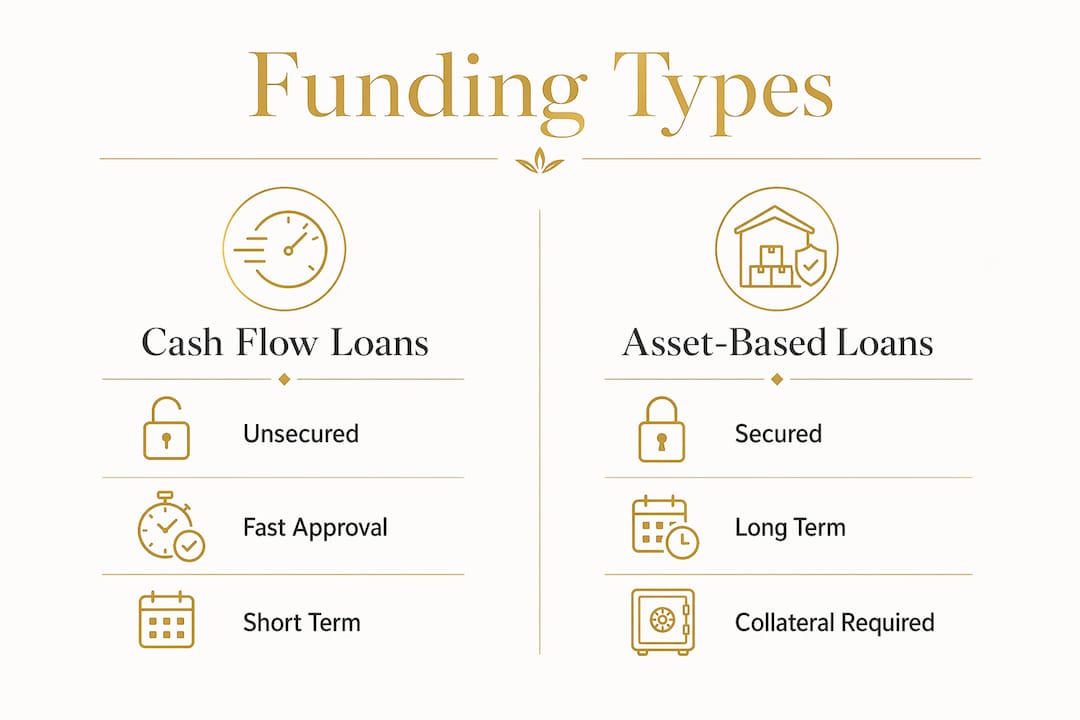
Cash flow loans are unsecured loans approved based on projected revenue. They carry no collateral requirement and fund quickly. The tradeoff is that rates tend to be higher than secured options, and repayment terms are often short.
Working capital lines of credit give you a revolving credit limit you draw from as needed. This suits businesses with irregular revenue cycles, like contractors or seasonal retailers, because you only pay interest on what you use.
Invoice financing and factoring let you unlock cash tied up in unpaid invoices. Instead of waiting 30 to 90 days for a customer to pay, you receive a percentage of the invoice value upfront. This is one of the fastest ways to fix a receivables gap without taking on traditional debt.
Peer-to-peer lending platforms like Funding Societies operate outside traditional banking regulations and offer faster approvals. P2P platforms provide short-term working capital without collateral but require a clear near-term repayment source. Some of these platforms can disburse funds within 5 days of approval.
| Funding Type | Collateral Required | Approval Speed | Best For |
|---|---|---|---|
| Cash flow loan | None | 1 to 5 days | Working capital, payroll |
| Line of credit | Sometimes | 2 to 7 days | Irregular revenue cycles |
| Invoice financing | Invoice as security | 24 to 48 hours | Receivables gaps |
| P2P lending | None | Same day to 5 days | Short-term capital needs |
| Asset-based loan | Yes (equipment, property) | 1 to 4 weeks | Capital expenditures |
One important note on P2P and short-term cash flow products: repayment terms are often short, capped at around 18 months, and monthly rate framing can obscure the true annual cost. Always convert the monthly rate to an annualized figure before comparing products.
How does cash flow timing affect funding approval and repayment?
Timing is the single most underestimated factor in cash flow financing. Andreessen Horowitz emphasizes that in cash flow management, timing and maturity matter, because only actual cash receipts affect liquidity. A business can show strong revenue on paper and still miss a loan payment because collections lagged by two weeks.
Here is how to think about timing in practical terms:
- Map your collection cycle. If you invoice net-30 and customers typically pay on day 40, your real cash arrival is 40 days after the sale, not 30. Build your forecast around actual collection history, not contract terms.
- Use a 13-week direct forecast for loan applications. Early-stage founders and growing businesses benefit from a 13-week direct forecast for liquidity and a monthly integrated model for fundraising conversations. The 13-week format shows week-by-week inflows and outflows, which is exactly what underwriters want to see.
- Align repayment dates with your peak inflow periods. If your business collects most receivables in the first week of the month, negotiate repayment drafts for that window rather than mid-month.
- Model three scenarios. Build a base case, a conservative case where collections run 15% slower, and a stress case where a major customer delays payment by 30 days. Lenders who see scenario planning in your application gain confidence that you understand your own risk.
- Account for deferred revenue and payroll timing. Underestimating cash outflows like payroll and vendor payments, or ignoring deferred revenue dynamics, can cause liquidity problems despite apparent revenue growth.
Pro Tip: Never submit a cash flow projection that shows perfectly smooth inflows. Lenders know real businesses have lumpy cash patterns. A forecast that reflects realistic variability is more credible than one that looks artificially clean.
The repayment structure on cash flow loans often mirrors your inflow pattern. Some lenders offer daily or weekly ACH debits tied to a percentage of deposits, which reduces default risk when your cash timing matches the forecast. This structure, sometimes called revenue-based repayment, is common among alternative funding solutions for businesses with variable monthly revenue.
What steps prepare you for a strong cash flow funding application?
Most loan rejections are not caused by a bad business. They are caused by a poorly prepared application that fails to tell a clear cash story. These steps close that gap.
Keep financial records current at all times. Lenders who receive outdated statements ask for updated ones, which delays approval by days or weeks. Treat your bank reconciliation and P&L as living documents, not quarterly tasks.
Segment your accounts receivable by aging. Segmenting accounts receivable into aging buckets and applying probabilistic collection rates can reduce inflow overestimation by 15 to 25%, improving forecast accuracy and lender confidence. An invoice that is 90 days past due has a very different collection probability than one that is 15 days out.
Write a clear use-of-funds statement. Lenders want to know exactly where the money goes. “Working capital” is not specific enough. “Covering payroll for three employees during a 60-day receivables gap while a $180,000 contract closes” is specific and credible.
Avoid the profit trap. Experienced entrepreneurs often fail because they rely on profit rather than actual cash conversion for lender approval. Profit is an accounting concept. Cash is what pays your bills and your loan. Your application should lead with cash, not earnings.
Communicate proactively with your lender. If your cash timing shifts after approval, tell your lender before you miss a payment. Lenders who work with business performance metrics rather than credit scores are generally more flexible when borrowers communicate early and honestly.
For a deeper look at what lenders check before approving working capital, the business loan eligibility guide for Southeastern small businesses covers documentation requirements in detail.
Cash flow funding vs. asset-based loans: which fits your business?
The core difference between cash flow lending and asset-based lending is what secures the loan. Asset-based loans use physical collateral: equipment, real estate, or inventory. Cash flow loans use your projected revenue. Cash flow funding offers faster access and no collateral requirement, but often carries higher rates and shorter terms than traditional asset-based loans.
| Factor | Cash flow lending | Asset-based lending |
|---|---|---|
| Approval basis | Revenue and cash projections | Collateral value |
| Collateral required | No | Yes |
| Approval speed | 1 to 5 days | 1 to 4 weeks |
| Interest rates | Higher | Lower |
| Loan term | Short (3 to 18 months) | Longer (1 to 10 years) |
| Best fit | Working capital, receivables gaps | Equipment, real estate, expansion |
Cash flow lending suits businesses with strong, consistent revenue but limited physical assets. A marketing agency, a staffing firm, or a software company rarely owns equipment worth pledging as collateral. For these businesses, cash flow lending is not just convenient. It is often the only viable path to growth capital.
Asset-based loans make more sense when you need long-term financing for a capital purchase, like a piece of manufacturing equipment or a commercial vehicle, and you can tolerate a longer approval process. The lower rates on asset-based products reward patience and collateral availability.
For businesses that are growing but asset-light, the working capital options at Emorylending are structured specifically around cash performance rather than collateral, which means more businesses qualify.
Key takeaways
Cash flow lending approves funding based on your business’s projected inflows, making it the most accessible financing path for revenue-generating businesses without significant collateral.
| Point | Details |
|---|---|
| Lenders evaluate cash, not just profit | Submit bank statements, DSCR calculations, and a 13-week forecast to prove repayment capacity. |
| Timing drives approval and repayment | Map actual collection dates, not booked revenue, to build credible projections lenders trust. |
| Multiple product types exist | Cash flow loans, lines of credit, invoice financing, and P2P lending each serve different needs. |
| Preparation separates approvals from rejections | Segment receivables by aging and write a specific use-of-funds statement before applying. |
| Cash flow beats asset-based for asset-light businesses | Faster approval and no collateral requirement make cash flow lending the right fit for service and tech firms. |
What I’ve learned from watching businesses win and lose on cash flow
The most common mistake I see is business owners walking into a funding conversation armed with a profit and loss statement and nothing else. They are proud of their margins, and they should be. But a lender evaluating repayment risk does not care what you earned last quarter. They care whether cash will be in your account on the day the payment drafts.
The second mistake is optimism in forecasting. I have reviewed projections where every customer pays on time, no invoices age past 30 days, and revenue grows 10% every month. That is not a forecast. That is a wish list. Lenders who see it either reject the application or discount the projections entirely. The businesses that get funded are the ones that show they understand their own cash variability and have a plan for the slow months.
The third thing I have learned is that alternative lenders and fintech platforms reward transparency more than traditional banks do. If your cash flow has a seasonal dip in February, say so. Explain it. Show what you did last February and how you managed it. That kind of honesty builds more trust than a polished deck that glosses over the rough patches.
Integrate cash flow forecasting into your monthly operations, not just your loan applications. The small business cash flow guide from Emorylending is a practical starting point for building that habit. Businesses that forecast consistently are better borrowers, and they know it, which makes them more confident in every funding conversation.
— Jason
Ready to explore funding built around your cash flow?
Emorylending evaluates your business performance and cash flow, not just your personal credit score. Whether you need working capital to cover payroll, capital to expand a location, or a line of credit to manage receivables gaps, Emorylending works with businesses from $5,000 to $5,000,000 and beyond.
The application process is straightforward. You will need recent bank statements, a basic profit and loss report, and a clear picture of how you plan to use the funds. From there, Emorylending moves fast. Browse the full business financing options to find the product that fits your cash flow cycle, or use the funding checklist to make sure your application is ready before you submit.
FAQ
What does funding based on cash flow mean?
Cash flow-based funding means a lender approves your loan primarily by analyzing your business’s projected and historical cash inflows rather than requiring physical collateral or focusing on personal credit. The lender’s core question is whether your business will generate enough cash to repay the loan on schedule.
What financial documents do lenders need for cash flow loans?
Lenders typically request 3 to 6 months of business bank statements, a profit and loss report, and accounts receivable aging data. A 13-week direct cash flow forecast significantly strengthens your application by showing repayment capacity week by week.
How is DSCR used in cash flow lending?
DSCR, or Debt Service Coverage Ratio, measures your net operating income against your total debt obligations. A ratio above 1.25 signals that your business generates sufficient cash to cover loan payments, which is the threshold most cash flow lenders look for during underwriting.
Is cash flow lending more expensive than traditional loans?
Cash flow loans generally carry higher interest rates and shorter repayment terms than asset-based loans because the lender takes on more risk without collateral. However, the faster approval speed and no collateral requirement often make the higher cost worthwhile for businesses that need capital quickly.
Can a profitable business be denied a cash flow loan?
Yes. Accrual accounting revenue does not equate to cash, and accounts receivable are not cash until collected. A business showing strong profits but slow collections can fail a cash flow underwriting review because the timing of actual cash arrivals does not support the repayment schedule.


