

A working capital advance is short-term financing that provides a lump sum of cash against your future sales or receivables, designed specifically to cover immediate operating expenses when your cash flow runs short. Unlike a traditional bank loan, this type of financing focuses on your business’s revenue performance rather than your personal credit score or long-term balance sheet. Common structures include merchant cash advances, SBA-backed credit lines, and invoice-based advances. Understanding what a working capital advance is, and how it differs from a working capital loan, can mean the difference between covering payroll this Friday and missing it.
What is a working capital advance and how does it work?
A working capital advance gives your business access to cash today by pledging a portion of your future revenue as repayment. The lender evaluates your recent sales history or outstanding receivables, then advances a percentage of that projected income upfront. This is the core mechanic that separates it from a conventional term loan, where repayment is fixed regardless of how your business performs.
Repayment works in one of two ways. With a merchant cash advance, the lender collects a fixed percentage of your daily or weekly credit card sales through automated ACH withdrawals until the total payback amount is satisfied. With a receivables-based advance, the lender advances funds against outstanding invoices and collects as those invoices are paid. Both structures mean your payments rise and fall with your revenue, which is a genuine advantage during slow periods.

Repayment timelines are typically under 12 months, often structured as daily or weekly payments rather than monthly installments. That speed matters because it directly affects your total cost. The faster you repay, the lower your annualized cost. The slower your sales run, the longer the advance stays outstanding and the more expensive it becomes in real terms.
Factor rates are how most providers price working capital advances. A factor rate of 1.25 on a $50,000 advance means you repay $62,500 total, regardless of how long it takes. There is no interest rate in the traditional sense. This makes direct comparisons to bank loans tricky, and it is exactly why you need to calculate the all-in cost over your expected repayment timeline before signing anything.
Pro Tip: Always convert a factor rate into an annualized percentage rate before comparing offers. A 1.3 factor rate repaid in 4 months costs far more annually than the same factor rate repaid in 10 months. The math changes everything.
Benefits and drawbacks compared to other working capital options
Working capital advances offer three advantages that traditional financing simply cannot match for most small businesses: speed, flexibility, and accessibility.
Speed is the most obvious. Many online lenders and merchant cash advance providers fund within 24 to 72 hours of approval. A traditional bank working capital loan can take weeks or months to close. When you need to cover payroll or restock inventory before a peak season, that timeline difference is not trivial.
Flexibility comes from the revenue-linked repayment structure. Merchant cash advances are repaid as a percentage of future sales, meaning your payment automatically shrinks during a slow week. A fixed monthly loan payment does not adjust. For businesses with seasonal revenue swings, like a landscaping company or a retail shop, this flexibility protects cash flow during off-peak months.
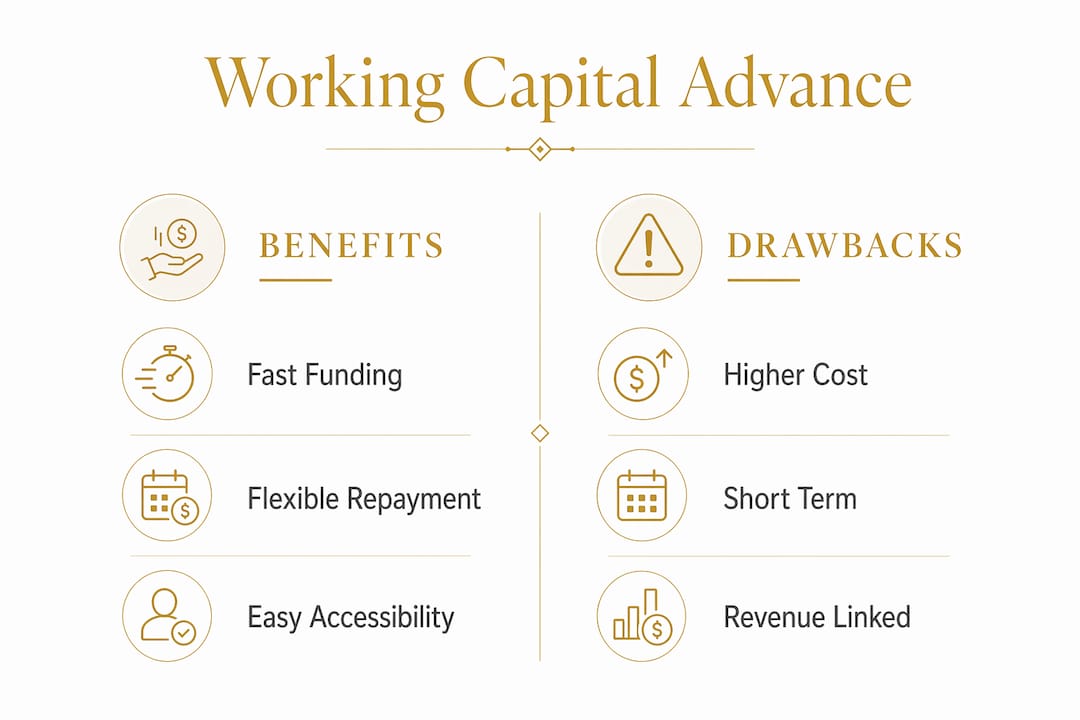
Accessibility matters because underwriting for advances focuses on your recent sales volume and receivables quality rather than years of credit history. Businesses that cannot qualify for SBA loans or bank lines of credit often qualify for merchant cash advances or invoice advances.
Here is how working capital advances compare to the most common alternatives:
| Financing type | Repayment structure | Speed to fund | Best for |
|---|---|---|---|
| Working capital advance | % of daily/weekly sales or receivables | 24 to 72 hours | Immediate cash flow gaps |
| Working capital loan | Fixed monthly installments | Days to weeks | Predictable short-term needs |
| Business line of credit | Draw and repay as needed | Days to weeks | Recurring operational expenses |
| Invoice financing | Paid when invoices clear | 24 to 48 hours | Businesses with slow-paying clients |
| SBA 7(a) working capital | Flexible, asset or transaction-based | Weeks | Manufacturers and exporters |
The drawbacks are real and worth naming directly. Working capital advances are best used for short-term liquidity needs, not for funding long-term growth or capital investments. Using an advance to buy equipment that takes three years to generate a return while repaying daily for the next six months is a cash flow trap. The effective cost of a merchant cash advance, when annualized, frequently exceeds that of a bank loan by a significant margin.
The SBA’s 7(a) Working Capital Pilot Program offers a middle ground worth knowing about. It advances up to 85% of eligible purchase orders and receivables with competitive rates and has delivered over $150 million in new lending since its launch, particularly benefiting small manufacturers. This program combines the accessibility of an advance with the cost structure closer to a traditional loan.
Pro Tip: If your business qualifies for an SBA-backed working capital line, the cost savings over a merchant cash advance can be substantial. Check eligibility before defaulting to the fastest option.
How to access working capital advances and what to consider first
Accessing a working capital advance starts with understanding what lenders actually evaluate. Underwriting focuses on near-term repayment ability and the quality of short-term collateral like receivables and inventory, not your five-year business plan. Lenders want to know: can you generate enough revenue in the next 90 to 180 days to repay this advance without strangling your operations?
Before you apply, prepare the following:
- Three to six months of bank statements showing consistent revenue deposits
- Recent credit card processing statements if applying for a merchant cash advance
- Outstanding accounts receivable aging report for invoice-based advances
- Basic profit and loss statement for the current and prior year
- Business tax returns for the past one to two years
Common sources for working capital advances include online lenders, merchant cash advance providers, and the SBA Working Capital Pilot Program through approved lenders. Each has different eligibility thresholds. Most merchant cash advance providers require a minimum of $10,000 to $15,000 in monthly revenue and at least six months in business. SBA-backed programs require more documentation but offer better pricing.
One critical mistake business owners make is borrowing an amount that does not match their cash conversion cycle. If your customers pay invoices in 60 days but your advance requires daily repayment starting tomorrow, you have created a cash flow problem worse than the one you were solving. Mismatched advances and cash cycles cause funding issues that can compound quickly.
Pro Tip: Map your cash conversion cycle before choosing an advance structure. If your revenue comes in weekly, a weekly repayment schedule fits better than daily ACH withdrawals. Ask lenders explicitly about repayment frequency options.
Practical ways to deploy a working capital advance effectively
The most effective uses of a working capital advance share one characteristic: the cash generates revenue or prevents a loss before the repayment period ends. Payroll is the clearest example. Missing payroll damages employee trust and can trigger legal liability. An advance that covers payroll for two weeks while you wait on a large receivable to clear is a direct, measurable use of short-term capital.
Other high-value deployment scenarios include:
- Inventory purchases ahead of peak season, where the advance funds stock that sells through before repayment completes
- Marketing campaigns with short payback windows, such as a targeted digital ad push tied to a product launch
- Bridging a gap between project completion and client payment, common in construction, consulting, and staffing
- Covering rent or utilities during a slow month to protect your lease and avoid late fees
What you should avoid funding with a working capital advance is equally clear. Equipment with a multi-year useful life, leasehold improvements, hiring for new roles, and market expansion all require capital that stays productive for years. Working capital financing covers the “in-between moments” of cash flow, not permanent capital needs. Treating an advance as growth funding creates a repayment burden that outlasts the benefit.
Managing repayment requires the same discipline as managing the advance itself. Track your daily or weekly payment amounts against your actual revenue. If sales drop sharply, contact your lender immediately. Some providers will adjust repayment schedules rather than let a business default. SBA-backed lines are often self-liquidating through transaction cash flows, which requires disciplined invoicing and receipt processes to keep cash available for operations while the line repays itself.
For a broader look at how advances fit into your overall financing mix, the working capital guide for small businesses at Emorylending covers the full picture of short-term cash management.
Key takeaways
A working capital advance is a short-term liquidity tool tied to future revenue, and its true cost only becomes clear when you calculate the all-in repayment against your actual cash conversion cycle.
| Point | Details |
|---|---|
| Core definition | A working capital advance provides cash against future sales or receivables to cover immediate operating expenses. |
| Repayment structure | Payments are typically daily or weekly as a percentage of revenue, not fixed monthly installments. |
| True cost calculation | Always convert factor rates to an annualized rate over your expected repayment timeline before comparing offers. |
| Best use cases | Payroll, inventory, and short-term cash gaps work well. Long-term investments do not. |
| SBA option available | The SBA 7(a) Working Capital Pilot Program advances up to 85% of eligible receivables at competitive rates. |
Why the true cost conversation matters more than the approval
Most business owners I work with focus on one question when they first consider a working capital advance: “Can I get approved?” That is the wrong starting point. The right question is: “What will this actually cost me, and does my business generate enough revenue in the repayment window to absorb it?”
I have seen businesses take a merchant cash advance at a 1.4 factor rate, repay it in 90 days because sales were strong, and find the effective annualized cost was well above 100%. They were fine because the advance solved a specific problem and they moved on. I have also seen businesses take the same advance, hit a slow quarter, and spend six months watching daily ACH withdrawals drain an account that never fully recovered.
The advance itself is not the problem. The mismatch between repayment speed and revenue reality is the problem. Working capital financing exists to fill a specific gap, not to substitute for a sustainable cash flow model. If you find yourself rolling one advance into another to cover the repayment of the first, that is a signal to stop and reassess your business funding approach rather than take on more short-term debt.
The SBA Working Capital Pilot Program is genuinely underutilized by small businesses that would qualify. The documentation requirements are higher, but the cost difference compared to a merchant cash advance can be significant over a six-month repayment period. If your business has consistent receivables or purchase orders, it is worth the extra week of paperwork.
Use advances as a precision tool. Know exactly what problem you are solving, confirm the repayment timeline fits your revenue cycle, and calculate the total cost before you sign. That discipline separates businesses that use working capital advances to grow from those that use them to survive.
— Jason
How Emorylending helps you find the right working capital financing

Emorylending works with small businesses that need fast, fair access to working capital without the friction of traditional bank underwriting. Unlike lenders that focus on personal credit scores, Emorylending evaluates your business performance and cash flow directly, which means more businesses qualify and get funded faster. Whether you need to cover payroll, restock inventory, or bridge a gap between invoices and expenses, Emorylending offers financing from $5,000 to $5,000,000+. Explore the full business financing options available to small businesses and find the structure that fits your operational timing and repayment capacity.
FAQ
What is the difference between a working capital advance and a loan?
A working capital advance provides cash against future sales or receivables with repayment tied to revenue, while a working capital loan is typically a fixed-term facility with scheduled monthly payments. Advances fund faster and require less documentation, but often carry higher effective costs than traditional loans.
How does repayment work for a merchant cash advance?
Repayment occurs as a fixed percentage of your daily or weekly credit card sales, automatically withdrawn via ACH. Payments fluctuate with your revenue, so slower sales weeks mean smaller payments, but the total payback amount remains fixed regardless of how long repayment takes.
What credit score do I need for a working capital advance?
Most merchant cash advance providers focus on revenue volume and sales consistency rather than credit score, with many approving businesses that have scores below 600. SBA-backed working capital programs have stricter credit requirements but offer significantly better pricing.
Is a working capital advance right for my business?
A working capital advance fits businesses with consistent revenue that need fast cash to cover short-term operational gaps like payroll, inventory, or rent. It is not suitable for funding long-term investments or growth capital, where the repayment speed would outpace the return on the spending.
What is the cost of a working capital advance?
Cost is expressed as a factor rate rather than an interest rate, typically ranging from 1.1 to 1.5 of the advance amount. The effective cost depends on repayment speed, so a 1.3 factor rate repaid in 3 months carries a much higher annualized cost than the same rate repaid over 10 months.


