

Separating business credit from personal credit is the single most important financial move a small business owner can make. The formal term is “business credit segregation,” and it means your company builds its own credit profile with bureaus like Experian, Equifax, and Dun & Bradstreet, completely independent of your personal FICO score. Without this separation, a bad business quarter can wreck your personal credit, a personal hardship can block your business loan, and a lawsuit can reach your personal savings. The reasons to separate business finances go far beyond bookkeeping tidiness. They touch liability, tax compliance, loan access, and long-term growth.
Why separate business credit from personal credit?
Business credit segregation protects your personal assets by keeping your company’s financial identity distinct from your own. When you mix the two, courts can apply a legal doctrine called “piercing the corporate veil,” which treats your business as an extension of you personally. That means commingled finances can void the liability protection your LLC or corporation was designed to provide, exposing your home, savings, and personal accounts to business debts.
The financial upside is equally concrete. A strong business credit history helps businesses secure better loan terms, higher credit limits, and favorable vendor relationships, all independent of the owner’s personal credit score. That independence is what lets a business grow on its own financial track record rather than riding on the owner’s personal reputation.

Tax preparation also becomes cleaner. Separate accounts allow accurate revenue and expense tracking, which supports legitimate deductions and reduces the risk of an IRS audit triggered by mixed personal and business transactions.
The benefits of business credit separation include:
- Personal asset protection: Your home and savings stay shielded from business creditors when finances are kept separate.
- Better financing terms: Lenders offer lower rates and higher limits to businesses with independent credit histories.
- Cleaner tax filings: Dedicated accounts make deductions clear and defensible.
- Business identity theft prevention: The U.S. Small Business Administration notes that separate business credit helps prevent business identity theft, a complex issue with no standardized federal protections.
- Independent credit growth: Your business builds its own financial reputation, which survives even if your personal credit takes a hit.
Pro Tip: Open a dedicated business checking account the same week you register your business. Every dollar that flows through a personal account for business purposes is a liability risk and a tax headache.
What role does your business structure play in separating credit?
Your legal business structure determines how much natural separation exists between you and your company. A sole proprietorship offers zero separation. The IRS and creditors treat you and the business as one entity, so every business debt is your personal debt by default.
An LLC or corporation creates a legal wall between you and the business. That wall only holds, however, if you treat the business as a genuinely separate entity. Commingling funds, paying personal bills from the business account, or skipping corporate formalities can all give a court grounds to pierce the corporate veil.
Personal guarantees add another layer of complexity. A personal guarantee ties your personal credit directly to a business debt obligation, regardless of your business structure. Many lenders require them for early-stage businesses with thin credit histories. Signing one does not undo your credit separation, but it does mean that specific debt will appear on your personal credit report if the business defaults.
Key structural considerations for business owners:
- Sole proprietorship: No legal separation exists. Personal and business credit are the same.
- LLC: Provides liability protection, but only if finances stay strictly separate.
- Corporation (S-Corp or C-Corp): Strongest structural separation, with more formal requirements to maintain it.
- Personal guarantees: Read every financing agreement carefully. A guarantee links that specific debt to your personal credit regardless of entity type.
Choosing the right structure before you take on debt is far easier than restructuring after the fact. Most small business attorneys recommend an LLC as the starting point for entrepreneurs who want liability protection without heavy administrative overhead.
How do credit bureaus track business credit separately?
Business credit profiles are tracked independently from personal credit scores by major commercial bureaus: Experian Business, Equifax Business, and Dun & Bradstreet. Each bureau uses its own scoring model. Dun & Bradstreet uses the PAYDEX score (0–100), Experian uses the Intelliscore Plus (0–100), and Equifax uses its own commercial scoring system.
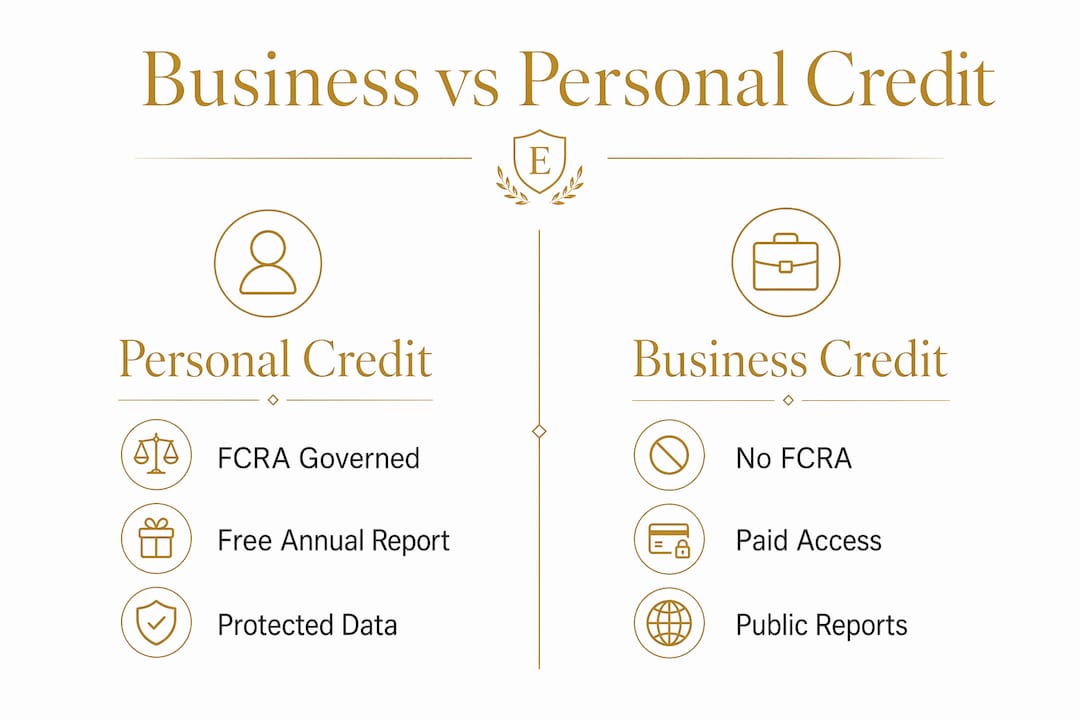
The rules governing business credit reports differ sharply from personal credit rules. Personal credit is governed by the Fair Credit Reporting Act (FCRA), which gives consumers free annual reports and formal dispute rights. Business credit reports have no mandated free access and no formal dispute rights, making proactive monitoring non-negotiable.
| Feature | Personal credit | Business credit |
|---|---|---|
| Governed by FCRA | Yes | No |
| Free annual report | Yes | No |
| Formal dispute rights | Yes | Limited |
| Public accessibility | No | Yes, for a fee |
| Score range (common) | 300–850 (FICO) | 0–100 (PAYDEX/Intelliscore) |
Business credit reports are also publicly accessible for a fee, which means vendors, suppliers, and potential partners can check your business credit before agreeing to work with you. That visibility cuts both ways. A strong profile opens doors. A thin or negative profile closes them.
Pro Tip: Check your business credit reports on Experian Business, Equifax Business, and Dun & Bradstreet at least once per quarter. Errors on business reports have no automatic correction process, so you have to catch and dispute them manually.
What practical steps can business owners take to separate their credit?
Building a separate business credit profile requires deliberate action. It does not happen automatically when you register a business.
- Get an Employer Identification Number (EIN). An EIN is your business’s tax ID, issued by the IRS. It replaces your Social Security Number in business financial transactions and is the foundation of a separate business identity.
- Obtain a DUNS number. A DUNS number uniquely identifies your business location and is required by many lenders and government contractors to establish an independent credit profile with Dun & Bradstreet.
- Open a dedicated business bank account. Use it exclusively for business income and expenses. Never pay personal bills from it.
- Apply for a business credit card. Use it only for business purchases. Business credit cards can offer up to 5% rewards on operational spending categories like advertising and office supplies, which adds real value beyond credit building.
- Work with vendors that report to business bureaus. Not all vendors report payment history. Prioritize suppliers who report to Experian Business, Equifax Business, or Dun & Bradstreet so your on-time payments build your profile.
- Monitor your business credit reports regularly. Since business reports lack FCRA protections, you bear full responsibility for catching errors. Set a quarterly calendar reminder.
For owners who want to understand how their credit profile affects financing decisions, the factors behind loan approval include business credit score, cash flow, and time in business. Building your business credit profile directly improves your position on all three.
Additional habits that protect your separation:
- Keep a separate business mailing address if possible.
- Sign contracts in the business name, not your personal name.
- Pay business invoices from the business account, always.
- Review your business credit improvement plan at least annually.
Key Takeaways
Separating business credit from personal credit protects your assets, improves loan access, and gives your company a financial identity that grows independently of your own.
| Point | Details |
|---|---|
| Liability protection | Commingled finances can pierce the corporate veil, exposing personal assets to business debts. |
| Independent credit profile | Bureaus like Dun & Bradstreet, Experian, and Equifax track business credit separately from your FICO score. |
| Better loan terms | A strong business credit history supports higher credit limits and lower rates without relying on personal credit. |
| Tax and bookkeeping clarity | Separate accounts make expense tracking accurate and tax deductions defensible. |
| Proactive monitoring required | Business credit reports have no FCRA protections, so owners must check for errors manually each quarter. |
The discipline gap most business owners miss
Most entrepreneurs I talk to understand, in theory, that they should keep business and personal finances separate. The gap is in execution. They open a business account but still run a personal card for “just a few” business expenses. They sign a lease in their own name because it was faster. They skip the DUNS number because it felt optional. Each of those shortcuts chips away at the separation they think they have.
The real risk is not just legal. It is psychological. When your business finances are tangled with your personal ones, you lose the ability to read your business clearly. You cannot tell if the business is actually profitable or if it just looks that way because your personal income is covering gaps. That confusion leads to bad decisions, delayed problems, and eventually a crisis that could have been avoided.
The owners I have seen build genuinely strong businesses treat their business credit with the same discipline they apply to their personal credit. They check reports. They pay on time. They know their scores. They understand that personal and business accounts affect loans differently, and they plan accordingly. That discipline is not complicated. It is just consistent.
Start with the basics: EIN, business bank account, business credit card. Then build from there. The separation you create in year one pays dividends in year five when you need a $500,000 line of credit and your business can qualify on its own merits.
— Jason
How Emorylending supports businesses with strong credit foundations
Emorylending evaluates small businesses based on performance and cash flow, not just personal credit scores. That approach rewards business owners who have done the work of building a separate, credible business credit profile.

Whether you need flexible small business financing for working capital, equipment, or expansion, a clean business credit profile makes the process faster and the terms better. Emorylending works with businesses securing funding from $5,000 to $5,000,000+. If your business is growing and your finances are in order, Emorylending has options built for where you are right now. Review the full business financing options available and apply when you are ready.
FAQ
Why should I separate business and personal credit?
Separating business and personal credit protects your personal assets from business liabilities and allows your company to build its own credit history. Without separation, a business debt or lawsuit can reach your personal savings and home.
Does my business structure affect credit separation?
Yes. An LLC or corporation creates a legal barrier between you and the business, but only if you keep finances strictly separate. A sole proprietorship offers no separation at all.
What is a DUNS number and do I need one?
A DUNS number is a unique identifier issued by Dun & Bradstreet that establishes your business as a separate credit entity. Most lenders and government contractors require one to evaluate your business credit profile independently.
Are business credit reports protected like personal credit reports?
No. Personal credit reports are governed by the Fair Credit Reporting Act, which provides free annual access and dispute rights. Business credit reports have no such federal protections, so owners must monitor and dispute errors on their own.
Can a personal guarantee undo my business credit separation?
A personal guarantee ties your personal credit to that specific debt, but it does not collapse your overall credit separation. It means that one obligation will affect your personal credit if the business defaults, while the rest of your business credit profile remains independent.


