

Timing is the single most decisive factor in business funding success. Securing capital at the right moment transforms funds from a survival tool into a growth accelerator. A Bill Gross analysis of 200 startups found that timing alone accounts for 42% of the difference between startup success and failure. That figure dwarfs team quality, business model, and idea combined. Why timing matters in business funding comes down to one truth: capital aligned with your business cycle creates momentum, while capital deployed at the wrong moment creates drag. Emorylending evaluates business performance and cash flow precisely because those signals reveal when a business is ready to put capital to work.
Why timing matters in business funding outcomes
The moment you apply for funding shapes every term you receive. Businesses that prepare early enjoy better negotiating leverage and more financing flexibility. That preparation gap is not small. Owners who approach lenders before pressure builds can compare options, negotiate rates, and choose structures that fit their growth phase. Owners who wait until cash is tight accept whatever is available.
Well-timed capital lets you respond immediately to market demand. A retailer who secures a line of credit before the holiday season can stock inventory at full margin. A contractor who arranges equipment financing before winning a large bid can start on day one without scrambling. The window between opportunity and execution is often measured in days, not months.

Poor timing creates a compounding problem. Borrowing too late decreases funding options and increases both costs and dependency on lenders. Higher rates and shorter terms eat into the same revenue the loan was meant to generate. The business ends up weaker after the loan than it would have been without it.
The importance of timing in funding also shows up in how cash flow stability depends more on payment timing than on raw sales volume. A business with strong revenue but slow-paying clients can still face a cash crisis. Financing timed to cover that gap keeps operations steady without long-term disruption.
Here is what separates owners who use capital well from those who do not:
- Apply before urgency. Lenders read desperation in your numbers. Applying from a position of strength produces better terms.
- Match loan type to purpose. Working capital loans cover short gaps. Equipment financing covers long-term assets. Mixing the two creates structural debt problems.
- Align repayment with revenue cycles. A seasonal business should not carry fixed monthly payments through its slow quarter.
- Track your cash flow gaps in advance. Predictable gaps, like net-60 receivables or seasonal inventory builds, are the clearest signal that financing is needed.
Pro Tip: Build your funding relationship before you need it. Lenders who already know your business history move faster and offer better terms when you do need capital.
What happens when you seek funding too early or too late

The two most common timing mistakes pull in opposite directions, but both destroy capital efficiency.
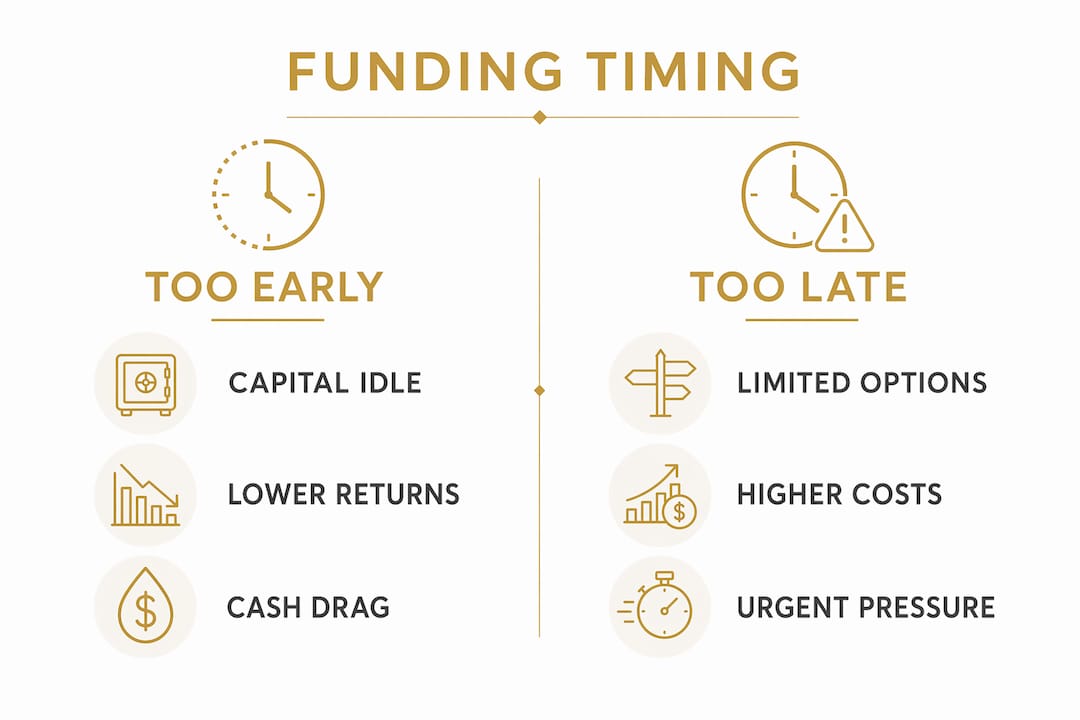
Being too early is a capital efficiency problem. When you raise or borrow before the market is ready, you spend that capital educating customers, building infrastructure, and waiting for behavior to shift. Second and third entrants in a market benefit from proven demand, existing customer habits, and supplier networks that the pioneer paid to create. The pioneer burns through capital with little to show for it.
Perfect timing means customer budgets, behavior, and infrastructure already align with what you are selling. You are not convincing anyone that the product category exists. You are simply capturing demand that is already there. That distinction changes your cost per customer, your conversion rate, and your burn rate simultaneously.
Being too late is a different trap. When financial pressure builds before you seek funding, your options narrow fast. Lenders see declining margins or stressed cash flow and either decline or price the risk into the rate. You lose negotiating power at exactly the moment you need it most.
“Raising capital when not desperate preserves control, optionality, and attracts more favorable terms. Raising after traction leads to better valuations and less dilution.” — 0toPMF
The signals that you are approaching the “too late” zone include:
- Payroll timing is getting tighter each cycle
- You are delaying supplier payments to manage cash
- A growth opportunity appeared but you cannot fund it without borrowing under pressure
- Your bank account balance is the primary reason you have not expanded
Recognizing these signals early gives you time to act from strength. Waiting until they become crises removes that option entirely. The business funding checklist from Emorylending is built around catching these signals before they become emergencies.
Timing strategies for business loans and funding applications
The best time to seek funding is when your business does not desperately need it. That sounds counterintuitive, but it is the core of every sound timing strategy for business loans.
Recognizing predictable cash flow gaps is the first practical step. Most businesses have recurring gaps tied to their industry cycle, payment terms, or seasonal demand. Mapping those gaps twelve months out tells you exactly when financing will add the most value and when repayment will be least painful.
The table below shows how funding timing aligns with different business phases:
| Business phase | Funding goal | Best timing signal |
|---|---|---|
| Early growth | Working capital, inventory | Consistent revenue for 6+ months |
| Expansion | Equipment, new locations | Signed contracts or proven demand |
| Seasonal peak | Inventory, staffing | 60–90 days before peak season |
| Cash flow gap | Bridge financing | At gap identification, not at crisis |
| Stabilization | Refinancing, restructuring | When cash flow is positive |
Aligning your funding request with a growth phase rather than a stability need also changes how lenders read your application. A loan request tied to a signed contract or a documented demand signal tells a clear story. A loan request tied to covering last month’s shortfall tells a different one.
Pro Tip: Pull your last 12 months of bank statements before you apply. Lenders will see your cash flow patterns. You should see them first and be ready to explain any dips.
Comparing financing options before urgency emerges is another underused strategy. When you have time, you can evaluate flexible financing options side by side and choose the structure that fits your cycle. When you are under pressure, you take what is available. Early preparation is what separates owners who build on their terms from those who borrow on the lender’s terms.
How economic cycles affect the best time to seek funding
Capital availability follows economic cycles in a pattern that works against most business owners. Capital is most abundant late in economic cycles and scarcest when businesses most need growth funds. Institutional lenders deploy capital based on their own fund timelines, not on when market opportunity peaks for your business.
That misalignment is not accidental. It reflects how institutional capital works. Funds raise money, deploy it over a fixed window, and return results to investors. Your business cycle and their deployment cycle rarely match. Understanding that gap is a real advantage.
The practical implication is that patient capital is a strategic asset. Owners who build cash reserves and credit relationships during strong periods can access capital quickly when conditions shift. Owners who wait for a downturn to start building those relationships find the door closed or the price too high.
Funds deployed under pressure also carry timing risk. A business that borrows to survive a slow quarter and then faces another slow quarter has compounded its problem. The loan that was meant to bridge a gap becomes a fixed cost that outlasts the gap it was meant to cover.
The owners who navigate economic cycles best treat funding timing as a continuous planning activity, not a one-time event. They monitor their cash flow management metrics regularly, maintain relationships with lenders before they need them, and apply when their numbers tell the strongest story. That discipline pays off in lower rates, better terms, and more control over how their business grows.
Key takeaways
Timing determines whether capital accelerates your business or burdens it. Applying early, aligning funding with your business cycle, and reading economic signals correctly are the three habits that separate owners who grow on their terms from those who borrow under pressure.
| Point | Details |
|---|---|
| Timing drives 42% of outcomes | Bill Gross research shows timing outweighs team, idea, and business model in startup success. |
| Apply before pressure builds | Owners who apply early get better rates, more options, and stronger negotiating position. |
| Map your cash flow gaps | Identifying predictable gaps 60–90 days out lets you time financing for maximum impact. |
| Avoid the too-early trap | Raising capital before market readiness burns funds educating customers instead of capturing demand. |
| Patient capital wins cycles | Building credit relationships during strong periods gives you access when conditions tighten. |
The timing lesson most owners learn too late
Most conversations about business funding focus on how much to raise. The more important question is when. I have seen owners secure large funding rounds and watch the capital sit idle because the market was not ready. I have also seen owners with a clear growth opportunity lose it because they waited two weeks too long to apply.
The conventional wisdom says raise money when you can. That is half right. The full truth is raise money when your business can absorb it productively. Capital that arrives before your systems, team, or market are ready creates distraction, not growth. It inflates your cost base and pressures you to justify the spend before the conditions for success exist.
Waiting for traction before seeking funding is not timidity. It is discipline. Owners who raise after proving demand get better valuations, give up less control, and walk into lender conversations with leverage. The funding impact on growth is real, but only when the business is positioned to deploy that capital against a proven opportunity.
The other mistake I see constantly is treating funding as a one-time decision. The owners who build the best capital relationships treat funding timing as an ongoing practice. They know their cash flow cycle. They know their growth triggers. They apply when their numbers are strongest, not when their bank account is weakest. That shift in mindset is worth more than any single funding round.
— Jason
Funding timed to your business cycle with Emorylending
Knowing when to apply is only half the equation. Having a lender who evaluates your business on its actual performance makes the other half possible.
Emorylending focuses on cash flow and business performance rather than personal credit scores. That means your application reflects what your business actually does, not just a number from your personal history. Whether you need working capital to cover a seasonal gap, equipment financing to fulfill a new contract, or funds to open a second location, Emorylending works with businesses from $5,000 to $5,000,000+. The right time to apply is when your business is positioned to grow. Emorylending is built to move fast when that moment arrives.
FAQ
Why does timing matter more than the amount raised?
Timing determines whether capital is deployed against real demand or spent waiting for the market to catch up. A well-timed smaller raise outperforms a larger raise that arrives too early or too late.
When is the best time to apply for a business loan?
The best time is before financial pressure builds, ideally when cash flow is positive and you can identify a specific growth opportunity or predictable gap 60–90 days ahead.
What are the risks of seeking funding too late?
Borrowing under pressure narrows your options, weakens your negotiating position, and typically results in higher rates and shorter repayment terms.
How do economic cycles affect funding timing?
Capital tends to be most available late in economic cycles when businesses need it least. Building lender relationships and credit history during strong periods gives you access when conditions tighten.
How can I recognize the right timing signal for my business?
Map your recurring cash flow gaps, track revenue trends over 12 months, and apply when your numbers show consistent performance. The funding readiness checklist from Emorylending helps identify those signals before they become urgent.


