

Fintech lending is defined as technology-driven platforms and processes that improve how business loans are originated, underwritten, priced, and monitored. The role of fintech in business loans goes well beyond speed. It fundamentally changes who qualifies, how risk is measured, and what loan products are available to small and mid-sized businesses. Where traditional banks rely on credit scores and collateral, fintech platforms use real-time cash flow data, API integrations, and alternative credit signals to make faster, more accurate lending decisions. For business owners who have been turned away by banks or need capital quickly, understanding how digital lending solutions work is one of the most practical things you can do in 2026.
How fintech reshapes business loan underwriting and monitoring
Traditional underwriting relies on quarterly financial statements and personal credit scores. Fintech underwriting replaces that slow, backward-looking process with real-time data pulled directly from business bank accounts, accounting software, and payment processors.
The core mechanism is API integration. When a business connects its bank account through a service like Plaid, a fintech lender can assess cash flow instantly, often approving or declining a loan application in minutes rather than weeks. Without that digital connection, the same approval can take days. This is why your accounting infrastructure matters as much as your credit profile when applying through a fintech platform.

Continuous monitoring is the other major shift. Instead of reviewing financials once at origination, fintech lenders track borrower performance in real time throughout the loan term. That ongoing visibility gives lenders more confidence in the borrower’s ability to repay, which translates directly into better terms. Research from the Bank for International Settlements affiliate SUERF shows that fintech monitoring reduces rates by 20–30 basis points on non-collateralized credit lines. That may sound small, but on a $500,000 credit line, it adds up to thousands of dollars per year.
Continuous monitoring also reduces collateral requirements by giving lenders accurate, real-time borrower data. Businesses that cannot pledge physical assets can still qualify because the data itself substitutes for traditional security.
Key fintech underwriting inputs include:
- Bank account transaction history pulled via API for cash flow analysis
- Revenue trends from payment processors like Square or Stripe
- Accounts receivable aging from accounting platforms
- Industry benchmarks used to contextualize a business’s performance
- Merchant processing volume for businesses with high card sales
Pro Tip: Connect your accounting software and business bank account before applying to any fintech lender. Lenders with full API access to your financials can approve you faster and often offer better rates than those working from uploaded PDFs.
What types of business loans do fintech platforms offer?
Fintech platforms offer a wider range of loan products than most business owners realize. Each product is built around a different repayment structure and risk profile, so matching the right product to your need matters more than finding the lowest headline rate.
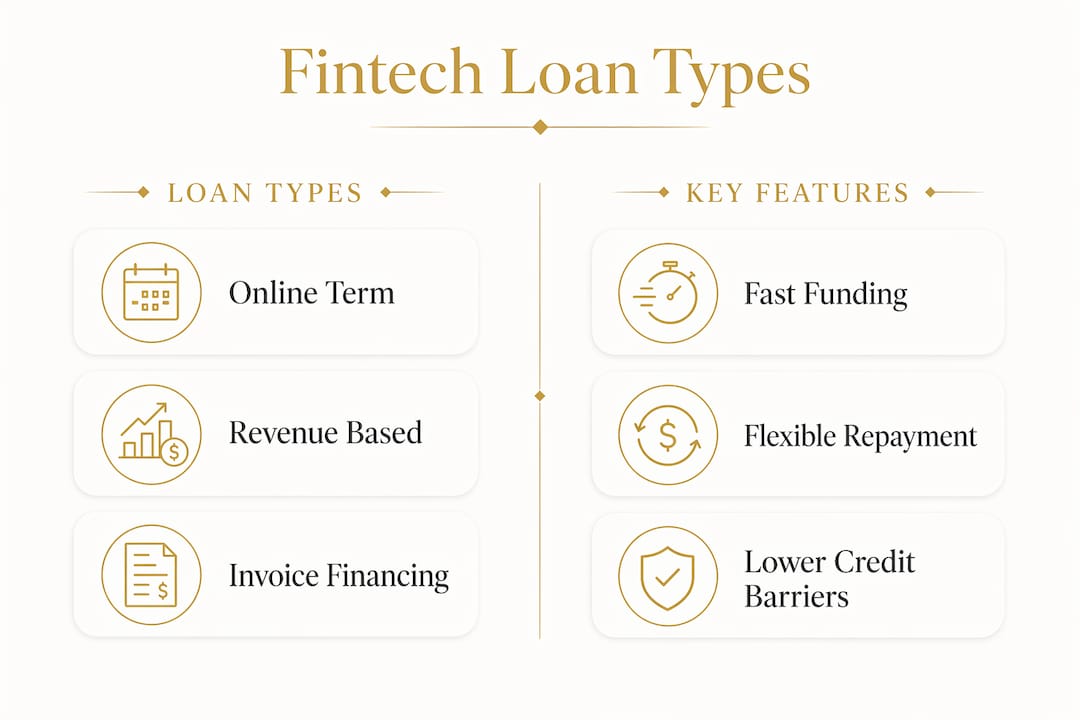
| Loan type | Typical funding time | Repayment structure | Best for |
|---|---|---|---|
| Online term loan | 1–3 days | Fixed monthly payments | Equipment, expansion |
| Business line of credit | Same day to 48 hours | Draw and repay as needed | Working capital, cash gaps |
| Revenue-based financing | 1–2 days | Percentage of daily revenue | Seasonal businesses |
| Invoice factoring | 24–48 hours | Advance on outstanding invoices | Businesses waiting on receivables |
| Merchant cash advance | Same day | Percentage of card sales | High-volume retail or food service |
Alternative business financing through fintech platforms typically funds in days, accepts lower credit scores, and prioritizes cash flow over collateral. Traditional bank loans and SBA loans offer lower rates but require stronger credit, more documentation, and weeks or months to close.
The tradeoff is real. Fintech loans fund faster and carry lower qualification barriers, but they cost more than traditional bank or SBA loans. A business line of credit from a fintech platform might carry an APR of 20–40%, while an SBA 7(a) loan sits closer to 10–13%. The right choice depends on how urgently you need capital and how much that speed is worth to your business.
Revenue-based financing deserves special attention for seasonal businesses. Repayments flex with your revenue, so a slow month means a smaller payment. That flexibility has real value when your cash flow is unpredictable.
How does fintech improve credit access for underserved businesses?
Fintech’s biggest contribution to small business lending is not speed. It is access. Banks have historically avoided small-ticket loans because the processing cost per loan is nearly the same whether the loan is $10,000 or $1,000,000. Fintech platforms automate that processing, making small loans economically viable.
The numbers reflect this shift. Fintech lenders accounted for 77% of small business loans disbursed by volume in FY26. That dominance in high-volume, small-balance lending shows exactly where fintech fills the gap traditional banks leave open.
The mechanism behind this expansion is the reduction of information asymmetry. Banks struggle to evaluate small businesses because those businesses often lack audited financials, long credit histories, or significant collateral. Fintech platforms use alternative data to fill that gap. A two-year-old restaurant with strong card sales and consistent deposits can qualify for a business line of credit even without a decade of tax returns.
Regulatory frameworks also play a role. Research from the Bank for International Settlements shows that well-designed data privacy rules like the California Consumer Privacy Act improve fintech loan market outcomes by encouraging data sharing and reducing default rates. Better data sharing means better screening, which means lenders can extend credit to more businesses without taking on more risk.
Fintech does not replace traditional banks. Research published in the Advance Journal of Econometrics and Finance confirms that fintech primarily relieves operational frictions such as transaction costs and information asymmetry, rather than fully solving structural collateral or business risk constraints. The two systems work best together. A business might use a fintech line of credit for short-term working capital while maintaining a traditional bank relationship for long-term loans.
What should business owners know about the costs of fintech loans?
Speed and access come at a price. The convenience premium on fintech loans is real, and business owners who focus only on whether they qualify often miss the full cost picture.
The most important number is not the interest rate. It is the Total Cost of Capital, which includes origination fees, factor rates, repayment timing, and any prepayment penalties. A merchant cash advance with a factor rate of 1.3 means you repay $1.30 for every $1.00 borrowed, regardless of how quickly you pay it off. Calculating total cost of capital rather than relying on headline APRs is the only way to compare fintech loan offers accurately.
Repayment structure also affects your cash flow in ways that a simple interest rate does not capture. Daily or weekly revenue-based repayments reduce your available cash more aggressively than monthly fixed payments. For a business with thin margins, that difference can create a cash crunch even when the loan is technically affordable.
Key questions to ask before accepting any fintech loan offer:
- What is the total repayment amount? Not just the rate, but the full dollar amount you will repay.
- How often are payments taken? Daily and weekly draws hit cash flow harder than monthly payments.
- Are there prepayment discounts? Some fintech lenders reduce the cost if you repay early.
- What triggers a default? Some agreements have revenue-based covenants that can accelerate repayment.
- Is the rate fixed or variable? Variable rates tied to prime can increase your cost mid-term.
Pro Tip: Before signing any fintech loan agreement, ask the lender to state the total repayment amount in dollars. If they can only quote you a rate or factor, calculate it yourself. Knowing the exact dollar cost removes ambiguity and helps you compare offers side by side.
Emorylending evaluates your business performance and cash flow rather than focusing on personal credit alone. That approach gives more business owners a realistic shot at funding without the guesswork of traditional credit-score gatekeeping. You can review common financing mistakes that business owners make when evaluating loan offers before you commit to any product.
Key takeaways
Fintech lending expands business loan access by replacing backward-looking credit checks with real-time cash flow data, continuous monitoring, and flexible loan products that fit how small businesses actually operate.
| Point | Details |
|---|---|
| Real-time underwriting | Fintech lenders use API-connected bank data to approve loans in minutes, not weeks. |
| Monitoring lowers rates | Continuous digital monitoring can reduce interest rates by 20–30 basis points on credit lines. |
| Access over replacement | Fintech fills the small-loan gap banks avoid, complementing rather than replacing traditional lenders. |
| Total cost matters most | Always calculate the full repayment amount, not just the headline APR or factor rate. |
| Digital readiness speeds approval | Connecting accounting software and bank accounts via API is the single fastest way to improve your loan terms. |
What I have learned from watching fintech reshape small business lending
The conversation about fintech loans usually focuses on speed, and speed is real. But after watching hundreds of small business owners go through the financing process, the more important story is about information.
Traditional banks are not slow because they are inefficient. They are slow because they genuinely do not have enough data on most small businesses to make a confident decision quickly. Fintech platforms solve that problem by pulling the data directly from the source. When a lender can see 24 months of daily transactions, they know your business better than you might think. That knowledge is what makes faster, fairer decisions possible.
The businesses that get the best fintech loan terms are not necessarily the most profitable ones. They are the ones with the cleanest, most connected financial data. A business running on spreadsheets and paper invoices will always get slower approvals and worse terms than a comparable business using cloud accounting and connected payment processing. That is a fixable problem, and fixing it before you need a loan is far better than fixing it under pressure.
The cost premium on fintech loans is legitimate and worth paying in the right situation. If you need $150,000 to cover payroll during a slow quarter and a bank loan would take 60 days to close, the extra cost of a fintech loan is not waste. It is the price of staying in business. The mistake is using expensive short-term fintech capital for long-term investments where a slower, cheaper loan would have served you better.
Fintech is not a cure-all. It works best for businesses that are already operating well and need capital to grow or bridge a gap. If your business has fundamental cash flow problems, a faster loan will not fix them. Know what you are solving before you borrow.
— Jason
Emorylending’s approach to fintech-powered small business financing
Emorylending uses the same data-driven underwriting principles that make fintech lending work, without the opaque pricing that frustrates so many business owners. The focus is on your business performance and cash flow, not your personal credit score.
Whether you need working capital, equipment financing, or funds to expand a location, Emorylending offers flexible financing options from $5,000 to $5,000,000+. The process is built around speed and transparency, so you know exactly what you are getting before you sign. If you want a clear picture of what financing options fit your business right now, the business financing options list is a practical place to start.
FAQ
What is fintech lending for small businesses?
Fintech lending uses technology, including API integrations, real-time data analysis, and automated underwriting, to originate and manage business loans faster and with fewer documentation requirements than traditional banks.
How does fintech improve loan approval speed?
Fintech lenders connect directly to business bank accounts via APIs to assess cash flow in real time. When that digital connection is in place, approval can happen in minutes rather than days or weeks.
Are fintech business loans more expensive than bank loans?
Yes, in most cases. Fintech loans carry higher costs than traditional bank or SBA loans in exchange for faster funding, lower qualification barriers, and more flexible repayment structures.
What is the Total Cost of Capital in fintech lending?
Total Cost of Capital is the full dollar amount you repay over the life of a loan, including fees, factor rates, and interest. It is a more accurate comparison tool than APR alone, especially for revenue-based repayment products.
Does fintech replace traditional bank lending for businesses?
No. Research confirms that fintech reduces operational frictions like transaction costs and information gaps, but it does not replace collateral-based bank lending. The two work best as complementary sources of capital.


