

Running a business in the Southeast means dealing with real growth opportunities and real cash flow gaps at the same time. Yet Southeast small businesses face more financing application rejections than firms in many other U.S. regions, according to the Atlanta Fed’s Small Business Credit Survey. That gap between wanting capital and actually securing it comes down to preparation, product selection, and how well your application tells your business story. This guide walks you through every step so you can close that gap and get the funding your business deserves.
Table of Contents
- Understanding your business’s funding needs
- Preparing your application: what lenders look for
- Choosing the right funding option
- Avoiding common funding mistakes in the Southeast
- What most guides miss: proven Southeast strategies for funding success
- Ready to fund your business growth? Explore smart solutions
- Frequently asked questions
Key Takeaways
| Point | Details |
|---|---|
| Match funding to need | Choose the right financial product for your growth goal—working capital, equipment, or expansion. |
| Strengthen your application | Lenders prioritize repayment ability and solid documentation, especially in the Southeast. |
| Apply smarter | Understand denial rates and tailor your application to product and lender-specific expectations. |
| Avoid common mistakes | Address cash-flow issues and present clear repayment strategies to improve approval odds. |
| Use Southeast strategies | Customize your narrative to regional lender concerns for the best chances at funding success. |
Understanding your business’s funding needs
Now that the challenge is clear, let’s start by identifying which funding is right for you. This step matters more than most owners realize. Walking into a lender conversation without knowing exactly what you need is like showing up to a job interview without knowing what role you applied for. Lenders want to see that you have a clear purpose for the money and a plan to repay it.
Funding types vary, and 75% of small businesses used some form of financing in the past 12 months. That means most of your competitors are already using capital to grow. The question is whether yours is working as hard as it could be.
Here is a quick breakdown of the most common funding categories for Southeast small businesses:
Common funding types and what they support:
- Working capital covers day-to-day operations, payroll, inventory restocking, and bridging gaps between invoicing and payment
- Equipment financing funds specific asset purchases like machinery, vehicles, kitchen equipment, or technology upgrades
- Growth capital fuels new locations, product launches, or hiring for expansion phases
- Lines of credit give you flexible access to funds you draw and repay on a revolving basis
- Merchant cash advances provide a lump sum repaid through a percentage of daily sales
Before you apply for anything, work through a business funding checklist to confirm your numbers are organized and your purpose is clearly defined.
| Funding type | Best for | Typical term | Speed |
|---|---|---|---|
| Working capital loan | Cash flow gaps, payroll | 6 to 24 months | Fast |
| Equipment financing | Asset purchases | 2 to 7 years | Moderate |
| SBA loan | Expansion, long-term growth | Up to 25 years | Slow |
| Line of credit | Ongoing, flexible needs | Revolving | Moderate |
| Merchant cash advance | Immediate cash needs | 3 to 18 months | Very fast |
For businesses buying machinery or vehicles, the equipment financing guide provides detailed options specific to small business owners. Equipment loans often use the asset itself as collateral, which means you may qualify even if your overall financials are not perfect.
Matching your funding type to your actual need is the single biggest factor in getting approved. If you need to buy a delivery truck, an equipment loan makes far more sense than a short-term working capital advance. Get this right before you fill out a single application.
Preparing your application: what lenders look for
With your funding goal clarified, next comes preparing a compelling application. A weak application is not usually the result of a struggling business. It is almost always the result of a business that failed to communicate its strength clearly.
SBA lenders focus on repayment ability, equity injection, and earnings potential as their primary approval criteria. These three factors tell a lender whether your business can handle the debt load, whether you have skin in the game, and whether your future looks profitable enough to justify the risk.
Sixth District firms often struggle with cash flow and operating expenses, and lenders in the region know this. That means your application must directly address these concerns rather than hope the reviewer overlooks them.
Here is how to build an application that works:
-
Organize your financial documents. Pull together your last two to three years of business tax returns, recent bank statements (at least three to six months), profit and loss statements, and a current balance sheet.
-
Create realistic cash flow projections. Show monthly projections for at least 12 months. Be honest about seasonal dips, especially if your business is in hospitality, construction, or retail where revenue swings are common in the Southeast.
-
Document your repayment plan. Lenders want to see exactly how you will repay the loan. Show which revenue sources will cover the payment and what happens if one of those sources slows down.
-
Prepare a management profile. Briefly summarize your experience running the business and any relevant background. This is especially important for newer businesses that do not have years of financials to lean on.
-
Calculate your equity injection. If you are applying for an SBA loan, be prepared to contribute capital. This shows commitment and reduces lender risk.
| Document | Why lenders need it |
|---|---|
| Business tax returns | Confirms reported revenue and profitability |
| Bank statements | Shows actual cash flow patterns |
| P&L statement | Demonstrates operational performance |
| Cash flow projections | Reveals ability to repay future debt |
| Balance sheet | Confirms assets, liabilities, and equity |
Pro Tip: Southeast businesses with seasonal revenue should annotate their cash flow projections to explain low months. A lender who does not understand why revenue drops in January may simply see a red flag. You control that narrative.
Understanding how business loans work before you apply gives you a significant edge. You will know what the lender is calculating, what ratios matter, and where your application might be weak before anyone else points it out. For businesses targeting term loans specifically, review the term loan approval tips to fine-tune your approach.
Choosing the right funding option
With preparation done, let’s match your business to the right funding option. This is where many Southeast owners make their most expensive mistake. They apply for the product they have heard of rather than the product that fits their situation.

Loan denial rates vary widely by product type, with SBA loans and lines of credit carrying the highest denial rates of any funding category. That does not mean you should avoid them. It means you need to go in prepared and only apply when you genuinely meet the criteria.
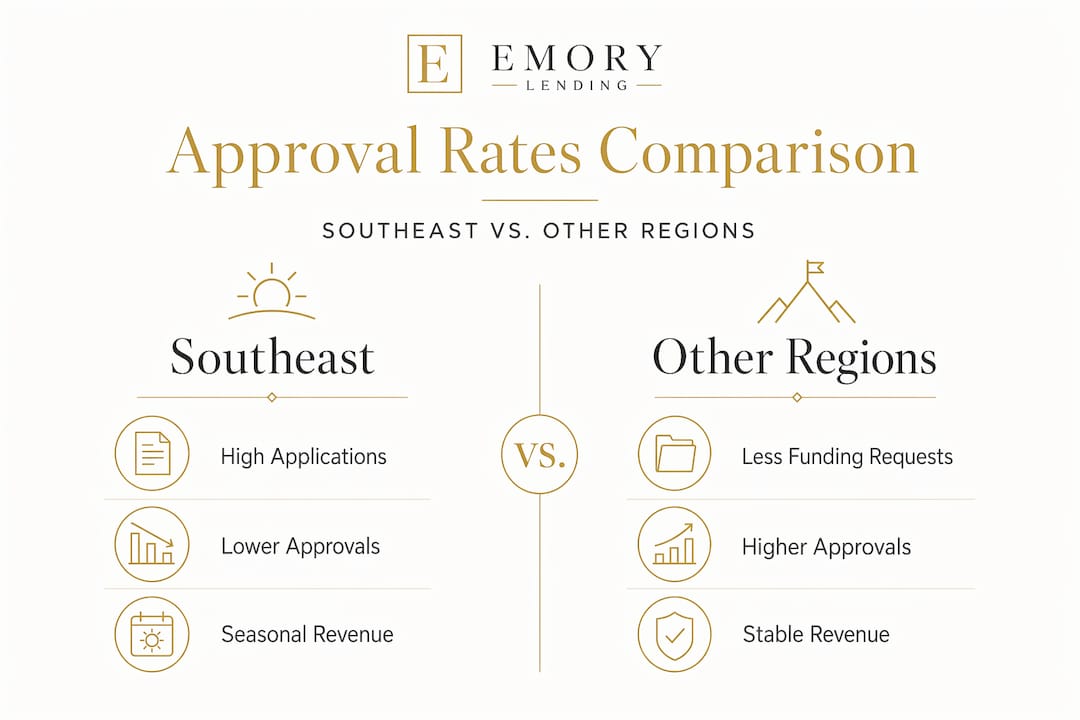
Sixth District businesses are more likely to apply for funding and less likely to be approved compared to businesses in other regions. Choosing your product carefully is not just good advice here. It is essential.
Here is a practical comparison to help you decide:
| Funding option | Approval difficulty | Best fit | Cost level |
|---|---|---|---|
| Bank term loan | High | Established businesses, strong credit | Low to moderate |
| SBA loan | Very high | Long-term growth, real estate | Low (long term) |
| Line of credit | High | Ongoing cash flow needs | Moderate |
| Alternative lender | Moderate | Newer businesses, weaker credit | Moderate to high |
| Merchant cash advance | Low | Fast cash, high daily sales | Very high |
A few key points worth knowing before you commit to any product:
- Bank loans are stable and affordable, but they require strong personal and business credit, two-plus years of history, and solid profitability. If you are a younger business, these may not be accessible yet.
- SBA loans offer favorable terms but take longer to process and involve more documentation. They are better suited for expansion or equipment purchases than for urgent working capital needs.
- A business line of credit gives you the flexibility to draw funds as needed, which is ideal for businesses with uneven revenue cycles common in Southeast markets like tourism, agriculture, or construction.
- Merchant cash advances are fast but expensive. Use them only when the cost is justified by the return on the investment you are making.
For businesses evaluating SBA and term loans side by side, the difference often comes down to how quickly you need the money and how well your application package is prepared. If your business is ready for serious growth, exploring business growth funding options designed for expansion is worth the time.
Pro Tip: Apply for the product that fits your situation today, not the one that sounds best on paper. Getting approved for the right product beats getting denied for the prestigious one every single time.
Avoiding common funding mistakes in the Southeast
Knowing which product to choose is important, but avoiding the mistakes that sink applications is just as critical. These are the errors we see most often, and each one is preventable.
“Denial risk is concentrated in regulated products like SBA loans and lines of credit. Apply smarter by matching the product to your need and strengthening your underwriting inputs.” Small-Business Application Denial Study
Southeast denial rates often stem from not addressing cash flow repayment and uneven revenue timing in the application. Here are the most common mistakes and how to correct them:
-
Submitting generic cash flow documents. If your business has seasonal revenue, a lender looking at a slow quarter without context will draw the wrong conclusion. Annotate your statements. Explain the pattern.
-
Applying for the wrong product. A restaurant owner who applies for an SBA 7(a) loan to cover a short-term ingredient shortage is using the wrong tool. Match the urgency and purpose to the product.
-
Failing to document a repayment strategy. Simply showing that you earn enough revenue is not sufficient. Show specifically which revenue stream covers the debt payment each month.
-
Ignoring your debt service coverage ratio. This ratio (your net operating income divided by total debt payments) tells lenders whether you can handle the loan. Know yours before you apply. Most lenders want to see a ratio of 1.25 or higher.
-
Skipping the management section. For newer businesses, the owner’s background and relevant experience can make or break an approval when financials alone are thin.
Common red flags lenders look for:
- Recent overdrafts on business bank statements
- Sharp revenue declines without explanation
- Personal and business finances mixed together
- Missing tax returns or inconsistent income reporting
- High existing debt relative to revenue
The small business loan blog covers many of these issues with detailed breakdowns specific to Southeast business types. Check it regularly if you are actively preparing an application.
What most guides miss: proven Southeast strategies for funding success
Most funding guides tell you to clean up your credit and organize your documents. That is fine advice. But after seeing hundreds of applications from Southeast businesses, there is a layer beneath that surface advice that actually determines outcomes.
Cash flow timing is your story, not just your data. Southeast businesses in agriculture, hospitality, construction, and retail often have legitimate revenue patterns that look alarming on paper. A resort in the Florida Panhandle that generates 70% of revenue between May and September is not a risky business. It is a seasonal business. The difference between getting funded and getting denied is how clearly you communicate that distinction in your application.
Denial is not always about weak financials. We see strong businesses get turned down regularly because the application fails to connect the dots for the lender. The lender does not know your business. They know your documents. If your documents do not tell a coherent story, they fill in the blanks with risk.
“Apply smarter” is a phrase worth taking seriously. It means customizing every pitch to match both the lender’s criteria and the specific product you are applying for. An application for a line of credit should emphasize how you will use it cyclically and repay it. An application for equipment financing should emphasize the asset’s productive value and lifespan.
Show that your business can survive the slow months, not just thrive in the good ones. Lenders are not just evaluating whether you can repay when things go well. They are evaluating whether you can repay when a hurricane hits Florida, when a construction slowdown hits Georgia, or when a restaurant has a slow January. Build that resilience into your narrative.
Explore growth capital strategies to see how successful Southeast businesses frame their expansion stories for lenders who want to see both ambition and risk awareness together.
Ready to fund your business growth? Explore smart solutions
Now that you know what works, here are resources to kickstart your funding journey. At Emory Lending, we evaluate your business on its performance and cash flow, not just your personal credit score. That means more Southeast business owners actually get the capital they need.
Whether you are looking at working capital options to cover a cash flow gap, exploring equipment financing for your next major purchase, or want to work through a funding checklist before you apply, we have the tools and expertise to move you forward. We help businesses secure funding from $5,000 to $5,000,000+, and we make the process simple, fast, and fair. Reach out today and let’s talk about what your business needs to grow.
Frequently asked questions
What are the most common reasons business funding applications are denied in the Southeast?
Southeast denial rates are often tied to poor cash flow documentation and unclear repayment plans, while SBA loans and lines of credit carry the highest denial rates due to strict underwriting criteria. Matching your funding product to your actual business need is the fastest way to improve your odds.
Which funding type is usually fastest for Southeast small businesses?
Merchant cash advances and business lines of credit move faster than SBA or traditional bank loans, though SBA loan denial rates are high and approval timelines are longer. Speed comes with a cost tradeoff, so weigh urgency against total repayment cost.
How much of a down payment or equity injection do SBA loans require?
SBA lenders require a reasonable equity injection as part of the approval process, typically in the range of 10 to 20%, though the exact amount depends on your specific loan type and lender.
Is business funding common for Southeast businesses planning growth?
Yes, 75% of small businesses surveyed used some form of financing in the past 12 months, which means the majority of growing businesses are already leveraging capital to scale. Not using funding while competitors do puts you at a disadvantage.


