

Getting capital for your small business should not feel like solving a puzzle without all the pieces. Yet for most owners, the small business funding workflow is exactly that: scattered documents, missed deadlines, and lender requests that catch them off guard. The difference between a business that secures funding quickly and one that waits months often has nothing to do with creditworthiness. It comes down to process. This guide walks you through every stage of a structured business financing workflow, from document prep through post-award compliance, so you spend less time chasing money and more time using it.
Table of Contents
- Key takeaways
- Building your small business funding workflow foundation
- Executing the funding application steps
- Navigating the federal grant application workflow
- Common workflow delays and how to fix them
- What a working funding workflow actually produces
- My honest take on why businesses struggle with funding
- Ready to put your funding workflow to work?
- FAQ
Key takeaways
| Point | Details |
|---|---|
| Prep documents before applying | Gather financial statements, tax returns, and a current business plan before submitting any funding application. |
| Match funding type to your profile | Loans, online lenders, and grants each have different requirements. Choose based on your business stage and cash flow. |
| Digital lending speeds decisions | Online lenders can approve or decline within 24 to 72 hours using automated underwriting and real-time accounting data. |
| Grant compliance is a separate workflow | Federal grants require quarterly reporting, a 120-day closeout window, and strict recordkeeping under 2 CFR Part 200. |
| Track performance metrics | Monitor resubmission rates, decision timelines, and document turnaround to measure your workflow efficiency over time. |
Building your small business funding workflow foundation
Before you submit a single application, you need a complete picture of your financial health. Lenders and grant reviewers evaluate your business using documentation you provide. If that documentation is incomplete, outdated, or inconsistent, the process stalls before it starts.
Here are the core documents every small business should have ready:
- Income statements (profit and loss) for the past two to three years
- Balance sheets showing assets, liabilities, and equity
- Business and personal tax returns for the past two years
- Three to six months of business bank statements
- A current business plan with a specific explanation of how you will use the funds
- Accounts receivable and payable aging reports if applicable
- Legal documents such as business licenses, articles of incorporation, and any existing loan agreements
Your business plan deserves special attention. Lenders want to know not just that you need money, but why you need it, how you will deploy it, and how the investment ties back to revenue. A vague “working capital needs” explanation does not inspire confidence. A plan that says “we are opening a second location in Q3 and need $120,000 to cover leasehold improvements and initial inventory” tells a clear story.
Accounting software transforms this preparation phase. Real-time bank feeds and automated reporting generate lender-ready financials on demand, which reduces underwriting times and signals to lenders that you manage your business with discipline.
| Document type | Traditional lender requirement | Online lender requirement |
|---|---|---|
| Tax returns | 2 to 3 years | 1 to 2 years |
| Bank statements | 6 months | 3 months |
| Business plan | Detailed | Summary often sufficient |
| Credit score focus | High | Moderate, cash flow weighted |
| Turnaround for decision | Weeks to months | 24 to 72 hours |
Pro Tip: Run a mock lender review on yourself before applying. Pull all your documents, check for inconsistencies between your tax returns and bank statements, and confirm your business plan numbers match your financials. Gaps that you find now will not surprise you later.
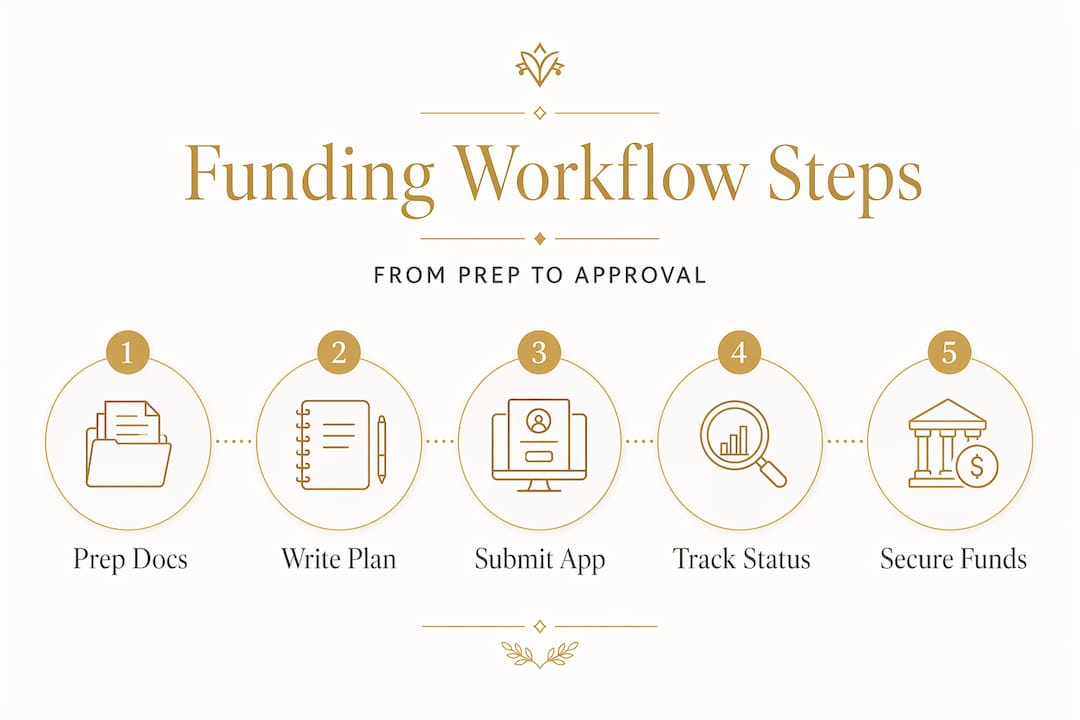
Executing the funding application steps
With documents in order, you move into the active phase of the small business loan process. This is where many owners rush and pay for it later.
-
Identify the right funding source. Traditional bank loans suit established businesses with strong credit and collateral. Online lenders work well for businesses prioritizing speed or those with limited credit history because they evaluate future cash flow rather than focusing solely on past credit scores. Grants through federal or state programs fit specific industries or demographics, but they carry more process overhead. Understanding business loan eligibility for each source before you apply saves significant time.
-
Organize your full application packet before submitting. Submitting a partial application, then trickling in missing items, tells lenders you are not ready. Pull everything together, confirm completeness, then submit once.
-
Submit and confirm receipt. Do not assume the portal received your files. Confirm submission with a timestamp and a contact at the lending institution. Log this in a centralized tracker.
-
Respond to lender requests within 24 hours. Speed matters here. A lender who asks for additional documentation and waits three days for a response will deprioritize your file. Treat every lender request as urgent.
-
Track your application status actively. Check in every three to five business days if you have not received an update. Being present in the process signals seriousness.
-
Receive and review the decision. If approved, read the term sheet carefully before signing. If declined, ask specifically why. Many lenders will tell you, and that feedback is a direct input for your next application.
Online lending decisions now arrive in as little as 24 to 72 hours for many business types, compared to the weeks or months that traditional bank channels require. That speed comes from digital underwriting that pulls in your accounting data automatically and evaluates it against cash flow models in real time.
Pro Tip: Write a one-page “business narrative” separate from your formal business plan. This short document explains who you are, what your business does, why you are applying, and what success looks like after funding. Give it to every lender. It humanizes your application and makes reviewers want to say yes.
Navigating the federal grant application workflow
Grants are not free money. They are a contract with reporting obligations, compliance requirements, and audit exposure. Many small businesses pursue grants without understanding this, which creates problems months after the award.
For federal grants, here is what the workflow actually looks like:
- Application: Submit through Grants.gov, where you will find active opportunities by agency. Note that Grants.gov manages applications but not post-award reporting. Those happen on separate agency portals.
- Award notification: If selected, you receive a Notice of Award outlining terms, conditions, and the period of performance.
- Quarterly reporting: Most federal grants require SF-425 financial reports on a quarterly basis. Missing these triggers compliance flags.
- Drawdowns: Funds are typically pulled through agency-specific payment systems, not sent automatically.
- Closeout: You have 120 calendar days after the award period ends to submit final reports, reconcile expenditures, and return any unused funds.
One critical point that catches many recipients off guard: starting closeout planning at least 90 days before the period ends is the standard recommendation to avoid delays. Waiting until after the period closes to start this process is the most common reason organizations miss the 120-day deadline.
“Owners depending solely on Grants.gov tracking often neglect post-award federal reporting deadlines, causing operational bottlenecks and compliance risks.” — Federal Grant Reporting Requirements
If your organization expends $1 million or more in federal awards in a fiscal year, you are subject to a Single Audit under 2 CFR Part 200. This requires a licensed independent auditor and submission to the Federal Audit Clearinghouse within nine months of your fiscal year end. Many small business recipients do not realize this threshold exists until they are already out of compliance.
Also worth knowing: the SBA does not provide grants to start or expand a business in the traditional sense. Most SBA-linked grant programs fund intermediary organizations like Small Business Development Centers, not individual businesses directly. If someone tells you there is an “SBA grant” for your business, verify the source.
Common workflow delays and how to fix them
The top reason funding applications stall is incomplete or slow document submissions. This is entirely preventable, and yet it remains the primary bottleneck across both loan and grant workflows.
Here is what causes the most damage:
- Outdated financials: Submitting last year’s tax return when a lender wants the current year signals disorganization.
- Mismatched numbers: A revenue figure in your business plan that does not match your income statement raises red flags immediately.
- Missing signatures or authorizations: Particularly on legal and ownership documents.
- Delayed responses to lender questions: As mentioned, even a 48-hour delay can move your file to the back of the queue.
- Assuming Grants.gov covers everything: Post-award reporting runs through separate federal portals, and many recipients miss deadlines simply because they did not know where to go.
Digital tools that centralize your grant and loan workflows reduce these risks significantly. Automated reminders for quarterly reporting dates, spend thresholds that trigger alerts, and compliance checklists that track outstanding items remove the human memory problem from the equation.
Pro Tip: Create a single shared folder, whether cloud-based or local, with clearly labeled subfolders for each funding application: documents submitted, correspondence, decisions, and follow-up items. This alone cuts response time to lender requests from days to minutes.
What a working funding workflow actually produces
When your small business financing workflow is running well, here is what you can measure:
| Metric | Without a workflow | With an organized workflow |
|---|---|---|
| Document prep time | 5 to 10 days per application | Under 24 hours |
| Lender decision timeline | 4 to 8 weeks (traditional) | 24 to 72 hours (online) |
| Resubmission rate | High (missing items common) | Low (complete first submission) |
| Grant reporting compliance | Missed deadlines common | On-time, documented |
| Lender relationship quality | Reactive and transactional | Proactive and trusted |
The compounding benefit here is lender confidence. When a lender sees clean financials, prompt responses, and a coherent business story, they treat your file differently. You move faster through underwriting. You get better terms. And when you need to come back for a second round, you are already a known quantity, which is an advantage most business owners underestimate.

Tracking your own performance matters too. Log how long each stage of your funding application steps takes. Note where documents were incomplete or where you lost days waiting. Over two or three funding cycles, patterns emerge, and you can close the gaps systematically.
My honest take on why businesses struggle with funding
I have watched hundreds of small business owners go through funding cycles, and the ones who struggle most share one trait. They treat funding as an event rather than a process. They scramble to pull documents together when they need capital, submit a rough application, and then wait, often getting declined or delayed because the paperwork tells a messy story.
The businesses that consistently secure capital faster are not necessarily stronger businesses. They are just more organized. They keep their financials current. They know their numbers cold. When an opportunity or need arises, they can submit a complete, compelling application in 24 hours.
The grant world makes this even more stark. I have seen organizations lose significant federal funding not because of any financial wrongdoing, but simply because they did not understand that Grants.gov is just the front door. The real compliance work happens on the back end, in agency portals most people do not even know exist until they are already behind.
My honest advice: adopt accounting software now, before you apply for anything. The reports it generates are not just useful for lenders. They force you to look at your own business clearly and regularly. That discipline changes how you make decisions, not just how you apply for funding.
The mindset shift from reactive to proactive is the actual unlock here. Funding is not something that happens to you. It is something you build toward.
— Jason
Ready to put your funding workflow to work?
You have the framework. Now it is time to act on it. Emorylending helps small businesses secure capital from $5,000 to $5,000,000 and above, with a process built around your business performance and cash flow, not just your personal credit score.
Whether you need working capital to cover payroll and receivables or you are looking to finance equipment for expansion, Emorylending reviews your actual business story. Approvals move fast because the process is built for small businesses, not around the red tape of traditional lending. If you are ready to apply or want to explore what your business qualifies for, visit the Emorylending application portal and get started today. You can also learn more about how equipment financing works if capital purchases are part of your growth plan.
FAQ
What documents do I need to start a small business loan application?
Most lenders require two years of tax returns, recent bank statements, an income statement, a balance sheet, and a clear business plan. Online lenders may need fewer documents and weight cash flow more heavily than credit history.
How long does the small business loan process take?
Traditional bank loans can take four to eight weeks or longer. Online lenders using automated underwriting typically return decisions within 24 to 72 hours after a complete application is submitted.
Does the SBA offer grants directly to small businesses?
Generally, no. The SBA primarily offers loans and funds intermediary support organizations like Small Business Development Centers, not direct grants to individual businesses looking to launch or expand.
What happens if I miss a federal grant reporting deadline?
Missing a quarterly SF-425 filing or the 120-day closeout deadline triggers compliance flags that can result in withheld future payments, required fund returns, or disqualification from future grants. Starting closeout procedures at least 90 days early is the standard best practice.
How do I measure whether my funding workflow is improving?
Track document prep time per application, the rate of complete first submissions, lender response times, and how often you are asked for additional information. Shorter prep times and fewer follow-up requests are reliable indicators your workflow is tightening up.


