

Getting the equipment your business needs shouldn’t stall your growth. Knowing how to apply for equipment loans the right way can mean the difference between approval in days and weeks of back-and-forth with a lender. This guide walks you through every step of the equipment loan application process, from gathering documents to submitting a lender-ready package, so you walk in prepared and walk out funded.
Table of Contents
- Key takeaways
- How to apply for equipment loans: what you need first
- Steps to complete and submit your application
- Common mistakes that derail equipment loan applications
- What to expect after you submit
- My take on what actually moves the needle
- Get your equipment funded with Emorylending
- FAQ
Key takeaways
| Point | Details |
|---|---|
| Preparation wins approvals | Organizing complete, consistent documentation before you apply dramatically reduces processing time and delays. |
| Legal name precision matters | Every document must match your exact legal business name to avoid UCC-1 filing errors that can kill a deal. |
| Show your affordability story | Lenders want proof the equipment’s cash flow will cover loan payments, not just that you need the gear. |
| Soft costs are your responsibility | “100% financing” often excludes taxes, delivery, and installation fees you must plan for separately. |
| Communication speeds everything | Disclosing credit issues upfront and responding fast to lender requests keeps underwriting moving. |
How to apply for equipment loans: what you need first
Before you fill out a single form, your document package needs to be airtight. Lenders require a comprehensive set of documents covering business identity, formation records, financial history, and detailed equipment information. Walking in with a half-complete package is the fastest way to trigger delays.
Here is what most lenders will ask for:
- Government-issued ID for all owners with significant equity stakes (typically 20% or more)
- Business formation documents such as your Articles of Incorporation, operating agreement, or partnership agreement
- Last two to three years of business tax returns and personal tax returns for owners
- Recent bank statements (typically three to six months) showing actual cash flow
- Profit and loss statement and balance sheet from the current year
- An equipment quote or invoice from the vendor, itemized and detailed
Each document serves a specific purpose. Your bank statements show a lender whether your business actually generates enough cash to service new debt. Tax returns verify that what you report matches what you earn. Formation documents confirm your legal business structure, which matters more than most borrowers realize.
Pro Tip: When requesting an equipment quote from a vendor, ask them to include the make, model, serial number, delivery timeline, and itemized pricing for installation. Vague or incomplete equipment quotes trigger lender follow-ups and slow everything down. An underwriting-readable quote can shave days off your approval timeline.

Used or specialized equipment sometimes requires additional documentation. Lenders may ask for an independent appraisal, photos, or a maintenance history to confirm the equipment’s condition and value. If you are buying used machinery, get ahead of this by including those materials proactively.
One detail most applicants overlook: every document must reflect the exact same legal business name. Your tax return, formation documents, and bank account should all read identically. Even a small abbreviation like “LLC” versus “Limited Liability Company” can create problems downstream when lenders file security interests.
| Document | Why lenders need it |
|---|---|
| Government-issued ID | Verifies owner identity and equity stake |
| Formation documents | Confirms legal structure and business name |
| Business tax returns | Shows verified income over time |
| Bank statements | Demonstrates real-time cash flow |
| Equipment quote | Establishes collateral value and loan amount |
| Profit and loss statement | Confirms current business financial health |
Steps to complete and submit your application
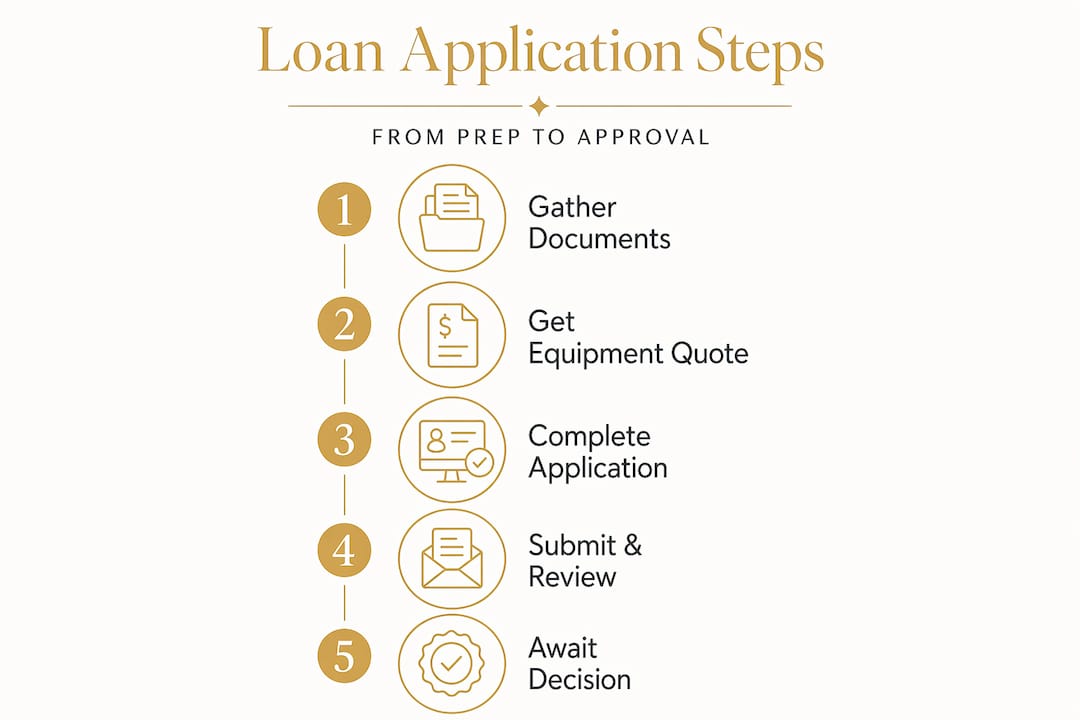
Once your documents are organized, the equipment loan application process follows a logical sequence. Think of it as telling a story in four parts: who you are, how your business performs, what equipment you are buying, and why you can afford it.
-
Complete the application form in full. Leave nothing blank. If a field does not apply to your business, write “N/A” rather than skipping it. Incomplete forms go to the back of the pile.
-
Attach your financial documents in order. Lead with your most recent tax returns, follow with bank statements, then your P&L and balance sheet. Logical organization signals professionalism.
-
Include the equipment details prominently. The vendor quote, equipment description, and intended business use should be easy for underwriters to locate. Lenders evaluate equipment’s potential resale value alongside your ability to repay, so a clear description that explains operational impact is worth writing carefully.
-
Write your coverage story. This is a short, clear explanation of how the equipment will generate or preserve enough cash flow to cover monthly payments. Repayment terms can extend up to seven years depending on asset value, but your underwriter still needs to see that today’s cash flow supports today’s loan payment.
-
Disclose credit issues upfront. If you have a bankruptcy, late payments, or other credit blemishes, address them proactively in a brief explanation letter. Proactive communication about special circumstances consistently leads to smoother review cycles than letting lenders discover issues on their own.
-
Understand what happens after submission. Equipment loans are secured by a lien on the equipment itself. Lenders perfect their security interest through UCC-1 filings, which are public records that establish their claim. This is why your legal name must be exact across every document in your package.
Pro Tip: Before submitting, run a quick self-audit. Read through your application the way a lender would. Ask yourself: Is the business name identical on every page? Does the equipment quote match the loan amount requested? Is my repayment math clearly shown? Catching your own errors before submission saves real time.
Understanding your loan term options before you apply also gives you negotiating flexibility. Shorter terms mean higher monthly payments but less total interest. Longer terms reduce monthly payments but cost more over time. Know your cash flow tolerance before you sit down with a lender.
Common mistakes that derail equipment loan applications
The majority of delays in applying for business equipment loans trace back to a short list of avoidable errors. Knowing what to watch for puts you ahead of most applicants.
-
Inconsistent documentation. Submitting incomplete or inconsistent financial documents is the single most common reason applications stall. A bank statement showing one business name and a tax return showing a slightly different version creates confusion that lenders will not overlook.
-
Legal name mismatches on UCC filings. Minor misspellings or abbreviations in a debtor’s legal name on a UCC-1 filing can invalidate lien perfection entirely. Double-check your exact legal name against your formation documents before any submission.
-
Underestimating total equipment cost. Many borrowers assume their loan covers everything. It often does not. 100% financing terms frequently exclude soft costs like taxes, delivery, installation fees, software, and documentation charges. Plan for these out of pocket so a funding shortfall does not derail your project after approval.
-
Ignoring lender-specific requirements. Some lenders have minimum time-in-business thresholds, industry restrictions, or credit score floors. Read lender guidelines before applying. Submitting to a lender whose criteria you clearly do not meet wastes everyone’s time and leaves an inquiry on your credit report.
-
Slow responses to lender requests. After submission, underwriters will often request additional information. How fast you respond matters. Treat every lender request as urgent. Delays on your end typically push your file to the bottom of the queue.
Treating your loan application like a business presentation, not a form to fill out, is the mindset that separates funded applicants from frustrated ones. Lenders are evaluating your judgment as much as your credit score.
What to expect after you submit
Once your application is in, underwriting begins. Here is what happens and how to make it work in your favor.
Lenders review several factors simultaneously. They assess credit history, business performance, industry stability, time in business, and collateral value to build a complete risk picture. No single factor automatically disqualifies you, but weaknesses in multiple areas compound quickly.
The review process typically involves:
- Credit pull and background check on the business and its owners
- Cash flow analysis comparing your revenue to the proposed monthly loan payment
- Collateral verification confirming the equipment’s value relative to the loan amount
- Title search and UCC check to identify any existing liens on your assets
- Vendor and equipment validation confirming the quote is legitimate and the vendor is real
Down payment requirements vary widely across lenders and borrower profiles. Some businesses qualify with little to no down payment. Others may be asked to put down 20% to 30% or more. If a lender requests a larger down payment than expected, it is often negotiable, especially if you can demonstrate strong cash flow or offer additional collateral.
Pro Tip: Before your file goes into underwriting, confirm your vendor’s delivery and installation timeline in writing. Lenders sometimes need to verify that equipment will be operational within a specific window after funding. Having that document ready saves a round of emails at a critical moment.
You can also use this waiting period to review loan terms before you sign. Equipment loans are secured by the equipment itself, which reduces lender risk and often makes approvals more accessible than unsecured financing. That leverage works in your favor when negotiating rate, term length, and structure.
My take on what actually moves the needle
I have reviewed hundreds of equipment financing applications over the years, and the pattern is consistent. The applications that move fast are not necessarily from businesses with the best credit. They are from business owners who came prepared.
What I have found is that most rejections or delays trace back to one thing: the applicant did not understand what the lender actually needed. They submitted documents that told an incomplete story or let inconsistencies slide through because they figured someone would ask if it mattered. Lenders do not always ask. Sometimes they just decline.
The UCC-1 issue is one that surprises people. A single character difference in your legal name is not a minor typo in this context. It is a potential legal defect in the lender’s security interest. I have seen deals delayed by weeks because of this, on applications that were otherwise strong.
My real advice: treat the equipment loan application like you are presenting to an investor, not submitting a tax form. Know your numbers cold. Understand your cash flow relative to the proposed payment. Have a plain-language explanation ready for anything unusual in your financials or credit history. And build a relationship with a lender who has actually financed businesses in your industry. Generic lenders who do not understand your equipment type or revenue model will slow you down.
The process is not as daunting as it looks when you know what is expected. Preparation is not extra work. It is the actual work.
— Jason
Get your equipment funded with Emorylending
At Emorylending, we evaluate your business performance and cash flow, not just your personal credit score. That means small businesses that get turned down elsewhere often find a path to funding with us. Whether you are buying a commercial vehicle, upgrading manufacturing equipment, or acquiring medical devices, our team understands how to structure a loan that fits your actual operation. Explore our equipment financing options to see what you qualify for, or browse our business funding checklist to confirm you are fully prepared before you apply. We fund from $5,000 to $5,000,000 and we make the process straightforward from application to closing.
FAQ
What documents do I need to apply for an equipment loan?
Most lenders require government-issued ID, business formation documents, two to three years of tax returns, recent bank statements, a profit and loss statement, and an itemized equipment quote from the vendor. Having all of these organized before you apply significantly speeds up approval.
How does a UCC-1 filing affect my equipment loan?
A UCC-1 filing is a public record that establishes the lender’s legal claim on your equipment as collateral. Your exact legal business name must appear on this filing, because even minor name discrepancies can invalidate the lender’s security interest and delay or derail closing.
What are the typical repayment terms for equipment loans?
Equipment loan terms commonly range from two to seven years, depending on the asset value and lender policies. Shorter terms cost less in total interest but carry higher monthly payments. Choosing a term that aligns with your actual cash flow is more important than chasing the longest possible term.
Can I get equipment financing with less-than-perfect credit?
Yes. Many lenders, including Emorylending, evaluate business cash flow and performance alongside credit history. Strong revenue, solid bank statements, and a clear repayment plan can offset credit weaknesses. Disclosing any credit issues upfront with an explanation letter also tends to improve outcomes.
What costs does equipment financing typically not cover?
“100% financing” offers typically exclude soft costs such as delivery fees, installation labor, software licenses, training, and applicable taxes. Budget for these separately to avoid a funding gap that leaves your equipment sitting idle after your loan closes.


