

If you’ve been searching for business financing, you’ve probably come across SBA loans and wondered what they actually are. The short answer: SBA loans are not government handouts. They’re loans originated by private lenders and backed by a guarantee from the U.S. Small Business Administration. That distinction matters more than most people realize. Understanding SBA loans means understanding how the guarantee structure shapes your approval odds, your interest rate, and the entire application experience. This guide breaks down the types, eligibility rules, and real-world uses so you can make a confident, informed decision.
Table of Contents
- Key takeaways
- What are SBA loans and how do they actually work
- Types of SBA loans: 7(a) vs. 504
- SBA loan eligibility: what you actually need to qualify
- Real-world uses of SBA loans for small businesses
- My take on what most SBA loan guides get wrong
- Ready to find the right financing for your business?
- FAQ
Key takeaways
| Point | Details |
|---|---|
| SBA loans come from lenders | The government guarantees the loan, but a private bank or lender originates and approves it. |
| Two main programs to know | The 7(a) and 504 programs serve different needs: flexible working capital vs. fixed asset purchases. |
| Eligibility is stricter than expected | You must meet SBA size standards, show creditworthiness, and prove you can’t get credit on comparable terms elsewhere. |
| Documentation drives approval | Lender readiness and complete financial records often matter more than the SBA’s guarantee criteria alone. |
| Alternatives exist | If SBA timelines or requirements don’t fit, faster business financing options can cover the gap. |
What are SBA loans and how do they actually work
Most people assume the federal government writes the check. It doesn’t. SBA loans originate from approved lenders with the SBA providing a guarantee on a portion of the loan balance. That guarantee reduces the lender’s risk if you default, which is why lenders are willing to offer better terms than they might on a conventional small business loan.
The only time the SBA lends directly is during declared disasters. Every other loan goes through an SBA-approved bank, credit union, or non-bank lender. Think of the SBA as a co-signer with a government seal behind it. The lender still decides whether you qualify. The lender still reviews your financials, evaluates your business, and makes the credit decision. The SBA’s role is to back the deal and reduce the lender’s downside.
Here’s why that matters to you:
- Your application goes to a lender, not a government office
- The lender’s internal underwriting standards shape your approval, not just SBA rules
- A strong relationship with an SBA-preferred lender can speed up the process significantly
- Because approval resembles a conventional loan application, being prepared for a full financial review is non-negotiable
Pro Tip: Look specifically for SBA Preferred Lenders in your area. These lenders have delegated authority to approve SBA loans in-house, which cuts weeks off the typical processing timeline.
Types of SBA loans: 7(a) vs. 504
The SBA offers several loan programs, but two dominate for most small businesses: the 7(a) program and the 504 program. Picking the wrong one for your situation is a common and costly mistake.
SBA 7(a) loans
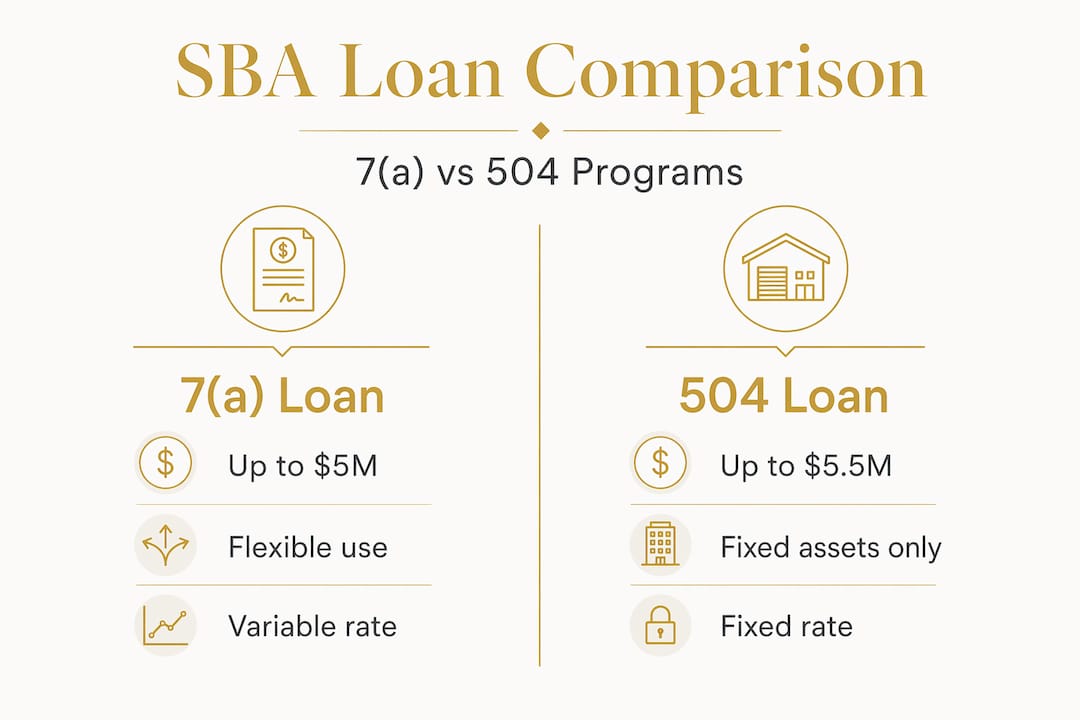
The 7(a) is the most widely used SBA loan program, and for good reason. It covers the broadest range of business needs. 7(a) loans support working capital, debt refinancing, real estate, and equipment purchases with a maximum loan amount of $5 million. If your business need doesn’t fit neatly into one box, the 7(a) is usually the right starting point.
The program also includes a Working Capital Pilot option. Lines of credit up to $5 million are available under this pilot for businesses with at least one year of operating history and solid financial reporting. That’s a significant expansion of what SBA financing can do for cash-flow-sensitive businesses.
SBA 504 loans
The 504 program works differently. 504 loans provide fixed-rate financing up to $5.5 million for major fixed assets like buildings, land, and heavy equipment. The program is administered through Certified Development Companies (CDCs), which introduces a multipart loan structure: a conventional lender covers roughly 50%, the CDC covers 40% via an SBA-backed debenture, and you put in 10%.

What the 504 cannot do is just as important as what it can. Working capital and inventory are explicitly ineligible under the 504 program. If you need to buy a warehouse, it’s a strong fit. If you need cash to cover operations while you grow, look at the 7(a).
Side-by-side comparison
| Feature | SBA 7(a) | SBA 504 |
|---|---|---|
| Maximum loan amount | $5 million | $5.5 million |
| Primary use | Working capital, equipment, real estate, refinancing | Fixed assets: buildings, land, heavy equipment |
| Interest rate type | Variable or fixed | Fixed rate (504 portion) |
| Working capital eligible | Yes | No |
| Loan structure | Single lender | Lender + CDC + borrower down payment |
| Repayment term | Up to 25 years (real estate) | Up to 25 years |
Key differences between 7(a) and 504 loans include not just loan purpose but also down payment requirements, rate structures, and how the loans are administered. Understanding that difference before you apply saves you significant time.
Pro Tip: If you are purchasing commercial real estate and also need working capital, consider pairing a 504 loan for the property with a separate 7(a) loan for operations. Some SBA-approved lenders can structure both simultaneously.
SBA loan eligibility: what you actually need to qualify
This is where a lot of applicants get surprised. SBA loans are not easy money, and the government guarantee does not make them a sure thing. Eligibility includes business type, size standards, location, credit history, and an inability to obtain credit on reasonable terms elsewhere. Every one of those boxes needs to be checked.
Here’s what lenders and the SBA will specifically look at:
- Operating business status. Your business must be actively operating, not a passive investment or a shell entity.
- SBA size standards. The SBA defines “small” differently by industry. Most standards are based on employee count or annual revenue. Check the SBA’s size standards table for your specific NAICS code.
- Creditworthiness. Both your business credit profile and your personal credit history will be reviewed. There’s no published minimum score, but most SBA lenders want to see a personal FICO above 650.
- U.S.-based operations. Your business must operate primarily within the United States.
- Inability to get credit elsewhere. You must demonstrate that you cannot obtain financing on reasonable terms through conventional channels. This is not about having bad credit. It’s about justifying why the SBA guarantee is necessary.
One widespread misconception is that the SBA guarantee means lenders will approve borderline applications. It doesn’t work that way. The SBA guarantee reduces lender risk but does not replace the lender’s own underwriting judgment. A lender that isn’t comfortable with your cash flow will decline your application regardless of the guarantee. You can review loan eligibility criteria for small businesses to understand exactly what documentation you should prepare before you ever sit down with a lender.
Pro Tip: Prepare at least two years of business tax returns, current financial statements, a business plan or executive summary, and a clear “use of proceeds” statement before contacting any lender. Walking in without these adds weeks to the process and signals unpreparedness.
Real-world uses of SBA loans for small businesses
Understanding the types of SBA loans only gets you halfway there. Knowing how to deploy them strategically is what separates smart borrowers from ones who end up with the wrong product.
Here are the most common and effective ways small businesses actually use SBA financing:
-
Equipment acquisition. A manufacturer buying a $400,000 CNC machine can use a 7(a) loan to spread that cost over 10 years at a rate that makes the monthly payment manageable. You can also explore dedicated equipment financing options to compare SBA terms against alternatives.
-
Working capital. Seasonal businesses, retailers ahead of a slow quarter, and service companies waiting on large receivables all use 7(a) loans to stabilize cash flow. The Working Capital Pilot line of credit adds a revolving option for businesses that need ongoing flexibility.
-
Debt refinancing. If you’re carrying high-interest business debt from a merchant cash advance or short-term loan, a 7(a) loan can consolidate that debt at a lower rate and longer term. SBA loans provide more predictability and access to capital than many short-term alternatives.
-
Commercial real estate. A restaurant owner buying the building they’ve leased for five years is a textbook 504 loan use case. The fixed rate and long term make the payment structure work for real estate investments.
-
Business expansion. Opening a second location, hiring a production crew, or entering a new market often requires more capital than retained earnings can support. SBA loans support expansion and business transitions when timed correctly with growth milestones.
The most common pitfall is applying for the wrong product. Businesses sometimes apply for a 504 loan when they actually need working capital, then get denied because the use of proceeds doesn’t fit. Taking 20 minutes to read the smart ways to use business loans before you apply will save you far more time on the back end.
My take on what most SBA loan guides get wrong
I’ve worked with hundreds of small business owners trying to navigate SBA financing, and I keep seeing the same pattern. People spend weeks reading about the SBA’s guarantee percentages and interest rate caps, then show up to a lender meeting with incomplete financials and no clear use-of-proceeds statement. The loan dies on the spot.
Here’s what I’ve learned: the SBA guarantee is the least important variable in your application. The most important variable is lender readiness. Applicants consistently underestimate how much documentation matters compared to the program’s technical eligibility rules. A lender can’t approve what they can’t verify, and “I’ll get that to you later” ends conversations.
I’ve also seen businesses push for a 504 loan on a deal that clearly needed a 7(a). The use of proceeds restrictions on 504 loans are not flexible. Trying to shoehorn working capital needs into a fixed-asset program causes delays and, usually, denial. Pick the right tool before you apply. That’s a decision worth making deliberately, not reactively.
My honest advice: treat your SBA loan application like a job interview, not a form submission. Know your numbers cold. Know why you need the money and how it generates a return. And choose a lender who actually has SBA experience, not just one that offers SBA loans on paper.
— Jason
Ready to find the right financing for your business?
SBA loans are one piece of a broader financing picture. At Emorylending, we help small businesses find the right capital structure based on actual business performance, not just personal credit scores.
Whether you need working capital to cover operations, funds to buy equipment, or capital to expand to a new location, Emorylending works with businesses from $5,000 to $5,000,000 and beyond. Our team evaluates your cash flow and business performance to match you with financing that actually fits. Use our business funding checklist to get organized before your first conversation with a lender. The faster you’re prepared, the faster you get funded.
FAQ
What are SBA loans in simple terms?
SBA loans are business loans originated by private lenders and partially guaranteed by the U.S. Small Business Administration. The guarantee reduces lender risk, which typically results in better rates and terms for qualified borrowers.
Who qualifies for an SBA loan?
To qualify, your business must be actively operating in the U.S., meet SBA size standards for your industry, demonstrate creditworthiness, and show that you cannot obtain comparable financing through conventional channels.
What is the difference between a 7(a) and 504 loan?
The 7(a) loan is flexible and covers working capital, equipment, and real estate up to $5 million. The 504 loan focuses on fixed assets like buildings and heavy equipment up to $5.5 million, with a fixed interest rate and is not available for working capital.
How long does it take to get an SBA loan?
Timelines vary by lender and loan complexity. SBA Preferred Lenders with delegated authority can process applications in a few weeks, while standard SBA lenders may take two to three months from application to funding.
What is an SBA loan alternative if I don’t qualify?
If you don’t meet SBA requirements or need faster funding, alternatives include equipment financing, working capital loans, and invoice factoring. These options often have fewer documentation requirements and shorter approval timelines.


