

More than half of small businesses in the Southeastern U.S. report uneven cash flows and real difficulty covering operating expenses, according to 2025 Southeast insights from the Atlanta Fed’s Small Business Credit Survey. That’s not just a statistic. It’s the reason so many business owners across Georgia, Tennessee, the Carolinas, and Florida are looking past traditional banks for funding. This guide explains exactly what alternative business funding is, how it works, what it costs, and how to tell whether it’s the right move for your business right now.
Table of Contents
- What is alternative business funding?
- Why owners in the Southeast turn to alternative funding
- How alternative funding works: Speed, criteria, and fit
- Risks and real cost trade-offs of alternative funding
- A smarter approach to alternative funding: Fit first, not speed
- Explore smart funding options for your business
- Frequently asked questions
Key Takeaways
| Point | Details |
|---|---|
| Faster access to cash | Alternative funding can deliver approvals and funds much more quickly than banks, meeting urgent business needs. |
| Flexible qualification | Nonbank lenders consider factors like cash flow and sales instead of strict credit history. |
| Potential higher costs | Many borrowers pay higher rates with alternative funding, so always check the total repayment amount. |
| Fit is crucial | The best alternative funding matches your business’s seasonality and cash flow—speed is only part of the equation. |
What is alternative business funding?
Alternative business funding refers to any financing that comes from outside the traditional bank lending system. That means online lenders, merchant cash advance providers, invoice financing companies, and peer-to-peer lending platforms. These sources share one key feature: they evaluate your business differently than a bank does.
Where a bank focuses heavily on your credit score, years in business, and collateral, alternative lenders care more about your actual revenue and cash flow. As alternative lending mechanics show, these lenders rely on revenue and cash flow signals rather than long credit histories, and they deploy funds far faster than traditional banks. That shift in evaluation criteria opens the door for a much wider group of business owners.
Here are the main types of alternative business funding available today:
- Online term loans: Fixed loans from web-based lenders with faster approval than banks, often funded within days.
- Merchant cash advance (MCA): A lump sum in exchange for a percentage of your future credit card or daily sales. Repayment is automatic and tied to revenue.
- Invoice financing: You borrow against outstanding invoices. Great if customers routinely pay late and you need cash now.
- Peer-to-peer (P2P) lending: Online platforms connect business borrowers directly with investors willing to fund them.
- Revenue-based financing: Repayments fluctuate as a percentage of monthly revenue, which matches well with seasonal businesses.
Understanding the business loan approval differences between these options and traditional bank loans is critical before you apply anywhere. And if you need a refresher on the fundamentals, reviewing working capital basics will give you the language you need to evaluate any offer intelligently.
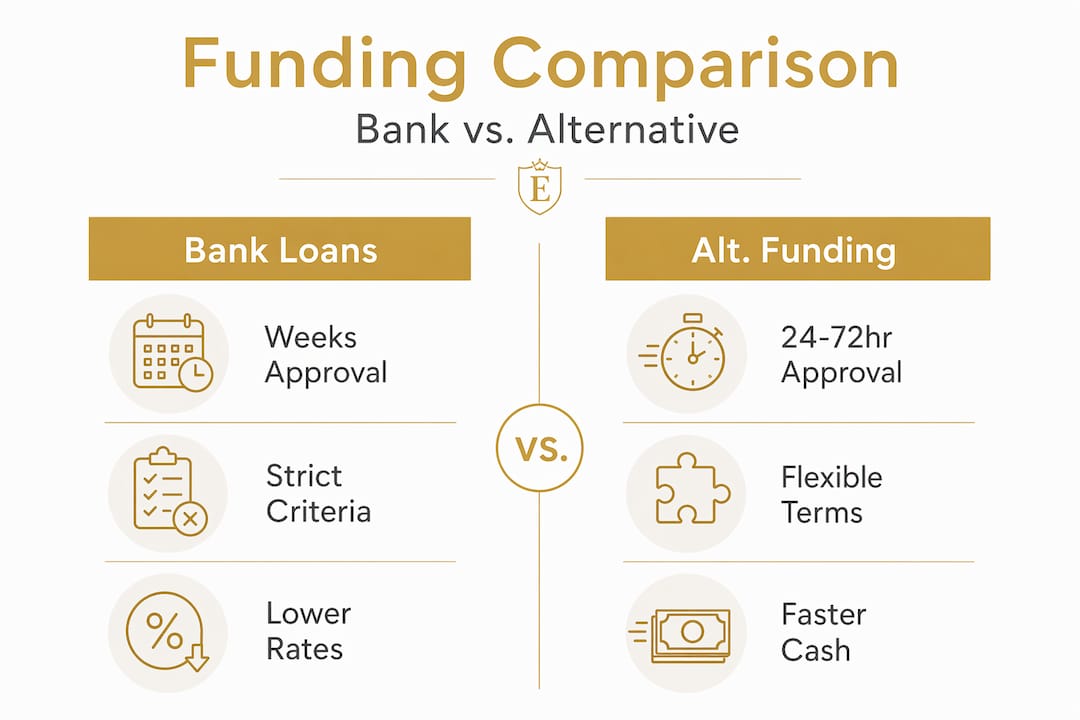
| Feature | Traditional bank loan | Alternative funding |
|---|---|---|
| Approval time | Weeks to months | 24 to 72 hours |
| Key approval factor | Credit score, collateral | Revenue, cash flow |
| Application process | In-person, paper-heavy | Online, digital documents |
| Minimum time in business | 2+ years typical | Often 6 to 12 months |
| Flexibility of repayment | Fixed monthly payments | Daily, weekly, or revenue-tied |
| Funding amount range | Varies widely | $5,000 to $5,000,000+ |
The table makes it clear: alternative funding is not just “bank lite.” It’s a structurally different product designed for a different kind of borrower situation.
Why owners in the Southeast turn to alternative funding
With the basics clear, let’s look at why so many Southeastern business owners are turning to these nonbank options.
The Southeast is one of the fastest-growing economic regions in the country, but growth creates its own pressure. Contractors waiting 60 days to get paid. Restaurants hit hard by a slow January after a strong holiday season. Retailers who need inventory 90 days before the revenue arrives. These are not failing businesses. They’re businesses caught in normal timing gaps, and traditional banks are not built to solve timing gap problems quickly.

Research tells a clear story: Southeast small businesses primarily use nonbank funding to bridge cash flow timing gaps when expenses arrive before receivables are collected, and to support growth when traditional loans are too slow or hard to qualify for. That covers a huge slice of small business life.
The most common pressure points driving owners toward alternative funding include:
- Seasonal revenue swings: A landscaping company in Alabama or a beach rental business in South Carolina needs cash in the off-season to stay operational.
- Payroll deadlines: Employees need to be paid on time regardless of when a big client finally sends their check.
- Supplier payment terms: Many suppliers require payment upfront or within 30 days, even when your customers take 60 to 90 days to pay.
- Unexpected equipment failure: A broken commercial oven or a failed HVAC system can stop revenue cold. Waiting six weeks for bank approval is not an option.
- Fast growth opportunities: A chance to land a major contract or open a second location does not wait for bank committee approval.
The working capital funding guide goes deeper on how to think about timing gaps and what type of financing fits each scenario. If you want a broader look at why funding can accelerate your business rather than just keep it afloat, the business loan benefits breakdown is worth reading.
Pro Tip: Use alternative funding to solve a specific, short-term need, not to paper over ongoing financial problems. If your business is consistently losing money, no funding product will fix that. But if you have a profitable business with a timing problem, alternative funding can be exactly the right tool.
How alternative funding works: Speed, criteria, and fit
Knowing why owners look for alternatives, let’s dig into how these solutions actually operate.
The application process for alternative funding is dramatically simpler and faster than going to a bank. Here’s what a typical process looks like from start to funded:
- Complete an online application. Most lenders ask for basic business information, estimated monthly revenue, and the purpose of the funding. This takes 10 to 20 minutes.
- Submit supporting documents. Usually three to six months of bank statements and, for some products, recent tax returns. No lengthy business plans required.
- Automated underwriting review. The lender’s system analyzes your revenue trends, deposit patterns, and cash flow consistency. This can happen in hours.
- Receive an offer. You’ll see the funding amount, total cost, and repayment structure. Review carefully before accepting.
- Funds deposited. Most alternative lenders fund within 24 to 72 hours of approval. Some same-day options exist for smaller amounts.
As the alternative lending process confirms, lenders in this space operate online and evaluate borrowers through revenue signals far more than credit histories. That changes who qualifies and how fast the decision gets made.
| Evaluation criteria | Traditional bank | Alternative lender |
|---|---|---|
| Personal credit score | Critical (typically 680+) | Considered but not the primary factor |
| Business revenue | Reviewed but secondary | Central to approval |
| Time in business | Usually 2+ years required | Often 6 months minimum |
| Collateral | Frequently required | Rarely required |
| Cash flow analysis | Basic review | Deep, real-time analysis |
| Debt service coverage | Carefully calculated | Evaluated but more flexible |
“Alternative lenders evaluate borrowers primarily on revenue consistency and cash flow capacity, not the traditional credit file. That shift in evaluation is what makes speed possible.” — Shopify Blog: Alternative Lending
Who is this a good fit for? Businesses that have strong, consistent revenue but don’t have years of credit history or substantial collateral. New businesses that are already profitable but are too young to qualify for bank products. Businesses in time-sensitive situations where waiting 60 days for a bank decision is not viable.
When is it not a good fit? If your revenue is highly erratic with no predictable floor, if you already carry heavy debt obligations, or if you need very long repayment terms to make the payments affordable. In those cases, you may want to explore business growth capital options that are structured specifically for expansion phases.
Risks and real cost trade-offs of alternative funding
To give you a complete picture, let’s talk about what can go wrong and how to protect your business.
Speed and accessibility are real advantages, but they come with trade-offs. The most significant is cost. Alternative funding products almost always carry a higher effective cost than traditional bank loans. That’s not inherently bad. Paying more for faster access and lower qualification barriers can absolutely be worth it. The problem arises when business owners don’t fully understand the cost before signing.
The data here is sobering. 60% of online lender borrowers reported that their actual borrowing costs were higher than they expected going in. That’s not a small number. It means the majority of people who used these products were surprised by what they paid. Some of that surprise comes from how costs are presented. Factor rates (common in merchant cash advances) don’t work like interest rates and can be misleading if you’re used to thinking in APR terms.
Here are the most important risks to understand before you commit:
- Daily or weekly repayment schedules can strain cash flow. An MCA that pulls a percentage of your daily sales sounds manageable until you have two slow weeks in a row and the payments keep coming.
- Factor rates obscure true cost. A factor rate of 1.3 on a $50,000 advance means you repay $65,000. That sounds simple, but the effective APR depends entirely on how long repayment takes.
- Short-term funding for long-term needs is a trap. Using a six-month term product to fund a renovation that will take two years to pay back creates a refinancing cycle that gets expensive fast.
- Stacking debt multiplies risk. Taking multiple alternative funding products simultaneously is a real problem in this industry. Each product increases your fixed payment obligations.
- Prepayment penalties vary widely. Some products charge you even if you pay off early. Read the full agreement.
“Mismatching funding to your revenue cycle is where alternative financing turns from a solution into a problem. The structure of the repayment must match the rhythm of your income.”
Pro Tip: Before accepting any alternative funding offer, do a simple 90-day cash flow projection. Lay out your expected income and expenses, then add the new payment obligation on top. If you can’t clearly see how you service that debt in a slow month, the product may not fit your business cycle.
For more context on the full landscape of small business lending risks and options, the small business loan articles library has detailed breakdowns on specific situations.
A smarter approach to alternative funding: Fit first, not speed
Here’s an opinion that many people in this industry won’t say out loud: speed is the worst reason to choose an alternative lender.
We understand why owners focus on speed. When you need cash to cover payroll on Friday, you’re not thinking about effective APR. But that urgency is precisely when clear thinking matters most. The lenders who benefit most from urgency are not always the ones offering you the best deal.
Evidence from the Federal Reserve’s small business research shows that while alternative funding’s flexibility solves real working capital problems, borrowers who approach it through “I need approval now” rather than “does this fit my cash flow” are the same ones reporting higher-than-expected costs later.
The smarter frame is fit first. Ask yourself three questions before you apply anywhere:
First: Does the repayment structure match how my business earns money? A daily sweep works for a restaurant with consistent daily revenue. It can be damaging for a construction company that gets paid in large, infrequent installments.
Second: Is this a timing problem or a profitability problem? Alternative funding can bridge timing gaps beautifully. It cannot save a fundamentally unprofitable business. Knowing the difference before you borrow protects you from making a bad situation worse.
Third: What is the full cost, not just the factor rate or weekly payment? Calculate the total repayment amount. Divide by your average monthly revenue. If that percentage feels uncomfortable, the product is probably too expensive for your situation.
The growth funding strategies guide offers a framework for thinking through funding decisions systematically rather than reactively. That’s the mindset shift that separates business owners who use alternative funding well from those who end up in a cycle of expensive refinancing.
Explore smart funding options for your business
You’ve now got the full picture on alternative business funding, what it is, how it works, what it costs, and when it makes sense. The next step is finding the right product for your specific situation.
At Emory Lending, we evaluate your business on what actually matters: your revenue, your cash flow, and your growth trajectory. Whether you need working capital solutions to bridge a seasonal gap, equipment financing options to replace critical machinery, or help figuring out what kind of funding you even need, we’re built for exactly that conversation. Start with our business funding checklist to clarify your needs and prepare for a fast, confident decision. We fund from $5,000 to $5,000,000 and we’re ready to help you move.
Frequently asked questions
How fast can I get funds with alternative business lending?
Many online alternative lenders approve and fund applications within 24 to 72 hours, which is dramatically faster than traditional banks. Some lenders offer same-day funding for smaller amounts when your documents are in order, based on their revenue-focused evaluation process.
What are common uses for alternative funding in the Southeast?
Southeast business owners most often use alternative funding to bridge cash flow gaps between expenses and incoming receivables, cover payroll during slow periods, or move quickly on a growth opportunity. As 2025 Southeast research confirms, timing gaps and growth support are the two primary drivers.
Are alternative loans more expensive than traditional bank loans?
Yes, in most cases alternative loans carry higher costs than traditional bank loans, and the gap can be significant. In fact, 60% of borrowers who used online lenders reported their actual borrowing costs were higher than expected, which is why understanding total cost before signing matters.
How can I avoid the common pitfalls of alternative funding?
Review the complete repayment terms, calculate the total cost (not just the rate), and run a 90-day cash flow projection before accepting any offer. Most problems stem from mismatched repayment structures that don’t align with how and when your business actually earns revenue.


