

Most founders think startup business financing means walking into a bank and asking for a loan. That’s one option, but it’s a narrow view of a much wider field. Startup business financing, known in the industry as startup capital or new venture funding, covers every method you use to get money into your business so it can launch, operate, and grow. Capital can come from debt or equity, each with very different consequences for ownership, cash flow, and long-term control. This guide breaks down exactly what your options are and how to pick the right one.
Table of Contents
- Key takeaways
- What is startup business financing, really
- Common types of startup funding options
- Understanding startup loan eligibility
- How to choose the right financing for your startup
- My honest take on startup financing
- How Emorylending helps startups get funded
- FAQ
Key takeaways
| Point | Details |
|---|---|
| Financing means more than loans | Startup capital includes debt, equity, grants, and personal funds, each with different trade-offs. |
| Lender definitions matter | Most lenders classify startups as businesses under two years old, which limits traditional loan access. |
| Equity costs ownership | Selling equity brings capital without repayment, but reduces your control over business decisions. |
| SBA limits just doubled | As of July 4, 2026, eligible borrowers can combine SBA loans for up to $10 million in backed financing. |
| Match funding to your stage | Early-stage needs often call for microloans or bootstrapping before scaling into larger loan products. |
What is startup business financing, really
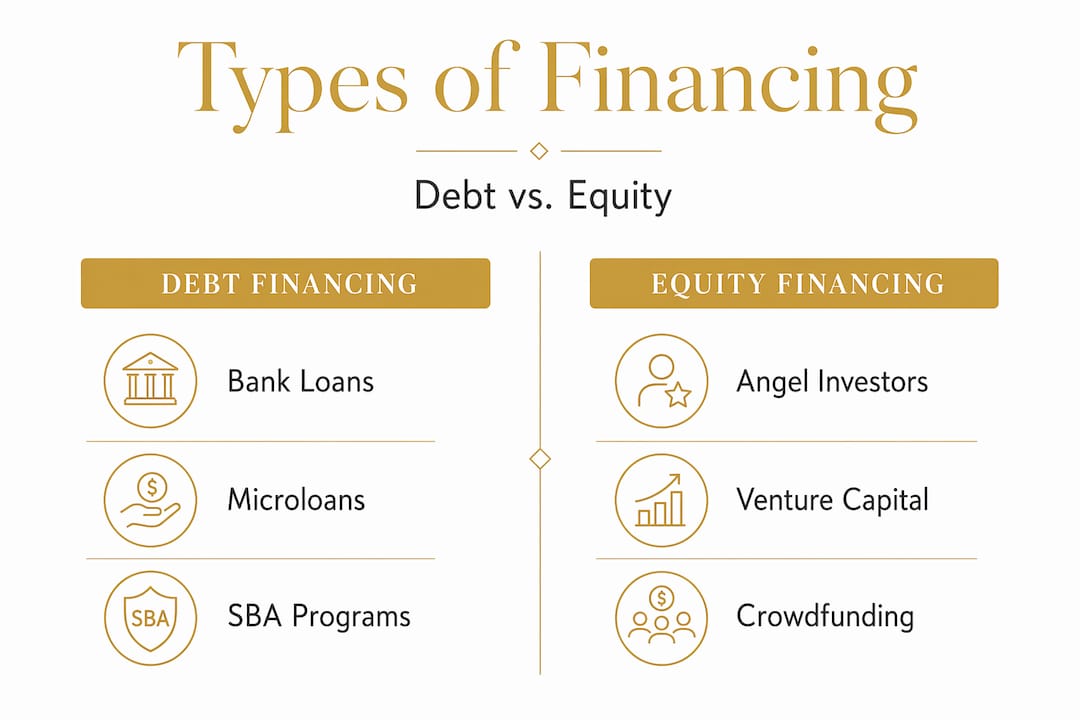
At its core, startup business financing is the process of obtaining funds to start, operate, or grow a business. That definition sounds simple, but the mechanics split into two fundamentally different tracks: debt and equity.
Debt financing means you borrow money and pay it back with interest. You keep full ownership of your business, but you take on a repayment obligation whether your revenue is strong or flat. Debt financing keeps ownership intact but creates a fixed financial obligation that can strain cash flow in early months.
Equity financing works the opposite way. An investor gives you capital in exchange for a percentage of your company. There is no monthly payment to make, but equity financing reduces ownership and, by extension, your say in how the business runs.
A few terms you will hear constantly once you start talking to lenders and investors:
- Working capital: The money you use to cover day-to-day operations, payroll, and inventory. It is short-term by nature.
- Fixed assets: Physical purchases like equipment, vehicles, or commercial real estate that require longer-term financing.
- Collateral: An asset you pledge to the lender in case you cannot repay. Many startups lack significant collateral, which creates friction with traditional lenders.
Pro Tip: Before you talk to any lender or investor, get clear on whether you need working capital or a long-term asset purchase. That distinction narrows your list of suitable financing options immediately.
Common types of startup funding options
The range of ways to fund a startup is broader than most first-time founders expect. Here is how the major categories work in practice.
Bootstrapping and personal funds
Bootstrapping is the most common early-stage funding method. You use savings, personal credit cards, or money from a side income to get the business off the ground. The upside is total ownership and zero investor pressure. The downside is a hard ceiling on how fast you can grow.
Startup business loans
This category includes traditional bank loans, online lender products, and SBA-backed loans. Startup loans typically carry higher interest rates and shorter repayment windows than loans for established businesses, because lenders view early-stage companies as higher risk. Online lenders often move faster and ask for less documentation, but the cost of capital is higher. SBA loans sit in the middle: better rates than online lenders, but more paperwork and longer approval timelines.

Microloans and government programs
There are no federal grants for starting a business, but government-backed microloan programs fill a real gap. The SBA’s Microloan Program, for example, offers loans up to $50,000 through nonprofit intermediaries. These are designed for businesses that cannot qualify for traditional bank financing yet need more capital than personal savings can provide.
Equity financing: angel investors and venture capital
Angel investors are typically high-net-worth individuals who invest personal funds in early-stage companies in exchange for equity. Venture capital firms do the same but at a larger scale, usually for businesses with proven traction and significant growth potential. Both routes mean giving up ownership. The upside is that experienced investors often bring networks, mentorship, and credibility alongside their money.
Friends, family, and crowdfunding
Friends and family money is informal and often carries low or no interest, but it introduces personal risk into your closest relationships. Crowdfunding platforms let you raise small amounts from many people, either as pre-orders (rewards-based) or as equity stakes (equity crowdfunding under Regulation Crowdfunding). Neither route replaces a solid business plan, but both can validate your idea while generating capital.
| Funding type | Best for | Key trade-off |
|---|---|---|
| Bootstrapping | Very early stage, low capital need | Limits growth speed |
| Bank or SBA loan | Established cash flow, collateral | Repayment obligation |
| Microloan | Early stage, small capital need | Lower loan amounts |
| Angel investor | High-growth potential startups | Equity dilution |
| Crowdfunding | Consumer products, community appeal | Time-intensive campaigns |
Pro Tip: If you are exploring alternative funding sources like revenue-based financing or invoice financing, compare the total cost of capital, not just the interest rate. Fees and factor rates can make a cheap-looking product expensive.
Understanding startup loan eligibility
Here is where many founders hit a wall. Lenders typically define startups as businesses under two years old, and that classification creates a specific set of challenges when applying for traditional financing.
Traditional banks use underwriting models built around financial history. They want to see two or three years of tax returns, consistent revenue, and meaningful collateral. A startup, by definition, has little or none of that. The result is that most early-stage founders get turned away from conventional bank products before the conversation really starts.
What lenders actually look for when evaluating startups:
- Personal credit score: In the absence of business credit history, lenders lean heavily on the founder’s personal score. A score above 680 opens more doors. Below 600 closes most of them.
- Business plan strength: Especially for SBA loans, a clear and realistic plan for how you will use and repay the funds matters significantly.
- Collateral and personal guarantees: Many startup loans require a personal guarantee, meaning your personal assets back the loan if the business cannot pay.
- Industry and business model: Certain industries, like food service or retail, are viewed as higher risk regardless of the founder’s credit profile.
The good news is that alternative financing options like microloans and revenue-based financing were built specifically because traditional underwriting excludes early-stage businesses. And on the institutional side, the SBA just made its programs more accessible. Effective July 4, 2026, eligible borrowers can combine 7(a) and 504 loans for up to $10 million in total SBA-backed financing. That doubles the previous $5 million cumulative cap and is a meaningful shift for growing startups planning significant capital investments.
Before you apply anywhere, review the business loan eligibility criteria that lenders in your region typically use. Knowing where you stand before you apply saves time and protects your credit.
How to choose the right financing for your startup
Picking a financing method is not just about what you qualify for. It is about matching the capital to what you actually need it for and what you are willing to give up to get it.
Here is a practical process for narrowing your options:
-
Identify what the money is for. Working capital needs, like covering payroll or buying inventory, call for short-term flexible financing. Buying equipment or a commercial space calls for longer-term, fixed-rate financing. Mixing these up leads to expensive mismatches.
-
Decide how much ownership you are willing to give up. If keeping control of your company matters deeply to you, debt financing is your lane. If you want an investor’s network and mentorship as much as their money, equity is worth considering. Weigh control dilution against funding needs before you start any conversation with investors.
-
Be honest about your repayment capacity. Take a 12-month revenue projection and stress-test it against a loan payment. If missing two months of expected revenue would make repayment impossible, you are borrowing too aggressively.
-
Explore what you actually qualify for. Check your personal credit score, gather your financial documents, and review the startup funding options available at your current business stage. Do not assume you only qualify for one type.
-
Avoid overborrowing. Taking more than you need feels safe in the moment but adds unnecessary repayment pressure. Borrow for a specific use with a specific plan, not for a vague sense of financial cushion.
Pro Tip: Talk to an SBA resource partner or a SCORE mentor before committing to any financing structure. These free resources exist specifically to help startups avoid expensive early mistakes.
My honest take on startup financing
I have worked with dozens of early-stage founders over the years, and the same misunderstanding comes up every time: they think the goal is to get as much money as possible, as fast as possible. That instinct is understandable. Cash feels like security when you are building something from scratch.
But what I have actually seen is that founders who take on equity too early often regret it by year three, when investor priorities start to conflict with their original vision. And founders who take on too much debt too fast can kill a good business before it ever finds its footing.
What actually works is matching the financing to the stage. Use personal funds and microloans to prove your model. Use SBA loans or term loans once you have some revenue history. Bring in equity partners only when growth truly demands capital you cannot access any other way.
The uncomfortable truth about startup loan eligibility is that it is often more personal than business. Your personal credit score, your savings, your personal guarantee. That is the reality for most early-stage founders. The SBA programs and alternative lenders exist to soften that reality, but they do not eliminate it.
My advice: get informed before you get desperate. The founders who understand their financing options before they urgently need money make far better decisions than those who are searching under pressure.
— Jason
How Emorylending helps startups get funded
Getting clear on your options is the first step. Taking action on them is where Emorylending comes in.
At Emorylending, we evaluate your business based on performance and cash flow, not just your personal credit score. That matters enormously for startups that have solid momentum but limited credit history. We help businesses secure funding from $5,000 to $5,000,000+, covering working capital needs, equipment purchases, payroll gaps, and expansion costs.
Whether you are just starting out or ready to scale, our team works with you to find the financing structure that fits your business, not the one that is easiest for us to sell. Start by exploring our small business financing options to see what makes sense for your stage and goals. If you are ready to get into specifics, our funding guide for business owners walks you through the process step by step.
FAQ
What does startup business financing mean?
Startup business financing refers to the process of obtaining capital to launch, operate, or grow a new business. It includes both debt options, like loans and credit lines, and equity options, like angel investment or venture capital.
How do I know if I qualify for a startup loan?
Most lenders define startups as businesses under two years old and will evaluate your personal credit score, collateral, and business plan. Scores above 680 and a clear repayment plan significantly improve your chances.
What is the difference between debt and equity financing?
Debt financing means borrowing money you repay with interest while keeping full ownership. Equity financing means selling a stake in your company in exchange for capital, with no repayment required but with reduced ownership.
Are there government programs to help fund a startup?
Yes. The SBA offers loan programs including 7(a) and 504 loans, and as of July 2026, eligible borrowers can access up to $10 million in combined SBA-backed financing. The SBA Microloan Program also helps early-stage businesses access smaller amounts.
What is the safest way to fund a new business?
Bootstrapping with personal funds carries the least financial risk since there is no repayment obligation or ownership loss. However, it limits growth speed. Most founders combine bootstrapping with one additional funding source once their model is proven.


