

Most small businesses don’t fail because they run out of customers. They fail because they run out of cash. This small business cash flow guide exists to close that gap. Cash flow, known formally as liquidity management, is the discipline of tracking actual money moving in and out of your business, not just what you’re earning on paper. 56% of small businesses reported trouble covering operational expenses in 2024, and 51% dealt with uneven cash timing. This guide gives you the tools to forecast, manage, and protect your cash before the warning lights come on.
Table of Contents
- Key takeaways
- Small business cash flow guide: the basics that matter
- Building your forecasting system
- Working capital: the fastest cash levers you have
- Building your weekly cash flow routine
- My honest take after years of watching businesses manage cash
- How Emorylending can help when cash needs a boost
- FAQ
Key takeaways
| Point | Details |
|---|---|
| Profit does not equal cash | A business can show strong profits and still miss payroll if cash timing is off. |
| Rolling forecasts beat static budgets | A 13-week weekly-updated forecast tells you where cash will be, not just where it was. |
| Working capital is a cash lever | Tightening receivables and payables can unlock 5 to 15% of annual revenue in cash. |
| Routine monitoring catches problems early | Daily and weekly cash reports reveal stress signals weeks before they become crises. |
| Financing fills planned gaps | When cash shortfalls are predictable, strategic financing becomes a tool, not a rescue. |
Small business cash flow guide: the basics that matter
Cash flow is straightforward in concept and deceptively tricky in practice. It measures the actual dollars entering and leaving your bank account during a specific period. Profit, by contrast, is an accounting calculation. You can invoice a client $50,000 in December, record that as revenue, and still start January with nothing in the bank if they pay net 60.
Cash flow statements track liquidity through three categories:
- Operating activities: Cash from your core business operations, including customer payments received and vendor payments made.
- Investing activities: Cash spent or received from buying or selling long-term assets like equipment or property.
- Financing activities: Cash from loans, investor capital, or debt repayments.
The cash flow statement is the one financial document that tells you the truth about liquidity. Your income statement tells you if you’re profitable. Your balance sheet tells you what you own and owe. But neither one tells you whether you have enough cash on hand to make Friday’s payroll.
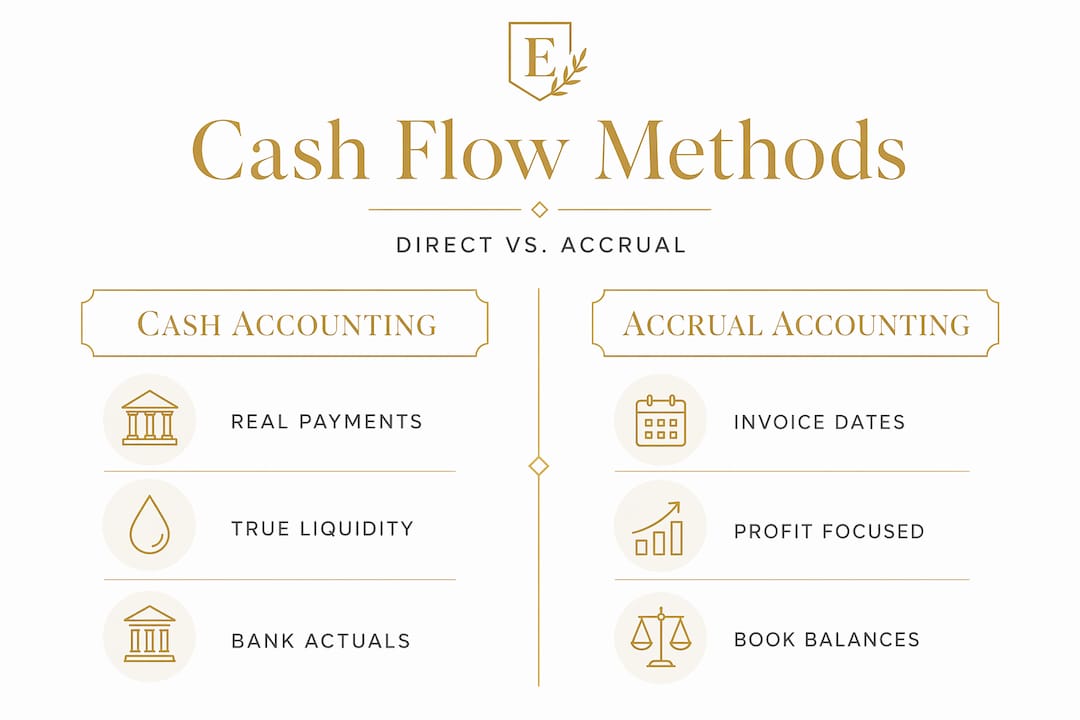
One more distinction worth locking in: cash accounting records income and expenses when money actually changes hands. Accrual accounting records them when they’re earned or incurred. If you use accrual accounting, your reported profits and your actual cash position can diverge significantly. Understanding that gap is where cash flow management for small business really begins.
Building your forecasting system
Getting your cash flow under control starts with accurate records and the right tools. Before you can forecast anything, you need clean books. Use digital accounting software that generates real-time reports. Manual spreadsheets create lag and errors. Set aside dedicated accounts for tax obligations and payroll costs so those funds aren’t accidentally spent on operations. Separating these accounts prevents one of the most common and painful cash surprises small owners face.
Once your records are clean, build a 13-week rolling cash flow forecast. This is the gold standard for small business finance tips around liquidity. Here is how to set it up:
- Start with your actual bank balance today. Not your accounting balance. Your real, confirmed bank balance.
- List all fixed outflows by date. Payroll, rent, loan payments, subscriptions. Put them on the exact week they clear.
- Forecast all expected receipts by collection date. Not invoice date. When do your customers actually pay?
- Roll the forecast forward every week. Update actuals, add a new Week 13, and remove the week that just passed.
- Compare forecast to actuals and find the gaps. When a receipt came in late or an expense ran high, document why.
A direct timing model like this, anchored to actual bank movements, catches liquidity pinches that accrual-based summaries miss entirely. The common mistake is treating a static annual budget as a forecast. A budget tells you where you planned to be. A rolling forecast tells you where you’re actually going.
Pro Tip: Color-code your 13-week forecast: green when cash stays above your minimum reserve threshold, yellow within 20% of it, and red below. This turns a spreadsheet into a decision-making tool you can read in 30 seconds.
| Forecast type | Update frequency | Best use |
|---|---|---|
| 13-week rolling | Weekly | Operational cash timing |
| Annual budget | Monthly or quarterly | Strategic planning |
| Scenario forecast | As needed | Crisis and growth planning |
Working capital: the fastest cash levers you have
Working capital is the difference between your current assets and your current liabilities. It represents the cash tied up in the day-to-day cycle of your business. The metric that brings this to life is the cash conversion cycle (CCC): how many days it takes to turn inventory and receivables into actual cash in your account.

Here is a concrete example of why this matters. Reducing your cash conversion cycle by just 10 days on $5 million in annual revenue frees approximately $135,000 in cash. You don’t need a new product line or a bigger market. You just need faster collections and smarter payment timing.
The levers that move CCC the fastest:
- Invoice immediately. Don’t batch invoices weekly. Send them the day work is complete or goods are delivered.
- Require milestone deposits. For projects over 30 days, collect 25 to 50% upfront to fund work in progress.
- Follow up on AR at day 15, not day 31. Most overdue invoices stay unpaid because no one asked. Set a recurring calendar reminder.
- Renegotiate vendor payment terms. Ask for net 45 or net 60 with key suppliers. Many will agree without pushback if you have a good history.
- Trim slow-moving inventory. Every dollar sitting in unsold stock is cash you can’t spend. Review inventory turns monthly and liquidate dead SKUs.
- Offer an early payment discount. A 1% discount for payment in 10 days can accelerate collections significantly on large invoices.
- Tighten credit terms for new customers. Reserve net 30 or longer for proven accounts. New clients start on net 15 or credit card.
For a deeper look at how working capital ratios and optimization strategies connect, Emorylending’s guide on working capital basics breaks it down in practical terms for small owners.
Pro Tip: Calculate your own CCC this week using: Days Sales Outstanding + Days Inventory Outstanding minus Days Payable Outstanding. If you don’t know your DSO, pull your AR aging report right now. That number alone will tell you more than a month of budget reviews.
Building your weekly cash flow routine
Knowing your numbers once is not cash flow management. It’s a snapshot. Real cash flow analysis for entrepreneurs happens through consistent weekly and monthly routines that surface warning signs before they become emergencies.
Here is a practical weekly and monthly workflow:
- Monday morning: check actual bank balance against forecast. Log the variance. If receipts are running behind, flag the specific invoices.
- Mid-week: review AR aging. Any invoice over 20 days unpaid gets a follow-up call or email that day, not at month end.
- End of week: update the 13-week rolling forecast. Add actual receipts and payments from the prior week and revise upcoming weeks based on new information.
- Monthly: run a full variance root-cause analysis. For every line that missed by more than 10%, write one sentence explaining why. Patterns show up within two months.
- Monthly: review working capital ratios. Calculate current ratio and quick ratio. Know your trend, not just your current number.
Variance analysis and AR aging are disciplines that 80% of small businesses skip but are foundational to reliable forecasting. The businesses that skip them are the ones calling their banker in a panic.
Set a cash reserve target. A common benchmark is two months of fixed operating expenses held in a separate savings account. Service businesses with low variable costs can often operate with six to eight weeks. Businesses with inventory, payroll-heavy operations, or seasonal revenue need closer to three months.
Warning signs to watch for: you’re consistently paying vendors late, you’re drawing on a line of credit to cover payroll, and your bank balance is lower at the end of every month than it was the month before. These are the early signals that your cash flow stress is structural, not seasonal.
Build scenario plans alongside your base forecast. Your base case assumes normal collections and expenses. Your downside case assumes your two largest customers pay 30 days late. Your crisis case assumes one major customer doesn’t pay at all. For each scenario, decide in advance what action you’ll take if cash drops below a specific threshold.
Pre-deciding your response triggers is what separates businesses that survive cash crunches from those that scramble. When you’ve already decided “if cash drops below $40,000, we pause discretionary hiring immediately,” you act in days, not weeks. Scenario planning linked to triggers compresses your response time when it matters most.
My honest take after years of watching businesses manage cash
I’ve worked alongside enough small business owners to spot a pattern that repeats itself. The business looks profitable on paper. The owner is confident because revenue is growing. Then a slow-paying client or an unexpected equipment repair hits, and suddenly the account is overdrawn. Profit masked the problem.
The biggest mindset shift I’ve seen pay off is treating your 13-week forecast like a living operating tool, not a reporting exercise. Systems that translate expected performance into actual bank cash movements catch problems weeks ahead of time. Most owners build a forecast once, set it aside, and come back when things feel tight. That’s precisely backwards.
The working capital levers that pay off fastest in my experience are AR follow-up and upfront deposits. Not because they’re sophisticated, but because most businesses aren’t doing them consistently. Getting paid faster doesn’t require renegotiating anything. It just requires asking.
If I had to give one piece of advice to every small business owner reading this, it would be: do your 13-week forecast update every Monday before you check your email. Make it a 20-minute ritual. Six weeks in, you’ll wonder how you ever ran a business without it.
— Jason
How Emorylending can help when cash needs a boost

Even the best-managed cash flow sometimes runs into a gap. Seasonal slowdowns, a big customer paying late, or a growth opportunity that requires upfront capital. These aren’t signs of poor management. They’re the realities of running a growing business.
Emorylending evaluates your business performance and actual cash flow, not just your personal credit score. Whether you need working capital to cover a slow quarter, equipment financing to expand capacity, or growth capital to take on a larger contract, there are options built specifically for businesses like yours. Explore financing options covering $5,000 to $5,000,000 and find the structure that fits your cash cycle, not the other way around.
FAQ
What is the difference between cash flow and profit?
Profit is an accounting figure representing revenue minus expenses, while cash flow measures actual money entering and leaving your bank account. A business can be profitable and still miss payments if customers pay slowly.
How do I create a cash flow forecast for my small business?
Start with your confirmed bank balance, list all scheduled outflows by their actual payment date, estimate receipts by the date you expect to collect, and update the forecast every week by comparing actuals to predictions.
What is a healthy cash reserve for a small business?
Most small businesses should target two to three months of fixed operating expenses held in a dedicated reserve account. Service-based businesses with predictable revenue can often manage with six to eight weeks of reserves.
How can I improve cash flow without taking on debt?
The fastest options are invoicing immediately after delivery, following up on overdue accounts receivable within 15 days, requiring upfront deposits on large projects, and renegotiating extended payment terms with key vendors.
What does a cash flow statement show that an income statement doesn’t?
A cash flow statement shows actual cash movements by category, including operating, investing, and financing activities. An income statement shows revenue and expenses on an accrual basis, which can differ significantly from when cash actually changes hands.


