

What are the top alternatives to Emerson Capital Corp for small business financing?
If you’ve been searching for emersoncapitalcorp.com alternatives, the first thing to sort out is which “Emerson Capital” you’re actually dealing with. Emerson Capital Corp, based in Glencoe, Illinois, is a small business acquisition loan specialist led by Douglas Adams, who brings over 30 years of SBA lending experience. It is a completely separate entity from Emerson Capital Partners, a private equity firm that acquires lower middle-market companies and does not offer loans at all. Confusing the two leads business owners down the wrong path fast.
Once you clear up that distinction, four genuine alternatives emerge for U.S. small business owners: Emorylending (cash flow-focused loans from $5,000 to over $5 million), Emko Capital (industrial and manufacturing growth capital), Klaris Capital (strategic advisory and late-stage tech investment), and Emerson Equity LLC (brokerage and private placement services for high-net-worth and institutional clients).
| Firm | Financing type | Business stage | Typical funding | Eligibility focus | Advisory available |
|---|---|---|---|---|---|
| Emorylending | Working capital, equipment, expansion loans | Startups to established | $5,000 to over $5 million | Cash flow and business performance | Yes |
| Emko Capital | Industrial growth capital, acquisitions | Established manufacturers | Not publicly listed | Manufacturing sector fit | Yes |
| Klaris Capital | M&A advisory, Series A to pre-IPO capital | Growth to late-stage tech | — | Tech and services ecosystem | Yes |
| Emerson Equity LLC | Private placements, brokerage | Established, high net worth | Not publicly listed | Accredited investors | Yes |
- Emorylending evaluates business cash flow rather than personal credit, enabling more owners to access financing compared to traditional banks.
- Emko Capital focuses exclusively on U.S. manufacturing, aerospace, and industrial sectors, investing from committed funds with certainty to close.
- Klaris Capital, backed by a multi-generational family office, operates without fund-driven timelines and advises on cross-border M&A and capital raises across a global network.
- Emerson Equity LLC is a full-service boutique brokerage founded in 2003, serving both sponsor companies and individual investors through carefully vetted private placements.
Table of Contents
- How do these alternatives compare across key financing criteria?
- How do you choose the right small business financing partner?
- What types of business financing do these alternatives actually offer?
- Emorylending: a direct financing alternative built for small business owners
- Key Takeaways
How do these alternatives compare across key financing criteria?
The differences between these firms go deeper than just industry focus. Each one serves a distinct buyer at a distinct stage, and matching yourself to the wrong type can cost you months.

| Criterion | Emorylending | Emko Capital | Klaris Capital | Emerson Equity LLC |
|---|---|---|---|---|
| Best for | Small businesses needing fast working capital or equipment | Manufacturing and industrial owners seeking growth equity | Tech founders and boards needing M&A or capital raise advisory | Accredited investors and sponsor companies in private placements |
| Financing type | Working capital, equipment, expansion, payroll | Equity acquisitions and recapitalizations | Principal investing, M&A advisory, capital raising | Private placements, secondary transactions, alternative investments |
| Typical funding | $5,000 to over $5 million | Not publicly listed | — | Not publicly listed |
| Eligibility focus | Business cash flow and performance | Manufacturing sector expertise and fit | Technology and services ecosystem | Accredited investor or sponsor company status |
| Strategic advisory | Yes | Yes, operational and industry expertise | Yes, cross-border and global family office network | Yes, personalized boutique attention |
| Special features | Fast processing, no personal credit focus | industrial focus, engineers and operators on team | Permanent capital, no exit pressure | Nimble boutique model, broad alternative investment access |
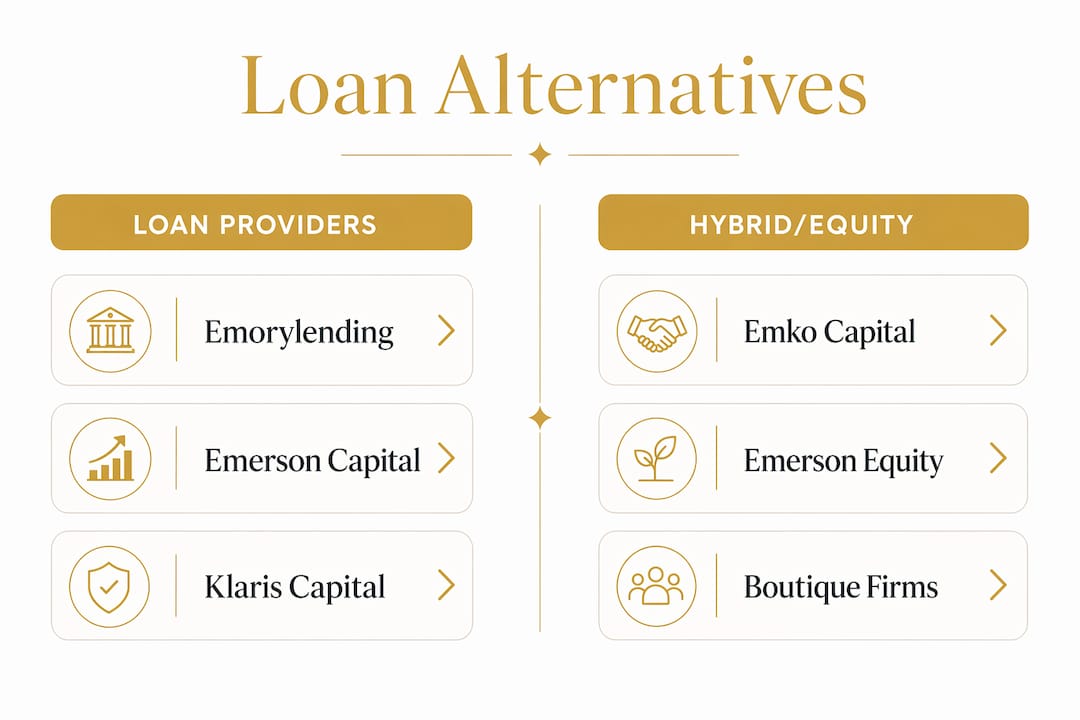
Emko Capital’s team of engineers and operators brings hands-on manufacturing expertise that a generalist lender simply cannot replicate. Klaris Capital’s backing by a multi-generational family office means it can hold positions and advise over decades, not quarters. Emerson Equity LLC’s boutique structure lets it stay flexible for clients who need access to alternative investments outside the standard bank menu.
The clearest dividing line is this: Emorylending and Emerson Capital Corp both operate in the loan space, while Emko Capital, Klaris Capital, and Emerson Equity LLC are equity, advisory, or brokerage firms. Choosing the wrong category means you’re not getting a loan at all.
How do you choose the right small business financing partner?
Start with your actual need. A business owner who needs $200,000 for equipment next month has no use for a private equity firm seeking a controlling acquisition. Clarity on your financing type, amount, and timeline eliminates most options before you even fill out an application.
Key evaluation criteria to work through before you apply:
- Loan size fit: Does the lender’s range match your need? Emorylending offers funding from $5,000 to over $5 million, spanning most small business scenarios.
- Financing type: Working capital, equipment loans, SBA acquisition financing, and private equity are not interchangeable. Know which one you need.
- Eligibility focus: Some lenders weight personal credit heavily. Others, like Emorylending, center their decision on verifiable business cash flow.
- Strategic advisory: If you want a financing partner who also helps with growth planning, confirm that service is actually included, not just implied.
- Fees and total cost: Get the full cost picture, including origination fees, interest rates, and any prepayment penalties, before signing.
- Exit pressure for equity partners: If you’re considering a private equity firm, ask directly about their liquidation timeline. Permanent capital structures can hold businesses indefinitely, unlike blind-pool funds with fixed exit dates.
Pro Tip: Douglas Adams, principal at Emerson Capital Corp, emphasizes that lenders scrutinize add-back legitimacy in your cash flow analysis. Overstating add-backs reduces lender confidence and can shrink your qualifying amount. Before applying anywhere, prepare a clean, verifiable cash flow statement where every add-back can be documented.
Readiness checkpoints before you apply:
- Gather at least two years of business tax returns and profit-and-loss statements.
- Prepare a cash flow statement that separates owner compensation from operating expenses clearly.
- Identify and document every add-back with supporting receipts or records.
- Know your business’s monthly revenue average and any seasonal patterns.
- Have your business bank statements for the past 12 months ready to upload.
For owners exploring small business loan options beyond a single lender, comparing multiple sources before committing is worth the extra week it takes.
What types of business financing do these alternatives actually offer?
Understanding the spectrum of financing types prevents costly mismatches. These are the main categories relevant to the firms covered here.
SBA loans and acquisition financing are structured debt products, typically used to buy a business or finance expansion. Douglas Adams at Emerson Capital Corp works with roughly 18 banks to shop SBA deals competitively for each client. Acquisition debt and ownership capital are fundamentally different: one you repay, the other you trade equity for.
Working capital loans cover short-term operational needs like payroll, inventory, or receivables gaps. They’re typically faster to approve than SBA loans and don’t require collateral at the same level.
Private equity and growth capital involve selling a stake in your business in exchange for capital and, often, operational support. Emko Capital operates this way in manufacturing. This is not a loan. You are giving up ownership.
Permanent capital vs. blind-pool private equity is a distinction worth understanding if you’re considering any equity partner. Traditional private equity funds have fixed timelines and must exit investments, often forcing a sale you didn’t want. Firms backed by committed capital bases, like Emerson Capital Partners and Klaris Capital, can hold positions indefinitely, which suits owners focused on legacy and succession planning.
Brokerage and private placement services, as offered by Emerson Equity LLC, connect accredited investors and sponsor companies to alternative investments outside public markets. This is not a financing option for a business owner seeking a loan; it’s a capital markets service.
- SBA loans: best for acquisition financing and established businesses with documented cash flow.
- Working capital loans: best for businesses with consistent revenue needing short-term liquidity.
- Growth equity: best for manufacturing or tech companies ready to scale with an operational partner.
- Private placements: best for accredited investors or companies raising capital from institutional sources.
- M&A advisory: best for founders planning a sale, merger, or cross-border transaction.
Boutique firms like Emerson Equity LLC offer personalized attention that large institutional lenders rarely match, though their eligibility requirements and minimum investment thresholds reflect a narrower client base. For most small business owners needing straightforward financing, a cash flow-focused lender is the faster, more accessible path.
Emorylending: a direct financing alternative built for small business owners
Most small business owners searching for financing alternatives don’t need a private equity firm or a brokerage. They need capital, fast, from a lender who actually understands how their business generates money.
Emorylending evaluates your business performance and cash flow rather than fixating on personal credit scores, which means more businesses qualify. The funding range runs from $5,000 to over $5 million, covering working capital, equipment purchases, location expansion, payroll, and receivables gaps. That breadth matters when your needs shift quarter to quarter. Emorylending also publishes detailed alternative lender comparisons and financing guides, reflecting genuine depth in the small business lending market as of 2026.
If you’re ready to see what you qualify for, start with Emorylending’s flexible financing guide or review the full business financing options list to match your need to the right product.
Key Takeaways
Emorylending is the clearest loan-based alternative to Emerson Capital Corp for U.S. small business owners, covering $5,000 to over $5 million with a cash flow-first qualification model that bypasses the personal credit barrier most traditional lenders impose.
| Point | Details |
|---|---|
| Entity confusion is costly | Emerson Capital Corp (loans) and Emerson Capital Partners (private equity) are separate firms with entirely different services. |
| Match financing type to your need | Loans, growth equity, M&A advisory, and private placements serve different purposes; choosing the wrong category wastes time. |
| Cash flow documentation wins approvals | Lenders scrutinize verifiable add-backs; clean, documented cash flow statements improve both approval odds and qualifying amounts. |
| Permanent capital changes the exit equation | Firms with committed capital bases can hold businesses indefinitely, unlike blind-pool funds with fixed liquidation timelines. |
| Emorylending covers the widest loan range | Funding from $5,000 to over $5 million with cash flow-based eligibility makes Emorylending accessible to most small business stages. |


