

Commercial lending is the practice of banks, credit unions, and specialist lenders providing debt-based financing to businesses for purposes like equipment acquisition, real estate, working capital, and growth. Unlike personal loans, commercial loans involve larger amounts, stricter underwriting, and collateral requirements that reflect the scale of business risk. For entrepreneurs and small business owners, understanding how business loans work is the first step toward securing capital on terms that actually support your goals. This guide covers commercial loan types, the underwriting process, eligibility criteria, and practical strategies to improve your approval odds.
What is commercial lending and how does it work?
Commercial lending is defined as debt financing extended by financial institutions to businesses rather than individuals. The borrower receives capital and repays it over time with interest, while the lender holds collateral and often a personal guarantee as security. This structure differs from personal lending in three key ways: loan size, underwriting rigor, and the requirement that the business itself demonstrate repayment capacity.
Commercial lending provides debt-based financing for business goals including equipment acquisition, real estate purchase, and working capital management. That scope means a single commercial loan can fund a $500,000 equipment purchase or a $3 million facility expansion. Emorylending works with businesses seeking funding from $5,000 to $5,000,000 and above, which illustrates just how wide the commercial lending spectrum runs.
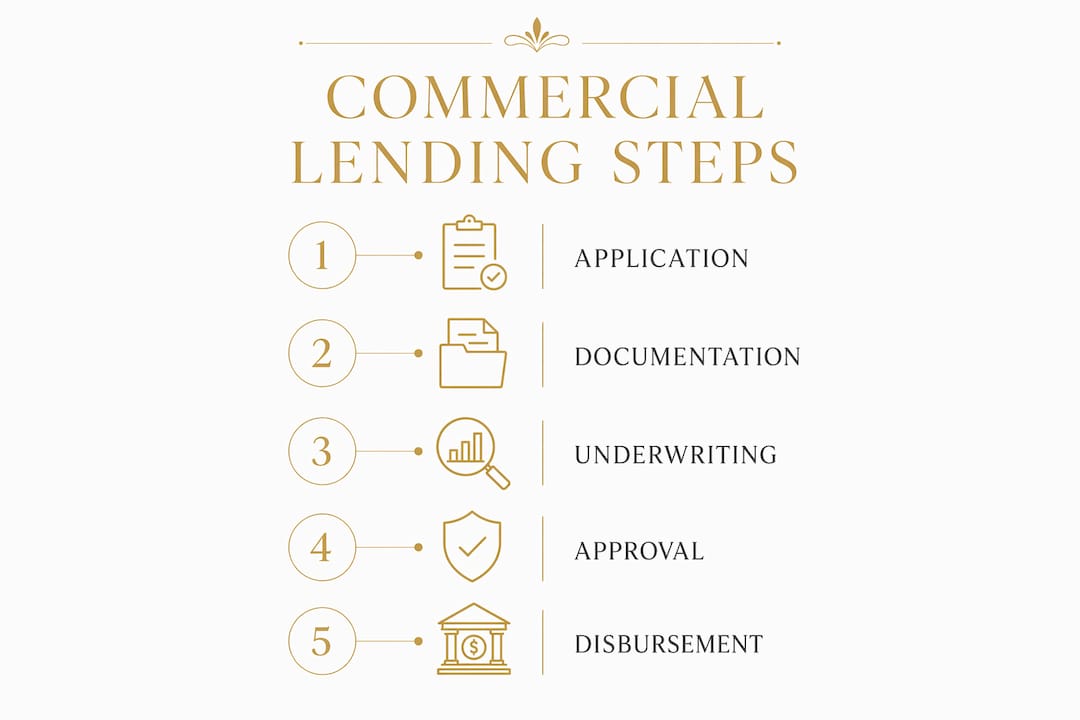
The mechanics are straightforward. A business applies to a lender, submits financial documentation, and goes through underwriting. The lender evaluates risk, sets terms, and either approves or declines. Approved borrowers receive funds and begin repayment according to a fixed or variable schedule. The entire process, from application to disbursement, typically runs longer than most entrepreneurs expect.

What types of commercial loans are available?
Commercial loan types vary by purpose, structure, and repayment terms. Choosing the wrong product for your situation can cost you significantly in interest or flexibility.
| Loan Type | Structure | Best Use Case |
|---|---|---|
| Term loan | Lump sum, fixed repayment schedule | Equipment, expansion, one-time capital needs |
| Line of credit | Revolving access, interest on drawn amounts only | Working capital, payroll, inventory gaps |
| SBA loan | Government-backed, lower rates, longer terms | Startups, underserved borrowers, larger projects |
| Equipment financing | Asset-secured loan tied to specific equipment | Machinery, vehicles, technology purchases |
| Commercial real estate loan | Property-secured, amortized over 15 to 25 years | Buying or refinancing business property |
Term loans deliver a lump sum upfront and require fixed monthly payments over a set period. They work well for capital investments where you know the exact cost. A line of credit, by contrast, gives you revolving access to funds and you only pay interest on what you draw. This makes it the preferred tool for managing cash flow gaps, covering payroll, or buying inventory before a seasonal spike.
SBA loans, backed by the U.S. Small Business Administration, add a layer of government guarantee that allows lenders to approve deals they might otherwise decline. The tradeoff is a longer processing timeline and additional documentation requirements. Equipment financing ties the loan directly to the asset being purchased, which often simplifies collateral requirements since the equipment itself secures the loan.
Pro Tip: If you are unsure whether a term loan or line of credit fits your situation better, map out your cash flow for the next 12 months. A one-time capital need points to a term loan. Recurring gaps in operating cash point to a line of credit.
How does commercial loan underwriting work?
Commercial loan underwriting is the lender’s formal process of assessing whether a business can repay a loan, will repay on time, and has fallback options if circumstances change. Those three core questions guide every underwriting decision, regardless of loan size or lender type. Understanding this framework helps you prepare documentation that directly answers what underwriters need to see.
The financial metrics that determine approval
The most critical metric in commercial loan underwriting is the Debt Service Coverage Ratio, or DSCR. This ratio measures your net operating income against your total debt obligations. Most institutional lenders require a DSCR between 1.20 and 1.25 at minimum. A DSCR of 1.25 means your business generates $1.25 in operating income for every $1.00 of debt service. Anything below 1.20 signals to lenders that repayment is at risk.
Beyond DSCR, underwriters examine the loan-to-value ratio, debt-to-asset ratio, and net-worth-to-loan-size. These metrics collectively paint a picture of your business’s financial stability. Underwriters prioritize consistent operating cash flow over profit on paper, because profit can be manipulated through accounting while cash flow reflects actual business performance.
Collateral is another major factor. Commercial loans typically require collateral equal to or greater than the loan value, often with a 20% cushion above the loan amount to meet lender loan-to-value thresholds. For real estate loans, the underwriting process also involves legal documentation including promissory notes, security agreements, and recording liens with county offices. This adds time and complexity that borrowers often underestimate.
What to expect from the underwriting timeline
The underwriting timeline runs 60 to 120 days from application to capital disbursement for most commercial loans. Complex deals, SBA loans, or larger loan amounts push toward the longer end of that range. This is one of the most common surprises for entrepreneurs who assume commercial financing works like a consumer loan approval.
SBA loans carry additional requirements layered on top of conventional underwriting, including stricter personal guarantee rules. The tradeoff is access to projects that conventional lenders would not finance at all. If your deal requires SBA backing, build at least 90 to 120 days into your planning timeline.
Pro Tip: Prepare a complete documentation package before you submit your application. Lenders who receive incomplete files restart their review clock. Delays almost always trace back to missing tax returns, outdated financial statements, or unsigned personal guarantee forms.
What are the eligibility requirements for commercial loans?
Qualifying for a commercial loan requires demonstrating financial health across several dimensions. Lenders do not approve businesses based on potential alone. They approve businesses that can prove current repayment capacity.
The core documentation requirements include:
- Two to three years of business tax returns
- Current profit and loss statements and balance sheets
- Three to six months of business bank statements
- A detailed business plan or use-of-funds statement for larger loans
- Personal tax returns for all owners with 20% or more ownership
Credit score thresholds matter significantly. Many lenders require minimum credit scores in the 650 to 700 range for approval, and scores below that threshold either increase borrowing costs or result in outright rejection. Both business credit and personal credit are reviewed, which is why almost all commercial loans require a personal guarantee that exposes the owner’s personal assets if the business defaults.
Common reasons commercial loan applications get denied
Poor DSCR is the leading cause of commercial loan denial. If your business does not generate enough operating income to cover proposed debt payments with a 20 to 25% cushion, most lenders will decline. Inconsistent cash flow, recent bankruptcies, insufficient collateral, and incomplete documentation round out the most common deal killers.
Emorylending takes a different approach from traditional lenders by evaluating business performance and cash flow directly, rather than leading with personal credit scores. This opens financing to more small businesses that have strong operations but imperfect credit histories. If your application has been declined elsewhere, reviewing your DSCR and cash flow documentation is the right starting point.
Pro Tip: Before applying, calculate your own DSCR using the last 12 months of net operating income divided by projected annual debt payments. If the result is below 1.20, address cash flow gaps before submitting. Applying with a weak DSCR creates a record of denial that can complicate future applications.
How entrepreneurs can use commercial lending funds strategically
Commercial loan funds serve a wide range of business purposes, and the right use depends on your growth stage and financial position. Matching the loan type to the use case protects your cash flow and maximizes the return on borrowed capital.
The most common uses include:
- Working capital: Covering payroll, inventory purchases, and operating costs during slow periods or rapid growth phases. A working capital line of credit is often the most cost-effective tool here.
- Equipment acquisition: Purchasing machinery, vehicles, or technology that generates revenue. Equipment financing ties the loan to the asset, which simplifies collateral and often lowers rates.
- Facility expansion or renovation: Upgrading or expanding physical locations to increase capacity or enter new markets.
- Commercial real estate: Buying property your business occupies rather than paying rent, which builds equity over time.
- Refinancing existing debt: Consolidating higher-cost debt into a single commercial loan with better terms to reduce monthly obligations.
Debt financing through commercial lending has a clear advantage over equity financing: you retain full ownership of your business. The tradeoff is that debt requires repayment regardless of business performance, while equity investors share the risk. For businesses with predictable cash flow, smart use of loan funds through commercial lending almost always costs less than giving up equity.
The strategic question is not whether to borrow but how much to borrow and for what purpose. Borrowing to fund revenue-generating assets, like equipment or a new location, creates a direct return that offsets debt service. Borrowing to cover chronic operating losses does not.
Key takeaways
Commercial lending approval depends on demonstrating consistent cash flow, adequate collateral, and a DSCR above 1.20, not just a strong credit score.
| Point | Details |
|---|---|
| Definition of commercial lending | Debt financing from banks or lenders to businesses for growth, equipment, real estate, or operations. |
| DSCR is the critical metric | Lenders require a minimum DSCR of 1.20 to 1.25 to confirm reliable debt repayment capacity. |
| Underwriting takes time | Expect 60 to 120 days from application to funding, longer for SBA or complex deals. |
| Personal guarantee is standard | Most commercial loans expose owner assets if the business defaults, a risk to plan for. |
| Match loan type to purpose | Term loans suit one-time capital needs; lines of credit suit recurring cash flow gaps. |
What I’ve learned watching entrepreneurs navigate commercial lending
Most entrepreneurs I work with underestimate two things: how long underwriting actually takes, and how much documentation lenders genuinely require. They apply expecting a two-week turnaround and receive a document request list that runs three pages long. That gap between expectation and reality creates stress and sometimes causes borrowers to make poor decisions, like accepting worse terms from a faster lender just to close quickly.
The other misunderstanding I see constantly is around personal guarantees. Business owners treat them as a formality. They are not. Signing a personal guarantee means your home, savings, and personal assets are on the line if the business cannot service the debt. That reality should shape how much you borrow and whether the use of funds genuinely justifies the risk.
My honest advice: treat your loan application like a financial audit you are presenting to a skeptical audience. Organize your tax returns, reconcile your bank statements, and calculate your DSCR before you walk in the door. Lenders approve borrowers who make their job easy. Transparent, well-organized documentation signals that you run your business the same way.
The entrepreneurs who get approved quickly are rarely the ones with the best credit scores. They are the ones who show up prepared, understand their own numbers, and communicate clearly about how the loan funds will generate returns. That preparation is entirely within your control.
— Jason
How Emorylending helps small businesses secure commercial financing
If you are ready to explore your commercial lending options, Emorylending makes the process straightforward. Unlike traditional lenders that lead with personal credit, Emorylending evaluates your business performance and cash flow directly, which means more small businesses qualify for the capital they need.

Whether you need working capital to cover payroll, equipment financing to expand capacity, or a term loan to fund a new location, Emorylending works with businesses from $5,000 to $5,000,000 and above. Explore the full business financing options available to small businesses and find the product that fits your situation. Getting started takes minutes, and pre-approval gives you a clear picture of what you qualify for before you commit to anything.
FAQ
What is the definition of commercial lending?
Commercial lending is debt-based financing provided by banks, credit unions, or specialist lenders to businesses for purposes like equipment purchase, real estate, working capital, and expansion. It differs from personal lending in scale, collateral requirements, and underwriting rigor.
What is commercial loan underwriting?
Commercial loan underwriting is the lender’s process of evaluating whether a business can repay a loan, will repay on time, and has collateral or guarantees as fallback. Underwriters assess DSCR, credit scores, cash flow, and collateral value before approving terms.
How long does the commercial loan underwriting process take?
The underwriting process typically takes 60 to 120 days from application to funding. SBA loans and larger or more complex deals often run closer to the longer end of that range.
What credit score do you need for a commercial loan?
Most lenders require a minimum credit score of 650 to 700 for commercial loan approval. Scores below that range typically result in higher interest rates, stricter terms, or outright denial.
Do commercial loans require a personal guarantee?
Almost all commercial loans require a personal guarantee, meaning the business owner’s personal assets are at risk if the business defaults. This is standard practice across banks, credit unions, and most private lenders.


