

Cash flow management is the practice of controlling the timing and amounts of money entering and leaving your business to maintain liquidity and fund operations. Many small business owners confuse strong revenue with financial health, but a profitable business can still run out of cash if payments arrive too slowly or expenses hit too early. Tools like QuickBooks, NetSuite, and automated invoicing platforms give you real-time visibility into where your money sits at any given moment. The strategies in this article cover how to improve cash flow through faster collections, smarter payables, accurate forecasting, and strategic financing.
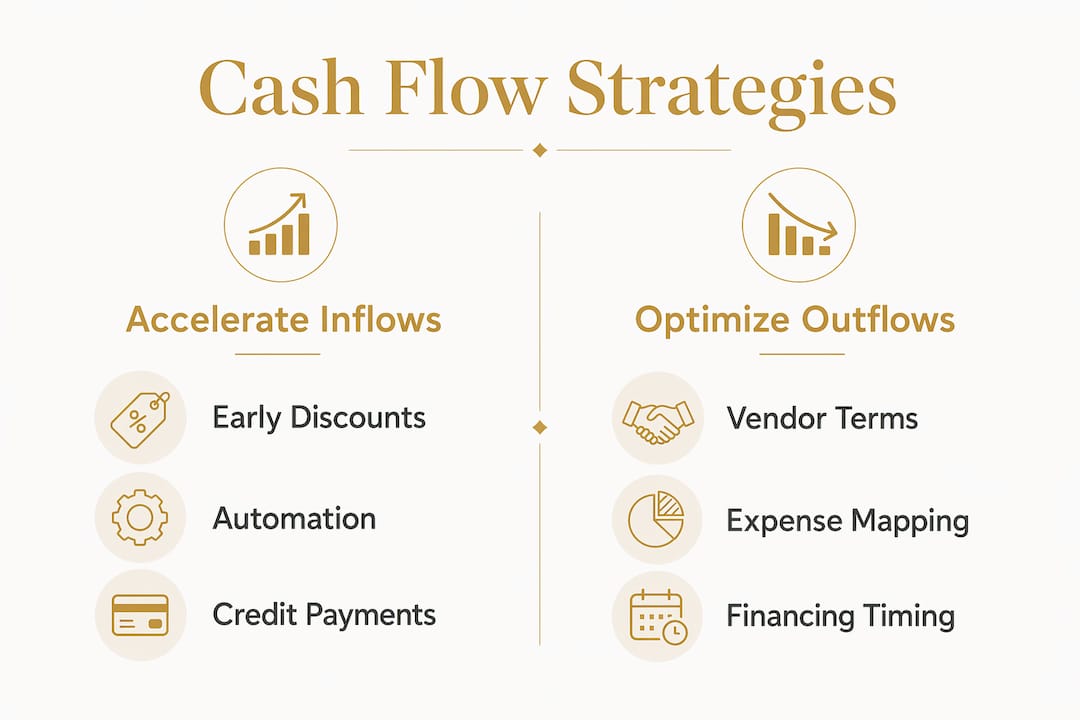
How to improve cash flow by accelerating cash inflows
The fastest way to strengthen your cash position is to collect money sooner. Every day an invoice sits unpaid is a day you are financing your customer’s operations with your own capital.

The most proven tactic is offering a 1% to 2% early payment discount for invoices settled within 10 days instead of the standard 30. This reduces days sales outstanding (DSO), which is the average number of days it takes to collect payment after a sale. A lower DSO means cash arrives faster and sits in your account longer before you need to spend it.
Automating your invoicing process removes the human delays that slow collections. Platforms like NetSuite and QuickBooks send invoices the moment a job is complete and follow up automatically on overdue accounts. Pairing automation with 24/7 digital payment options means customers can pay at midnight on a Sunday without waiting for your office to open Monday morning.
For businesses with large outstanding receivables, invoice factoring is a direct acceleration tool. Factoring gives you up to 90% of an invoice’s value immediately by selling that receivable to a third party who then manages collections. You receive cash today instead of waiting 45 or 60 days. The trade-off is a discount fee and the loss of direct control over the collection relationship, so it works best for businesses with creditworthy customers and predictable invoice volumes. Emorylending offers invoice factoring solutions designed specifically for small businesses that need to convert receivables into working capital without waiting on slow-paying clients.
Key tactics to accelerate inflows:
- Send invoices immediately upon delivery, not at the end of the month
- Offer multiple payment methods including ACH, credit card, and digital wallets
- Set clear payment terms on every invoice and follow up on day 1 of overdue status
- Require deposits or partial prepayments on large orders
- Use platforms like DavinciPay to reduce payment friction for high-volume or high-risk transaction environments
Pro Tip: Accepting credit cards increases payment speed even though fees apply. The cost of a 2.5% processing fee is almost always less than the cost of waiting 30 extra days for a check.
How can small businesses optimize cash outflows for better cash flow?
Controlling what leaves your account is just as important as speeding up what comes in. Most small businesses have more flexibility on the payables side than they realize.
Here is a practical sequence for optimizing outflows:
- Audit every recurring expense. Pull three months of bank statements and flag every subscription, software license, and service retainer. Cutting non-essential expenses like unused tools and redundant services frees cash without touching your core operations. Most businesses find at least one or two items they forgot they were paying for.
- Negotiate longer payment terms with vendors. Ask your top five suppliers to extend net 30 terms to net 45 or net 60. Longer payment terms create a buffer between when you collect from customers and when you pay suppliers, which is the definition of working capital. Vendors who value your business will often agree, especially if you have a strong payment history.
- Stagger large payments. If you have a major annual expense like insurance or a software contract, ask to pay quarterly or monthly instead of in one lump sum. The total cost may be slightly higher, but the cash you retain in the interim earns more value than the small premium.
- Lease equipment instead of buying. Purchasing a $50,000 piece of equipment drains cash immediately. Leasing spreads that cost over 36 or 60 months, preserving capital for payroll, inventory, and growth.
- Balance early payment discounts against cash reserves. If a vendor offers 2% off for paying in 10 days, calculate whether you have the cash to take it. If your account is tight, preserving cash is worth more than the discount.
Pro Tip: Treat vendor negotiation as an ongoing practice, not a one-time conversation. Revisit payment terms annually, especially after your business grows, because your scale gives you more leverage than you had when you first signed the contract.
How does cash flow forecasting and monitoring improve business financial health?
Forecasting turns cash flow from a reactive problem into a proactive plan. Without a forecast, you discover shortfalls when they arrive. With one, you see them coming weeks in advance and have time to act.
The standard approach is a rolling 3 to 6 month forecast updated weekly with actual results. You project expected inflows from confirmed orders and historical patterns, then map out known outflows including payroll, rent, loan payments, and supplier invoices. The gap between the two lines tells you exactly when your cash position will be tight and when you will have surplus to deploy.
Stripe experts recommend reviewing cash data weekly and treating it as an advisory tool rather than a monthly bookkeeping task. Weekly reviews catch small leaks before they compound. A $2,000 subscription you forgot to cancel or a client who is 15 days late shows up immediately in a weekly review. In a monthly review, it may not surface until the damage is done.
The metrics that matter most in your forecast are DSO, DPO (days payable outstanding), and inventory turnover. Tracking DSO and DPO together shows you the spread between when cash comes in and when it goes out. A business collecting in 25 days and paying in 45 days has a healthy spread. A business collecting in 60 days and paying in 30 days is constantly funding a gap.
| Metric | What it measures | Healthy target |
|---|---|---|
| DSO (days sales outstanding) | Average days to collect payment | Under 30 days |
| DPO (days payable outstanding) | Average days to pay suppliers | 30 to 60 days |
| Cash conversion cycle | DSO minus DPO plus inventory days | As low as possible |
| Operating cash flow ratio | Cash from operations vs. current liabilities | Above 1.0 |
Accounting software dashboards in QuickBooks and NetSuite automate cash visibility by pulling live data from your bank accounts, invoices, and payables into a single view. This removes the spreadsheet work and lets you spend time interpreting the numbers instead of compiling them.
What practical expense management and revenue strategies boost cash flow?
Beyond cutting costs, there are revenue-side moves that generate cash without requiring significant upfront investment.
- Raise prices selectively. If you have not adjusted pricing in 12 months, you are likely absorbing inflation. A 5% to 10% price increase on your highest-margin services often goes unnoticed by loyal customers and directly improves cash flow.
- Upsell existing customers. Selling more to someone who already trusts you costs a fraction of acquiring a new customer. Offer add-ons, service upgrades, or annual contracts with a small discount in exchange for prepayment.
- Sell prepaid packages or gift cards. Prepaid revenue hits your account before you deliver the service. A salon, consultant, or contractor who sells a 10-session package collects cash today and delivers value over the next three months.
- Reduce inventory to its minimum viable level. Cash tied up in excess stock is cash you cannot use. Review your inventory turnover rate and cut reorder quantities on slow-moving items. Lean inventory frees cash and reduces storage costs simultaneously.
- Accept credit cards and online payments. Payment convenience drives faster collection and can increase total sales volume by removing friction at the point of purchase.
Small business CEO Jen Millard recommends calendar-mapping expenses to identify cash-poor periods before they arrive. When you plot every known expense on a 12-month calendar alongside projected revenue, the months where cash gets tight become visible. You can then plan promotions, delay purchases, or draw on a credit line before the gap opens.
When and how should businesses use financing to support cash flow?
Financing works best as a timing tool, not a rescue mechanism. The businesses that use credit well set it up before they need it.
Revolving credit lines are the most flexible option for managing short-term gaps. You draw what you need, repay it as cash comes in, and pay interest only on the outstanding balance. A $100,000 credit line costs nothing if you never draw on it, but it eliminates the panic of a slow month or a delayed client payment.
| Financing type | Best use case | Key consideration |
|---|---|---|
| Revolving credit line | Covering short-term gaps | Set up before you need it |
| Working capital advance | Funding growth tied to revenue | Repayment tied to sales volume |
| Invoice factoring | Unlocking cash from receivables | Involves a fee and outsourced collections |
| Short-term loan | One-time equipment or project cost | Fixed repayment schedule |
Working capital advances tied to sales volume, like those offered through platforms such as Stripe Capital, adjust repayment to your actual revenue. When sales are strong, repayment is faster. When sales slow, repayment slows with them. This structure protects cash flow during seasonal dips. Emorylending evaluates your business financing options based on performance and cash flow rather than personal credit, which means more small businesses qualify for the capital they need. You can also explore working capital solutions that are structured around your actual cash cycle rather than arbitrary loan terms.
The critical rule: never use short-term financing to cover long-term structural losses. If your business is consistently spending more than it earns, financing delays the problem rather than solving it. Use credit to bridge timing gaps, fund confirmed growth, or cover seasonal shortfalls with a clear repayment plan.
Key takeaways
Improving cash flow requires shortening the gap between when money leaves your business and when it arrives, using forecasting, faster collections, and disciplined expense management.
| Point | Details |
|---|---|
| Accelerate collections | Offer early payment discounts and automate invoicing to reduce DSO below 30 days. |
| Optimize payables | Negotiate net 45 to net 60 terms with vendors to create interest-free working capital. |
| Forecast weekly | Build a rolling 3 to 6 month forecast and review cash data every week, not monthly. |
| Cut before you borrow | Audit recurring expenses and trim non-essential costs before reaching for credit. |
| Use financing proactively | Set up a credit line or working capital advance before a cash gap opens, not after. |
Cash flow is a timing game, not a profit problem
I have worked with hundreds of small business owners who were genuinely confused about why their bank account felt empty despite solid revenue numbers. The answer is almost always timing. They were profitable on paper but cash-poor in practice because their money was sitting in unpaid invoices, excess inventory, or prepaid annual contracts.
The mistake I see most often is treating cash flow as a finance department problem rather than an operational one. Your payment terms, your invoicing speed, your vendor contracts, and your pricing structure all directly determine how cash moves through your business. None of those are accounting decisions. They are management decisions.
The businesses that handle cash well do two things consistently. They forecast, and they review. Not once a quarter. Every week. Cash flow as a timing game means the small leaks matter as much as the big ones. A $300 subscription you forgot about and a client who is 20 days late are individually minor. Multiplied across a year, they can represent tens of thousands of dollars in lost liquidity.
My honest advice: start with your DSO. If it is above 35 days, fixing that single metric will do more for your cash position than any other change you can make. Automate your invoicing, add a payment link to every invoice, and follow up on day one of overdue status. You will feel the difference within 60 days.
— Jason
How Emorylending helps you manage cash flow gaps
When your cash flow needs a boost beyond what operational changes can deliver, Emorylending provides fast, fair financing built around your business performance. Unlike traditional lenders, Emorylending evaluates your revenue and cash flow rather than your personal credit score, so more small businesses qualify. Whether you need working capital to cover payroll, bridge a gap while waiting on receivables, or fund an expansion, Emorylending offers business loan options from $5,000 to $5,000,000 with a straightforward application and quick funding. If you are ready to stop letting cash timing slow your growth, explore your options with Emorylending today.
FAQ
What is the fastest way to improve cash flow?
The fastest improvement comes from reducing DSO by automating invoicing and offering early payment discounts of 1% to 2% for payment within 10 days. Invoice factoring provides an even faster option by converting outstanding receivables into cash within 24 to 48 hours.
How is cash flow different from profit?
Profit is the difference between revenue and expenses on paper. Cash flow measures the actual timing of money moving in and out of your account. A business can be profitable and still run out of cash if customers pay slowly or expenses arrive before revenue does.
How often should I review my cash flow forecast?
Stripe recommends reviewing cash data weekly rather than monthly. Weekly reviews catch small discrepancies and late payments before they compound into a serious shortfall.
What metrics should I track to monitor cash flow health?
Track DSO, DPO, and your cash conversion cycle. A DSO under 30 days and a DPO between 30 and 60 days indicates a healthy spread between collections and payments.
When should a small business use financing to support cash flow?
Set up a revolving credit line or working capital advance before a cash gap appears, not after. Financing works best as a timing tool to cover confirmed seasonal gaps or fund growth with a clear repayment plan tied to incoming revenue.


