

Florida business owners have access to more capital than most realize. The funding options for Florida businesses span SBA loans, federal and state grants, emergency bridge loans, and county-level capital programs, each designed for a different stage, need, or industry. Knowing which option fits your situation is the difference between a fast approval and months of wasted effort. This guide breaks down every major path, explains what lenders actually want to see, and shows you how to sequence capital sources for maximum impact.
What funding options are available to florida businesses?
SBA loans are the most widely used financing tool for Florida small businesses. The U.S. Small Business Administration offers two primary programs: the 7(a) loan for working capital, business acquisitions, and equipment, and the 504 loan for real estate and long-term fixed assets. Both programs are built around a guarantee structure that reduces lender risk and lowers the barrier for borrowers. As of July 4, 2026, the SBA doubled its cumulative limit to $10 million for eligible borrowers combining 7(a) and 504 loans. That change significantly expands what Florida businesses can finance through a single SBA relationship.
Beyond SBA programs, Florida businesses can pursue federal grants through programs like SBIR (Small Business Innovation Research) and STTR (Small Business Technology Transfer), particularly in biomedical, defense, and clean energy sectors. State-level direct grants are limited in Florida compared to other states, but local county programs fill some of that gap. Emergency bridge loans from the state provide short-term working capital for businesses hit by declared disasters. Each of these paths requires different preparation, different timelines, and different documentation.

What SBA loans are available to florida businesses?
SBA loans work because the federal government guarantees a portion of the loan, which means lender risk drops and borrowers can access capital with lower down payments and longer repayment terms than conventional financing allows. In Florida, buyers using SBA 7(a) loans for business acquisitions often put down as little as 10%. That makes SBA financing one of the most capital-efficient tools available for Florida business acquisition funding.
Here is what each program covers:
- SBA 7(a) loans: Working capital, business acquisitions, equipment purchases, and sometimes real estate. Maximum loan amount is $5 million per loan.
- SBA 504 loans: Commercial real estate, heavy equipment, and long-term fixed assets. Structured as a partnership between a Certified Development Company (CDC), a bank, and the borrower.
- Combined limit: Effective July 2026, eligible borrowers can stack both programs for up to $10 million in total SBA-backed financing.
- Seller financing: In acquisition deals, sellers sometimes carry a portion of the purchase price, which can satisfy SBA equity injection requirements.
- Florida SBA lenders: Banks like Seacoast Bank, TD Bank, and Live Oak Bank are active SBA lenders in Florida with experience in local market deals.
Seller financing is underused in Florida acquisitions. When a seller agrees to carry 10–15% of the deal price on a standby note, it can satisfy the SBA’s equity injection requirement without the buyer needing additional cash. That structure makes deals work that would otherwise fall apart.
Pro Tip: Package your loan request by separating working capital needs from fixed asset needs before you approach a lender. SBA underwriters categorize these differently, and mixing them in one undifferentiated request slows approval.
What grants can florida business owners apply for?
Federal grants are the most competitive but highest-value funding source for Florida startups and growth-stage companies in qualifying industries. The SBIR program, administered through agencies including NIH, NSF, and the Department of Defense, awards grants from $250,000 to over $320,000 for Phase I and Phase II R&D projects. Florida companies in biomedical research, clean energy, and defense contracting are well-positioned for these awards.
Here is a practical breakdown of grant options ranked by accessibility:
- Section 41 R&D Tax Credit (federal): Available to any Florida business investing in qualified research activities. This is a tax credit, not a grant, but it directly reduces your federal tax liability dollar for dollar.
- Florida R&D Tax Credit (state): Available to C-corporations with qualified research expenses in Florida. The state credit is more limited in scope than the federal version.
- SBIR/STTR grants: Highly competitive, but Florida companies in life sciences, defense, and energy have a strong track record. Phase I awards typically run $250,000 or more.
- Local grants: Miami-Dade County and other municipalities run targeted programs supporting equipment purchases and marketing for small businesses. These are smaller in dollar amount but far less competitive.
- CDBG (Community Development Block Grant): Florida has awarded over $157 million to communities since 2019 through this federal program. The funds go to municipalities, not directly to businesses, but they often flow into local economic development initiatives that benefit small businesses.
The honest reality about small business grants in Florida is that direct state grants are scarce. Most Florida entrepreneurship funding at the state level comes through tax incentives and indirect programs. Federal grants are real money but require significant time investment and technical writing capacity to win.
How do emergency bridge loans and local programs help?
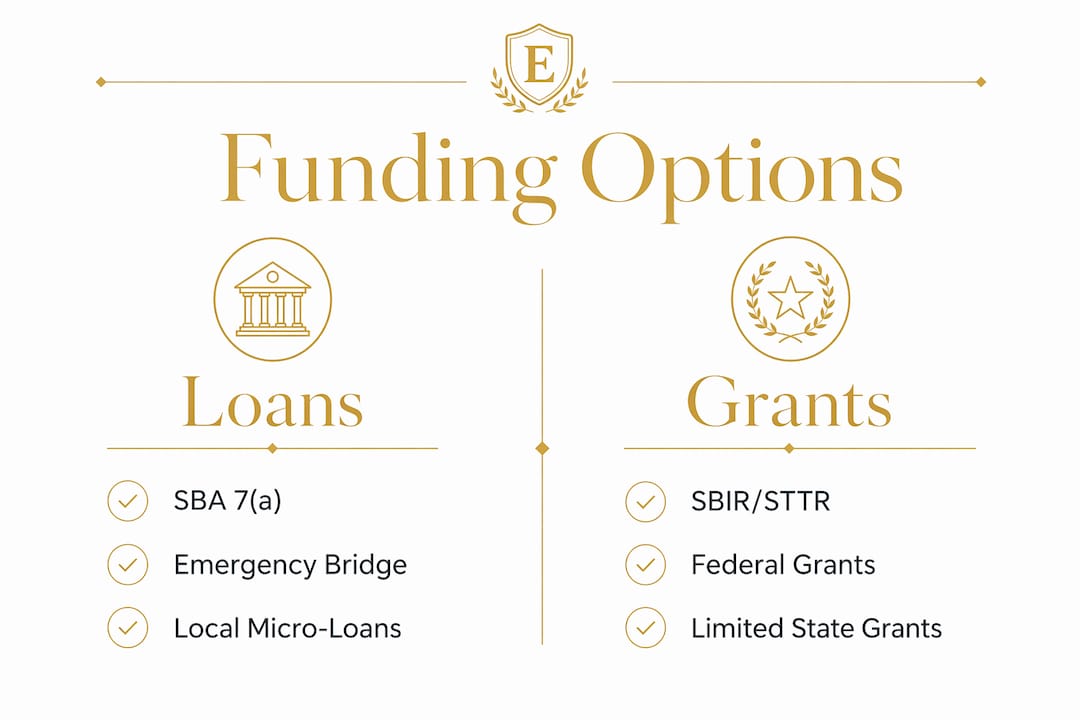
The Florida Small Business Emergency Bridge Loan is a short-term, low-interest working capital loan of up to $50,000 for businesses impacted by declared state or federal emergencies. It is designed for companies with 100 or fewer employees and functions as bridge financing while a business applies for longer-term disaster recovery aid through FEMA or the SBA. The interest rate is low, and the application process is faster than standard SBA loans.
Local capital programs fill the gap between emergency loans and full SBA financing. The Martin Loan Fund in Martin County offers three tiers:
- Launch Fund: $5,000–$25,000 for early-stage businesses
- Growth Fund: $25,000–$50,000 for expanding businesses
- Impact Fund: $50,000–$250,000 for established businesses with larger capital needs
These tiered loan structures work in partnership with organizations like InclusiFi and are designed to sequence with larger financing. A business might start with a Launch Fund loan to establish credit history and cash flow documentation, then graduate to an SBA 7(a) loan 12–18 months later.
Pro Tip: Use a local micro-loan or county fund as your first capital layer, even if you qualify for more. The repayment history builds your lender profile and makes your SBA application significantly stronger.
| Funding Type | Loan Amount | Best Use | Timeline |
|---|---|---|---|
| Emergency Bridge Loan | Up to $50,000 | Disaster recovery working capital | 2–4 weeks |
| Local Launch Fund | $5,000–$25,000 | Early-stage startup capital | 3–6 weeks |
| Local Growth/Impact Fund | $25,000–$250,000 | Expansion and equipment | 4–8 weeks |
| SBA 7(a) | Up to $5 million | Acquisitions, working capital | 60–90 days |
| SBA 504 | Up to $5 million | Real estate, fixed assets | 60–90 days |
What preparation maximizes your chances of approval?
Preparation separates approvals from rejections more than any other factor. DSCR analysis and lender packaging provided by Florida SBDC (Small Business Development Center) consultants are the two most cited factors in successful SBA loan applications. DSCR, or Debt Service Coverage Ratio, measures whether your business generates enough cash flow to cover loan payments. Most SBA lenders want a DSCR of at least 1.25.
Florida SBDCs offer no-cost, confidential consulting at locations across the state. Their services include financial projections, use-of-funds mapping, and full lender package preparation. For manufacturers and equipment-intensive businesses, SBDC consultants at the University of Central Florida specialize in matching financing structures to capital needs.
Common mistakes that kill applications:
- Unclear use-of-funds: Lenders need to know exactly what the money will buy. “General business purposes” is not an acceptable answer.
- Incomplete financials: Three years of tax returns, current profit and loss statements, and a balance sheet are the minimum for most SBA lenders.
- Weak projections: Revenue projections without supporting assumptions read as guesswork. Back every number with a specific driver.
- No lender relationship: Cold applications to banks that do not know your business take longer and get less favorable terms.
Pro Tip: Start your financial documentation process at least 90 days before you plan to apply. Clean, organized financials reflecting consistent operating history are the single biggest accelerator for acquisition loan approvals.
How do you combine funding sources for maximum impact?
The most effective Florida business financing strategies stack multiple sources rather than relying on a single loan or grant. A business buying a commercial property might use an SBA 504 loan for the real estate, an SBA 7(a) loan for working capital, and a Section 41 R&D Tax Credit to offset development costs. That combination is legal, common among sophisticated borrowers, and dramatically reduces out-of-pocket costs. For more on combining financing sources effectively, the sequencing strategy matters as much as the individual products.
Here is how different funding types compare across key dimensions:
| Funding Type | Cost | Speed | Best For | Eligibility |
|---|---|---|---|---|
| SBA 7(a) | Low to moderate | 60–90 days | Acquisitions, working capital | 2+ years in business |
| SBA 504 | Low | 60–90 days | Real estate, equipment | Profitable, job creation |
| SBIR/STTR Grants | Free | 6–12 months | R&D-stage startups | Tech/science focus |
| Emergency Bridge Loan | Very low | 2–4 weeks | Disaster-impacted businesses | 100 or fewer employees |
| Local Capital Funds | Low | 3–8 weeks | Early-stage, micro-businesses | County-specific criteria |
The sequencing principle is straightforward. Start with the fastest, smallest capital source to cover immediate needs. Build your repayment track record. Then apply for larger, longer-term financing with a stronger profile. Early-stage Florida businesses should also review startup funding strategies before committing to a single path, since the right tool depends heavily on your industry and growth stage.
Key takeaways
Florida businesses that combine SBA loans, local capital programs, and federal grants in a deliberate sequence access more capital at lower cost than those relying on a single funding source.
| Point | Details |
|---|---|
| SBA loan limits expanded | Eligible borrowers can now combine 7(a) and 504 loans for up to $10 million as of July 2026. |
| Preparation drives approvals | DSCR analysis and clean financials are the top factors separating approved and rejected applications. |
| Local funds build your profile | County-level micro-loans create repayment history that strengthens future SBA applications. |
| Grants require industry fit | SBIR and STTR grants favor Florida businesses in biomedical, defense, and clean energy sectors. |
| Sequencing beats single-source | Stacking emergency loans, local funds, and SBA financing reduces cost and increases total capital access. |
What i have learned about florida business funding
After working with business owners across Florida, the pattern I see most often is this: the businesses that struggle to get funded are not underfunded because the money does not exist. They are underfunded because they showed up unprepared.
The SBA guarantee structure is genuinely powerful. A 10% down payment on a business acquisition that would require 30% under conventional financing is a real advantage. But lenders still need to see that the business generates enough cash flow to service the debt. That means your financials need to tell a clear, consistent story before you ever walk into a bank.
Seller financing is the most underused tool in Florida acquisition deals. I have seen transactions that looked impossible on paper close cleanly because the seller agreed to carry a portion of the price. That flexibility can satisfy SBA equity requirements without draining the buyer’s reserves.
My strongest advice: connect with a Florida SBDC consultant before you apply anywhere. The consultation is free, the guidance is specific, and the lender packaging they help you build is the same work you would pay a consultant thousands of dollars to produce. Use that resource. Then approach lenders with a complete, organized package and a clear ask. That combination closes deals.
— Jason
How Emorylending can help you access business financing
Florida business owners have more funding paths available than ever, but navigating them takes the right partner. Emorylending evaluates your business performance and cash flow, not just your personal credit score, which means more businesses qualify for the capital they need to grow.
Whether you need working capital to cover payroll and receivables, or you are looking for equipment financing to expand your operations, Emorylending offers financing from $5,000 to $5,000,000 and up. Explore the full business financing options list to find the product that fits your stage and your goals. Fast decisions, fair terms, and a team that understands what Florida businesses actually need.
FAQ
What are the main SBA loan programs for florida businesses?
The SBA 7(a) loan covers working capital, acquisitions, and equipment, while the SBA 504 loan is designed for real estate and long-term fixed assets. As of July 2026, eligible borrowers can combine both programs for up to $10 million in total SBA-backed financing.
Do florida small businesses qualify for federal grants?
Florida businesses in biomedical research, clean energy, and defense can apply for SBIR and STTR grants, which range from $250,000 to over $320,000 per award. Most other small businesses are better served by tax credits like the Section 41 R&D Tax Credit than by direct grant programs.
What is the florida small business emergency bridge loan?
The Florida Small Business Emergency Bridge Loan provides up to $50,000 in short-term working capital for businesses with 100 or fewer employees impacted by a declared emergency. It functions as bridge financing while the business applies for longer-term disaster recovery funding.
How do local capital programs work in florida?
County-level programs like the Martin Loan Fund offer tiered loans from $5,000 to $250,000 depending on business stage. These funds are designed to sequence with larger SBA or conventional loans, helping businesses build credit history and cash flow documentation.
How much down payment does an SBA loan require in florida?
SBA 7(a) loans for business acquisitions in Florida typically require a down payment of around 10%, compared to 20–30% for conventional financing. The SBA guarantee structure reduces lender risk, which is what makes lower down payments possible.


