

Access to capital is the single most reliable predictor of whether a growing business scales or stalls. Understanding how funding impacts growth means recognizing that money is not just fuel. It is the mechanism that converts strategy into execution. Businesses that accept financing grow revenue 27 percentage points faster on average, with top performers hitting 70–95 percentage point gains when capital targets scaling or new product sales. The recognized industry term for this dynamic is capital-driven growth, and it applies whether you are borrowing from a bank, raising private equity, or tapping a government grant.
How funding impacts growth: revenue and expansion data
The connection between financing and revenue acceleration is not theoretical. It is measurable, consistent, and documented across business sizes and sectors.
Stripe Capital’s research shows that small businesses gain 11–18 percentage points in revenue growth after accepting financing, while select top performers see gains as high as 211 percentage points. That range matters. It tells you that funding does not produce a flat result. The outcome depends entirely on what you do with the capital.

The table below breaks down how different uses of capital produce different growth outcomes.
| Funding Use | Typical Revenue Growth Boost | Primary Driver |
|---|---|---|
| Scaling operations | 70–95 percentage points | Increased output capacity |
| New product development | 50–80 percentage points | Market expansion |
| Working capital coverage | 27 percentage points | Operational continuity |
| Equipment purchases | 20–40 percentage points | Productivity gains |
| Small business general use | 11–18 percentage points | Baseline stabilization |
Capital targeted at scaling or product sales produces the largest returns. General working capital still delivers meaningful gains, but the ceiling is lower. This is why the how of deployment matters as much as the how much.
A separate economic study found that every 1% increase in domestic investment correlates with a 0.30% increase in real GDP per capita in emerging markets. That relationship holds at the business level too. Sustained investment in your own operations compounds over time in ways that a single cash infusion cannot replicate.
How do funding sources differ in their impact?
Not all capital is created equal. The source of your funding shapes your growth trajectory, your decision-making authority, and your long-term operational flexibility.
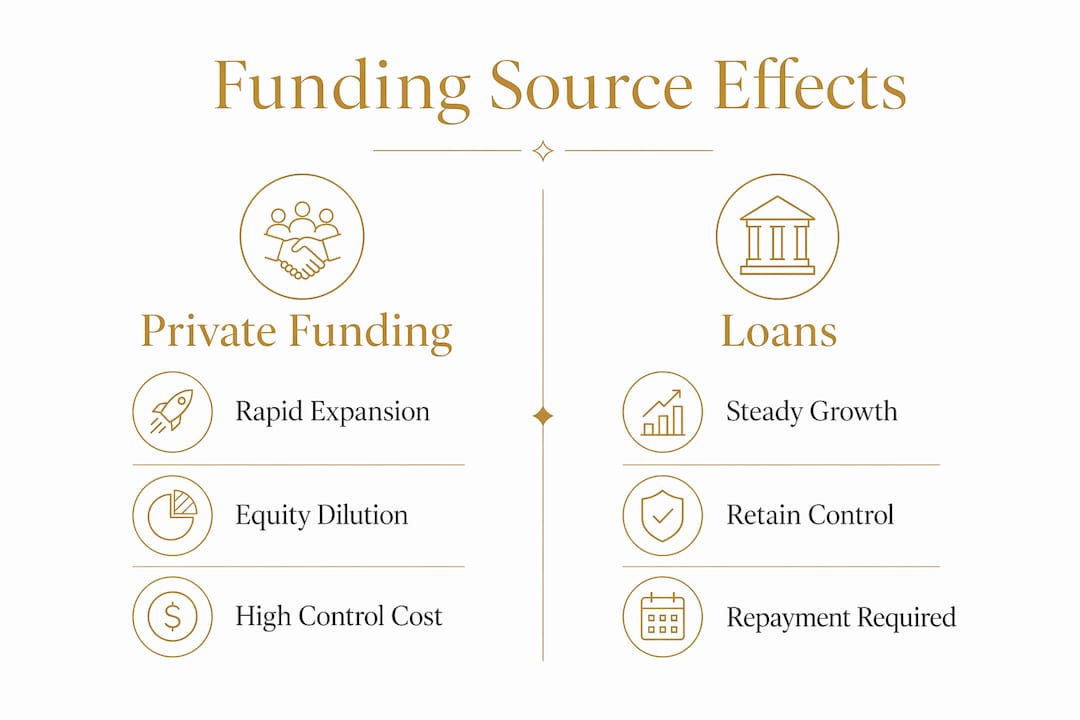
Here is a direct comparison of the four most common funding sources:
Bootstrapping
- Pro: Full control, no dilution, no repayment pressure
- Con: Growth is capped by personal cash flow, limits speed of scaling
Bank Loans and Alternative Lenders
- Pro: Retain full equity, predictable repayment terms
- Con: Requires revenue history or collateral, approval can be slow at traditional banks
Private Equity and Venture Capital
- Pro: Large capital pools, access to networks and expertise
- Con: Equity dilution, investor alignment pressure, loss of some autonomy
Government Grants
- Pro: Non-dilutive, often tied to innovation or job creation
- Con: Competitive, slow, restricted use cases
Private funding enables rapid expansion and market entry but requires founders to weigh equity dilution against growth speed. In 2025, $425 billion flowed into private companies, concentrated in AI and mega-rounds. That figure shows where private capital concentrates and why founders outside high-growth sectors often find better terms through lenders than investors.
Pro Tip: Before choosing a funding source, map your growth goal to a specific metric. If you need to cover a 90-day cash gap, a working capital advance fits better than equity financing. If you are entering a new market, private capital with strategic investors may justify the dilution.
The role of capital in growth also depends on non-financial factors. Research on Indian startup founders found that over 80% rely on informal or self-generated funds due to regulatory complexity and fear of dilution. Funding alone does not guarantee success. Founder capability and market timing are decisive variables that capital cannot replace.
Does funding trajectory matter more than total volume?
The answer is yes, and the research is clear on this point.
Funding trajectory, meaning steady and sustained increases, is more effective at boosting productivity than total funding volume. Developing economies with foreign direct investment shares of GDP between 10% and 70% show higher productivity when inflows follow upward trends rather than arriving in large, irregular bursts. The same principle applies to individual businesses.
A startup that raises $500,000 in three staged rounds tied to specific milestones will almost always outperform one that raises $1.5 million upfront with no deployment plan. The reason is discipline. Staged funding forces you to prove each growth assumption before spending on the next one.
“Raising excessive capital leads to pressure for growth that may outpace business model maturity, increasing collapse risk.” — Too Much Funding Will Kill Your Startup Faster
Overfunding startups accelerates failure by causing premature scaling, inflated expectations, and spending before product-market fit is established. This is one of the most counterintuitive findings in startup research, and most founders learn it the hard way. More money does not mean more runway if the spending rate outpaces the business model’s ability to generate returns.
The practical takeaway: pace your fundraising to match your growth capacity. Raise what you need for the next 12–18 months of defined milestones, not the next five years of ambition.
Pro Tip: Track your LTV:CAC ratio before and after each funding round. If capital deployment is not improving that ratio within two quarters, your spending plan needs revision before you raise again.
What strategic funding decisions maximize sustainable growth?
Capital deployed without a plan is just overhead. The businesses that convert funding into durable growth treat every dollar as a decision, not a resource.
Growth and investment create a virtuous cycle. Sustained growth signals quality to investors and lenders, which attracts more capital, which enables further growth. Getting into that cycle requires deliberate decisions at each stage.
Here is a practical framework for planning effective funding use:
- Define the specific growth metric you are funding. Revenue growth, customer acquisition, geographic expansion, and operational capacity each require different capital structures. Name the metric before you raise.
- Calculate the minimum capital needed to move that metric. Raising more than necessary introduces spending pressure without proportional returns.
- Align your funding source with your growth timeline. Short-term needs fit working capital products. Long-term expansion fits equity or term loans.
- Set milestone gates before deploying each tranche. Tie spending to proof points, not calendar dates.
- Evaluate non-financial resources alongside capital. Mentorship, market access, and operational expertise from investors or lenders can be worth more than the check itself.
The best fundraising outcome is the right amount at the right valuation, with capital targeted to improve specific growth metrics rather than serving as a scoreboard of total fundraising volume. Founders who prioritize improving LTV:CAC ratios over headline raise amounts consistently produce better long-term outcomes.
You can explore proven funding strategies that align capital deployment with specific growth stages, which is where most businesses find the clearest path from financing to results.
Pro Tip: If you are unsure how much to raise, work backward from your target metric. Ask: what is the minimum spend required to prove this growth assumption? That number is your raise target, not your wish list.
Key takeaways
Capital-driven growth works when funding is matched to specific metrics, deployed in stages, and supported by strong operational execution rather than volume alone.
| Point | Details |
|---|---|
| Funding accelerates revenue | Businesses with financing grow revenue 27+ percentage points faster than those without. |
| Deployment determines outcome | Capital used for scaling or new products generates 70–95 percentage point gains versus 11–18 for general use. |
| Trajectory beats volume | Steady, staged funding outperforms large one-time infusions by preventing premature scaling. |
| Source shapes control | Loans preserve equity; private capital brings networks but costs ownership and autonomy. |
| Non-financial factors decide success | Founder capability and market timing determine whether capital converts to growth. |
The uncomfortable truth about funding and growth
I have worked with enough business owners to say this plainly: most of them overestimate what funding will fix and underestimate what it will expose.
When a business raises capital before its operations are ready to absorb it, the money does not accelerate growth. It accelerates every existing problem. Hiring too fast, entering markets before the product is proven, spending on brand before the unit economics work. These are not funding problems. They are execution problems that capital makes visible faster.
The founders I have seen build durable businesses treat capital as a precision tool. They raise for a defined purpose, deploy against a specific metric, and stop before the spending outruns the model. They also recognize that the best investors and lenders bring more than money. A lender who evaluates your cash flow and business performance rather than just your credit score is giving you a more honest read of your business health than most advisors will.
The virtuous cycle between investment and sustained growth is real, but it only activates when the business is operationally ready to convert capital into output. Funding is not a substitute for product-market fit, a capable team, or a realistic growth plan. It is a multiplier. And multipliers work in both directions.
If I had one piece of advice for any business owner considering their next raise: get the plan right before you get the money. Capital follows clarity.
— Jason
Smart financing built for growing businesses
If you are ready to put capital to work against a specific growth goal, Emorylending makes that process straightforward. Unlike traditional lenders that focus on personal credit scores, Emorylending evaluates your business performance and cash flow directly. That means more small businesses qualify for the capital they actually need.

Emorylending offers financing options for small businesses from $5,000 to $5,000,000+, covering working capital, equipment financing, payroll coverage, and expansion funding. Whether you are waiting on receivables or opening a second location, the right product exists for your stage. You can also review common business funding myths that may be holding your growth back before you apply.
FAQ
Does funding guarantee business growth?
Funding does not guarantee growth. Research shows that founder capability and market timing are decisive factors, and capital alone cannot compensate for weak execution or poor product-market fit.
What is the best use of business funding for growth?
Capital targeted at scaling operations or new product development produces the highest revenue gains, with top businesses seeing 70–95 percentage point boosts compared to 11–18 points for general working capital use.
Is it better to raise more funding or less?
Less is often better. Raising the right amount for defined milestones outperforms large upfront raises because overfunding accelerates failure through premature scaling and spending before product-market fit is established.
How does funding source affect growth outcomes?
The source determines both speed and control. Private equity enables rapid expansion but costs equity and autonomy. Loans preserve ownership but require revenue history. Grants are non-dilutive but slow and restricted in use.
How does sustained funding compare to a single large investment?
Steady, incremental funding is more effective at driving productivity than one large capital infusion, particularly because it forces milestone-based deployment and prevents operational overextension.


