

Most small business owners looking at loan offers zero in on one number: the interest rate. That single percentage feels like the whole story. It isn’t. Explaining small business loan rates properly means going beyond that quoted figure to understand APR, fees, loan structure, and how your business profile shapes what you actually pay. Get this wrong and a “low rate” loan can cost you thousands more than a higher-rate offer. This guide breaks down every piece of the puzzle so you can compare financing with confidence and avoid the traps most borrowers walk into.
Table of Contents
- Key takeaways
- Explaining small business loan rates: nominal vs APR
- Key factors that affect your loan rate
- How loan structure shapes what you pay
- SBA 7(a) loan rates as a benchmark
- How to compare loan rates and make the right call
- My take on what most borrowers get wrong
- Ready to see what your rates actually look like?
- FAQ
Key takeaways
| Point | Details |
|---|---|
| APR beats nominal rate | Always compare loans using APR, which includes fees, not just the quoted interest rate. |
| Your profile changes your rate | Credit scores above 700 and strong collateral can lower your rate by 1 to 3 points below maximum caps. |
| Loan term affects total cost | A longer term lowers your monthly payment but often costs thousands more in total interest paid. |
| SBA 7(a) has rate benchmarks | SBA loans are capped based on loan size, giving you a useful ceiling when evaluating any offer. |
| Fees compound your cost | Origination and guarantee fees financed into the loan increase your balance and the interest you pay on it. |
Explaining small business loan rates: nominal vs APR
The interest rate a lender quotes you is called the nominal rate. It tells you the percentage of principal you’ll pay in interest annually. What it doesn’t tell you is what the loan actually costs.
APR, or Annual Percentage Rate, is the number that actually matters for comparison. It includes the interest rate plus mandatory fees like origination charges, underwriting costs, and closing costs, all spread across the loan term. Two loans with identical nominal rates can have very different APRs once fees enter the picture.
Here’s what commonly drives the gap between a nominal rate and the real APR:
- Origination fees: Charged upfront as a percentage of the loan amount, typically 1% to 5%
- Underwriting fees: Administrative costs to evaluate and approve your application
- Guarantee fees: Common in SBA loans, these range from 2% to 3.75% depending on loan size
- Closing costs: Document preparation and legal costs tied to funding
- Annual service fees: Ongoing charges, such as the 0.55% annual service fee on SBA loans
The math gets even trickier when fees are folded into the loan principal rather than paid upfront. When that happens, fees financed into principal increase your loan balance, and you pay interest on those fees for the entire repayment period. That’s a cost most borrowers don’t see coming.
Pro Tip: Always ask lenders for the APR in writing, not just the interest rate. If a lender resists sharing APR, that’s useful information about how they operate.
Key factors that affect your loan rate
Loan pricing isn’t random. Every rate you’re offered reflects a set of variables the lender has calculated about you, your business, and the loan itself. Understanding those variables gives you real leverage.
Credit score and collateral
Your personal and business credit history is the first thing lenders price. Credit scores above 700 combined with strong collateral typically earn you rates 1 to 3 percentage points below maximum SBA caps. Below that threshold, you’ll pay more. Lenders see lower scores as higher default risk and charge accordingly.

Collateral reduces that risk. Real estate, equipment, or receivables backing your loan signal that the lender can recover value if you default. That security translates directly into a lower spread.
Loan size and program type
Bigger loans often come with tighter rate caps under SBA guidelines. The SBA 7(a) program structures spreads this way precisely because larger loans represent more capital at risk and attract more creditworthy borrowers.
The type of lender also shapes your rate significantly. Here’s a general picture of what to expect:
- SBA-approved banks: Lower rates with stricter qualification requirements, best for established businesses
- Credit unions: Competitive rates for members with strong relationships
- Online lenders: Faster approvals but rates often run higher to offset risk and speed
- Alternative lenders: Accessible to newer businesses but can carry the highest APRs
The prime rate connection
The prime rate is the core benchmark in small business lending. It equals the federal funds rate plus 3%, and it moves the same day the Federal Reserve adjusts rates. As of early 2026, the prime rate sits at 6.75%.
Variable rate loans are priced as a spread over prime. If your loan is priced at Prime + 2.5%, your rate is currently 9.25%. When the Fed raises or cuts rates, your payment changes accordingly. Fixed rate loans lock in your spread regardless of Fed moves, which protects you from payment volatility.
Pro Tip: If the Fed has signaled rate cuts in the near term, a variable rate loan may cost less over time. If rates are expected to rise, locking in a fixed rate today protects your cash flow.
How loan structure shapes what you pay
Understanding loan structures matters as much as the rate itself. Two offers with nearly identical APRs can have dramatically different impacts on your cash flow and total cost depending on term length and rate type.
Fixed vs variable rates
Fixed rate SBA loans protect you from future increases. Your payment stays predictable every single month regardless of what the Fed does. Variable rates start lower but create uncertainty, especially for businesses running on tight margins.
Variable rates work in your favor when rates are falling and you plan to pay the loan off early. They work against you when rates rise over a multi-year term and you’re locked into the loan structure for the long haul.
Term length and total interest cost
This is where most small business owners make their biggest miscalculation. A longer repayment term reduces your monthly payment, which looks attractive. But you’re paying interest for more months, which adds up fast.
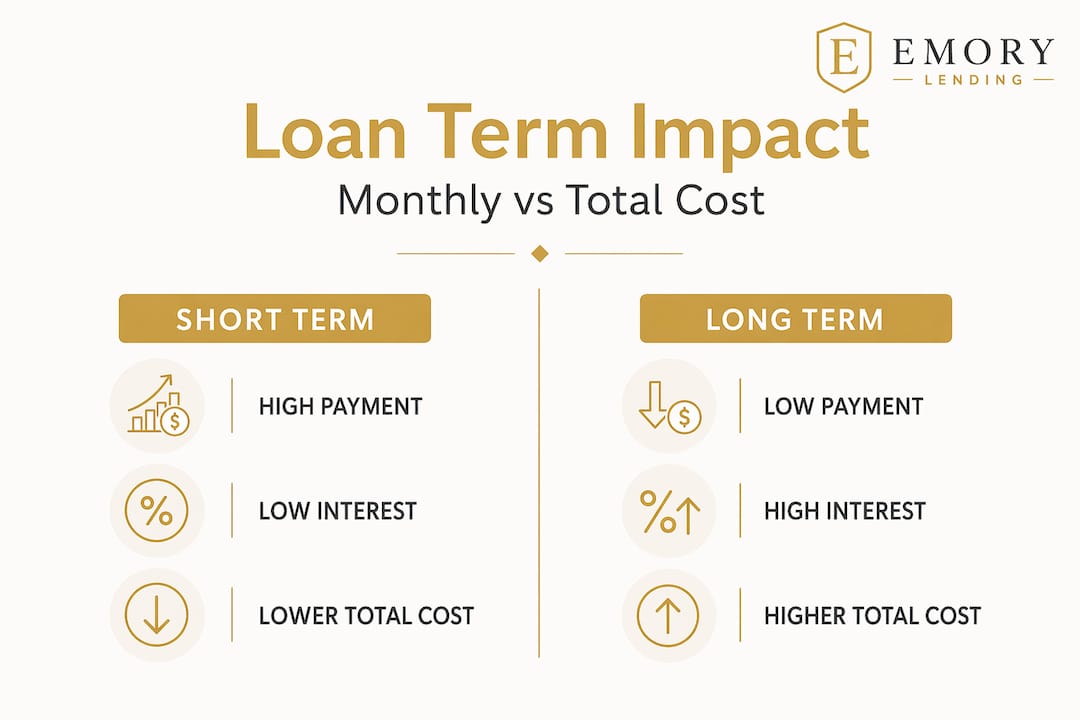
The numbers make this concrete. According to loan cost comparison data, a loan structured for a longer term with a 41% lower monthly payment can cost $4,285 more in total interest over its lifetime. Lower payment, higher total cost. That trade-off is real and often underappreciated.
Here’s a simplified comparison to illustrate what term and rate structure differences look like in practice:
| Loan Feature | Option A | Option B |
|---|---|---|
| Loan Amount | $100,000 | $100,000 |
| Interest Rate (APR) | 9.5% | 9.5% |
| Term | 5 years | 10 years |
| Monthly Payment | ~$2,100 | ~$1,295 |
| Total Interest Paid | ~$26,000 | ~$55,400 |
| Total Cost | ~$126,000 | ~$155,400 |
The monthly payment difference looks appealing on a tight month. The $29,400 difference in total cost is the number that should drive your decision.
Pro Tip: Use a loan comparison calculator to model different term lengths side by side before committing. Monthly payment is a cash flow question. Total cost is a profitability question. Treat them separately.
SBA 7(a) loan rates as a benchmark
The SBA 7(a) program is the most widely used government-backed small business loan in the country. Its rate structure is also one of the most transparent, making it an excellent benchmark when evaluating any financing offer.
As of 2026, the prime rate is 6.75%. SBA 7(a) loan rate caps are structured by loan size as follows:
- Loans up to $25,000: Maximum rate of Prime + 6.5% (currently 13.25%)
- Loans from $25,001 to $50,000: Maximum of Prime + 6.0% (currently 12.75%)
- Loans from $50,001 to $250,000: Maximum of Prime + 4.5% (currently 11.25%)
- Loans over $250,000: Maximum of Prime + 3.0% (currently 9.75%)
Well-qualified borrowers typically negotiate rates below those caps. Strong credit and collateral can push your actual rate 1 to 3 points below the maximum, which represents significant savings on larger loan amounts.
The SBA also charges upfront guarantee fees of 2% to 3.75% based on loan size. These fees are often folded into the loan balance, which means you’ll pay interest on them throughout the term. Add the annual 0.55% service fee on the outstanding balance and the true APR can run noticeably higher than the nominal rate.
Repayment terms vary by purpose. Working capital loans typically run 7 to 10 years, equipment loans up to 10 years, and real estate loans up to 25 years. The longer real estate term explains why those loans show the biggest gap between nominal rate and lifetime interest cost.
How to compare loan rates and make the right call
Knowing the concepts is one thing. Applying them when you’re facing multiple loan offers with competing terms is another. Here’s a structured approach to compare loan rates effectively:
- Request APR from every lender, in writing. This is your apples-to-apples comparison number. Nominal rates without APR are incomplete.
- Use the same loan amount and term when requesting quotes. Comparing a $100,000 five-year offer against a $100,000 ten-year offer tells you nothing useful about rate differences.
- Calculate total interest paid, not just monthly payment. Multiply the monthly payment by the number of months, subtract the principal, and you have your true interest cost.
- List every fee. Origination, underwriting, guarantee, service fees, and closing costs all belong in your comparison. Build a simple spreadsheet if needed.
- Check prepayment penalties. Some lenders charge fees if you pay off early. If you plan to refinance or pay ahead, this is a real cost factor.
- Run the numbers on rate adjustment terms. For variable rate loans, ask how often rates adjust and whether there are caps on how much they can move per period.
- Weigh monthly cash flow against total cost separately. Both matter. Your business’s monthly cash position may genuinely require the lower payment option even if total cost is higher. Know what you’re trading.
Pro Tip: If you have strong credit and collateral, don’t accept the first offer. Mention competing quotes and ask lenders to sharpen their pricing. Many will. A one-point reduction on a $250,000 loan saves you roughly $2,500 per year in interest.
You can also review Emorylending’s business funding checklist before approaching any lender. Walking in prepared puts you in a stronger negotiating position from the first conversation.
My take on what most borrowers get wrong
I’ve seen the same pattern repeat itself more times than I can count. A business owner walks in excited about a “low rate” they were quoted, and within five minutes of looking at the actual terms it becomes clear the rate was the least important number in the whole offer. The fees were buried in the loan balance, the term was extended to make the payment look manageable, and the total cost was 30% higher than a slightly higher-rate loan with better structure.
The prime rate’s predictable relationship to Fed policy is actually one of the most underused tools available to small business borrowers. Because prime equals the federal funds rate plus 3% and has held that relationship without exception since 1994, you can watch Fed meetings and forecast what variable rate loans will cost you within hours of a decision. Most borrowers never think to do this. The ones who do time their financing strategically and save real money.
My honest advice: stop leading with “what’s your rate?” and start asking “what’s the total I’ll repay?” Then ask for APR. Then ask about fees. Rate is just the starting line. The finish line is total cost, and that’s where the decision actually lives.
Building a real relationship with a lender also pays off more than most people realize. Lenders who know your business history are more willing to sharpen spreads on repeat deals. That relationship is worth cultivating even before you need capital.
— Jason
Ready to see what your rates actually look like?
At Emorylending, we believe you should understand exactly what you’re paying before you sign anything. We don’t lead with rates and hide the fees. We evaluate your business performance and cash flow to build financing that works with how your business actually runs, not just what shows up on a credit report.
Whether you need equipment financing with transparent terms or a working capital loan to keep operations moving, Emorylending has funding options from $5,000 to $5,000,000 and up. We’ll walk you through the APR, total cost, and fee structure before you commit to anything. That’s what fair financing looks like. Start a conversation with us today and bring the questions this guide raised.
FAQ
What is APR and why does it matter for small business loans?
APR, or Annual Percentage Rate, includes your interest rate plus mandatory fees spread over the loan term. It gives you a more accurate picture of borrowing cost than the nominal rate alone.
What are current SBA 7(a) loan rate caps in 2026?
With the prime rate at 6.75%, SBA 7(a) rate caps range from Prime + 3.0% for loans over $250,000 to Prime + 6.5% for loans under $25,000. Qualified borrowers typically negotiate 1 to 3 points below those caps.
How do loan fees affect my total borrowing cost?
Fees like origination and guarantee charges are often financed into your loan balance, meaning you pay interest on them throughout the entire term. This raises your effective APR well above the quoted nominal rate.
Should I choose a fixed or variable rate for my small business loan?
Fixed rates protect you from payment increases and work best when rates are low or expected to rise. Variable rates can save money when rates are falling, but they add cash flow uncertainty over multi-year terms.
How does loan term length affect what I pay overall?
A longer term reduces monthly payments but significantly increases total interest paid. A lower monthly payment on an extended term can cost thousands more over the life of the loan compared to a shorter-term option with the same rate.


