

Pre-qualification for business loans is a preliminary assessment where lenders use basic financial information and a soft credit check to estimate whether your business qualifies for specific loan products. This process gives small business owners a realistic picture of their borrowing power before they commit to a full application. Lenders like SBA loan programs, Wells Fargo, and online lenders such as American Express Business Blueprint all offer some form of pre-qualification. Understanding what is pre-qualification for business loans helps you shop smarter, protect your credit score, and walk into any lender conversation with confidence.
How does business loan pre-qualification work?
Pre-qualification is the quickest way to see if you are likely to get approved for a loan. It requires only basic details and takes just a few minutes to complete online. Here is the typical process:
- Submit basic business information. You provide your business name, industry, time in operation, and estimated annual revenue. No supporting documents are required at this stage.
- Share financial details. Lenders ask for your approximate monthly income, the loan amount you need, and the intended use of funds. This helps them match you with relevant products.
- Authorize a soft credit inquiry. The lender pulls a soft credit check, which does not affect your credit score. This gives them a snapshot of your credit history without triggering a formal inquiry.
- Receive an estimate. Within minutes, you get a preliminary view of potential loan amounts, interest rate ranges, and repayment terms. These are estimates, not final offers.
- Compare and decide. You can repeat this process with multiple lenders to compare options side by side before choosing where to apply formally.
Pre-qualifying online is fast and can typically be completed in a few simple steps. That speed matters when you are evaluating several lenders at once.
Pro Tip: Submit pre-qualification requests to at least three lenders before making any decision. Seeing multiple estimates side by side reveals which lender offers the most competitive terms for your specific business profile.

What criteria do lenders review during pre-qualification?
Lenders evaluate a specific set of factors during pre-qualification to gauge your business’s loan readiness. Most lenders want to see at least a 670 credit score, though some accept lower scores depending on the loan product. Requirements vary significantly by lender and loan type.
Common eligibility factors lenders assess include:
- Personal and business credit score. Your credit score signals repayment reliability. Scores below 600 may limit options to alternative or short-term lenders.
- Annual business revenue. Most lenders set a minimum revenue threshold, often $50,000 to $100,000 per year, to confirm the business generates enough cash flow.
- Time in business. Lenders typically prefer businesses operating for at least one year. SBA loans often require two or more years of operating history.
- Industry type. Certain industries, such as cannabis, gambling, or speculative real estate, face restrictions from many traditional lenders.
- Loan purpose. Working capital, equipment financing, and expansion loans each carry different risk profiles, which affects pre-qualification outcomes.
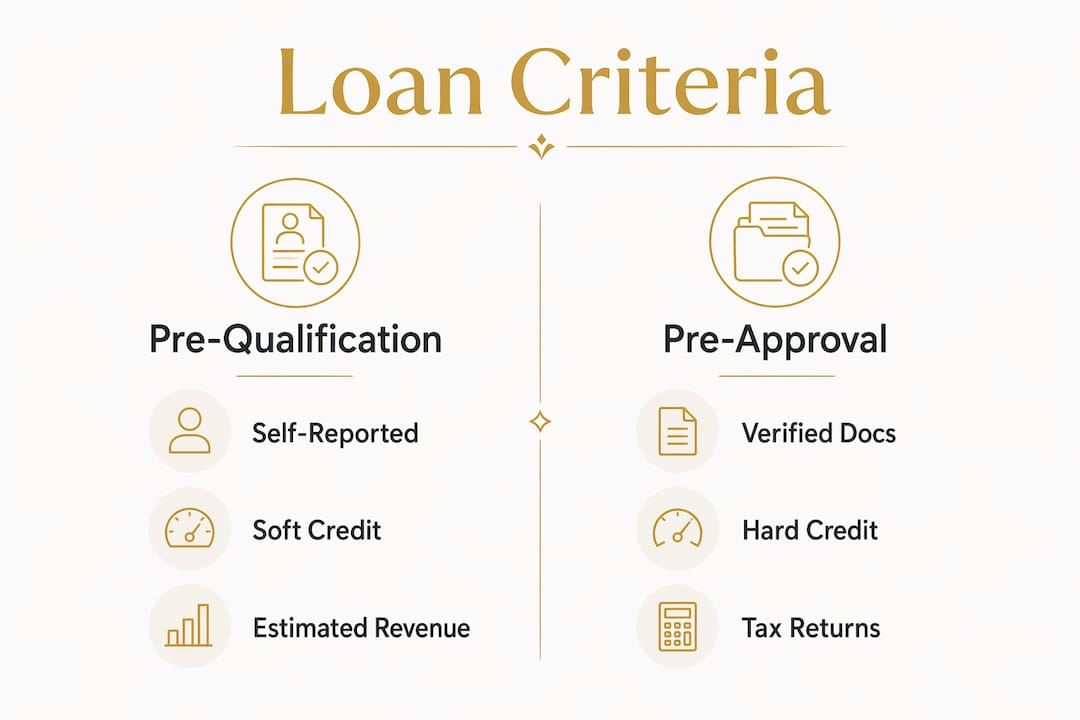
At the pre-qualification stage, lenders rely on self-reported data. You are not required to submit tax returns, bank statements, or audited financials yet. That verification comes later. Understanding business loan eligibility requirements before you pre-qualify helps you present accurate information and get more reliable estimates.
The distinction matters: pre-qualification data is unverified. If your self-reported revenue turns out to be lower once verified, the final loan offer may differ from the initial estimate.
What is the difference between pre-qualification and pre-approval?
Pre-qualification and business loan pre-approval are two separate steps in the lending process, and confusing them is one of the most common mistakes small business owners make. Pre-qualification is exploratory. Pre-approval is a conditional commitment backed by verified data.
| Factor | Pre-qualification | Pre-approval |
|---|---|---|
| Credit check type | Soft inquiry, no score impact | Hard inquiry, may lower score temporarily |
| Financial verification | Self-reported information only | Verified documents required |
| Documents needed | None typically required | Tax returns, bank statements, financial records |
| Accuracy of offer | Estimate only | Conditional but more reliable |
| Time to complete | Minutes | Days to weeks |
| Commitment level | No obligation | Conditional loan commitment |
Pre-qualification uses a soft credit check while pre-approval involves a hard credit pull and more financial documentation. That difference has real consequences for your credit score if you apply to multiple lenders simultaneously.
Pre-approval often requires W-2s, tax returns, and bank statements for verification, unlike pre-qualification which relies on self-reported data. Think of pre-qualification as a first conversation and pre-approval as a handshake deal pending final checks.
Neither pre-qualification nor pre-approval guarantees final approval. Full underwriting and verification are always required before funds are released. Knowing this prevents you from treating a pre-qualification estimate as a guaranteed loan offer.
What are the benefits of pre-qualification for small businesses?
Pre-qualifying for a loan gives small business owners a significant strategic advantage before they ever submit a formal application. The benefits go beyond just knowing your odds.
- No credit score damage. Loan pre-qualification involves a soft credit check, so your score stays intact. You can pre-qualify with ten lenders and your credit report shows nothing.
- Realistic loan expectations. Pre-qualification reveals the loan amounts and interest rates you are likely to qualify for. This prevents you from building a business plan around funding you cannot actually access.
- Faster comparison shopping. Reviewing estimated terms from multiple lenders in one afternoon is far more efficient than submitting full applications one at a time over several weeks.
- Lower-pressure decision making. Pre-qualification carries no obligation. You gather information without committing to anything, which means you can take time to evaluate options carefully.
- Identifies gaps before they become rejections. If your credit score or revenue falls short of a lender’s threshold, pre-qualification reveals that early. You can address the gap before a hard inquiry appears on your report.
Pre-qualification is a tool for shopping smart, helping owners avoid the credit damage that comes from submitting multiple full applications. That protection is especially valuable when you are still deciding which type of financing fits your business best.
Pro Tip: Use your pre-qualification results to build a comparison spreadsheet. List each lender’s estimated rate, loan amount, and repayment term. Patterns in the data will tell you where your business profile is strongest.
How to use pre-qualification effectively when seeking business financing
Getting pre-qualified is only useful if you act on the results strategically. Here is how to turn pre-qualification estimates into a smarter funding decision:
- Pre-qualify with multiple lenders at once. Submit requests to at least three to five lenders covering different categories: a traditional bank, an SBA-affiliated lender, and an online or alternative lender. Each evaluates your profile differently, and the spread of offers tells you a lot.
- Read the estimates carefully. Focus on the annual percentage rate, not just the monthly payment. A lower monthly payment stretched over five years can cost far more than a higher payment over two years.
- Use low estimates as a diagnostic tool. If every lender returns a low loan amount or high rate, your business profile has a weak point. Common culprits are a credit score below 670, revenue below lender minimums, or less than one year in business. Fix the issue before applying formally.
- Advance to pre-approval only when ready. Once you have identified your preferred lender through pre-qualification, gather your tax returns, bank statements, and financial statements. Moving to pre-approval with complete, accurate documents reduces delays and improves your chances of a strong final offer.
- Avoid treating estimates as guarantees. Pre-qualification results are based on unverified data. Build your funding plan around a conservative version of the estimate, not the best-case scenario.
- Revisit pre-qualification after improving your profile. If your first round of pre-qualification returns weak results, spend three to six months improving your credit score or revenue, then pre-qualify again. The difference in offers can be substantial.
Understanding how business loans work end to end makes each pre-qualification result easier to interpret. Context turns a number into a decision.
Key Takeaways
Pre-qualification for business loans is the fastest, lowest-risk way to understand your funding options before committing to a formal application.
| Point | Details |
|---|---|
| Definition of pre-qualification | A soft-credit-check assessment that estimates loan eligibility using self-reported financial data. |
| No credit score impact | Soft inquiries leave no mark, so you can pre-qualify with multiple lenders safely. |
| Pre-qualification vs. pre-approval | Pre-qualification is exploratory and unverified; pre-approval requires documents and a hard credit pull. |
| Key eligibility factors | Credit score, annual revenue, time in business, and industry type all influence pre-qualification outcomes. |
| Best practice | Pre-qualify with three to five lenders, compare estimates, then advance to formal application with your top choice. |
Why I think most small business owners skip the most valuable step in lending
Most small business owners I have worked with skip pre-qualification entirely. They find a lender they like, fill out the full application, and hope for the best. That approach is expensive in two ways: it risks unnecessary hard inquiries on their credit report, and it leaves them with no comparison point to know whether the offer they received is actually competitive.
The owners who get the best loan terms are almost always the ones who treat pre-qualification like market research. They pre-qualify with five lenders in a single afternoon, build a simple comparison, and walk into their preferred lender’s formal application process already knowing what a strong offer looks like. That knowledge gives them leverage.
The other thing I see consistently: owners underestimate how much their business profile can improve in a short time. A credit score that sits at 640 today can reach 670 in four months with focused effort. Revenue documentation that looks thin can be strengthened with cleaner bookkeeping. Pre-qualification results are not a verdict. They are a starting point. The owners who treat them that way almost always end up with better financing than those who treat the first estimate as final.
If you are serious about funding your business, pre-qualify first. Always. It costs you nothing and tells you everything you need to know before you put a hard inquiry on your report.
— Jason
See what financing you qualify for with Emorylending
Emorylending evaluates your business based on performance and cash flow, not just personal credit. That means more small businesses qualify for the capital they actually need.
Whether you need working capital, equipment financing, or funds to cover payroll and expansion, Emorylending works with businesses seeking funding from $5,000 to $5,000,000+. The process starts with a fast, straightforward pre-qualification that gives you a clear picture of your options without affecting your credit score. Explore the full range of small business financing options available through Emorylending and take the first step toward funding your next move.
FAQ
What is pre-qualification for business loans?
Pre-qualification for business loans is a preliminary review where a lender uses basic financial information and a soft credit check to estimate whether your business qualifies for a loan. It does not affect your credit score and carries no obligation to apply.
Does pre-qualifying for a loan hurt your credit score?
No. Pre-qualification uses a soft inquiry, which does not impact your credit score. You can pre-qualify with multiple lenders without any negative effect on your credit report.
How is pre-qualification different from pre-approval?
Pre-qualification is based on self-reported data and a soft credit check, while pre-approval requires verified documents and a hard credit inquiry. Pre-approval produces a more reliable conditional offer but carries more risk to your credit score.
What documents do I need to pre-qualify for a business loan?
Most lenders require no formal documents at the pre-qualification stage. You typically provide estimated revenue, time in business, loan purpose, and basic personal and business information. Verified documents like tax returns and bank statements are only required during formal application.
Does pre-qualification guarantee loan approval?
No. Pre-qualification does not guarantee final approval. It is an estimate based on unverified data. Final approval depends on full underwriting, document verification, and a hard credit check during the formal application process.


