

Credit assessment is the structured process lenders use to evaluate whether a business can repay borrowed money, based on financial data, behavioral signals, and qualitative judgment. For small business owners, understanding this process is the difference between walking into a loan application prepared and walking out empty-handed. The evaluation combines hard numbers like FICO scores and the Debt Service Coverage Ratio with softer factors like management quality and loan purpose. Lenders apply the 5 Cs of Credit framework, Capacity, Character, Capital, Collateral, and Conditions, to build a complete picture of repayment risk. Knowing what lenders look for lets you present your business in the strongest possible light.
What are the key components of a credit assessment?
Credit assessment, formally called credit analysis, examines every dimension of a borrower’s financial health. Lenders do not rely on a single number. They pull together financial history, income trends, asset values, outstanding liabilities, and behavioral signals to form a forward-looking credit opinion on your ability to repay.
FICO scores range from 300 to 850, with payment history accounting for 35% and amounts owed for 30% of the total. Those two factors alone make up nearly two-thirds of your score, which means consistent on-time payments and keeping balances low are the fastest levers you control.

The 5 Cs of Credit give lenders a structured way to assess risk beyond the score. Capacity is the most predictive factor, measuring whether your cash flow covers debt payments. Character reflects your repayment track record. Capital is the money you have invested in the business. Collateral is the assets you can pledge. Conditions cover the loan purpose and the broader economic environment.
| C Factor | What lenders measure | Modern signals used |
|---|---|---|
| Capacity | Cash flow vs. debt obligations | Bank statement transaction analysis |
| Character | Repayment history and reliability | Behavioral data, payment patterns |
| Capital | Owner investment in the business | Balance sheet equity, retained earnings |
| Collateral | Assets pledged against the loan | Property, equipment, receivables |
| Conditions | Loan purpose and market context | Industry trends, macroeconomic data |
Pro Tip: Lenders often triage applications by checking document coherence first. If your financials are inconsistent or incomplete, many underwriters will decline before they ever run your numbers.
How do lenders use financial ratios in credit assessments?
Financial ratios translate your business performance into a language lenders can compare across thousands of applications. The most important ratio in business credit analysis is the Debt Service Coverage Ratio, or DSCR. A DSCR of 1.25 or higher is the standard low-risk benchmark as of 2026. A DSCR of 1.25 means your business generates $1.25 in operating cash flow for every $1.00 of required debt payments. Anything below 1.0 signals the business cannot cover its obligations from operations alone.
Lenders also examine leverage and liquidity ratios to stress-test your financial position. The debt-to-equity ratio shows how much of your business is funded by debt versus owner investment. The current ratio compares current assets to current liabilities, revealing whether you can meet short-term obligations. You can use a DSCR loan calculator to estimate your own coverage ratio before you apply.
| Ratio | Formula | Benchmark | What it tells the lender |
|---|---|---|---|
| DSCR | Operating cash flow ÷ total debt payments | 1.25+ is low risk | Can the business service its debt? |
| Debt-to-equity | Total debt ÷ owner equity | Lower is safer | How leveraged is the business? |
| Current ratio | Current assets ÷ current liabilities | 1.5–2.0 is healthy | Can short-term bills be paid? |
| Gross profit margin | Gross profit ÷ revenue | Industry-dependent | Is the core business profitable? |
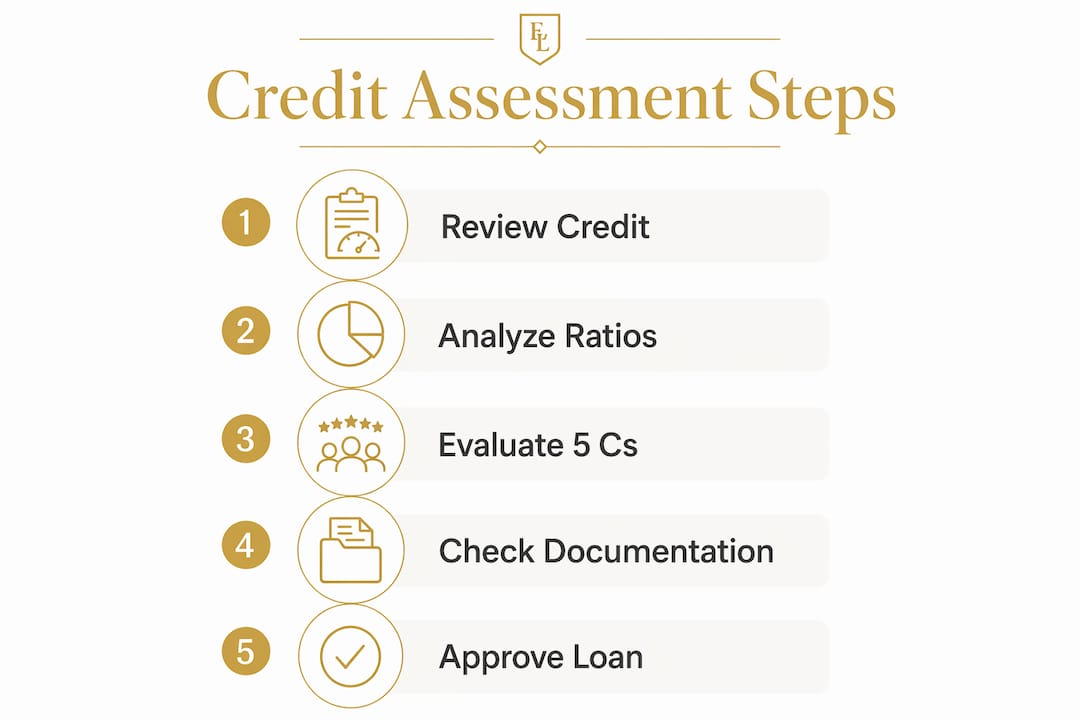
Well-organized financial statements speed up this entire process. Digital, normalized financials enable automation tools that reduce underwriting time significantly. Submitting clean, digital records instead of paper statements is one of the simplest ways to move your application forward faster.
Pro Tip: Calculate your DSCR before you apply. If it falls below 1.25, pay down short-term debt or increase revenue documentation first. Arriving with a strong ratio gives you negotiating power on loan terms.
What qualitative factors influence credit assessments beyond the numbers?
Numbers tell lenders what happened. Qualitative factors tell them what is likely to happen next. Credit analysis combines qualitative judgment with financial metrics to form a complete view of repayment capacity. No ratio can fully capture whether a business owner will prioritize loan repayment when cash gets tight.
Management quality is one of the most weighted qualitative factors. Lenders assess how long you have operated the business, whether you have navigated downturns before, and whether your team has the depth to handle growth. A sole proprietor with five years of consistent revenue often looks stronger than a newer business with flashier numbers.
Loan purpose also carries real weight. A loan to buy income-producing equipment reads very differently than one to cover operating losses. Lenders want to see that the borrowed capital will generate returns that support repayment. Risk assessment factors in payment history, obligations, fraud signals, and loan purpose, and higher perceived risk leads directly to denial, reduced loan amounts, or higher pricing.
“Underestimating the importance of business character and consistent documentation can lead to loan denial regardless of credit score. Lenders are not just evaluating your past. They are making a judgment call about your future behavior.”
Consistent, authentic documentation builds trust. Gaps in records, unexplained revenue spikes, or mismatched figures across documents raise red flags that no credit score can offset. The story your documents tell must match the story you tell in conversation.
What practical steps can small business owners take to improve credit assessment outcomes?
Preparation is the single biggest variable you control before a lender ever reviews your file. Small business owners who treat credit assessment as an ongoing practice, not a one-time scramble, consistently secure better terms. Here are the most effective steps:
- Organize your financial documents now. Gather two to three years of business tax returns, profit and loss statements, balance sheets, and bank statements. Lenders need these in clean, readable formats. Well-organized digital statements reduce underwriting delays and signal professionalism.
- Protect your payment history. Pay every vendor, supplier, and creditor on time. Payment history drives 35% of your FICO score, making it the highest-impact factor you can actively manage.
- Reduce amounts owed before applying. Pay down revolving credit balances. Lower utilization directly improves your score and your debt-to-equity ratio simultaneously.
- Build Capital deliberately. Retain earnings in the business rather than distributing all profits. Lenders see retained capital as evidence that you have skin in the game.
- Separate personal and business credit. Mixing the two creates confusion in underwriting and can expose personal assets unnecessarily. Read more about separating business credit to protect both profiles.
- Communicate transparently with lenders. If your business had a rough quarter, explain it. Lenders respond better to owners who acknowledge challenges and show a recovery plan than to those who hope the numbers go unnoticed.
- Understand how lenders handle your debt. Knowing how lenders evaluate business debt during underwriting helps you structure your liabilities before you apply.
Avoid the common financing mistakes that trip up otherwise strong applicants. Applying for multiple loans simultaneously, submitting incomplete documents, or misrepresenting revenue are the fastest ways to trigger a denial.
Key Takeaways
Credit assessment combines quantitative ratios, FICO scores, and the 5 Cs of Credit with qualitative factors like management quality and loan purpose to determine whether a business can repay borrowed funds.
| Point | Details |
|---|---|
| 5 Cs framework | Capacity, Character, Capital, Collateral, and Conditions are the core evaluation criteria lenders apply. |
| DSCR benchmark | A DSCR of 1.25 or higher signals low repayment risk to lenders as of 2026. |
| FICO score weight | Payment history (35%) and amounts owed (30%) drive nearly two-thirds of your credit score. |
| Qualitative factors matter | Management quality, loan purpose, and document consistency influence decisions beyond the numbers. |
| Preparation wins | Clean digital financials, separated business credit, and transparent communication improve approval odds. |
What I have learned from watching small businesses navigate credit assessments
The biggest misconception I see is that a strong credit score is a golden ticket. Credit scores rank riskiness but cannot precisely quantify default probability, which is exactly why lenders layer in ratios, qualitative reviews, and fraud checks on top of the score. Owners who walk in assuming a 720 FICO guarantees approval are often blindsided when the underwriter flags a low DSCR or inconsistent bank statements.
The owners who fare best treat the credit assessment process as a presentation, not a test. They know their numbers cold. They can explain a bad quarter in two sentences and pivot to what changed. They have already separated personal and business credit, and their documents are organized before anyone asks. That level of preparation signals to a lender that this owner runs a real business, not a hobby with a checking account.
The other thing I have seen consistently: qualitative factors break ties. When two applicants have similar financials, the one with a cleaner paper trail, a clearer loan purpose, and a track record of honest communication wins. Character is not a soft concept in underwriting. It is a scored judgment that can override a marginal ratio. Treat it that way, and your chances improve significantly.
— Jason
How Emorylending approaches small business financing
Understanding the credit assessment process is the first step. Knowing where to apply that knowledge is the next one.
Emorylending evaluates small businesses on performance and cash flow, not just personal credit history. That means more business owners qualify, even those who have been turned down by traditional lenders focused on a single score. Whether you need flexible financing options for working capital, equipment, or expansion, Emorylending works with businesses seeking funding from $5,000 to $5,000,000+. If you want to understand how your business performance influences lending decisions before you apply, that resource walks through exactly what lenders look for in your operations and financials.
FAQ
What does credit assessment mean for a small business?
Credit assessment is the process lenders use to evaluate whether a business can repay a loan, based on financial data, credit scores, and qualitative factors like management quality and loan purpose.
What is the 5 Cs of Credit framework?
The 5 Cs are Capacity, Character, Capital, Collateral, and Conditions. Capacity is the most predictive factor, measuring whether cash flow covers debt payments.
What DSCR do lenders require for loan approval?
A DSCR of 1.25 or higher is the standard low-risk benchmark as of 2026, meaning the business generates $1.25 in operating cash flow for every $1.00 in debt obligations.
Do lenders rely only on credit scores to make decisions?
No. Credit scores rank risk but cannot precisely predict default probability, so lenders also evaluate financial ratios, document consistency, fraud signals, and loan purpose before making a decision.
How can I improve my credit assessment outcome before applying?
Organize two to three years of financial documents, pay down revolving balances, maintain on-time payment history, and separate personal and business credit to present the strongest possible profile to lenders.


