

Your business credit profile determines whether you get funded, at what rate, and on what terms. The core business credit evaluation steps are straightforward: gather company data and consent, apply the 5 Cs framework, pull reports from Dun & Bradstreet, Experian Business, and Equifax Business, read beyond the score, and monitor continuously. Most small business owners skip at least one of these. About 45% didn’t even know they had a business credit profile, and 27% reported being blocked from funding because of credit report problems they never saw coming.
Here’s the short version of what a complete credit assessment covers:
- Collect company information and get written consent before pulling any credit
- Evaluate creditworthiness through the 5 Cs: Character, Capacity, Capital, Collateral, and Conditions
- Order reports from all three major bureaus and compare them side by side
- Read the full report, not just the score: payment history, public records, and trade line counts all matter
- Set up ongoing monitoring so you catch problems before lenders do
The sections below walk through each step in detail.
What the 5 Cs of credit actually measure
The 5 Cs of credit are the framework lenders use to decide whether to approve your application, how much to offer, and at what rate. No fixed formula exists. Lenders weigh the five factors together, situationally, based on the loan type and their own risk appetite.

Character is your reputation for paying what you owe. Lenders look at your personal FICO score, your business credit reports from Dun & Bradstreet, Equifax Business, and Experian Business, and any public records like liens or judgments. Trade references matter here too. Most business credit applications ask for at least three, and lenders actually call them.
Capacity is the one that trips up growing businesses most often. It measures whether your cash flow can cover a new loan payment on top of everything you’re already paying. The standard metric is the debt service coverage ratio (DSCR). A DSCR of 1.25 or higher is what most lenders want to see, meaning your net operating income runs at least 25% above your total debt payments. Below 1.0 means you’re already spending more than you bring in.
Capital is how much of your own money you’ve put into the business. Lenders read this as skin in the game. They examine your debt-to-equity ratio: the smaller the ratio, the better your position. A business with strong retained earnings and cash reserves signals stability; a thinly capitalized one signals fragility.
Collateral covers the assets you can pledge to secure the loan. Commercial real estate, equipment, inventory, accounts receivable, and personal guarantees all qualify. Once a lender accepts collateral, they calculate the loan-to-value ratio based on the asset type. Each lender sets that value differently, so ask upfront.
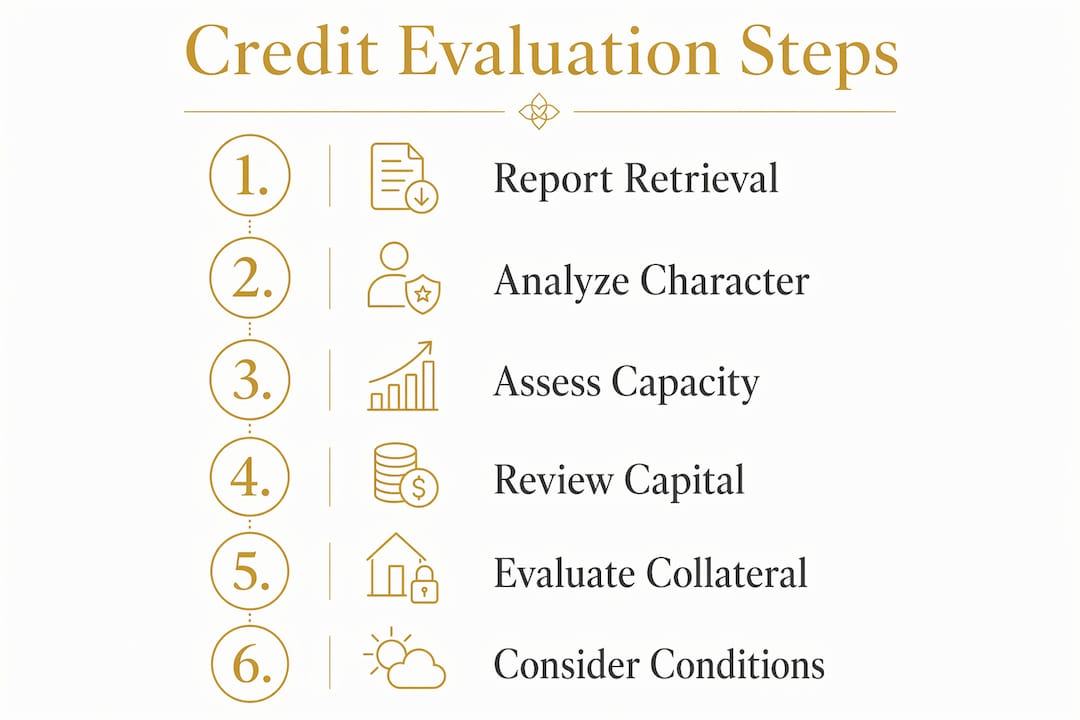
Conditions account for the broader environment: the purpose of the loan, industry trends, and the current economic climate. A specific, well-documented use of funds (“$75,000 to purchase a CNC machine that increases production capacity by 40%”) lands better than “working capital.” Lenders respond to clarity because it reduces their uncertainty about repayment.
Most lenders treat capacity as the most critical factor, since repayment ability is their primary concern. Character, though, is usually the first filter. A weak credit history can close the door before the other four Cs even get reviewed.
How to evaluate business creditworthiness step by step
A thorough credit assessment follows a defined sequence. Skipping steps doesn’t save time; it creates gaps that surface later as denials or worse terms.
-
Collect the credit application and get consent. Start with a formal credit application that captures the business’s legal name, address, EIN, years in operation, and ownership structure. Get written authorization to pull credit before you do anything else. This is both a legal requirement and a baseline for the file.
-
Pull reports from all three major bureaus. Order reports from Dun & Bradstreet, Experian Business, and Equifax Business separately. Each bureau uses a different scoring model, and a business may appear on one but not another. Comparing all three surfaces discrepancies and gives you a fuller picture than any single report can.
-
Check public records before you look at the score. UCC filings, liens, judgments, and bankruptcies are the most actionable data in any report. A lien filed in the last 90 days tells you more about current financial stress than a PAYDEX score of 75. If a company has pledged its accounts receivable or inventory as collateral elsewhere, that changes your recovery position in a default scenario.
-
Analyze payment history and trade line data. Look at how the business pays its vendors: on time, 30 days late, 60 days late. Count the trade lines and check when they last reported. Three trade lines from vendors who last reported 18 months ago is not meaningful coverage. You want recent data from vendors extending similar payment terms to yours.
-
Review financial statements and cash flow. For larger credit decisions or borderline cases, request certified financial statements and a current cash flow statement. Calculate the debt-to-income ratio by dividing monthly debt payments by gross monthly income. A ratio below 36 is generally favorable, though acceptable ranges vary by industry.
-
Contact trade references directly. Ask how long the reference has extended credit, what the credit limit is, when the last purchase occurred, and how many times the account has run late. Vendors rarely give negative references on accounts they still want to keep, so read between the lines.
-
Assess score trends, not just the current score. Declining score trends indicate increased credit risk before a single snapshot score reflects the problem. A business that scored 72 a year ago and scores 68 today is a different risk than one that has held steady at 68 for three years. Most bureau reports include historical trend data.
-
Factor in industry and economic conditions. A business in a contracting industry during a downturn carries more risk than the same financials in a growing sector. Check regional trade risk if the business operates in markets with currency exposure or political instability.
-
Make a credit decision with documented reasoning. Set credit terms, limits, and any risk mitigation requirements based on the full picture. Document your reasoning. If you approve with conditions, state them clearly.
How to get your business credit report and read it
The three bureaus you need are Dun & Bradstreet, Experian Business, and Equifax Business. Each operates independently, collects data from different sources, and uses its own scoring model. Different bureaus use varied scoring models, so a score from one bureau is not directly comparable to a score from another.
Getting your reports:
- Dun & Bradstreet: Register for a D-U-N-S Number first. It’s a free, unique nine-digit identifier for your business location and the key to your D&B file. You can request it directly through D&B’s website. D&B’s primary score is the PAYDEX, which runs from 0–100. Paying early can push your score into the 90–100 range; paying exactly on the due date typically lands in the 80–89 range.
- Experian Business: Experian’s score is called the Intelliscore Plus, also on a 0–100 scale. You can purchase your report directly through Experian’s business credit portal.
- Equifax Business: Equifax uses a Payment Index and a Credit Risk Score. Access your report through Equifax’s business credit section.
What to look for beyond the score:
- Payment history: How long accounts have been open, the credit limits extended, and how many times payments ran late. Lenders weigh this heavily because past behavior predicts future behavior.
- Public records: Liens, judgments, UCC filings, and bankruptcies. These are the red flags that move fastest and matter most to lenders assessing recovery risk.
- Trade line count and recency: A thin file with few trade lines signals limited credit history. When bureau data is scarce, supplement with trade references, financial documents, and industry-specific data to fill the gaps.
- Business profile information: Legal name, address, years in business, and ownership. Errors here can cause your file to be confused with another business or simply reduce lender confidence.
- Financial disclosures: Only available for businesses that have voluntarily shared financials with D&B or similar. Most small businesses have not, so don’t expect this section to be populated.
Pro Tip: A PAYDEX of 80 is not the same as an Intelliscore of 80. Never compare scores across bureaus without understanding the methodology behind each one. Doing so creates a false sense of precision that can lead to bad credit decisions.
Practical steps to build and improve your business credit
Building business credit is a process measured in months, not weeks. The U.S. Small Business Administration notes it can take over a year to meaningfully improve a business credit score. Starting early and being consistent matters far more than any single action.
- Separate your personal and business credit completely. Open a dedicated business bank account, get a business credit card, and use your EIN rather than your Social Security number on business applications. Separating personal and business credit protects your personal assets and reduces your reliance on personal guarantees over time. A personal guarantee still links owner risk, but strong business credit reduces how often lenders require one.
- Establish trade lines with vendors who report. Not all vendors report to commercial credit bureaus. Start with two to three suppliers who do, make purchases, and pay on time. New accounts can take 30–60 days to appear on your reports, so start this process before you need credit.
- Pay on time or early, every time. D&B measures payment behavior in “days beyond terms” (DBT). Even one or two days late gets recorded. Paying early consistently pushes your PAYDEX score into the highest tier.
- Keep your business registration current and accurate. Outdated addresses, wrong legal names, or mismatched EINs create file confusion across bureaus. Review your registration details annually and update them whenever anything changes.
- Resolve discrepancies on your reports promptly. File a dispute directly with the bureau reporting the error. Errors in payment history or public records can drag your score down for months if left uncorrected.
- Build capital and collateral over time. Reinvest profits rather than distributing everything. Maintain a business savings account with three to six months of operating expenses. Document your assets clearly so you know what’s unencumbered when a lender asks.
Why monitoring multiple bureaus protects your credit profile
One credit pull is a snapshot. What you need is a continuous picture, and that requires watching all three bureaus, not just the one your primary lender uses.
Continuous monitoring of payment behavior and external signals outperforms infrequent bureau checks in managing credit risk. The reason is timing: bureau data lags. A UCC filing or new lien often appears in public records weeks before it shows up in a credit score change. If you’re only checking annually, you’re seeing problems after they’ve already affected your profile.
New businesses face a specific challenge here. New businesses often rely on the owner’s personal credit because they have no business credit history yet. That creates a “thin file” problem: sparse bureau data that makes it hard for lenders to assess risk accurately. The answer isn’t to wait. Supplement your file early with trade references, private financial statements, and any industry data that demonstrates business viability.
Pro Tip: Don’t wait for an annual review to check your reports. Set a calendar reminder to pull reports from all three bureaus every quarter. If a payment slips or a new UCC filing appears, you want to know before a lender does.
The importance of business credit compounds over time. A business with a clean, well-documented credit profile across all three bureaus has more options, better rates, and more negotiating power with suppliers. A business that only discovers its credit profile when applying for a loan is already behind.
How credit evaluation shapes your loan approval and terms
Every lender who reviews your application runs some version of the business credit evaluation steps described above. The outcome determines not just whether you get approved, but the interest rate, the loan amount, the repayment period, and whether a personal guarantee is required.

A strong credit profile across the 5 Cs opens doors that a weak one closes. Character issues, meaning a history of late payments or public record negatives, often end the review before capacity or capital even get assessed. Lenders treat character as the first filter because it signals whether you can be trusted to repay, regardless of your current cash flow.
Understanding lending criteria before you apply lets you address weak spots proactively. If your DSCR is below 1.25, work on reducing existing debt obligations before submitting an application. If your trade line count is thin, spend three to six months building it up. If public records show an old lien, resolve it and document the resolution.
The factors affecting business credit don’t change between lenders, but how each lender weights them does. A lender focused on cash flow financing, like Emorylending, evaluates your business performance and cash flow rather than defaulting to personal credit history. That distinction matters most for businesses with strong revenue but limited credit history, or for owners who want to keep personal and business finances cleanly separated.
Business loan denials often trace back to problems that were fixable months before the application. Catching them during your own credit assessment, rather than in a lender’s rejection letter, keeps you in control of the timeline.
Ready to put your credit profile to work?
Emorylending evaluates your business on its actual performance and cash flow, not just a credit score. Whether you need working capital, equipment financing, or funds to expand, Emorylending works with businesses from $5,000 to $5,000,000+. If your credit profile is solid and your business is growing, explore your flexible financing options and see what you qualify for today.
Key Takeaways
A strong business credit profile requires pulling reports from all three major bureaus, evaluating the 5 Cs of credit, and monitoring continuously rather than checking once before a loan application.
| Point | Details |
|---|---|
| Know your profile exists | About 45% of small business owners didn’t know they had a business credit profile before needing funding. |
| Use all three bureaus | Dun & Bradstreet, Experian Business, and Equifax Business each use different scoring models; compare all three. |
| Public records first | Check liens, UCC filings, and judgments before reviewing scores; these signal financial distress earliest. |
| Separate personal and business credit | Building a standalone business credit profile reduces reliance on personal guarantees and protects personal assets. |
| Monitor trends, not snapshots | A declining score trend indicates rising risk before the current score reflects it; use historical trend data in every review. |


