

Why choose non-bank lenders? The core advantages explained
Non-bank lenders give small businesses faster capital, looser eligibility requirements, and loan products that traditional banks simply don’t offer. For a business owner who needs funding in days rather than months, or whose credit history doesn’t fit a bank’s rigid checklist, that combination is often the deciding factor.
Here’s what non-bank lending typically delivers:
- Speed: Funding can arrive quickly after approval, compared to weeks or months at a traditional bank.
- Flexible eligibility: Newer businesses, owners with imperfect credit, and companies with irregular revenue can still qualify.
- Diverse products: Options include merchant cash advances, revenue-based financing, equipment loans, invoice factoring, and lines of credit that adjust with your sales.
- Streamlined applications: Most require only bank statements, basic business financials, and a short online form, not a thick file of tax returns and collateral documentation.
- Broader access: Non-bank lenders enable funding for businesses that traditional banks are more likely to decline due to rigid standards.
The trade-off is real: non-bank loans usually carry higher interest rates and shorter repayment terms. Knowing when those costs are worth it is the whole game.
What makes non-bank lenders genuinely useful for small businesses
Small businesses are turning to alternative lenders in growing numbers because slow bank approvals, heavy paperwork, and tighter credit standards have made traditional financing impractical for many owners. A restaurant that needs a new walk-in cooler before summer, or a contractor waiting on a large invoice, can’t afford a 60-day underwriting process.
The advantages of non-bank financing go beyond speed:
- Approval based on business performance: Non-bank lenders weigh your actual revenue and cash flow, not just your personal FICO score.
- Loan products built for how businesses actually work: Revenue-based financing, for instance, ties repayment to your monthly sales, so a slow month doesn’t crush your cash flow.
- Less paperwork: Many lenders connect directly to your accounting software or bank account to pull the data they need, cutting application time from days to hours.
- Access for the underserved: Alternative lenders typically offer easier qualification criteria, allowing newer or less-established businesses and those with imperfect credit to qualify.
- Speed when it counts: When urgent funding needs arise, speed and flexibility often outweigh cost concerns for small business owners.
For a business in growth mode or facing a short-term cash gap, these advantages can outweigh the higher cost of capital.
The real downsides you need to know before signing

Non-bank lending has genuine drawbacks, and glossing over them would be a disservice. The most important one is cost. Non-bank lending usually carries higher interest rates and shorter repayment terms compared to bank loans, which means your periodic payments can be steep.
The other risks worth knowing:
- Higher total cost of borrowing: Annual percentage rates on merchant cash advances or short-term loans can run well above what a bank charges on a term loan.
- Shorter repayment windows: A 6-month or 12-month repayment schedule creates real pressure on cash flow, especially for seasonal businesses.
- Regulatory gaps: Some non-bank lenders have less regulatory oversight than banks, which can increase the risk of predatory practices. Borrower protections vary widely.
- Automatic daily or weekly repayments: Many non-bank products pull repayments directly from your bank account on a daily or weekly basis, which can catch owners off guard.
- Renewal traps: Some lenders push early renewals before the original loan is paid off, stacking debt and fees.
Read the full loan agreement before you sign. If a lender can’t clearly explain the total repayment amount and the effective annual rate, that’s a signal to walk away.
Banks vs. non-bank lenders: what actually differs for your business
Banks often provide larger loan amounts at lower interest rates but require longer approval times and stricter credit standards. That’s the core trade-off in one sentence. The table below maps out where the two diverge most sharply.

| Factor | Traditional banks | Non-bank lenders |
|---|---|---|
| Approval time | Weeks to months | 24 hours to a few days |
| Credit requirements | Strong personal and business credit | Flexible; cash flow often weighted more |
| Loan amounts | Typically larger | — |
| Interest rates | Lower | Higher |
| Repayment terms | Longer (years) | Shorter (months) |
| Product variety | Standard term loans, SBA loans, lines of credit | Revenue-based financing, MCAs, invoice factoring, equipment loans |
| Application process | Extensive documentation | Streamlined, often digital |
| Relationship focus | Branch-based, relationship-driven | Transactional, technology-driven |
Neither option is universally better. A business with strong financials and time to spare should pursue a bank loan. A business that needs capital now, or doesn’t fit a bank’s profile, has a strong case for going non-bank.
Real-world situations where non-bank financing makes sense
Most business owners don’t choose non-bank lenders on principle. They choose them because the situation demands it. Here are the scenarios where alternative financing genuinely fits:
- Urgent capital needs: A piece of equipment breaks down, a bulk inventory deal appears, or payroll is due before a client pays. Banks can’t move fast enough.
- Short or inconsistent credit history: A business that’s two years old with solid revenue but a thin credit file will often get declined by a bank and approved by a non-bank lender.
- Specialized loan products: Revenue-based financing and invoice factoring don’t exist at most banks. If your business model fits those structures, non-bank is your only real option.
- Bridge financing: Using non-bank capital to cover a gap while waiting for a larger bank loan to close is a common and legitimate strategy.
- Growth capital for emerging businesses: Non-bank lenders complement banks for growth financing. The most effective approach often involves using non-bank capital for short-term growth, then refinancing with a bank once the business stabilizes.
Pro Tip: If you’re using a non-bank loan as bridge capital, build your refinancing timeline into the loan agreement from day one. Knowing your exit point keeps the higher cost manageable.
How non-bank lenders assess your business differently
The underwriting process at a non-bank lender looks nothing like a bank’s. Rather than pulling a credit report and reviewing three years of tax returns, most non-bank lenders focus on what your business is doing right now.
- Real-time cash flow data: Non-bank lenders assess risk based on real-time business performance metrics such as daily cash flow and card sales, rather than relying mainly on traditional credit scores.
- Digital data sources: Lenders commonly evaluate business cash flow using digital data from bank statements, merchant accounts, and accounting software.
- Automated risk models: Alternative lenders use automated models that price risk in minutes, which is how they can approve and fund loans so quickly.
- Revenue trends over credit scores: A business with a 620 credit score but three years of consistent monthly deposits looks very different to a non-bank lender than it does to a bank.
- Flexibility for irregular income: Seasonal businesses, freelancers, and project-based companies often struggle with bank underwriting because their income doesn’t arrive in predictable monthly increments. Non-bank models handle that naturally.
For a deeper look at how lenders read your financials, business loan risk assessment methods are worth understanding before you apply anywhere.
What types of non-bank lenders actually exist
Non-bank lending isn’t one thing. It’s a category that covers several distinct lender types, each built around a different product and borrower profile.
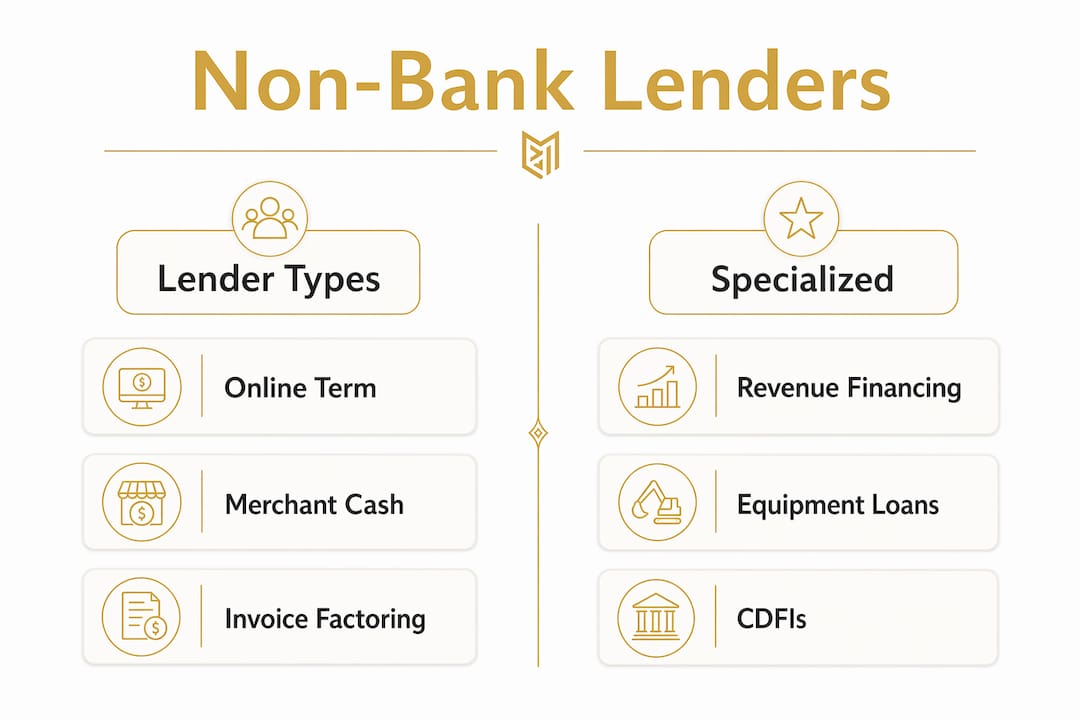
Online term lenders offer fixed-amount loans repaid over a set schedule, typically 3–24 months. They’re the closest non-bank equivalent to a traditional bank loan, just faster and more accessible.
Merchant cash advance providers give you a lump sum in exchange for a percentage of future card sales. Repayment is automatic and tied to revenue, which helps in slow months but makes the effective cost hard to calculate upfront.
Invoice factoring companies advance you a portion of outstanding invoices, typically 70%–90% of the invoice value, and collect directly from your customers. This works well for B2B businesses with long payment cycles.
Revenue-based financing providers offer capital repaid as a fixed percentage of monthly revenue until a set total is reached. The structure suits businesses with predictable but variable top-line sales.
Equipment financing lenders fund specific asset purchases, using the equipment itself as collateral. This keeps approval criteria focused on the asset’s value rather than your overall credit profile. Emorylending covers equipment financing options for businesses at various stages.
Community development financial institutions (CDFIs) are mission-driven non-bank lenders that serve underserved markets, often at rates closer to bank pricing. They’re worth exploring if your business is in a low-income area or serves a specific community.
What it takes to qualify and how the application works
Non-bank lenders vary in their requirements, but most share a common baseline. Time in business is usually a key factor: many lenders require some operating history, though some will work with newer businesses if revenue is strong.
Typical eligibility requirements include:
- Minimum monthly revenue: Often $10,000–$15,000 per month, though this varies by lender and product.
- Business bank account: Active for at least 3–6 months, with consistent deposits.
- Basic documentation: Three to six months of bank statements, a government-issued ID, and sometimes a voided check.
- Credit score: Many non-bank lenders accept scores in the 550–600 range. Some products, like invoice factoring, don’t check personal credit at all.
The application itself is usually online and takes 10–20 minutes. After submitting, automated underwriting can return a decision in hours. Funding often follows within 1–3 business days. For early-stage startups, understanding how non-bank lenders are structured before applying saves time and sets realistic expectations.
Businesses that have used non-bank financing to grow
Real-world examples show how alternative financing plays out across different industries and situations.
A food truck operator with 18 months in business and strong weekend sales was declined by two banks because of a personal credit score below 640. A non-bank lender approved a $40,000 working capital loan based on 12 months of bank statements showing consistent deposits. The owner used the funds to add a second truck and doubled revenue within eight months.
A small manufacturing company needed $120,000 in equipment to fulfill a new contract but couldn’t wait the 6–8 weeks a bank would require. An equipment financing lender approved the deal in three days, using the machinery as collateral. The contract revenue covered the repayment within the loan term.
A marketing agency with $30,000 in outstanding invoices from a slow-paying client used invoice factoring to access $24,000 immediately. That cash covered payroll and kept the team intact while the client settled the balance. The agency avoided taking on debt and paid only a factoring fee.
These aren’t outliers. They reflect the practical reality that alternative business funding fills gaps that traditional financing leaves open, particularly for businesses moving fast or operating outside the profile banks prefer.
Ready to explore your options with Emorylending?
Emorylending evaluates your business performance and cash flow, not just your credit score. Whether you need working capital, equipment financing, or funds to cover payroll, Emorylending works with businesses of all sizes. Explore your flexible financing options and see what your business qualifies for today.
Key Takeaways
Non-bank lenders offer small businesses faster access to capital and broader eligibility than traditional banks, making them the practical choice when speed, flexibility, or a non-standard credit profile is in play.
| Point | Details |
|---|---|
| Speed is the primary advantage | Non-bank lenders can fund in 24–72 hours, compared to weeks or months at a bank. |
| Eligibility is broader | Businesses with imperfect credit, short history, or irregular revenue can often qualify. |
| Cost is the main trade-off | Higher interest rates and shorter repayment terms mean non-bank loans cost more overall. |
| Risk evaluation is different | Non-bank lenders use real-time cash flow and digital data, not just credit scores. |
| Strategic use matters | Using non-bank capital for short-term growth, then refinancing with a bank, is a proven approach. |


