

Business funding myths are false beliefs about credit requirements, lender types, loan costs, and fundraising processes that prevent entrepreneurs from accessing capital they qualify for. Many small business owners reject viable financing options because they believe they need a perfect credit score, that banks are the only legitimate lenders, or that a high valuation guarantees startup success. These misconceptions are not harmless. They lead owners to accept worse terms, delay growth, or avoid funding entirely. This article debunks the most damaging business funding myths using April 2026 data, expert insights from YC partner Brad Flora, and analysis from lenders including Emorylending.
Business funding myths explained: do you need perfect credit?
Perfect credit is not a requirement for business funding. Modern lenders, including alternative and online lenders, evaluate multiple factors beyond your credit score. Business cash flow, revenue trends, time in operation, and industry type all carry significant weight in funding decisions. A 680 credit score with strong monthly revenue can outperform a 750 score with inconsistent cash flow.
The credit check process itself is widely misunderstood. Most modern lenders use soft credit inquiries during initial applications, which means your credit score is not affected when you shop for offers. This matters because it removes the penalty for exploring your options. You can apply to multiple lenders, compare terms, and make an informed decision without any damage to your credit profile.

Emorylending, for example, evaluates your business performance and cash flow rather than focusing primarily on personal credit. This approach reflects a broader industry shift away from the old bank model, where a credit score alone could disqualify a growing business from any funding at all.
Pro Tip: Request pre-qualification from at least three lenders before committing. Because initial screenings typically use soft pulls, you can compare multiple offers safely without any credit score impact.
Key factors lenders actually evaluate beyond credit score:
- Monthly and annual revenue
- Business bank account cash flow patterns
- Time in business (typically 6 months minimum for alternative lenders)
- Industry risk profile
- Outstanding receivables or existing debt obligations
Is a bank loan the only legitimate funding option?
Bank loans are one funding option among many, and they are often not the fastest or most accessible choice for small businesses. The funding landscape includes SBA loans, online lenders, angel investors, invoice factoring, merchant cash advances, revenue-based financing, crowdfunding, and bootstrapping. Each serves a different business profile, risk tolerance, and timeline.
The myth that non-bank lenders are automatically predatory or lower quality is directly contradicted by data. Over 70% of founders mistakenly believe higher interest rates signal lower lender quality, but total cost, term length, and repayment structure are far more accurate evaluation metrics. A 24% APR loan with no fees and flexible repayment can cost less in real dollars than a 10% bank loan with origination fees, prepayment penalties, and a rigid 7-year term.
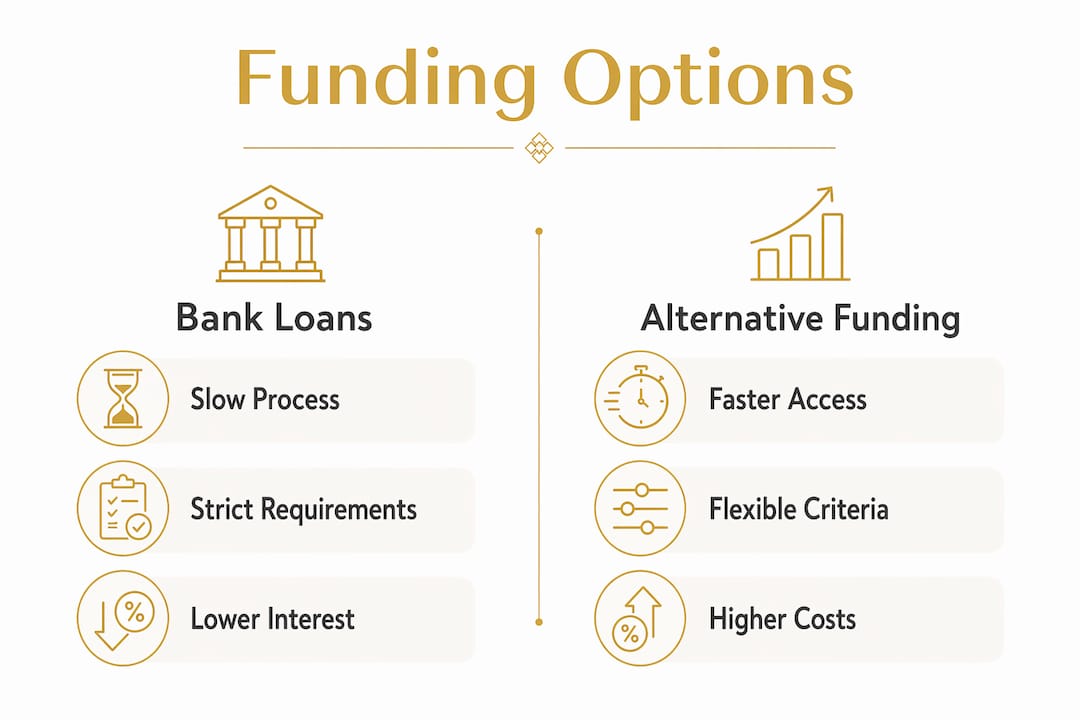
The table below compares the most common funding types by speed, typical use, and key tradeoff:
| Funding type | Speed to funding | Best use case | Key tradeoff |
|---|---|---|---|
| Traditional bank loan | 30 to 90 days | Long-term capital, real estate | Slow approval, strict requirements |
| SBA loan | 30 to 60 days | Equipment, expansion | Paperwork-heavy, collateral often required |
| Online lender | 1 to 5 days | Working capital, payroll | Higher rates, shorter terms |
| Invoice factoring | 24 to 48 hours | Cash flow gaps, receivables | Fee per invoice, client notification |
| Angel investor | Weeks to months | Early-stage startups | Equity dilution, investor involvement |
| Crowdfunding | Weeks | Product launches, community brands | Public exposure required, platform fees |
Fast-growing businesses are among the most frequent users of invoice financing, which disproves the myth that alternative funding is only for struggling companies. A business with $500,000 in outstanding invoices and a 60-day payment cycle has a cash flow problem, not a revenue problem. Invoice factoring solves exactly that. You can learn more about how this works through Emorylending’s invoice financing process guide.
Does a high valuation always mean better startup funding?
A high valuation feels like a win, but it often creates the conditions for a harder fall. Valuation in a funding round sets the price at which investors buy equity. When that number is inflated beyond what the business can realistically justify in the next 18 to 24 months, the company is locked into growth targets it may not hit.
High startup valuations often create unsustainable expectations, potentially leading to difficult down rounds and serious funding challenges. A down round occurs when a company raises money at a lower valuation than its previous round. This signals distress to future investors, dilutes existing shareholders, and can trigger anti-dilution clauses that further complicate the cap table.
YC partner Brad Flora has been direct about this reality in early-stage fundraising contexts:
“Founders should focus on realistic valuations that reflect actual traction, not aspirational projections. The goal is to raise what you need at terms you can grow into.”
The practical takeaway for small business owners and startup founders is this: the highest valuation offer is not automatically the best offer. Alignment between investor expectations and your actual growth trajectory matters more than the number on the term sheet. Not all funding is good funding. Some capital comes with control provisions, milestone requirements, or misaligned goals that can constrain your decisions for years.
Questions to ask before accepting a valuation-based offer:
- What growth milestones does this valuation require me to hit?
- What happens to my equity if I raise at a lower valuation next round?
- Does this investor’s portfolio and timeline align with my business model?
Are lower interest rates always the better loan deal?
A lower interest rate does not mean a cheaper loan. This is one of the most persistent and costly business loan myths in small business financing. The actual cost of a loan depends on origination fees, closing costs, prepayment penalties, the amortization schedule, and how the repayment structure aligns with your cash flow.
Consider two hypothetical loan offers. Loan A carries a 9% interest rate with a 2% origination fee, a 5-year term, and a prepayment penalty equal to 3% of the remaining balance. Loan B carries a 15% interest rate with no fees, an 18-month term, and no prepayment penalty. For a business that expects to repay within 12 months, Loan B is almost certainly cheaper in total dollars paid. Prepayment of a loan does not always save money due to upfront interest structures or prepayment penalties embedded in certain contracts.
Merchant cash advances add another layer of complexity. They use factor rates rather than APR, so a factor rate of 1.35 on a $100,000 advance means you repay $135,000 total, regardless of how quickly you pay it back. Comparing a factor rate to an APR without converting them to the same metric is like comparing miles to kilometers without doing the math.
Pro Tip: Before signing any loan agreement, request a full amortization schedule and a complete fee disclosure. Ask the lender to calculate the total repayment cost in dollars, not just the rate, so you can compare offers on equal footing.
The table below illustrates how two loans with different rates can produce very different real costs:
| Loan feature | Loan A (low rate) | Loan B (higher rate) |
|---|---|---|
| Interest rate | 9% | 15% |
| Origination fee | 2% ($2,000) | None |
| Term | 5 years | 18 months |
| Prepayment penalty | 3% of balance | None |
| Best for | Long-term capital needs | Short-term, fast repayment |
Understanding how business loans work at this level of detail separates owners who get good deals from those who get burned by fine print.
Do small businesses need large outside funding to succeed?
External capital is not a prerequisite for business success. Many of the most durable small businesses were built on sweat equity, which is the founder’s time, skill, and effort invested in place of cash. Sweat equity is often more critical for startup survival than initial external funding, particularly in the early stages when product-market fit is still being established.
Bootstrapping forces discipline. When you spend your own money or revenue, every dollar has to justify itself. Businesses that raise large rounds early sometimes develop spending habits that become liabilities when growth slows. The founders who build leverage before raising money, by developing customers, revenue, and proof of concept, negotiate from a position of strength rather than desperation.
The fundraising process itself is also widely misrepresented. Early-stage fundraising is not high-pressure Shark Tank pitching. According to YC’s Brad Flora, it typically involves numerous informal meetings and straightforward investor conversations focused on team execution rather than theatrical presentations. The polished deck and dramatic pitch room are largely fiction for most small business funding conversations.
When outside funding does make sense, the amount and source matter as much as the timing. Accepting less capital from the right investor can be better than accepting more from the wrong one. Goal alignment between founder and funder determines whether the relationship accelerates growth or creates friction. Explore alternative funding approaches to understand which capital structure fits your stage and goals.
Signs that outside funding makes sense right now:
- You have proven demand but lack inventory or capacity to fulfill it
- A specific growth opportunity has a defined timeline and measurable return
- Your cash flow gap is structural, not a symptom of a deeper business problem
- You have a clear repayment or exit path that aligns with the funding terms
Key takeaways
Business funding myths cost entrepreneurs real money and real opportunity. The most damaging misconceptions center on credit requirements, lender legitimacy, loan pricing, and the necessity of outside capital.
| Point | Details |
|---|---|
| Credit score is not the only factor | Modern lenders evaluate cash flow, revenue, and business performance alongside credit. |
| Banks are not the only credible lenders | Alternative lenders, invoice factoring, and SBA loans each serve distinct business needs. |
| Low rates do not equal low cost | Total repayment including fees, term length, and penalties determines the real cost of a loan. |
| High valuations carry real risk | Inflated valuations can lead to down rounds and investor misalignment in future funding. |
| Sweat equity often beats outside capital | Bootstrapping builds discipline and negotiating leverage before raising external funds. |
What I’ve learned from watching founders get funding wrong
After years of working in small business financing, the pattern I see most often is not that entrepreneurs lack access to capital. It’s that they disqualify themselves before they even apply. They assume their credit score is too low, that banks are the only real option, or that they need a dramatic pitch to raise money. Every one of those assumptions is a myth, and every one of them costs founders time and growth.
The most confident funding decisions I’ve seen come from owners who treat lender selection the way they treat vendor selection. They compare total cost, not just rate. They ask hard questions about prepayment terms and fee structures. They understand that a lender who evaluates their cash flow is often a better fit than one who fixates on a credit number from three years ago.
The valuation myth is the one I find most counterintuitive for founders to accept. Everyone wants the highest number. But a valuation you cannot grow into is a trap. The founders who raise at realistic terms and hit their milestones are in a far stronger position for their next round than those who raise at inflated numbers and miss.
My honest advice: get informed before you get funded. Read the full contract. Request the amortization schedule. Ask what happens if you pay early. And work with lenders who are transparent about how they evaluate your business, not just your credit report.
— Jason
Find the right funding for your business with Emorylending
Emorylending makes small business financing simple, fast, and fair by evaluating your business performance and cash flow rather than fixating on personal credit scores. Whether you need working capital, equipment financing, invoice factoring, or funds to cover payroll, Emorylending offers solutions from $5,000 to $5,000,000 and beyond. Browse the full business financing options list to find the product that fits your stage, revenue, and goals. When you’re ready to move forward, you can apply for funds directly and get a decision based on how your business actually performs.
FAQ
Does bad credit automatically disqualify you from business funding?
No. Most modern lenders evaluate business cash flow, revenue, and time in operation alongside credit scores. Many alternative lenders approve funding for businesses with credit scores below 680 when other performance indicators are strong.
What is the difference between APR and a factor rate?
APR is an annualized interest rate that includes fees, while a factor rate is a flat multiplier applied to the loan principal. A factor rate of 1.35 on $100,000 means you repay $135,000 total, regardless of repayment speed, making direct APR comparisons misleading without conversion.
Is invoice factoring only for businesses in financial trouble?
No. Fast-growing businesses use invoice factoring to manage cash flow gaps caused by slow-paying clients, not financial distress. It is a cash flow management tool, not a last resort.
Do I need a formal pitch deck to raise early-stage funding?
Not necessarily. Early-stage fundraising typically involves informal investor conversations focused on team execution and traction, not theatrical presentations. A clear explanation of your business model and revenue often matters more than a polished deck.
Can paying off a business loan early save money?
Not always. Prepayment penalties in certain loan contracts can offset or eliminate any savings from early repayment. Always review the full contract terms before assuming early payoff is financially beneficial.


