

Business performance is the primary factor lenders and investors use to determine your financing eligibility, terms, and cost of capital. How business performance affects financing comes down to one core principle: stronger financial signals mean lower perceived risk, which translates directly into better access to capital and more favorable loan conditions. Whether you are applying for a bank loan, seeking equity investment, or exploring alternative funding, your financial metrics tell the story before you say a word. Understanding which numbers matter most gives you real leverage in every financing conversation.
How does business performance affect financing decisions?
Lenders and investors treat your financial performance as a proxy for risk. A business with consistent revenue growth, healthy margins, and positive cash flow signals that it can service debt and sustain operations. A business with declining revenue or thin margins signals the opposite, and lenders price that risk into higher rates, tighter covenants, or outright rejection.
Borrowing to expand increases your financial exposure to adverse outcomes, which is exactly why lenders scrutinize performance metrics before committing capital. This is not a formality. It is how lenders protect themselves and, indirectly, how they protect you from taking on debt your business cannot support.
The relationship between performance and investment is direct and measurable. Strong metrics open doors. Weak metrics close them. The sections below break down exactly which metrics matter and why.

What key financial performance indicators influence financing decisions?
Lenders and investors do not evaluate your business on a single number. They build a picture from several interconnected metrics, each revealing a different dimension of financial health.
Revenue growth is the most visible signal. A business that grew revenues 83% year-over-year, with gross margin expanding from 41% to 51%, positions itself strongly for debt financing because the trajectory reduces lender uncertainty about repayment capacity. Growth at that rate tells a lender the business is capturing market share, not just holding steady.
Profitability metrics go deeper than revenue. Gross margin shows how efficiently you produce or deliver your product. Operating margin reveals how well you manage overhead. Net profit margin tells lenders what actually remains after all obligations. Each layer matters because a business can grow revenue while losing money, which is a red flag for debt financing.
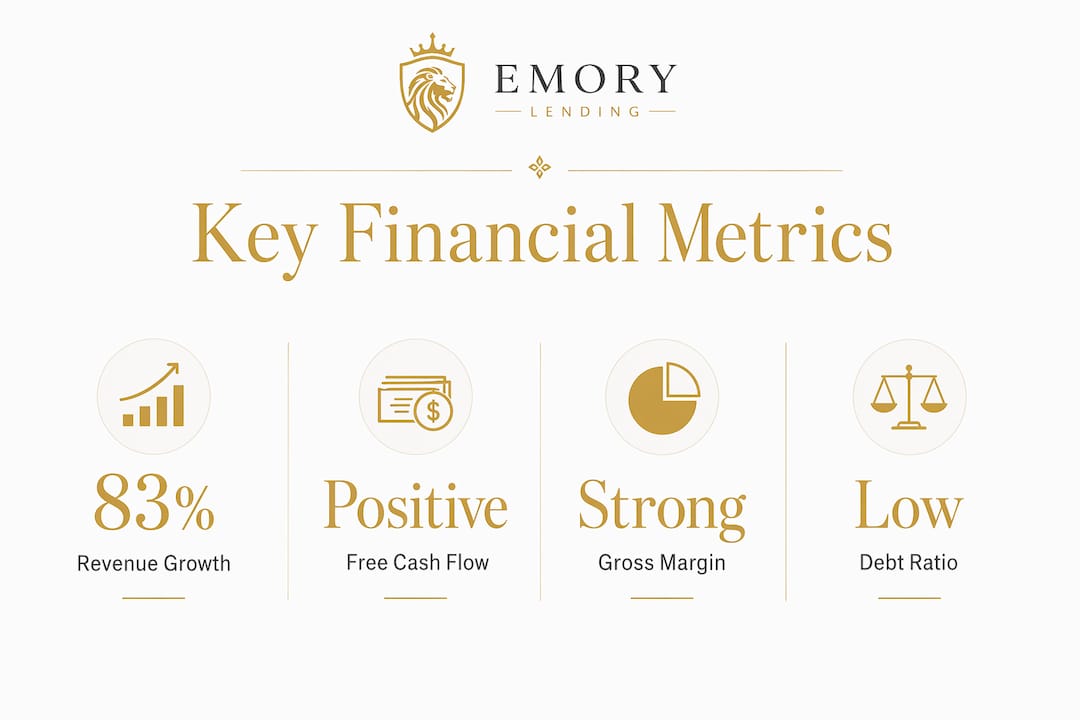
Free cash flow is the metric that separates real financial health from accounting performance. Positive free cash flow signals that your business generates actual cash available for debt repayment, reinvestment, or dividends. Negative free cash flow requires close monitoring and often triggers additional lender scrutiny or covenant restrictions.
Debt-to-equity ratio measures financial leverage. A high ratio signals that the business is already heavily financed by debt, which increases the risk of default if revenue dips. Lenders use this to assess how much additional debt the business can realistically carry.
Beyond traditional metrics, customer-centric KPIs like Customer Acquisition Cost, Lifetime Value, and churn rate are now standard in equity investor evaluations, particularly for subscription or recurring revenue businesses. These metrics reveal whether growth is sustainable or artificially inflated by unsustainable acquisition spending.
- Revenue growth rate (year-over-year)
- Gross, operating, and net profit margins
- Free cash flow (positive vs. negative)
- Debt-to-equity ratio
- Customer Acquisition Cost and Lifetime Value (for growth-stage businesses)
Pro Tip: Before approaching any lender, calculate your trailing twelve-month free cash flow and your debt-to-equity ratio. These two numbers will come up in every serious financing conversation, and knowing them cold signals financial sophistication.
Does financial reporting quality change your loan terms?
The quality of your financial reporting is not just a compliance matter. It directly affects the interest rate you pay and whether your application gets approved at all.
High-quality audited financial statements reduce lenders’ monitoring costs and lower the information asymmetry between you and the bank. When a lender cannot easily verify your financial position, they compensate by charging a higher rate or requiring more collateral. Audited GAAP financials remove that uncertainty, and lenders reward you with cheaper borrowing.
Since 2020, bank lending standards have tightened significantly. Higher reporting quality is no longer a differentiator. It is the baseline for loan pricing and approval. Businesses that rely on informal bookkeeping or unaudited statements face a structural disadvantage in the current credit environment.
“Information asymmetry drives lender monitoring costs. Transparent GAAP financials largely mitigate this, improving financing terms for businesses that invest in reporting quality.” — Financial Reporting Quality and Bank Credit Allocation to U.S. Small Firms Since 2020
The practical implication is straightforward. If your financials are prepared by a CPA using GAAP standards and reviewed or audited annually, you are starting from a stronger position than most small business applicants. That difference shows up in your interest rate, your approved loan amount, and the covenants attached to your financing.
Pro Tip: Even if a full audit is cost-prohibitive, a CPA-reviewed financial statement prepared under GAAP standards significantly improves your credibility with lenders compared to internally prepared books.
Why ESG performance is becoming a financing factor
Environmental, Social, and Governance performance, commonly called ESG, has moved from a corporate buzzword to a measurable factor in financing decisions, particularly for businesses seeking institutional capital or larger credit facilities.
Favorable ESG performance reduces financing constraints by 7.66% per one standard deviation increase in ESG score. That is a material improvement in capital access, not a marginal one. Lenders and investors interpret strong ESG scores as evidence of lower operational risk, better governance, and more sustainable long-term performance.
The table below summarizes how each ESG dimension affects financing outcomes:
| ESG dimension | Primary financing impact | Why lenders care |
|---|---|---|
| Environmental | Reduces regulatory and liability risk | Lower risk of fines, asset write-downs, or stranded assets |
| Social | Signals workforce stability and community trust | Lower turnover costs and reputational risk |
| Governance | Strongest direct impact on lender confidence | Transparent reporting, board oversight, and accountability |
| Digital transformation | Amplifies ESG benefits when combined | Improves data quality and reporting credibility |
Governance and Social dimensions carry the most direct weight in financing evaluations. A business with strong board oversight, transparent reporting, and documented social practices signals to lenders that management is accountable and that the business is less likely to produce surprises. ESG scores combined with digital transformation capabilities create a compounding effect, reducing financing constraints beyond what either factor achieves alone.
For small business owners, this does not require a full ESG reporting program. Documenting your governance practices, maintaining clear employee policies, and tracking basic environmental metrics puts you ahead of most competitors in lender evaluations.
Comparing financing options by business performance profile
Not all financing responds equally to business performance. The type of capital you can access depends heavily on your current financial profile, and understanding this match saves time and protects your credit.
Capital and bond financing correlate positively with improvements in sales and labor productivity, while supplier credit shows weaker effects on capital productivity. This means the financing source you choose has downstream consequences for your business performance, not just your balance sheet.
The table below maps common financing types to the performance profiles they favor:
| Financing type | Ideal performance profile | Key metrics evaluated | Common terms |
|---|---|---|---|
| Bank term loan | Stable revenue, positive cash flow, low leverage | Debt-to-equity, free cash flow, GAAP financials | Fixed rate, covenants, collateral |
| SBA loan | Growing revenue, solid margins, 2+ years in business | Revenue trend, credit history, business plan | Lower rate, longer term, government guarantee |
| Equity investment | High growth potential, strong CAC/LTV, scalable model | Revenue growth, customer metrics, market size | Dilution, board seats, milestone covenants |
| Revenue-based financing | Consistent monthly revenue, positive margins | Monthly recurring revenue, margin stability | Percentage of revenue repayment |
| Alternative/online lending | Moderate performance, shorter history | Cash flow, bank statements, revenue volume | Higher rate, faster approval |
Debt financing, including bank loans and SBA products, prioritizes stable and growing profits alongside strong cash flow. Equity investors focus on growth trajectory, customer economics, and long-term market potential. Alternative lenders, including performance-based lenders like Emorylending, evaluate cash flow and revenue patterns rather than personal credit scores, which opens financing to businesses that traditional banks would decline.
Understanding how lenders assess performance during the application process helps you choose the right financing type before you apply, not after a rejection.
- Match your financing type to your current performance profile before applying
- Prepare the specific metrics each financing type prioritizes
- Recognize that strong performance in one area (growth) does not compensate for weakness in another (cash flow) with all lenders
Key takeaways
Business performance determines financing access by directly shaping lender risk assessments, loan pricing, and the types of capital available to your business.
| Point | Details |
|---|---|
| Performance drives risk assessment | Lenders use revenue growth, margins, and cash flow to price risk and set loan terms. |
| Reporting quality lowers your rate | GAAP-compliant, audited financials reduce information asymmetry and produce cheaper borrowing. |
| ESG reduces financing constraints | A one standard deviation improvement in ESG score reduces financing constraints by 7.66%. |
| Match financing to your profile | Debt, equity, and alternative financing each favor different performance characteristics. |
| Customer metrics matter to investors | CAC, LTV, and churn rate now factor into equity evaluations alongside traditional profitability. |
What I’ve learned about performance and capital access
Most business owners I talk to focus almost entirely on their credit score when preparing for a financing application. That instinct is understandable, but it misses the bigger picture. Lenders who evaluate business performance rather than personal credit are looking at a richer, more accurate picture of your ability to repay.
The businesses that consistently secure the best financing terms are not always the most profitable. They are the most legible. Their financials are clean, current, and prepared under a recognized standard. Their revenue trends are documented. Their cash flow is predictable. Lenders reward legibility because it reduces their work and their risk.
The ESG finding surprised me when I first encountered it. A 7.66% reduction in financing constraints per standard deviation improvement is not a rounding error. It is a real competitive advantage that most small business owners have not yet recognized. You do not need a Fortune 500 ESG program. You need documented governance, basic employee policies, and a willingness to report transparently. That alone separates you from the majority of applicants.
The biggest mistake I see is businesses applying for the wrong type of financing given their current profile. A high-growth startup with thin margins applying for a bank term loan is almost always going to get rejected or receive unfavorable terms. The same business applying for revenue-based financing or equity investment has a much stronger case. Knowing your profile and matching it to the right capital source is not just smart. It is the difference between funded and declined.
— Jason
How Emorylending helps you turn performance into capital

Emorylending evaluates your business performance and cash flow directly, not your personal credit score. That means the metrics you have been building, your revenue growth, your margins, your cash position, actually work in your favor when you apply. Whether you need working capital, equipment financing, or funds to cover payroll while waiting on receivables, Emorylending matches your performance profile to the right financing structure.
Explore the full financing options for small businesses on the Emorylending platform to find the capital solution that fits where your business is right now. Funding ranges from $5,000 to $5,000,000+, and the application process is built for business owners who have real performance to show.
FAQ
How does business performance affect loan approval?
Lenders use revenue growth, profit margins, free cash flow, and debt-to-equity ratio to assess repayment capacity and risk. Strong performance across these metrics increases approval likelihood and produces better loan terms.
What financial metrics do lenders look at most?
Banks and alternative lenders prioritize free cash flow, revenue trend, gross margin, and debt-to-equity ratio. Equity investors add customer metrics like CAC, LTV, and churn rate to evaluate long-term growth potential.
Does financial reporting quality affect my interest rate?
Yes. Audited GAAP financial statements reduce lender monitoring costs and information asymmetry, which directly lowers the interest rate lenders charge. Since 2020, high-quality reporting has become a baseline requirement, not a bonus.
Can ESG performance improve my access to financing?
Strong ESG scores reduce financing constraints by 7.66% per one standard deviation increase. Governance and Social dimensions carry the most direct weight with lenders and institutional investors.
What financing option suits a business with strong growth but thin margins?
Revenue-based financing or equity investment fits this profile better than a traditional bank loan. Both structures prioritize revenue trajectory and growth potential over current profitability, which aligns with the performance characteristics of high-growth, early-stage businesses.


