

A business credit card is a revolving line of credit issued to a company rather than an individual, designed to separate business expenses from personal spending and give owners flexible short-term purchasing power. Think of it as a financial tool that does three things at once: keeps your books clean, funds day-to-day operations, and starts building your company’s credit profile.
Primary uses at a glance:
- Separating expenses: Every business purchase lands on one statement, which simplifies tax prep and bookkeeping.
- Short-term financing: Cover inventory, supplies, or travel costs between revenue cycles without touching a loan.
- Employee spending controls: Issue cards to staff with preset limits and category restrictions.
- Rewards: Earn cash back, points, or travel miles on purchases your business makes anyway.
The SBA, Dun & Bradstreet, and lenders like Emorylending all treat a well-managed business card as a foundational step toward stronger financing access.
Table of Contents
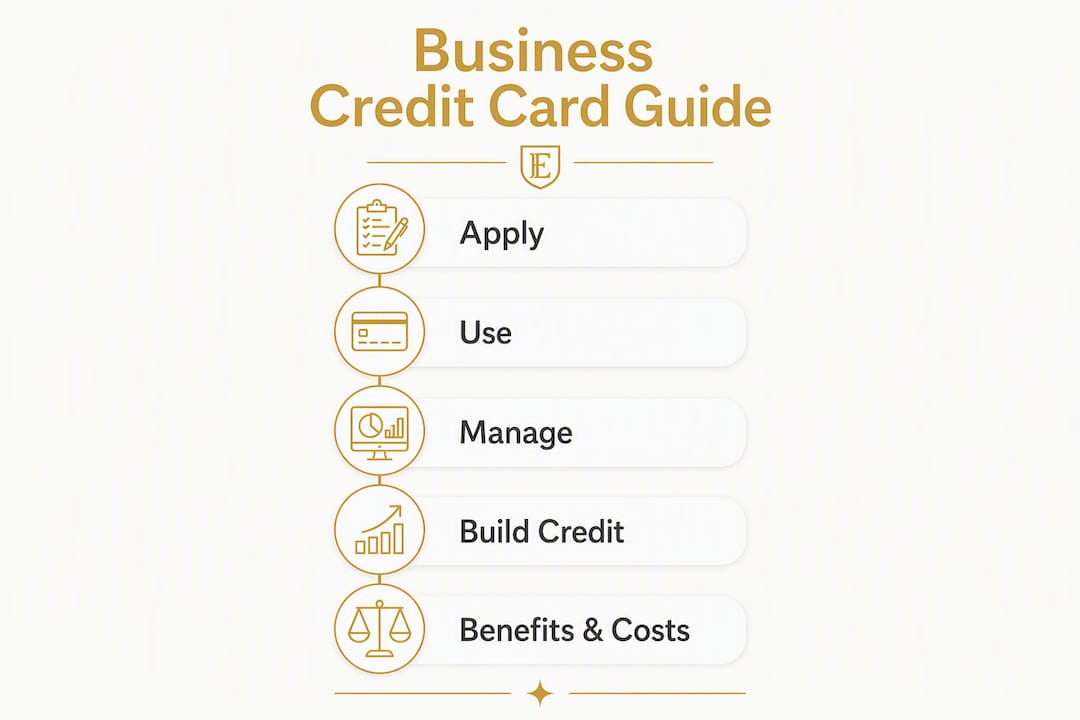
- How does a business credit card work day-to-day?
- What are the real benefits for small business owners?
- What does a business credit card actually cost?
- Who qualifies, and what do issuers actually look at?
- How do cards affect your credit, and how do you build business credit?
- When should you use a card versus a loan or line of credit?
- How do you apply for a business credit card?
- Key Takeaways
- A lender’s view on where cards fit in your funding strategy
- Emorylending can help when a card isn’t enough
- Useful sources and further reading
How does a business credit card work day-to-day?
A business card works like a personal card in its basic mechanics: you charge purchases up to your credit limit, receive a monthly statement, and make at least a minimum payment. The key difference is that higher credit limits, employee card management, and rewards categories are built around business spending patterns rather than consumer ones.
Here is what drives the billing cycle:
- Credit limit: Set by the issuer at approval; typically higher than a personal card for the same applicant.
- Billing cycle: Usually 30 days; a statement closes and shows all charges for that period.
- Grace period: Most cards give 21–25 days after the statement closes before interest accrues on new purchases.
- Interest: If you carry a balance past the due date, APR applies to the unpaid amount.
- Employee cards: Authorized users get their own cards; the primary account holder controls limits and sees all activity in one place.
Pro Tip: Pay the full statement balance every month, not just the minimum. That single habit eliminates interest charges entirely and keeps your utilization low, which matters when a lender pulls your credit later.
What are the real benefits for small business owners?

The clearest benefit is separation. Mixing personal and business spending creates a bookkeeping headache that costs real time at tax season. A dedicated card fixes that immediately.
Beyond clean records, the practical advantages stack up:
- Cash flow smoothing: Buy supplies today, pay the bill in 30 days when client payments arrive. That float is free if you pay in full.
- Expense tracking: Most issuers categorize spending automatically, which feeds directly into accounting software like QuickBooks or FreshBooks.
- Tax reporting: Every deductible expense is already documented on monthly statements.
- Employee spending controls: Set per-employee limits, restrict categories (no personal purchases), and review all charges in one dashboard.
- Rewards: Cards tailored to business purchases often offer elevated cash back on software subscriptions, advertising, shipping, and office supplies — categories where small businesses spend heavily.
For owners working to improve cash flow, a card with a 30-day float and automatic expense categorization can meaningfully reduce administrative overhead.
What does a business credit card actually cost?
Costs vary enough that the rewards on a card can easily be offset by fees if you carry a balance or miss a payment. Pay attention to these before you apply:
- APR: Carried balances on business cards commonly run in the high-teens to mid-to-high twenties — roughly 18%–28% depending on creditworthiness and issuer.
- Annual fee: Ranges from $0 to several hundred dollars; premium rewards cards charge more.
- Late payment fee: Can trigger a penalty APR on top of the standard rate.
- Cash advance fee: Typically 3%–5% of the amount, plus a higher APR from day one with no grace period.
- Foreign transaction fee: Usually 1%–3% per transaction; relevant if you purchase from international vendors.
Statistic to know: Business card APRs commonly fall in the 18%–28% range. At the high end, carrying even a modest balance for several months can cost more than the rewards you earn.
One more protection gap worth knowing: business cards are not covered by the CARD Act of 2009 the way personal cards are. Issuers may voluntarily apply consumer-friendly policies, but they are not legally required to, which means rate changes and fee structures can differ from what you’d expect on a personal card.
Introductory 0% APR offers are common and genuinely useful for planned purchases. The risk is straightforward: when the promotional period ends, any remaining balance converts to the standard rate immediately.
Who qualifies, and what do issuers actually look at?
For most small-business cards, approval hinges primarily on your personal credit and income, not your business revenue. Issuers often look for a good-to-excellent personal FICO score — generally around 690 or higher — though criteria vary by issuer and card tier.
Common underwriting factors:
- Personal FICO score: The primary driver for most small-business card applications.
- Personal income: Issuers want to see you can cover the debt if the business can’t.
- Business age: Startups can qualify, but established businesses often get better terms.
- Annual revenue: Reported at application; some issuers weight it more than others.
- EIN vs. SSN: You can apply with either, but using your EIN and having a registered business entity strengthens the application.
- Personal guarantee: Most issuers require one, meaning you’re personally liable if the business defaults.
- Documentation: Recent tax returns, bank statements, and business registration documents speed the process.
Pro Tip: Pull your personal credit report from AnnualCreditReport.com before applying. Dispute any errors first — a 20-point score improvement from a corrected error can move you from a denial to an approval.
How do cards affect your credit, and how do you build business credit?
Here is the dual-track reality: most business card applications trigger a hard inquiry on your personal credit, and many issuers report payment activity to consumer bureaus as well. That means late payments can hurt your personal score even when the card is in the business’s name.
On the business credit side, the picture is less automatic. Not all issuers report to commercial bureaus, so card use doesn’t always build a business credit profile on its own. The three commercial bureaus to monitor are Dun & Bradstreet, Experian Business, and Equifax Commercial.
Steps to build business credit deliberately:
- Register your business and get an EIN; accounts under your SSN don’t build a separate business profile.
- Open vendor trade lines (net-30 accounts with suppliers) that report to commercial bureaus.
- Confirm your card issuer reports to at least one commercial bureau before you apply.
- Keep utilization below 30% of your card limit.
- Pay on time, every time — payment history is the heaviest factor in business credit scoring.
“Establishing and managing business credit can help your company secure financing when you need it and with better terms. It can also help you negotiate supply agreements and protect against business identity theft.” — U.S. Small Business Administration
Strong business credit unlocks more than just loans. Suppliers extend longer payment terms, insurers offer lower premiums, and landlords reduce security deposits. Lenders evaluating larger financing requests may also consult the FICO SBSS score, which blends personal and business data into a single 0–300 score used for SBA-backed loans and lines of credit up to $1 million.
Pro Tip: Call your card issuer directly and ask: “Do you report to Dun & Bradstreet, Experian Business, or Equifax Commercial?” If the answer is no, prioritize opening a vendor trade line that does.
For a practical roadmap, Emorylending’s guide on how to improve business credit walks through each step in detail.
When should you use a card versus a loan or line of credit?
A business card is the right tool for short-term, recurring, or smaller purchases where you’ll repay within the billing cycle. It’s the wrong tool for large capital investments, payroll gaps that stretch beyond 30 days, or anything requiring predictable fixed payments.
Match the financing type to the need:
- Inventory restock (small, recurring): Card. The float covers the gap; rewards offset part of the cost.
- Payroll gap (one-time, short-term): Card if it’s a small shortfall; a working capital advance if it’s larger or recurring.
- Equipment purchase ($10,000+): Equipment financing or a term loan. Cards rarely offer limits high enough, and carrying that balance at 20%+ APR is expensive.
- Expansion (new location, major hire): Term loan or SBA-backed financing. Predictable payments and lower rates matter here.
- Daily operating expenses: Card, always. The rewards, float, and tracking features are built for exactly this.
Mixing tools is common and smart. Many owners run daily operations on a card while using a business line of credit or term loan for larger investments. A strong business credit score, built partly through responsible card use, directly improves the rates and terms you’ll get on that loan.
How do you apply for a business credit card?
Preparation takes 30 minutes and meaningfully improves approval odds. Here is the checklist:
- Check your personal credit report at AnnualCreditReport.com and dispute any errors.
- Decide on the card type — rewards card, secured card (if building credit from scratch), or a 0% intro APR card for a planned purchase.
- Gather your EIN and business registration documents.
- Estimate your annual revenue — you’ll self-report this on the application.
- List authorized users in advance so employee cards are ready at activation.
- Submit the application — most issuers give an instant decision or respond within 7–10 business days.
- Card arrival: Typically 7–10 days after approval.
If you’re denied, the issuer must tell you why. Common reasons include a score below the threshold, too many recent inquiries, or insufficient income. Address the specific reason before reapplying.
Pro Tip: If your personal credit is below 670, start with a secured business card. You deposit collateral, use the card, and build a payment history. After 6–12 months of on-time payments, most issuers will upgrade you to an unsecured card.
When a card won’t cover what you need, Emorylending evaluates financing based on business cash flow and performance rather than personal credit alone — which opens doors for owners who’ve been turned down elsewhere.
Key Takeaways
A business credit card is a revolving credit tool that separates expenses, builds credit, and funds short-term needs, but larger capital requirements call for a loan or line of credit.
| Point | Details |
|---|---|
| Core definition | A business card is a revolving credit line for company expenses, separate from personal spending. |
| APR risk | Carried balances commonly run 18%–28%; rewards rarely offset sustained interest charges. |
| Credit impact | Applications trigger a personal hard inquiry; not all issuers report to commercial bureaus automatically. |
| Build credit deliberately | Confirm your issuer reports to Dun & Bradstreet, Experian Business, or Equifax Commercial, and keep utilization below 30%. |
| Emorylending option | When a card’s limit falls short, Emorylending evaluates funding based on cash flow, not just personal credit. |
A lender’s view on where cards fit in your funding strategy
At Emorylending, the first question we ask isn’t “what product do you want?” It’s “what does your cash flow actually look like?” That distinction matters because a business card is genuinely the right answer for a lot of situations — daily operating expenses, small recurring purchases, employee spending management.
We’d tell any owner to get one and use it well.
Where we see owners get into trouble is treating a card as a substitute for real capital. A $15,000 credit limit at 24% APR is not a growth strategy. When a client comes to us carrying a card balance they can’t pay down because revenue is inconsistent, that’s a cash flow problem, not a credit card problem.
Cases where we typically recommend a card first:
- Owner needs to separate expenses and start building a business credit profile.
- Short-term purchase that will be repaid within one billing cycle.
- Employee expense management with spending controls.
Cases where we recommend a working capital advance, term loan, or line of credit instead:
- Purchase or investment that can’t be repaid within 30–60 days.
- Payroll coverage that recurs monthly.
- Equipment over $10,000 where a fixed payment schedule makes more sense than revolving debt.
The strongest funding strategies we see combine both: a card for daily ops and a dedicated credit facility for growth capital. Building your business credit profile through responsible card use also improves the terms you’ll get when you come to us for a larger loan.
Emorylending can help when a card isn’t enough
A business credit card handles day-to-day expenses well. When you need capital to buy equipment, cover payroll, or fund an expansion, the card’s limit and APR work against you.
Emorylending connects small business owners in North Carolina, South Carolina, Florida, and Virginia with funding from $5,000 to $5,000,000+. The evaluation focuses on your business performance and cash flow, not just your personal credit score. That means more owners qualify, including those who’ve been turned down by traditional lenders.
Whether you need working capital to smooth a cash flow gap or equipment financing for a major purchase, the application takes minutes. Check your options and see what your business qualifies for today at Emorylending.
Useful sources and further reading
These are the primary sources behind the claims in this article, organized by topic:
- U.S. Small Business Administration — Establish Business Credit: The SBA’s official guidance on registering for a DUNS number, monitoring personal and business credit, and using credit to secure better financing terms. Start here for regulatory grounding.
- Experian — How to Build Business Credit: Explains how business credit scores work (0–100 scale, 75+ considered excellent), how card activity is reported, and the personal guarantee requirement. Useful for the credit-building section.
- FICO SBSS Score — Nav: Covers how the FICO Small Business Scoring Service blends personal and business data into a 0–300 score used for SBA loans and lines of credit up to $1 million.
- Investopedia — Business Credit Card: Covers personal guarantee requirements and the liability implications of business card debt. Relevant for eligibility and credit-impact sections.
- Nav — What Is Business Credit?: Explains commercial bureau reporting and why vendor trade lines are critical to building a separate business credit profile.
- Ramp — Business vs. Personal Credit Cards: Details the CARD Act protection gap for business cards and how issuer policies vary. Relevant for costs and legal considerations.
- Emorylending — How to Improve Business Credit: Emorylending’s practical guide to building business credit step by step, tailored for small business owners in the Southeast.
This article is general information, not financial or legal advice. Confirm current rates, terms, and eligibility requirements directly with card issuers or a qualified financial professional before applying.


