

Most small business owners in the Southeast believe their personal credit score is the main gatekeeper standing between them and a business loan. That’s understandable, but it’s not accurate. When lenders genuinely explain business loan eligibility, the picture looks quite different. Your business financial performance, cash flow stability, and repayment capacity carry far more weight than your personal credit history alone. This guide breaks down exactly what lenders look at, how to assess where your business stands, and what steps you can take right now to improve your chances of approval.
Table of Contents
- Understanding business loan eligibility criteria
- Cash flow and repayment capacity: what lenders look for
- SBA loan eligibility: what business owners in the Southeast need to know
- Common pitfalls to avoid and documentation best practices
- How to improve your business loan eligibility and prepare for applications
- Why financial health matters more than personal credit for Southeastern small businesses
- Explore funding solutions tailored for Southeastern small businesses
- Frequently asked questions
Key Takeaways
| Point | Details |
|---|---|
| Eligibility depends on business health | Lenders primarily evaluate business financial performance and cash flow, not just personal credit, to determine loan eligibility. |
| Cash flow is critical | A strong Debt Service Coverage Ratio (DSCR) signals your business can reliably repay debt, which is key for approval. |
| SBA loans focus on repayment ability | SBA eligibility hinges on your business’s loan purpose, size standards, and demonstrating credit is not reasonably available elsewhere. |
| Prepare complete documentation | Organized, consistent financial records and business plans speed underwriting and reduce risk of rejection. |
| Build eligibility proactively | Strong financial discipline and matching loan type to your business needs improve chances of successful funding. |
Understanding business loan eligibility criteria
Lenders are not in the business of betting on potential. As one expert source puts it, banks lend against financial signals such as cash flow stability, operating history, and credit quality rather than ideas or ambitions. That is the foundation of every business funding eligibility process, whether you are applying for a short-term working capital loan or a long-term SBA product.
The business loan eligibility factors lenders weigh most consistently include:
- Business age: Most lenders want to see at least one to two years of operating history. A brand-new LLC with no revenue history is a very different risk profile than a three-year-old HVAC company with consistent contracts.
- Revenue and revenue consistency: It is not just how much you earn but whether it is predictable. Seasonal swings are not automatic disqualifiers, but unexplained revenue drops raise questions.
- Industry stability: Lenders assign risk ratings to industries. Construction, trucking, and restaurants face higher scrutiny because of historical default patterns, not because those are bad businesses.
- Owner credit history: Personal credit still matters, but it is one input among several, not the deciding factor. More on that distinction shortly.
- Loan purpose: Lenders match the purpose of the funds to the financial profile. Buying equipment against a confirmed purchase order looks very different from funding general operations with no documented plan.
Understanding how business loans work before you apply gives you a real advantage. You are essentially making a case that your business generates enough to repay a new obligation, and every document you provide either supports or weakens that case.
Cash flow and repayment capacity: what lenders look for
If there is one number that can make or break your loan application, it is your Debt Service Coverage Ratio, or DSCR. This metric compares your net operating income to your total debt payments, including the new loan you are requesting. Lenders focus on DSCR as the central measure of repayment capacity.
Here is how the math works in practice:
- A business with $200,000 in annual net operating income and $150,000 in annual debt payments has a DSCR of 1.33.
- Most lenders set their minimum threshold at 1.25, meaning your income must be at least 25% above your debt obligations.
- A DSCR below 1.0 means the business cannot cover its current debt from operations, which is a near-automatic denial.
“The central variable in any loan evaluation is cash flow. Lenders focus on Debt Service Coverage Ratio as a key metric for repayment capacity.” — Expert Eligibility Guide
What this means practically is that a landscaping company in Georgia pulling $400,000 in annual revenue but carrying heavy equipment leases and a previous line of credit may have a DSCR that disqualifies it, while a $200,000 revenue bookkeeping firm with no existing debt could be highly fundable. Revenue is not the story. Cash flow position is.
Key documents that support your cash flow case include:
- Three to six months of business bank statements: These show actual money movement, not just what is on a tax return.
- Profit and loss statements (P&L): Year-to-date and prior year P&Ls help underwriters see trajectory.
- Tax returns: Typically two years of business returns to verify reported income.
- Accounts receivable aging reports: Especially relevant if you are waiting on invoices.
Pro Tip: Calculate your own DSCR before submitting any application. Divide your monthly net operating income by your total monthly debt payments. If you are below 1.25, focus on reducing existing obligations or demonstrating upcoming revenue before you apply rather than after a denial.
Explore more practical small business loan insights to understand how lenders read your financials before you sit down with one.

SBA loan eligibility: what business owners in the Southeast need to know
SBA loans carry a reputation for being complicated, and part of that reputation comes from misunderstandings about who qualifies. One of the most persistent myths is that being financially comfortable or having personal liquidity disqualifies you. That is not how SBA eligibility actually works.
SBA eligibility focuses on repayment capacity and whether your business qualifies as small under SBA size standards, the loan purpose aligns with SBA guidelines, and you pass the “credit elsewhere” test. That last point is where most people get confused.
The credit elsewhere test asks whether conventional financing is reasonably available to you on comparable terms. Critically, SBA lenders must document why SBA financing is necessary even if you have personal liquidity. Having money in the bank does not automatically mean a conventional lender will offer you comparable terms on a commercial real estate purchase or equipment financing deal. The structure of the transaction matters enormously.
Key SBA eligibility checkpoints for Southeastern small business owners:
- Business size standards: Varies by industry, typically measured by employee count or average annual receipts.
- Legitimate business purpose: The loan must fund an activity the SBA supports. Passive investment properties generally do not qualify.
- Excluded liquidity: Retirement accounts and business working capital reserves are typically excluded from liquidity calculations, protecting your ability to qualify even with savings.
- U.S. operations: Your business must operate in the United States or its territories.
- Good standing: No outstanding federal debts or prior SBA loan defaults.
Pro Tip: Do not assume that because you own other real estate or have a healthy personal savings account, you are too wealthy for an SBA loan. Request a detailed eligibility review from a qualified lender before writing off this financing path.
SBA loan eligibility details vary by program, so matching the right product to your specific situation is worth the extra due diligence.
Common pitfalls to avoid and documentation best practices
Financial strength alone does not guarantee loan approval. Even financially strong businesses get declined regularly due to incomplete or inconsistent documentation. Underwriters are trained to spot discrepancies, and even minor inconsistencies between your tax returns and bank statements can stall or kill an application.
The most common documentation pitfalls include:
- Mismatched numbers across documents. If your tax return shows $300,000 in revenue but your bank statements only show $240,000 in deposits, underwriters will ask hard questions.
- Incomplete business plans. For larger loan requests, lenders want to see realistic projections tied to actual historical performance, not optimistic guesses.
- Outdated financials. Submitting last year’s P&L when the underwriter wants a current year-to-date statement wastes time and signals disorganization.
- Missing entity documents. Articles of incorporation, operating agreements, and ownership verification are standard requirements that routinely get forgotten.
- Unrealistic projections. Showing 200% revenue growth in year one with no supporting contracts or signed agreements raises immediate red flags.
Pro Tip: Before submitting any application, reconcile your bank statements, tax returns, and P&L statements against each other line by line. The underwriter will do exactly this. Getting there first lets you explain legitimate discrepancies proactively rather than scrambling after a request for clarification.
Documentation tips for loans are worth reviewing in depth before you start the formal application process. Preparation here is not just helpful, it is often the difference between a yes and a 30-day delay that costs you the opportunity you were trying to fund.
How to improve your business loan eligibility and prepare for applications
Building strong eligibility is work that happens long before you fill out an application. Eligibility is built before you apply through financial discipline, stable cash flow, and document readiness.
Practical steps to strengthen your position:
- Review your business profile against lender filters. Check your industry’s default risk profile, confirm your business age meets minimums, and verify your revenue trends are moving in the right direction.
- Maintain clean, current bookkeeping. A business with messy books forces underwriters to make assumptions. That rarely benefits you.
- Reduce existing debt obligations where possible. Even eliminating a small credit line before applying can improve your DSCR enough to cross a lender threshold.
- Choose the right loan product for your situation. Applying for a five-year term loan to cover a three-month cash flow gap is a mismatch that lenders notice immediately.
- Build your documentation file in advance. Treat it like tax season: gather everything early, verify it, and keep it organized.
Here is how common loan types compare against typical business loan eligibility criteria:
| Loan type | Minimum time in business | Typical revenue requirement | DSCR minimum | Best use case |
|---|---|---|---|---|
| SBA 7(a) loan | 2 years | Varies by industry | 1.25+ | Expansion, real estate, equipment |
| Business term loan | 1 to 2 years | $100,000+ annually | 1.25+ | Equipment, working capital |
| Business line of credit | 1 year | $75,000+ annually | 1.15 to 1.25 | Short-term cash flow needs |
| Equipment financing | 1 year | Varies | 1.0 to 1.25 | Equipment purchases only |
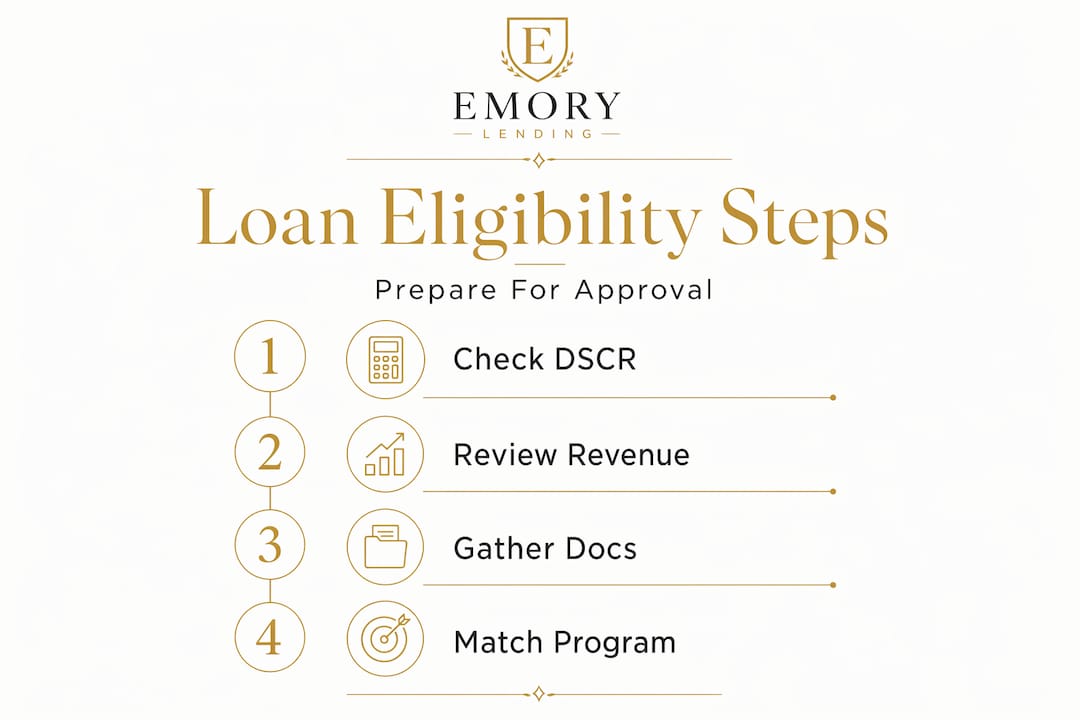
Use the funding checklist and preparation tips to build your application file systematically before you approach any lender.
Why financial health matters more than personal credit for Southeastern small businesses
Here is the perspective most loan guides skip over: the fixation on personal credit scores has led many solid Southeastern businesses to either avoid applying entirely or chase the wrong loan products. It is a real problem.
SBA rules require lenders to document why SBA financing is necessary even when a borrower has significant personal liquidity. That structure shifts the conversation away from “how good is your personal credit” toward “does this transaction make financial sense for the business.” That is a fundamentally better question for small business owners.
A restaurant owner in Charlotte or a trucking operation in Birmingham with strong revenue but a 620 personal credit score is not automatically out of options. The business cash flow story may be compelling enough to access SBA financing with favorable terms, specifically because SBA programs are designed to fill gaps that conventional credit markets leave open. Overlooking this because of assumptions about personal credit is leaving money on the table.
The deeper truth is that working capital financing insights reveal that businesses that understand their own financial position before approaching lenders consistently get better terms. Not because lenders reward preparation with generosity, but because well-prepared applications require less risk adjustment from the underwriter. Clarity about your numbers removes the uncertainty that inflates pricing.
Stop letting personal credit mythology define your funding strategy. Build the business financial narrative first, and the personal credit component finds its appropriate, secondary place.
Explore funding solutions tailored for Southeastern small businesses
You now have a clear picture of what lenders actually look for. The next step is connecting that knowledge to the right financing partner.
At Emory Lending, we evaluate your business on its actual financial performance, not just a credit score. Whether you need a working capital solution to bridge a cash flow gap, an equipment financing option to support your next growth phase, or guidance navigating SBA eligibility in the Southeast, we have programs built for how real businesses operate. Start with our business funding checklist to see exactly where you stand before you apply. We work with businesses from $5,000 to $5,000,000+ and we make the process straightforward.
Frequently asked questions
Does having a high personal net worth prevent me from getting an SBA loan?
No. SBA eligibility focuses on your business’s repayment capacity and whether conventional financing is available on comparable terms, not on your personal net worth. Lenders document why SBA financing is necessary regardless of your personal liquidity.
What is the most important financial metric lenders use to decide business loan eligibility?
Cash flow, specifically your Debt Service Coverage Ratio, is the primary measure. A DSCR of 1.25 or above generally meets lender minimums for most loan products.
Do I need a rejection letter from a bank to qualify for an SBA loan?
No. SBA lenders document why conventional financing is not available on comparable terms based on the transaction itself, not on prior rejection letters from other institutions.
Why do some businesses get loans rejected despite high turnover?
High revenue does not equal strong repayment capacity. Lenders evaluate profitability and cash flow consistency alongside documentation quality, meaning a high-revenue business with thin margins and messy books can still be denied.


