

Flexible financing is defined as a funding structure where repayment terms, borrowing amounts, and access to capital adjust based on your business’s actual revenue and cash flow. Unlike a traditional bank loan with a fixed monthly payment regardless of your sales, flexible financing moves with your business. Products like revenue-based financing and lines of credit are the most common forms. Emorylending works with small business owners who need capital that fits their reality, not a rigid schedule designed for a corporation.
What are the main types of flexible financing options?
Flexible financing, sometimes called adaptive lending or performance-based funding, covers several distinct products. Each one solves a different cash flow problem.
Revenue-based financing (RBF) is the most dynamic option. Repayment amounts fluctuate with your business sales. You pay more in strong months and less when revenue dips. RBF typically uses a flat fee rather than an interest rate, and repayments are automated as a percentage of daily or weekly sales. This structure suits seasonal retailers, restaurants, and e-commerce sellers.

Lines of credit work like a business credit card with a higher limit and lower rates. You draw funds when you need them and pay interest only on what you use. A line of credit is the go-to tool for covering payroll gaps, buying inventory before a busy season, or bridging a slow month.
Flex loans are open-ended credit lines with fast approval. Interest is charged only on withdrawn amounts, and monthly payments include both principal and interest. They offer speed and flexibility but carry higher risk if used without a repayment plan.
Embedded lending is the newest category. Platforms like e-commerce marketplaces and delivery apps offer financing directly inside their dashboards, based on your transaction history. Digital embedded lending uses real business activity data to approve funding in minutes, with no branch visit required.
Buy now, pay later (BNPL) for business and microloans round out the category. BNPL lets you purchase equipment or supplies and spread the cost over short installments. Microloans, often offered through nonprofit lenders and the SBA, serve businesses that need smaller amounts under $50,000.
| Product | Best for | Repayment style | Speed |
|---|---|---|---|
| Revenue-based financing | Seasonal or variable revenue | % of daily/weekly sales | Fast |
| Line of credit | Ongoing cash flow gaps | Draw and repay as needed | Fast |
| Flex loan | Short-term working capital | Monthly principal + interest | Very fast |
| Embedded lending | Platform-based businesses | Auto-deducted from platform revenue | Instant |
| Microloan | Early-stage or micro businesses | Fixed monthly payments | Moderate |
Pro Tip: Before applying, map your average monthly revenue for the past 12 months. That number tells you which product structure fits your cash flow cycle and how much you can realistically repay.
Why does flexible financing work well for small businesses?
Flexible financing approvals are increasingly data-driven, based on real-time business activity rather than traditional credit scores. That shift matters enormously for small business owners who have strong sales but a thin credit file or a past financial setback.
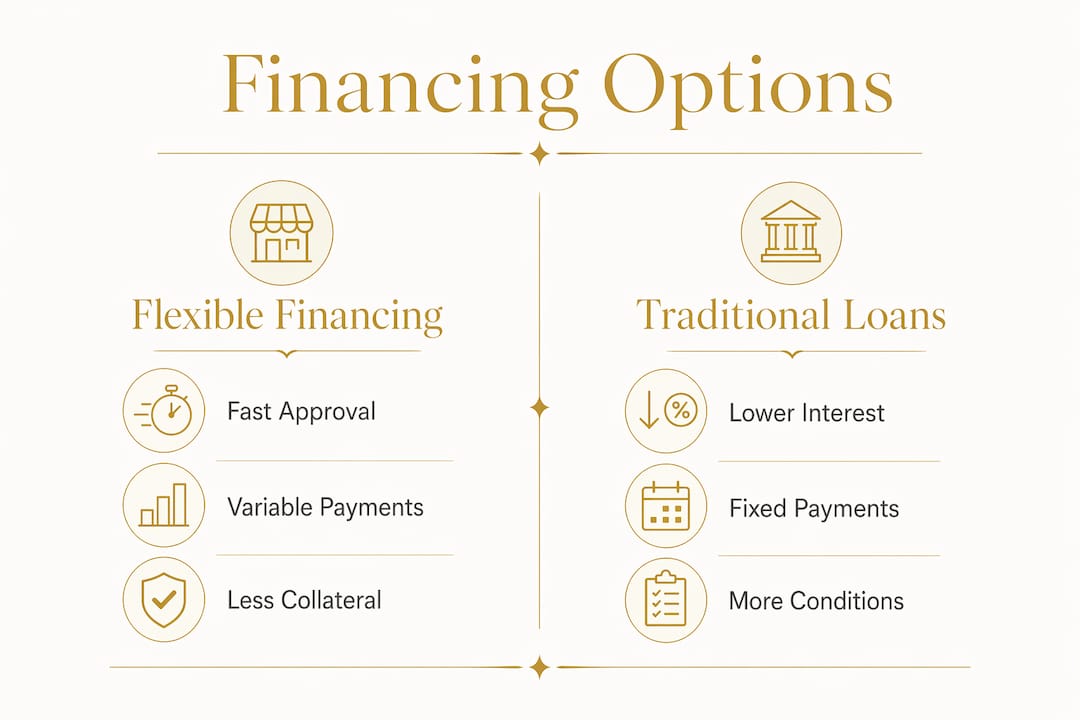
The businesses that benefit most share one trait: irregular revenue. Gig economy operators, retail shops, SaaS startups, and seasonal service businesses all face months where income swings sharply. A fixed loan payment due on the 1st of every month ignores that reality. Flexible financing designs that align repayment periods with income cycles sustain both the lender’s viability and the borrower’s financial health.
Cash flow management is the core benefit. Flexible lending solutions address the mismatch of rigid traditional loans by allowing borrowing amounts to scale with business activity like receivables and stock levels. That means you can borrow more when a large order comes in and pull back when business slows.
The advantages of flexible lending also include broader access. Many small businesses sit outside the traditional banking system because they lack collateral, have been operating for less than two years, or work in industries banks consider high risk. Flexible financing products from non-bank lenders evaluate your business performance directly.
- Approvals based on bank statements, sales data, and platform activity
- No requirement for real estate collateral in most cases
- Accessible to businesses with less than two years of operating history
- Faster decisions, often within 24–48 hours
- Repayment that scales down automatically during slow periods
“Flexible financing is increasingly seen as a proactive tool enabling businesses to scale and seize timely opportunities, not just a reactive emergency option.” — Principal Business Finance
Emorylending evaluates your business performance and cash flow directly, which means more small businesses qualify than they would through a traditional bank.
What should you consider before choosing flexible financing?
The benefits of flexible financing are real, but the product you choose must match your specific cash flow cycle. A mismatch creates financial stress rather than relief.
Start by understanding your revenue pattern. A business with steady monthly recurring revenue, like a subscription service or a staffing agency with long-term contracts, can handle a fixed repayment schedule. A restaurant or a contractor with project-based income needs a product that breathes with the business.
- Map your cash flow cycle. Identify your three slowest months and your three strongest. The gap between those figures tells you how much payment flexibility you actually need.
- Calculate the total cost of capital. RBF uses a factor rate, not an interest rate. A factor rate of 1.3 on a $50,000 advance means you repay $65,000 total. Compare that figure across products before signing.
- Model repayment under a bad scenario. Entrepreneurs should simulate repayment under various sales scenarios before committing. Run the numbers assuming your worst recent month repeats for three months straight.
- Layer your financing types. Combining a revolving line of credit with a term loan that has prepayment flexibility helps match funding structures to specific business needs. Use the line of credit for short-term cash flow and a term loan for equipment or expansion.
- Read the prepayment terms. Some flexible products charge a fee for early repayment. Others reward it. Know which applies before you draw funds.
Fast flexible financing offers speed and ease but becomes expensive when used as a long-term working capital solution without modeling repayment costs. A flex loan that solves a 60-day cash gap is a good tool. The same flex loan rolled over for 18 months becomes a costly habit.
Pro Tip: Use a loan repayment calculator to model how different repayment structures affect your monthly cash position before you commit to any product.
Real-world example: a landscaping company with strong April through October revenue used an RBF advance to buy equipment in march. Repayments were high during the summer peak and dropped automatically in november and december. The total cost was higher than a bank loan, but the business never missed payroll during the off-season.
How does flexible financing compare to traditional business loans?
Traditional term loans from banks offer lower interest rates, but they come with conditions that exclude many small businesses. Flexible financing trades some cost efficiency for speed, access, and adaptability.
Switching from traditional bank debt to flexible capital often removes burdensome personal guarantees and collateral demands. That shift directly benefits service-based and asset-light businesses, like marketing agencies, consultants, and home service providers, who have no equipment or real estate to pledge.
Flexible financing often eliminates the need for collateral and personal guarantees compared to traditional bank loans. Non-bank flexible capital also tends to carry borrower-friendly covenants, meaning fewer restrictions on how you use the funds.
| Feature | Flexible financing | Traditional bank loan |
|---|---|---|
| Approval speed | 24–72 hours | 2–8 weeks |
| Collateral required | Rarely | Often required |
| Personal guarantee | Usually not required | Frequently required |
| Repayment schedule | Adapts to revenue | Fixed monthly payments |
| Minimum credit score | Lower thresholds | Typically 680+ |
| Funding amount | $5,000 to $5,000,000+ | Varies widely |
| Best for | Variable revenue, fast needs | Stable revenue, long-term projects |
The right choice depends on your timeline and your revenue stability. A business buying a commercial property benefits from a traditional mortgage. A business covering a 90-day inventory gap benefits from a line of credit or RBF advance. Explore your business financing options before defaulting to whichever product a single lender offers.
Key Takeaways
Flexible financing works best when the repayment structure matches your actual revenue cycle, not a fixed calendar date.
| Point | Details |
|---|---|
| Definition matters | Flexible financing adjusts repayment and borrowing amounts based on real business revenue. |
| Multiple product types exist | RBF, lines of credit, flex loans, and embedded lending each solve different cash flow problems. |
| Data-driven approvals help more businesses | Approvals based on sales activity open access to businesses with thin credit files. |
| Cost modeling is non-negotiable | Always simulate repayment under your worst-case revenue scenario before committing. |
| Layering products works better | Combining a line of credit with a term loan matches short-term and long-term needs separately. |
What I’ve learned from watching business owners get financing wrong
The most common mistake I see is treating flexible financing as a single category with one right answer. Business owners come in looking for “the best loan” when what they actually need is a funding stack, not a single product.
A retail client once used an RBF advance to fund a six-month marketing campaign. The repayments were tied to daily sales, which worked fine in month one. By month four, the campaign had not yet produced results, sales were flat, and the daily deductions were draining the operating account. The product was not wrong. The use case was wrong.
Flexible financing uniquely suits businesses with recurring revenues, like SaaS companies, because it avoids rigid repayment schedules that ignore growth variability and customer churn. But that same logic applies in reverse. If your revenue is unpredictable in the downward direction, you need a product that shrinks with you, not one that keeps pulling a fixed percentage of a declining number.
My honest advice: treat financing like a tool selection problem. A line of credit handles working capital needs. An RBF advance handles a specific growth push. A term loan handles capital expenditures. Use each tool for the job it was designed for, and you will rarely overpay or overextend.
Approach financing before you need it. The business owners who get the best terms are the ones who apply when the business is performing well, not when they are three weeks from missing payroll.
— Jason
Emorylending’s approach to small business funding
Emorylending evaluates your business performance and cash flow directly, not just your personal credit score. That means more small businesses qualify for the capital they need to grow, cover payroll, buy equipment, or manage a slow season.
Emorylending works with businesses seeking funding from $5,000 to $5,000,000+. Whether you need a working capital advance, a line of credit, or equipment financing, the right structure depends on your specific cash flow cycle. The business financing options page outlines the full range of products available, with clear explanations of how each one works. If you are ready to see what your business qualifies for, Emorylending makes the process fast and straightforward.
FAQ
What is flexible financing in simple terms?
Flexible financing is a funding structure where repayment amounts and borrowing access adjust based on your actual business revenue. It contrasts with traditional loans that require fixed monthly payments regardless of how your business performs.
How does revenue-based financing work?
Revenue-based financing automatically deducts a set percentage of your daily or weekly sales as repayment. Repayment amounts fluctuate with your sales volume, so you pay less during slow periods and more during strong ones.
Is flexible financing more expensive than a bank loan?
Flexible financing typically costs more than a traditional bank loan because it offers faster access and fewer qualification requirements. The total cost depends on the product type, the factor rate or interest rate, and how long you carry the balance.
What types of businesses benefit most from flexible financing?
Businesses with seasonal or variable revenue benefit most, including retailers, restaurants, contractors, and gig economy operators. Flexible financing approvals based on real-time business activity also help businesses that fall outside traditional bank lending criteria.
Can I use multiple flexible financing products at the same time?
Yes. Layering financing types, such as a revolving line of credit for cash flow and a term loan for equipment, is a common approach that matches different funding tools to different business needs.


