

Collateral secures a lender’s position by giving them a legal claim on a specific asset if you default, and pledging it typically improves your approval odds, increases the loan amount available to you, and lowers your interest rate. That’s the short version. The longer version involves knowing which assets lenders actually value, how they convert those assets into loan dollars, what legal steps follow your signature, and when skipping collateral altogether makes more sense for your business.

Research backs the pricing benefit: secured loans reduce borrowing costs on average, with the largest discount for marketable securities and real estate. The SBA does not require collateral on smaller 7(a) loans. And even “unsecured” loans almost always carry a personal guarantee or a UCC lien, so the distinction between secured and unsecured is less clean than it sounds.
Table of Contents
- What collateral is and how it works in a business loan
- Common types of collateral and how lenders rank them
- How collateral changes your approval odds, loan size, and rate
- What lenders typically expect by lender type
- Can you get a business loan without collateral?
- Legal mechanics: UCC-1 filings, lien priority, and what happens if you default
- Documents and steps to prepare collateral before you apply
- When collateral matters most — and what Emorylending’s approach means for you
- Key Takeaways
- What I’d actually tell a business owner this week
- A practical take on collateral and what to do first
- Emorylending helps you navigate collateral and find the right fit
- Authoritative sources and further reading
What collateral is and how it works in a business loan
Collateral is an asset you pledge to a lender as security for a loan. If you stop making payments, the lender has a legal right to seize and sell that asset to recover what you owe. Common examples include real estate, equipment, inventory, accounts receivable, cash deposits, and marketable securities. A personal guarantee functions similarly: instead of a specific business asset, you’re pledging your personal financial standing.
The mechanics follow a predictable sequence:
- Pledge. You identify the asset and agree to use it as security in the loan agreement.
- Valuation. The lender appraises or discounts the asset to determine how much credit it supports.
- Lien filing. For business personal property, the lender files a UCC-1 financing statement, giving them a public, perfected security interest.
- Monitoring. Some lenders require periodic updates on collateral condition (insurance certificates, updated appraisals).
- Enforcement. If you default, the lender can repossess, foreclose, or liquidate the pledged asset.
Lenders don’t evaluate collateral in isolation. They weigh it alongside your cash flow, credit history, time in business, and sometimes a personal guarantee. Collateral is one input in a broader underwriting picture, not a substitute for a viable business. As Philadelphia Fed research notes, banks often require collateral precisely from borrowers they already view as higher risk, which means collateral presence alone doesn’t signal a strong borrower.
Collateral improves bilateral enforcement by conveying rights of seizure that a creditor can exercise against a borrower — and improves multilateral enforcement by conveying rights of exclusion against other creditors.
Pro Tip: Before you apply, run a UCC search on your business through your state’s Secretary of State database. If a prior lender filed a blanket lien, a new lender may decline or require lien subordination before they’ll proceed.
Common types of collateral and how lenders rank them
Lenders don’t value all collateral equally. What matters most is redeployability: how quickly and reliably can the lender sell this asset if you default? The more liquid and transferable the asset, the smaller the discount a lender applies.

1. Marketable securities and cash deposits
The easiest collateral for a lender to value and liquidate. Savings accounts, CDs, and brokerage holdings often support lending close to their value. The tradeoff: you’re tying up liquid capital you might need.
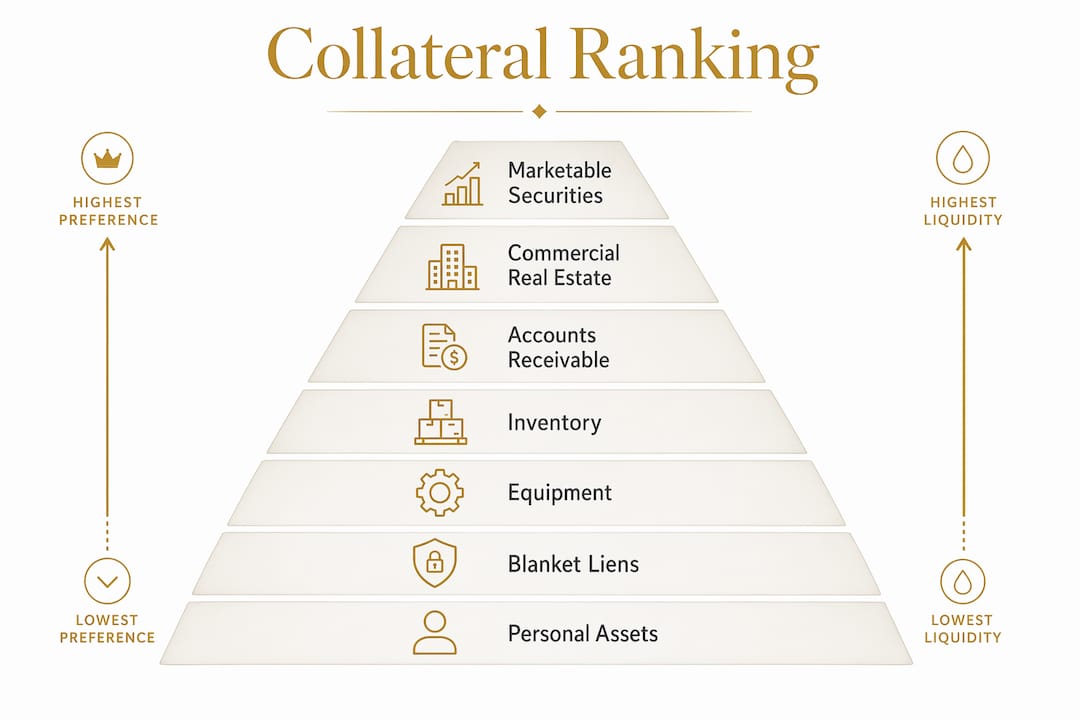
2. Commercial real estate
Widely accepted, relatively stable in value, and easy to appraise. Lenders typically lend a substantial portion of the appraised value. The downside is that foreclosure is slow and expensive, so lenders still apply a meaningful discount.
3. Accounts receivable
Strong receivables from creditworthy customers are attractive collateral. Lenders usually advance a significant portion of eligible receivables. Aged receivables (90+ days) or receivables from a single concentrated customer get discounted heavily or excluded.
4. Inventory
Harder to value and harder to sell quickly, especially finished goods in niche industries. Lenders often advance a moderate portion of inventory value, and perishable or highly specialized inventory may be excluded entirely.
5. Equipment and machinery
Useful collateral, but depreciation and redeployability matter. General-purpose equipment (forklifts, trucks, standard CNC machines) holds value better than highly specialized assets. ECB research confirms that specialized machines receive heavier haircuts because secondary markets are thin.
6. Blanket liens
A blanket lien covers all business assets rather than a single named item. Online lenders use these frequently. They’re convenient for the lender but can restrict your ability to pledge specific assets to other creditors later.
7. Personal assets
A home, personal savings, or investment accounts pledged by the business owner. Lenders often require this when business assets are insufficient. The risk is obvious: a default can cost you personal property.
Pro Tip: If you’re pledging equipment, get a third-party appraisal before you apply rather than relying on book value. A credible appraisal reduces the lender’s uncertainty discount and can meaningfully improve your loan-to-value ratio.
How collateral changes your approval odds, loan size, and rate
The pricing effect of pledging collateral is real and measurable. Research published in the Journal of Financial and Quantitative Analysis found that secured loans reduce borrowing costs by about 23 basis points on average, with the largest discounts going to borrowers pledging marketable securities or real estate. European Central Bank research on credit markets found a collateral elasticity of roughly 0.7–0.8, meaning a 10% increase in pledged collateral value is associated with roughly a 7%–8% increase in committed loan volume.
Here’s how that plays out in practice:
| Asset | Typical lender valuation | Potential loan amount on an asset | Rate benefit |
|---|---|---|---|
| Cash / CD | Close to 100% | Nearly full asset value | Largest |
| Commercial real estate | a substantial portion of value | a substantial portion of asset value | Large |
| Accounts receivable | a significant portion of value | A substantial portion of asset value | Moderate |
| General equipment | About half to slightly more | A moderate portion of asset value | Moderate |
| Specialized equipment | 30%–50% | A lower portion of asset value | Small |
| Inventory | a moderate portion of value | a moderate portion of asset value | Small |
Beyond pricing, collateral affects approval itself. A borrower with thin credit history or a short operating track record may only qualify for a secured product. Collateral gives the lender a recovery path that compensates for uncertainty in your financials.
Pro Tip: Ask the lender for their specific advance rate on your asset type before you apply. Knowing their discount upfront lets you calculate whether the loan amount you need is actually achievable from the collateral you have.
What lenders typically expect by lender type
Collateral requirements vary significantly depending on who you’re borrowing from. Understanding these differences helps you decide where to apply and what to bring.
| Lender type | Typical collateral requirement | Notes |
|---|---|---|
| Traditional bank | High loan-to-value coverage | Strict appraisal requirements; may require both business and personal assets |
| SBA 7(a) | Collateral required for loans over $50,000; not required at or below that amount | Lender follows SBA collateral guidelines |
| SBA 504 | Project property serves as collateral | Fixed-asset financing; real estate or equipment secures the loan |
| Online / alternative lenders | UCC blanket lien or personal guarantee | Physical collateral less common; cash flow weighted more heavily |
| Equipment lenders | The financed equipment itself | Asset-specific; LTV depends on equipment type and age |
The SBA’s approach deserves a closer look. Per SBA guidance on 7(a) loans, lenders are not required to take collateral for loans of $50,000 or less. For larger amounts, lenders must follow SBA collateral policies, which generally require pledging available business assets first, then personal real estate if business assets are insufficient. The SBA does not decline a loan solely because collateral is unavailable, but it does require lenders to document the collateral analysis.
For a detailed comparison of how SBA and conventional commercial loans handle collateral differently, this SBA vs. commercial loan breakdown is worth reading before you choose a path.
Online and alternative lenders tend to rely more on cash flow and revenue data than physical assets. They often file a blanket UCC lien rather than requiring a specific appraisal, which speeds up underwriting but gives them a broad claim on your business assets. Understanding why non-bank lenders underwrite differently can help you weigh that tradeoff clearly.
Can you get a business loan without collateral?
Yes, but “unsecured” rarely means “no strings attached.” Most lenders that don’t require physical collateral still protect themselves through a personal guarantee, a blanket UCC lien, or both. You’re not eliminating the lender’s security interest; you’re changing its form.
Genuine unsecured products do exist, and they come with tradeoffs:
- Higher interest rates. Without an asset to recover, lenders price in more risk. Rates on unsecured products typically run higher than comparable secured loans.
- Shorter repayment terms. Unsecured lenders want their money back faster.
- Lower loan amounts. Without collateral to support larger credit, maximum amounts are usually capped.
- Stricter revenue and credit requirements. Cash flow and credit score carry more weight when there’s no asset backstop.
Common unsecured or lightly secured options for small businesses include:
- Business lines of credit backed by a personal guarantee rather than specific assets.
- Merchant cash advances repaid as a percentage of daily card sales; no traditional collateral, but the advance provider often files a UCC lien.
- Invoice factoring where your receivables serve as the implicit security without a formal pledge.
- SBA microloans (up to $50,000) where collateral requirements are more flexible.
- Community Development Financial Institution (CDFI) loans that weigh mission and community impact alongside financials.
The right choice depends on your situation. If you have strong, consistent cash flow but limited hard assets, an unsecured or cash-flow-based product may cost less in total than a secured loan with appraisal fees and title work. If you have solid assets and want the best rate on a larger loan, pledging collateral usually wins. You can review the full range of financing options to compare these paths side by side.
Pro Tip: If a lender insists on a personal guarantee, negotiate the scope. A “limited” personal guarantee tied to a specific dollar amount or time period is far less risky than an unlimited, unconditional one.
Legal mechanics: UCC-1 filings, lien priority, and what happens if you default
When you pledge business personal property as collateral, the lender almost always files a UCC-1 financing statement with your state’s Secretary of State. This is how they “perfect” their security interest, meaning they establish a public, legally enforceable claim that takes priority over later creditors.
The process from pledge to enforcement:
- Security agreement. You sign a document describing the collateral and granting the lender a security interest.
- UCC-1 filing. The lender files with the state, creating a public record. This establishes lien priority: first to file generally wins.
- Lien perfection. For real estate, the lender records a deed of trust or mortgage with the county.
- Default trigger. If you miss payments or breach loan covenants, the lender can declare default.
- Repossession or foreclosure. For personal property, lenders can repossess without a court order in many states if they can do so without breaching the peace. Real estate requires a formal foreclosure process.
- Sale and recovery. The lender sells the asset and applies proceeds to the outstanding balance. If the sale doesn’t cover the full debt, you may still owe the deficiency.
- Lien release. Once the loan is fully repaid, the lender files a UCC-3 termination statement to release the lien.
Watch for these borrower risks:
- Blanket liens cover all current and future business assets, which can block you from pledging specific assets to other lenders.
- Cross-default clauses mean a default on one loan can trigger default on others with the same lender.
- Vague collateral descriptions in the security agreement can give a lender broader rights than you intended.
Philadelphia Fed research notes that forced asset sales often recover less than market value, which means the lender’s recovery may fall short and you could still owe a balance after losing the asset. Pledging irreplaceable operational assets — your only delivery truck, your core production equipment — carries real business continuity risk beyond the financial loss.
Pro Tip: Before signing, ask the lender to carve out specific operational assets from a blanket lien. Many will agree to exclude assets that are critical to your daily operations, especially if your other collateral is sufficient.
Documents and steps to prepare collateral before you apply
Lenders move faster and discount less when you hand them clean, organized collateral documentation. Surprises during underwriting — a title with an old lien, an insurance lapse, missing serial numbers — slow approvals and sometimes kill deals.
Gather these before you apply:
- Real estate: Current deed, most recent appraisal (within 12 months preferred), title report showing no undisclosed liens, property insurance certificate with lender named as additional insured.
- Equipment: Purchase invoices or titles, serial numbers and photos, maintenance records, current market value estimate or appraisal, insurance documentation.
- Accounts receivable: Aging report (current, 30, 60, 90+ days), top-customer concentration breakdown, any existing factoring or assignment agreements.
- Inventory: Current count with valuation method (FIFO, LIFO, or cost), description of goods and turnover rate.
- UCC search results: Pull a search on your business name from your state’s Secretary of State to identify any existing liens.
Suggested order of tasks:
- Run the UCC search first. Existing liens need to be addressed before a new lender will proceed.
- Order appraisals for real estate and major equipment early — they take time and lenders won’t accept stale ones.
- Confirm insurance is current and that your lender can be added as a loss payee.
- Organize receivables aging and remove ineligible receivables (government, foreign, 90+ days) before presenting the report.
- Compile everything into a single collateral package you can share digitally.
A third-party appraisal almost always outperforms internal documentation when it comes to lender confidence. An owner’s estimate of equipment value and a certified appraiser’s opinion are not the same thing to an underwriter. The investment in a credible appraisal can reduce the lender’s discount and improve your effective loan-to-value ratio.
For a broader application checklist, the business funding checklist walks through the full document set lenders typically request.
When collateral matters most — and what Emorylending’s approach means for you
Not every small business owner benefits equally from pledging collateral. Research from the Journal of Financial and Quantitative Analysis shows that smaller, private firms and borrowers seeking longer maturities see the largest pricing and volume benefits from pledging high-quality collateral. For a well-established business with strong cash flow and a solid credit profile, collateral may improve terms modestly. For a younger business or one with uneven revenue, it can be the difference between approval and denial.
Collateral also functions as a signaling device: borrowers willing to pledge assets tend to self-select into safer risk profiles, which gives lenders confidence to offer better pricing. The willingness to put something at stake communicates commitment.
Collateral acts as both a recovery mechanism and a behavioral signal. Borrowers who pledge assets often self-select into safer profiles, which allows lenders to offer lower rates to those borrowers.
When to prioritize collateral:
- You’re seeking a larger loan ($250,000+) where rate differences compound significantly.
- Your credit score or time in business is below typical bank thresholds.
- You want the longest possible repayment term to keep monthly payments manageable.
- You have high-quality, liquid assets (real estate, cash) that won’t disrupt operations if pledged.
When to focus on cash flow instead:
- Your business generates strong, consistent revenue that speaks for itself.
- You lack hard assets or your assets are operationally critical.
- You’re borrowing a smaller amount where the rate difference is minimal.
- Speed matters and you can’t wait for appraisals and title work.
Emorylending’s underwriting approach starts with business performance and cash flow, not just personal credit or asset lists. That means owners in North Carolina, South Carolina, Florida, and Virginia who have strong revenue but limited hard collateral still have a real path to funding. Collateral can still improve your terms through Emorylending’s lender network, but it’s one factor in a fuller picture, not a gatekeeper.
Key Takeaways
Pledging quality collateral typically lowers your borrowing cost, increases the loan amount available, and improves approval odds, but the legal risks and documentation requirements mean preparation matters as much as the asset itself.
| Point | Details |
|---|---|
| Rate impact | Secured loans average roughly 23 basis points lower in borrowing cost, with the largest discounts for cash and real estate. |
| SBA small-loan exception | SBA 7(a) loans of $50,000 or less do not require collateral; larger amounts follow SBA collateral guidelines. |
| “Unsecured” still has strings | Most unsecured business loans still require a personal guarantee or UCC blanket lien. |
| Prepare before you apply | Run a UCC search, order appraisals early, and confirm insurance to avoid underwriting delays. |
| Emorylending’s approach | Emorylending evaluates business performance and cash flow first, giving owners in NC, SC, FL, and VA a path to funding even when hard assets are limited. |
What I’d actually tell a business owner this week
A practical take on collateral and what to do first
The conventional advice is to pledge as much collateral as possible to get the best terms. That’s not wrong, but it misses the real question: which assets can you afford to lose?
Collateral works best when you’re pledging assets that are valuable to a lender but not operationally irreplaceable to you. A commercial property you own but don’t depend on daily is ideal collateral. Your only piece of production equipment is not, even if it appraises well. The 23-basis-point rate improvement is real, but it doesn’t justify betting the business on a single asset.
Here’s what I’d suggest doing this week. First, pull a UCC search on your business name. You may have a lien you’ve forgotten about, or one from a lender you paid off years ago that was never terminated. That lien will surface during underwriting and slow everything down. Second, list your assets and honestly assess which ones are redeployable versus operationally critical. Third, call your lender and ask directly: which asset types do you value most, and what advance rate do you apply? That conversation takes ten minutes and tells you more than any general guide.
One more thing worth knowing: strong cash flow can substitute for collateral in ways that most owners underestimate. If your revenue is consistent and your margins are healthy, a cash-flow-forward lender may offer you better terms than a traditional bank that fixates on your asset list. That’s worth exploring before you commit to pledging anything.
Emorylending helps you navigate collateral and find the right fit
Figuring out what to pledge, how lenders will value it, and which loan product actually fits your business takes more than a checklist. Emorylending works with small business owners in North Carolina, South Carolina, Florida, and Virginia to match them with lenders from a network of funding partners, with loan amounts from $5,000 to $5,000,000+.
The application process focuses on your business performance and cash flow, not just your personal credit score or asset inventory. That means more owners qualify, and those with strong collateral can use it to negotiate better terms rather than just meet a minimum threshold. Whether you’re looking at equipment financing, working capital, or a term loan, Emorylending’s team helps you understand what each lender will ask for and how to present your financials clearly.
Ready to see what you qualify for? Start with Emorylending’s flexible financing guide to understand your options, then complete a quick application to get matched with lenders suited to your situation.
Authoritative sources and further reading
The claims in this article draw on primary research and government guidance. These sources are worth bookmarking if you want to verify lender-specific rules or dig deeper into the mechanics.
- SBA — 7(a) loan program types and collateral guidance: Official SBA rules on when collateral is required, the $50,000 small-loan exception, and how lenders must document collateral analysis.
- NBER working paper on collateral and loan pricing: Quantifies the average 23-basis-point rate reduction associated with pledging collateral, with breakdowns by asset type.
- Journal of Financial and Quantitative Analysis — The Valuation of Collateral in Bank Lending: Corroborates the pricing finding and shows which borrower profiles benefit most from pledging high-quality assets.
- Philadelphia Fed — Using Collateral to Secure Loans: Explains the recovery and behavioral incentive roles of collateral, and the risks of forced-sale losses.
- ECB working paper on collateral and credit: Documents collateral elasticity and the heavier discounts applied to specialized, illiquid assets.
- ACPR / Banque de France — Collateral and asymmetric information: Covers the signaling and adverse-selection effects of collateral pledging.
- Emorylending — Business financing options for small businesses: Compares secured and unsecured financing categories available through Emorylending’s lender network.
Lender-specific rules change. Always confirm current collateral requirements directly with your lender or an SBA-approved lender before submitting an application.
This article is general information, not financial or legal advice. Confirm current rules with the SBA, your lender, or a qualified financial professional before making decisions for your specific situation.


