

Many small business owners believe their credit score is the single factor standing between them and the capital they need. That misconception costs real businesses real money every year. The truth is that a well-structured, data-driven business plan can shift a lender’s decision even when your credit history is less than perfect. If you’re running a business in North Carolina, South Carolina, Florida, or Virginia, understanding how to build and use a business plan strategically could be the difference between a rejection letter and a funded account.
Table of Contents
- Why funders demand a business plan
- Core components funders scrutinize
- Tailoring your plan: Southeast nuances and special cases
- From blueprint to bank: Practical steps for funding success
- Why most business plans fall short—and what actually works in 2026
- Next steps: Connect your plan to funding solutions
- Frequently asked questions
Key Takeaways
| Point | Details |
|---|---|
| Funders evaluate risk | A business plan helps funders gauge your risk, boosting your approval odds. |
| Tailor for your lender | Customize your business plan for each funder, especially regional lenders and alternative programs. |
| Startups need projections | Strong projections are key for startups, even if you lack financial history. |
| Microloans help poor credit | Microloans and CDFIs offer funding options for applicants with limited credit. |
| Keep your plan ‘living’ | Regularly update your business plan to maintain relevance and support ongoing funding needs. |
Why funders demand a business plan
Funders are not looking for a reason to say yes. They’re looking for a reason not to say no. A business plan is the tool that reduces their risk and gives them a clear picture of what they’re investing in.
Whether you’re approaching a traditional bank, an SBA lender, or an alternative financing source, each one needs to know: What does this business do? How does it make money? Who runs it? And most importantly, can it repay what it borrows? Understanding how business loans work helps you see why funders rely so heavily on documentation before committing capital.
Here’s what a business plan actually signals to a funder:
- Risk profile: A detailed plan shows the owner understands the risks in their market and has a strategy to manage them.
- Operational maturity: Businesses with well-defined processes and clear leadership structures look far more stable to lenders.
- Revenue credibility: Financial projections backed by actual market data are far more persuasive than vague revenue goals.
- Repayment capacity: A cash flow forecast directly answers the lender’s most pressing question.
“A business plan is essential for traditional funding, SBA loans, and bank financing. Even for bootstrappers who may not need one to raise funds, the process of creating a plan forces stress-testing of ideas and reveals weaknesses before they become problems in the market.” Business plan guide
One often-overlooked benefit is the “living document” concept. Your business plan should not sit in a drawer after you secure funding. It should be updated as your business grows, as markets shift, and as new opportunities open up. The business loan benefits you gain from strategic borrowing are directly tied to how well your plan guides your decision-making over time.
Core components funders scrutinize

Not all sections of a business plan carry equal weight with every funder. Banks look at different things than venture capital firms. Community development financial institutions (CDFIs) have their own priorities. Knowing what each funder wants lets you tailor your plan instead of submitting a generic document.
Here are the core sections every serious funder expects to find:
- Executive summary: This is the first thing a funder reads and often the only thing they read thoroughly before deciding to continue. Keep it to one or two pages. State your business model, what you need the money for, and how you’ll repay it.
- Market analysis: Show that you understand your industry, your customers, and your competition. Use actual data from regional and national sources, not assumptions.
- Management and organization: Funders lend to people as much as to businesses. Highlight experience, relevant skills, and the team’s track record.
- Products and services: Describe what you sell and why customers choose you over competitors. Be specific.
- Financial projections: Include income statements, cash flow forecasts, and balance sheets for at least three years. Provide base case, best case, and worst case scenarios.
- Funding request: State exactly how much you need, what it will be used for, and the repayment timeline you can support.
What different funders look for
| Funder type | Primary focus | Key document sections |
|---|---|---|
| Traditional banks | Collateral and repayment history | Financial projections, assets, credit history |
| SBA lenders | Business viability and use of funds | Full plan, executive summary, cash flow |
| Venture capital firms | Growth potential and exit strategy | Market analysis, scalability, team |
| CDFIs | Community impact and owner background | Mission alignment, management section |
| Alternative lenders | Cash flow and revenue consistency | Revenue history, cash flow projections |
Pro Tip: Never submit a single version of your business plan to every funder. Tailor the executive summary and financial section to match each funder’s specific priorities. A bank wants to see collateral and repayment capacity. A VC wants to see your growth runway and exit options. The core of the plan stays the same, but the emphasis shifts.
The biggest mistake small business owners make is building projections that only show an optimistic scenario. Funders are trained to spot unrealistic numbers immediately. According to guidance on how to use business plan to secure financing, startups without revenue history need especially strong projections rooted in verifiable market data, since historical financials aren’t available to support the request. If you’re applying for SBA and term loans, your financial projections must align with what those loan structures require in terms of repayment timelines and debt service coverage ratios.
Reviewing business term loan requirements before you finalize your financial section will help you avoid formatting or calculation mistakes that can raise red flags during underwriting.
Tailoring your plan: Southeast nuances and special cases
Running a business in the Southeast comes with regional advantages and regional realities. Lenders in North Carolina, South Carolina, Florida, and Virginia often have specific preferences based on local economic conditions, industry concentrations, and available programs.
If your credit is limited or your business is relatively new, there are still strong options available:
- Microloans: The SBA Microloan program offers up to $50,000 for small businesses and startups. These loans come with technical assistance and tend to have more flexible credit requirements than traditional bank loans.
- CDFIs: Community Development Financial Institutions specialize in lending to underserved businesses and communities. Many operate throughout the Southeast and offer both capital and business support services.
- SBDCs (Small Business Development Centers): North Carolina, South Carolina, Florida, and Virginia all have active SBDC networks that offer free or low-cost help writing business plans, preparing financials, and identifying the right funding programs.
Regional funding program comparison
| Program | Credit requirements | Loan range | Business stage |
|---|---|---|---|
| SBA Microloan | Flexible, credit coaching available | Up to $50,000 | Startup or early stage |
| CDFI loans | Community-based criteria | $5,000 to $250,000 | Any stage |
| SBA 7(a) loans | Good personal and business credit | Up to $5,000,000 | Established or startup |
| Bank term loans | Strong credit and collateral | $25,000 and above | Established |
| Alternative lenders | Revenue and cash flow focused | $5,000 to $5,000,000+ | Any stage |
Regional lenders also respond well to business plans that reference local market data. If you’re opening a second location in the Raleigh-Durham corridor or expanding your service area in Tampa Bay, include data from those specific markets. Generic national projections rarely resonate the same way with a local banker who knows the regional economy firsthand.
Pro Tip: Use the small business loan blog to stay current on regional lending trends and program updates. The funding landscape shifts, and a plan built on outdated program details can cost you credibility with an informed funder.
If cash flow is the immediate concern while you’re building your plan or waiting on a decision, explore working capital options that can bridge the gap. And when your plan is ready, the next step is straightforward: apply for funds with the documentation you’ve built.
From blueprint to bank: Practical steps for funding success
A polished business plan is only half the equation. How you present it, submit it, and follow up matters just as much. Here’s a practical sequence to move from a completed plan to a funded account:
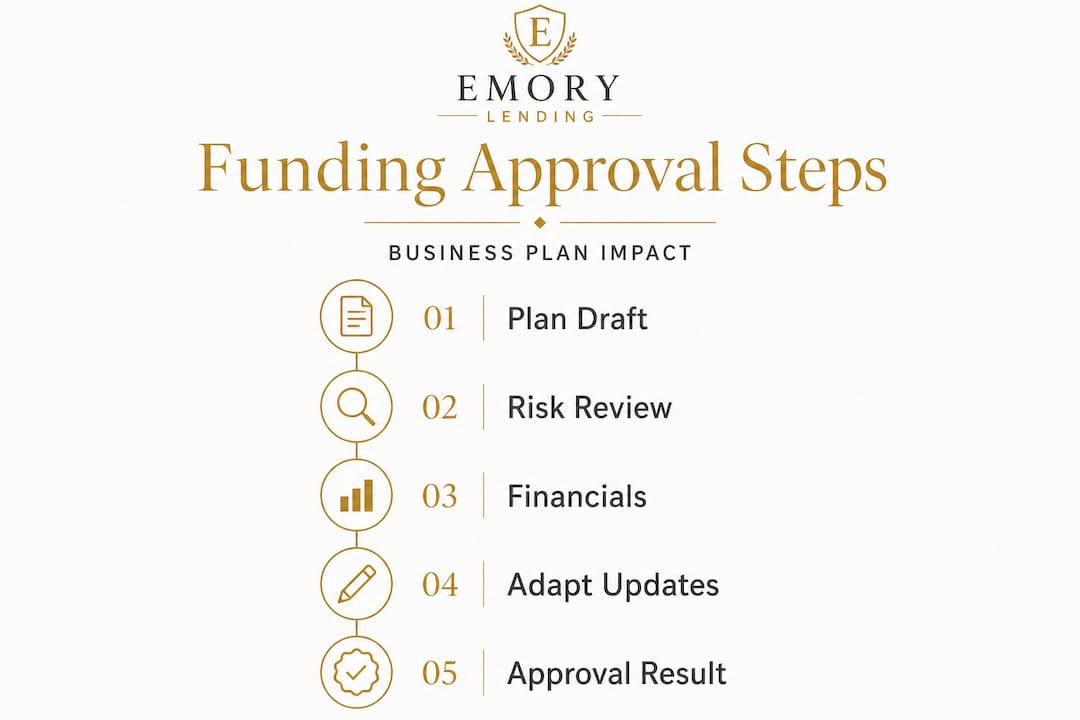
- Audit your plan before submitting: Check every number for internal consistency. If your revenue projections in the executive summary don’t match the income statement in the financial section, you’ll lose credibility immediately.
- Match the format to the funder: Some lenders want a formal 30-page document. Others prefer a streamlined 10-page summary with supporting financials attached. Ask before you submit.
- Prepare a pitch version: Many funders will want a brief verbal or slide-based presentation before they review the full document. Have a 10-minute version ready that covers your business model, market opportunity, and repayment capacity.
- Attach supporting documents: Include licenses, lease agreements, client contracts, tax returns, and bank statements. These documents validate the numbers in your plan.
- Follow up strategically: After submitting, check in within five to seven business days. Funders receive a lot of applications. A professional follow-up keeps you on their radar without being pushy.
- Update your projections after funding: Once you receive capital and start deploying it, update your plan to reflect actual results versus projections. This practice keeps your plan credible and prepares you for future funding rounds.
Pro Tip: Treat your business plan like a business growth capital tool, not just a paperwork requirement. The businesses that secure funding most consistently are the ones that revisit and refine their plans as market conditions evolve. Static plans go stale fast.
The common pitfall after funding is abandoning the business plan entirely once the money is in the bank. That’s a mistake. Lenders who funded you the first time may fund you again at higher amounts if you can show them that your actual results tracked closely with your projections. That credibility is built document by document, quarter by quarter.
Why most business plans fall short—and what actually works in 2026
Here’s the hard truth from working directly with Southeastern business owners: most business plans that fail to secure funding aren’t rejected because of bad credit. They’re rejected because they’re unconvincing. And “unconvincing” usually comes down to two things: lack of realism and lack of adaptability.
A business plan packed with optimistic projections and no evidence to back them up tells a funder that the owner hasn’t done the work. It signals wishful thinking over operational readiness. Funders have seen thousands of plans. They know when a revenue number is inflated or when a cost estimate is unrealistically low.
What actually works is honesty combined with evidence. Show the funder that you’ve modeled a scenario where things go wrong, and that your business can still service its debt in that scenario. That kind of conservative, evidence-backed planning builds more trust than any amount of polished formatting.
The second issue is adaptability. A business plan written in January that still has January assumptions in October is out of date. Markets move. Supply chains shift. Customer behavior changes. Funders increasingly want to see that owners treat their business plan as a dynamic tool rather than a static document they filed away.
There’s also a consistency issue that most articles won’t tell you about. Funders don’t just read your plan in isolation. They compare it to your bank statements, your tax returns, your accounts receivable records, and what you say in your meeting. When your plan says one thing and your financials suggest another, the inconsistency creates doubt that’s very hard to overcome.
The loan benefits for growth that most owners are chasing are absolutely available in the Southeast. But the businesses that actually capture that capital are the ones willing to do the unglamorous work: building realistic models, referencing real regional data, stress-testing their assumptions, and updating their documents when conditions change. Clarity and consistency beat optimism every single time.
Next steps: Connect your plan to funding solutions
Your business plan is more than a document. It’s your most powerful tool for securing the capital your business needs to grow, hire, and expand. The good news is you don’t have to navigate the funding process alone.
At Emory Lending, we look beyond credit scores. We evaluate your business performance and cash flow, which means a strong business plan works directly in your favor with us. Whether you need working capital solutions to cover day-to-day operations, equipment financing options to expand your capabilities, or a larger funding package to open your next location, we have solutions designed specifically for small businesses in the Southeast. When your plan is ready, apply for funds and let us show you how fast and straightforward small business financing can be.
Frequently asked questions
Do I need a business plan for all types of funding?
Traditional lenders demand a business plan, but bootstrapping and some microloans may not require one. Having a plan always strengthens your case regardless of the funding source.
How can startups without financial history build a convincing plan?
Startups should create strong financial projections based on realistic market research and scenario analysis. Credible projections built on verifiable data can compensate for the absence of historical financials.
Are there funding options for businesses with poor credit?
Microloans and CDFIs offer funding to businesses with poor credit or limited history, especially across North Carolina, South Carolina, Florida, and Virginia. Organizations like SBDCs also help build the documentation needed to qualify.
How often should I update my business plan after funding?
Update your business plan whenever major milestones are achieved or market conditions shift. At minimum, treat it as a living document that gets a full review at least once per year.


