

Growing a small business in the Southeast takes more than ambition. It takes capital, and knowing how to deploy it at exactly the right moment. 75% of small businesses used some form of financing in the past 12 months, and businesses that access outside capital are twice as likely to be in an active growth phase as those relying only on personal savings. In this guide, you’ll learn how to evaluate your funding options, prepare your business for approval, choose the right mix of financing, and measure whether your investment is actually driving growth.
Table of Contents
- Understanding the need for business growth funding
- Compare business funding options: Traditional vs. alternative
- Step-by-step: How to prepare for growth funding
- Choosing the right funding mix for your business goals
- Measuring funding impact and maintaining growth momentum
- The overlooked value of diversified growth funding
- Grow your business with expert funding support
- Frequently asked questions
Key Takeaways
| Point | Details |
|---|---|
| Mix funding types | Combining traditional and alternative financing helps maximize flexibility for business growth. |
| Plan before applying | Carefully assess your capital needs and prepare required documents to improve approval chances. |
| Monitor growth impact | Track how funding affects your business and adjust strategies to keep momentum strong. |
| Tailor your strategy | Choose the funding blend that aligns best with your business type and long-term goals. |
| Seek trusted support | Expert guidance and up-to-date resources can help you secure the right funding quickly. |
Understanding the need for business growth funding
Every thriving business reaches a moment where opportunity outpaces resources. You might land a contract that requires more inventory than you can stock. A second location becomes available at the perfect time, but your cash flow is tied up in receivables. Equipment breaks down right before your busiest season. These situations aren’t signs of failure. They’re signs that your business is growing, and growth has a price tag.
The risk of moving forward without proper capital is real. Under-financing means you scale slowly, miss windows, and watch competitors take opportunities you couldn’t grab. Over-financing, on the other hand, means you carry debt that drains cash flow before growth kicks in. Both extremes can stall a business. The key is purposeful, right-sized funding that matches your actual goals.
Businesses that use financing are more likely to be in active growth phases, not because money solves every problem, but because access to capital makes action possible. It lets you move when timing matters, hire before demand spikes, and invest in infrastructure that supports a bigger version of your business.
Small businesses in the Southeast seek capital for a wide variety of reasons:
- Covering payroll during seasonal slowdowns
- Purchasing or upgrading equipment
- Expanding to a new location
- Buying inventory ahead of a major contract
- Bridging cash flow gaps while waiting on receivables
- Funding marketing campaigns to enter new markets
Understanding loan benefits for growth before you apply puts you in a much stronger position to borrow strategically rather than reactively.
Pro Tip: Never wait until you’re desperate to seek financing. Apply when your business is performing well. Lenders respond better to businesses with positive momentum, and you’ll get better terms.
With the funding stakes clear, let’s break down the types of financing available and how to decide what works best for your growth objectives.
Compare business funding options: Traditional vs. alternative
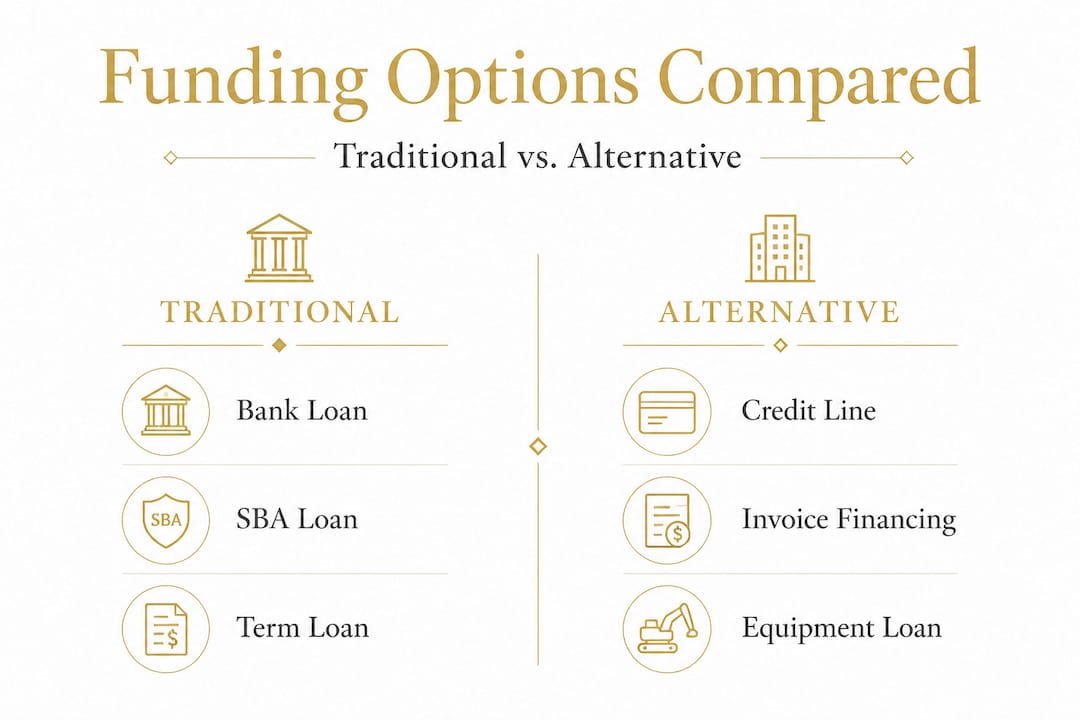
Not every funding product is right for every situation. Traditional bank loans offer stability but come with longer approval timelines and stricter requirements. Alternative financing is faster and more flexible, but may carry higher costs. Knowing the difference helps you choose with confidence.
“Many owners are turning to multiple financing types, including alternatives to traditional bank lending, for growth funding in 2026.”
Here’s a side-by-side look at the most common options:
| Funding type | Speed | Requirements | Best for |
|---|---|---|---|
| Bank term loan | Slow (weeks to months) | Strong credit, financials | Long-term investment |
| SBA loan | Moderate (weeks) | Good credit, business history | Affordable expansion capital |
| Business line of credit | Moderate to fast | Revenue history | Ongoing working capital |
| Equipment financing | Fast | Equipment as collateral | Buying or leasing equipment |
| Invoice financing | Very fast | Outstanding invoices | Bridging receivables gaps |
| Bridge/alternative loans | Very fast | Revenue-based | Immediate operational needs |
Bank loans and SBA loans are best suited for businesses with established financials and a clear long-term investment plan. SBA and term loans typically offer lower interest rates, but the application process can take weeks. If your need is urgent, they may not be the right tool.

Lines of credit offer flexibility that term loans can’t match. You draw what you need, when you need it, and pay interest only on what you use. They work especially well for seasonal businesses or companies that carry fluctuating inventory costs.
Equipment financing is one of the fastest, most direct forms of small business lending. The equipment itself serves as collateral, which means approvals are more accessible for businesses that can’t offer other assets. Explore equipment financing options if you’re planning a major purchase in the next 90 days.
Invoice financing (also called accounts receivable financing) lets you unlock cash that’s already earned but not yet collected. If you’re a B2B company waiting 30 to 90 days on client payments, this type of financing can bridge that gap without taking on traditional debt.
Bridge financing fills short-term capital gaps while a longer-term solution is being finalized. Think of it as a connector between where you are and where your next funding takes you.
The most sophisticated growth strategies often combine products. For example, a Georgia-based contractor might use a term loan to buy a new truck fleet, a line of credit to manage payroll during slow winter months, and invoice financing to collect faster on completed commercial jobs. Each product solves a different problem within the same business.
Now that you understand your funding options, let’s talk about how to get your business ready to apply.
Step-by-step: How to prepare for growth funding
Lenders want to see a business that knows itself. Before you apply for anything, you need to have a clear picture of your financial situation and growth plans. 75% of small businesses used some form of financing last year, which means lenders are receiving more applications than ever. Preparation is what separates approvals from rejections.
Here’s how to get funding-ready in a structured way:
-
Assess your current cash flow. Pull your last 6 months of bank statements and identify your average monthly revenue, your fixed costs, and where cash gaps occur. This tells you both how much you need and when you need it.
-
Define your funding purpose. Vague requests get rejected. Know exactly what the capital will fund, whether it’s a specific piece of equipment, a lease deposit, or a hiring push. Lenders want to see a plan, not just a number.
-
Gather financial documents. You’ll typically need 3 to 6 months of bank statements, profit and loss statements, tax returns for 1 to 2 years, and a current balance sheet. Some lenders also request accounts receivable and payable reports.
-
Check your business credit profile. Know your score before a lender does. Disputes or errors can slow the process. If your personal credit is a concern, explore lenders like Emory Lending who evaluate business cash flow rather than personal scores.
-
Calculate your funding gap. Use this simple formula: projected growth cost minus available cash equals the capital you need. If you’re expanding a location and the total cost is $180,000, and you have $50,000 in reserves, your gap is $130,000.
-
Match your need to a product. Review the table in the previous section and identify which funding type fits your timeline, use of funds, and risk tolerance. A business line of credit fits recurring needs; a term loan fits one-time investments.
-
Review your application for accuracy. Errors or inconsistencies are red flags. Double-check every number against your actual financial documents. Use a business banking checklist to ensure nothing gets missed.
Here’s a quick reference for common application documents:
| Document | Why lenders want it |
|---|---|
| Bank statements (6 months) | Verify revenue and cash flow patterns |
| Tax returns (1 to 2 years) | Confirm annual income and obligations |
| P&L statement | Show profitability at a glance |
| Balance sheet | Assess assets, liabilities, and equity |
| Business plan or projections | Validate how funds will be used |
Pro Tip: Work through a business loan application guide before submitting your first application. Even experienced borrowers find it useful to verify that all required documents are organized and current.
With your plan and documentation in place, it’s time to execute your funding strategy.
Choosing the right funding mix for your business goals
There’s rarely a single perfect loan that solves every challenge. Businesses in active growth phases often need more than one tool working at the same time. Businesses accessing financing are twice as likely to be in active growth, and many of those businesses are working with layered capital strategies, not a single product.
When deciding on your mix, consider these four factors:
- Loan term. Short-term financing costs more but gives you speed. Long-term financing is cheaper but takes time to secure. Match the term to how long your investment will take to generate returns.
- Speed. If you need capital within a week, bank loans won’t cut it. Alternative lenders can often fund within 24 to 72 hours.
- Flexibility. Lines of credit are reusable. Term loans are fixed. Know whether your need is a one-time event or an ongoing condition.
- Cost. Compare the total cost of capital, not just the interest rate. Factor in fees, draw costs, and early repayment penalties.
A practical example: A Tennessee restaurant owner uses a term loan to fund a kitchen renovation that will increase capacity by 40%. At the same time, she opens a working capital line of credit to handle the seasonal dip in January while the renovation is underway. The loan builds the growth infrastructure. The credit line keeps operations running smoothly during the transition.
Avoid over-leveraging by capping your total debt service at roughly 20 to 25% of your monthly revenue. If repayments are eating more than that, growth stalls because cash flow can’t support both operations and debt.
Pro Tip: Revisit your funding strategy every 6 months. As your revenue grows, your borrowing power grows too. What made sense at $30,000 per month may need adjustment at $100,000 per month. Use an invoice financing overview to spot new opportunities as your receivables volume increases.
Once you’ve secured funding, you’ll want to put it to work and monitor performance for the best results.
Measuring funding impact and maintaining growth momentum
Securing capital is a milestone. Using it well is the real work. Too many small business owners apply for financing, receive funds, spend them, and never measure whether those funds actually drove growth. That’s a missed opportunity.
Here’s a practical process for tracking your funding impact:
-
Set specific benchmarks before you deploy capital. If you’re buying equipment, define the expected productivity increase. If you’re hiring, project the revenue per new employee. Numbers set in advance give you something to measure against.
-
Track monthly key metrics. Revenue, gross margin, customer acquisition cost, and monthly cash flow should all be monitored. Improvements in these numbers confirm that your capital is working.
-
Review repayment progress. Stay on top of payment schedules and confirm you’re never more than 30 days from your next payment. Setting up automatic payments eliminates missed due dates.
-
Assess whether you need additional capital. If growth is exceeding your projections, that’s a good problem, but it may require a second round of financing. Plan proactively rather than scrambling reactively.
-
Learn from each funding cycle. What product worked best? What would you do differently? Document these insights before your next application.
Businesses accessing financing are more likely to be in active growth phases, but the ones who sustain that growth are the ones who measure, adjust, and plan ahead. Dig into current trends and case studies on the loan blog insights to keep learning between funding cycles.
With these best practices delivered, let’s shift perspective.
The overlooked value of diversified growth funding
Most small business owners spend a lot of energy searching for “the best loan.” That framing is understandable, but it’s also limiting. After working with businesses across the Southeast, from solo operators in rural Alabama to growing logistics firms in Atlanta, the clearest pattern we see is this: the most resilient, fastest-growing businesses don’t rely on a single funding source. They build a capital stack.
Here’s the contrarian truth. Bank loans aren’t always best, even when you qualify. A bank loan locks you into a fixed repayment structure that doesn’t flex when business slows down. An alternative lender who evaluates your cash flow can often offer terms that fit your actual business rhythm far better than a rigid bank product.
The myth that “real” businesses only use traditional financing holds a lot of owners back. We’ve seen businesses in Florida and the Carolinas turn down fast-approval equipment financing because they were waiting for a bank decision that took four months and ultimately came back with worse terms. The window they needed closed. The opportunity cost was significant.
Diversified funding also protects you when one source becomes unavailable. If your bank tightens credit during an economic slowdown, a relationship with an alternative lender means you’re not frozen. If a line of credit is maxed out during a surge, invoice financing can unlock cash already sitting in your receivables.
Browse the loan trend archives to see how other Southeastern businesses are structuring their capital as market conditions evolve. Agility beats perfection in uncertain economic cycles, and having multiple tools ready beats waiting for the ideal single solution every time.
Grow your business with expert funding support
You now have a complete picture of how to fund growth strategically. But knowing the options and navigating the application process are two very different things. That’s where Emory Lending comes in.
We evaluate your business performance and cash flow, not just your personal credit score. That means more small businesses across the Southeast can access capital that traditional lenders would pass on. Whether you need to explore working capital for day-to-day operations, fund a major asset with an equipment financing guide, or you’re simply ready to move forward, we can connect you with the right product fast. The process is straightforward, and funding ranges from $5,000 to $5,000,000+. Take the first step and apply for business funds today.
Frequently asked questions
What is the most popular funding source for small business growth?
Most small businesses use a mix of financing types, with traditional loans, lines of credit, and equipment financing among the most common. In fact, 75% of small businesses used some form of financing in the past 12 months.
Do businesses that use financing actually grow faster?
Yes. Businesses accessing financing are about twice as likely to be in an active growth phase compared to those relying only on personal funds.
How can I prepare my business to get approved for funding?
Organize your financial records, including bank statements, tax returns, and a profit and loss statement, and be ready to clearly explain how you’ll use the capital.
Should I combine funding sources for expansion?
Combining loans, credit lines, and tools like invoice financing increases flexibility and reduces risk. Many owners are actively layering multiple financing types for growth in 2026.
Is alternative financing a good option if I’m not eligible for a bank loan?
Alternative funding like equipment or invoice financing can be a smart, fast solution when traditional loans are hard to qualify for, especially for businesses with strong revenue but limited credit history.


