

Business performance in lending is defined as the assessment of a company’s financial health, cash flow, and operational metrics to determine loan eligibility and terms. Lenders do not simply check your credit score and move on. They examine revenue levels, profitability, cash flow consistency, and the quality of your financial records to build a complete picture of repayment risk. Understanding the role of business performance in lending gives you a real advantage when you approach a lender, because it shifts the conversation from “do you qualify?” to “here is why you are a strong borrower.”
What financial metrics do lenders prioritize when evaluating business performance?
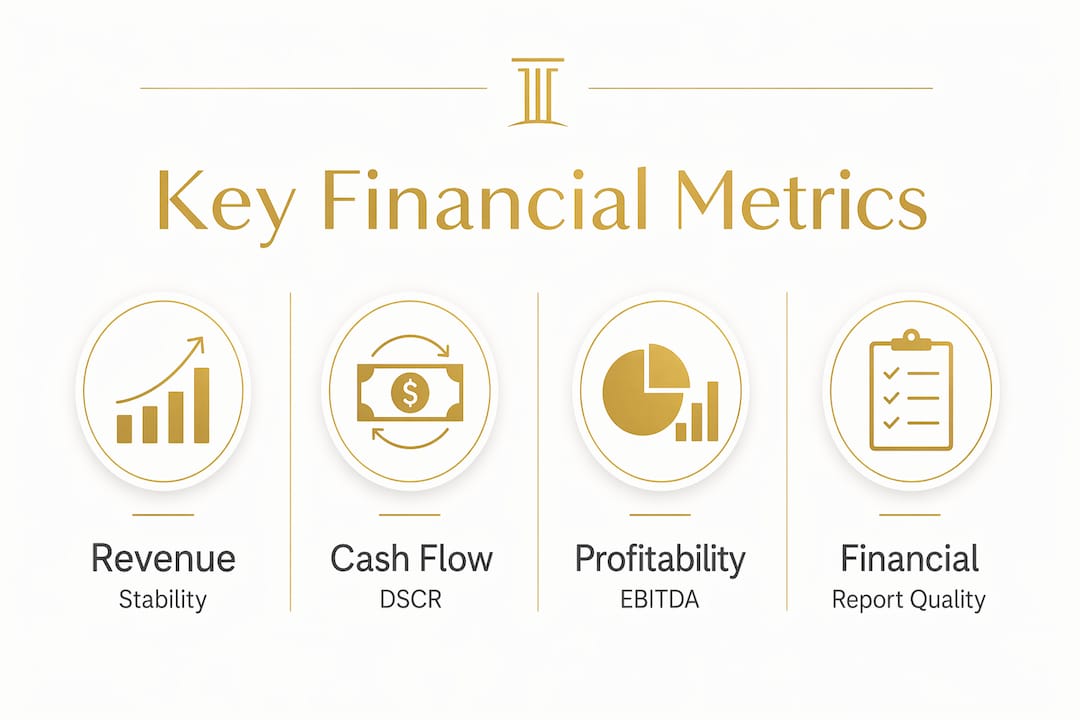
Revenue stability and growth trends are the primary quantitative factors lenders use to predict loan repayment capability. A business generating $800,000 annually with consistent year-over-year growth tells a very different story than one generating the same amount with erratic swings. Lenders read those trends as a signal of whether your business can absorb a loan payment without strain.
Cash flow is the metric that matters most in day-to-day credit decisions. Lenders calculate your Debt Service Coverage Ratio (DSCR), which compares your net operating income to your total debt obligations. A DSCR above 1.25 generally signals that your business generates enough cash to cover loan payments with room to spare.

Beyond cash flow, lenders examine profitability through metrics like EBITDA (earnings before interest, taxes, depreciation, and amortization). EBITDA strips out financing and accounting decisions to show the raw earning power of your operations. A business with strong EBITDA can often qualify for larger loan amounts and better rates.
The quality of your financial reports also carries significant weight. GAAP-compliant, audited financial statements improve lender confidence, reduce loan pricing, and increase credit availability. Banks have increasingly required standardized statements in post-2020 lending environments, making clean books a competitive advantage.
Key metrics lenders evaluate:
- Revenue levels and growth trends: Consistent upward movement signals repayment strength.
- DSCR: A ratio above 1.25 is a common approval benchmark.
- EBITDA: Reflects true operating profitability, independent of financing structure.
- Financial report quality: Audited, GAAP-compliant statements reduce lender uncertainty.
- Business age: Longer operating history signals stability and reduces perceived risk.
Pro Tip: Keep at least two years of clean, organized financial statements ready before you approach any lender. Gaps or inconsistencies in your records slow approvals and raise red flags.
How do lenders adjust financial statements when assessing performance?
Lenders rarely take your financial statements at face value. Lenders normalize financial statements by removing one-time expenses and aligning accounting policies to derive a true operating cash flow. This process directly affects how much you can borrow.
Here is how that normalization process typically works:
- Remove one-off expenses. A legal settlement or a one-time equipment write-off inflates your costs for that year. Lenders strip these out to see your recurring expense base.
- Adjust owner compensation. Many small business owners pay themselves above or below market rate. Lenders restate compensation to a market equivalent to get an accurate picture of operating profit.
- Align accounting policies. If you switched from cash-basis to accrual accounting mid-period, lenders restate figures for comparability across years.
- Derive the borrower cash flow view. This is the lender’s internal model of your true free cash flow, which feeds directly into credit risk scoring and loan sizing.
- Assess management accounts. Clean, standardized management accounts lead to faster loan approvals. Disorganized records force lenders to do more work, which slows decisions and increases scrutiny.
The practical implication is clear. If your books show a rough year because of a one-time event, a skilled lender will adjust for that. Your job is to explain the context, not hide it.
Pro Tip: Before applying for a loan, prepare a one-page summary that explains any unusual line items in your financials. Lenders appreciate transparency, and it speeds up the underwriting process considerably.
What qualitative factors beyond metrics impact lending decisions?
Numbers tell lenders what happened. Qualitative factors tell them what will happen next. Successful lending depends on the story behind the numbers, with lenders valuing management’s market understanding and clear growth plans alongside metrics like DSCR. A business owner who can articulate their market position and explain how a loan accelerates growth is a fundamentally more attractive borrower.
Lenders assess qualitative factors across several dimensions:
- Management quality. Can you explain your competitive advantage? Do you understand your cost structure? Lenders treat management competence as a direct indicator of repayment risk.
- Loan purpose clarity. A vague request for “working capital” raises questions. A specific plan to fund a second location with projected revenue attached to it signals preparation and discipline.
- Resilience during market challenges. Businesses that maintained operations or adapted during economic disruptions demonstrate the kind of durability lenders want to see in a borrower.
- Ability to explain the numbers. If your gross margin dropped 8 points last year, you need to know why and be able to say it clearly. Lenders who hear “I am not sure” lose confidence fast.
- Performance monitoring triggers. Lenders embed performance-based triggers in loan agreements that require mandatory financial reviews if EBITDA drops or receivables collection times lengthen. Understanding these triggers before you sign protects you from surprises.
The businesses that get the best terms are not always the most profitable. They are the ones that present their performance clearly and communicate a credible plan for growth.
How does strong business performance influence loan approval and terms?
Strong business performance directly improves your approval odds, your loan size, and your interest rate. The impact of business metrics on loans is not abstract. It shows up in concrete approval decisions and pricing.

The 2026 NerdWallet Small Business Loan Study produced a finding that should matter to every business owner with a less-than-perfect credit score. 80% of approved borrowers with credit scores below 660 had at least $500,000 in annual revenue. High revenue compensates for lower personal credit scores. That means your business performance can carry weight that your personal financial history cannot.
Business longevity compounds that effect. 71% of those approved with sub-660 credit scores had been in business at least five years. Lenders treat operating history as evidence of resilience. A five-year-old business has survived market cycles, seasonal swings, and operational challenges. That track record reduces perceived risk.
Higher-quality financial reporting significantly reduces lender uncertainty and monitoring costs, increasing approval likelihood and lowering loan pricing. This effect has grown since 2020 as banks adopted stricter financial screening. The practical result is that investing in clean books pays off in lower interest rates.
| Performance factor | Effect on lending outcome |
|---|---|
| Annual revenue above $500,000 | Compensates for credit scores below 660 |
| Five or more years in business | Increases approval odds for lower-credit borrowers |
| GAAP-compliant audited financials | Reduces loan pricing and increases credit availability |
| DSCR above 1.25 | Qualifies borrower for larger loan amounts |
| Clear loan purpose with growth plan | Improves lender confidence and speeds approval |
“Lenders prioritize borrowers who can explain how funding improves performance and aligns with business trajectory.” — Let’s Do Business Finance
The takeaway for business owners is direct. Treat your financial health as a loan approval factor you can actively manage, not a fixed score you are stuck with.
Key takeaways
Lenders evaluate business performance through revenue, cash flow, financial report quality, and qualitative factors, and strong performance in these areas directly improves loan approval odds, loan size, and interest rates.
| Point | Details |
|---|---|
| Revenue compensates for credit | Borrowers with $500,000+ revenue get approved even with sub-660 credit scores. |
| Business age reduces risk | Five or more years of operating history significantly improves approval odds. |
| Clean financials lower your rate | GAAP-compliant, audited statements reduce lender uncertainty and loan pricing. |
| DSCR drives loan sizing | A ratio above 1.25 qualifies your business for larger and better-structured loans. |
| Qualitative factors close the deal | A clear growth plan and strong management narrative strengthen any application. |
What I have learned about performance and lending after years in the field
The most common mistake I see business owners make is treating their financial statements as a tax document rather than a sales tool. Your financials are the first thing a lender reads. They form an impression before you say a single word.
Business owners who get the best financing outcomes are not always the ones with the highest revenue. They are the ones who walk in prepared. They know their DSCR. They can explain the one-off expense that made last year look rough. They have a clear answer when the lender asks, “What is this loan for and how does it grow your business?”
The shift I have seen since 2020 is real. Lenders are more rigorous about financial reporting quality than they were five years ago. If your books are messy or your records are incomplete, you are not just slowing down your approval. You are signaling to the lender that your business may be equally disorganized. That perception costs you money in the form of higher rates or outright rejection.
My honest advice is to treat loan preparation as a quarterly discipline, not a last-minute scramble. Reconcile your accounts monthly. Keep a running summary of your revenue trends and cash flow. Know your EBITDA. When you walk into a lender’s office or fill out an online application, you want to be the borrower who already has the answers.
— Jason
Business financing built around your performance, not just your credit score
Emorylending evaluates your business performance and cash flow, not just your personal credit history. That means more small businesses qualify for the capital they need to grow.

Whether you need working capital to cover payroll, funds to buy equipment, or capital to open a second location, Emorylending matches your performance profile to the right financing structure. The application process is fast, and the team works with businesses securing funding from $5,000 to $5,000,000+. Browse the full business financing options available for small businesses and find the structure that fits where your business is headed.
FAQ
What is the role of business performance in lending?
Business performance in lending is the evaluation of a company’s revenue, cash flow, profitability, and financial reporting quality to determine loan eligibility and terms. Lenders use these metrics to assess repayment risk and set loan pricing.
Can strong revenue offset a low personal credit score?
Yes. The 2026 NerdWallet Small Business Loan Study found that 80% of approved borrowers with credit scores below 660 had at least $500,000 in annual revenue. High revenue is one of the most effective ways to compensate for a weaker personal credit profile.
What is DSCR and why do lenders care about it?
DSCR, or Debt Service Coverage Ratio, measures your net operating income against your total debt obligations. A ratio above 1.25 signals that your business generates enough cash to cover loan payments, which is a standard benchmark for approval.
How does financial report quality affect loan terms?
GAAP-compliant, audited financial statements reduce lender uncertainty and monitoring costs, which directly lowers loan pricing and increases credit availability. Banks have tightened these requirements significantly since 2020.
Do lenders monitor business performance after a loan is approved?
Yes. Lenders embed performance-based triggers in loan agreements that require mandatory financial reviews if metrics like EBITDA drop or receivables collection times lengthen, even when formal loan covenants are still being met.


